


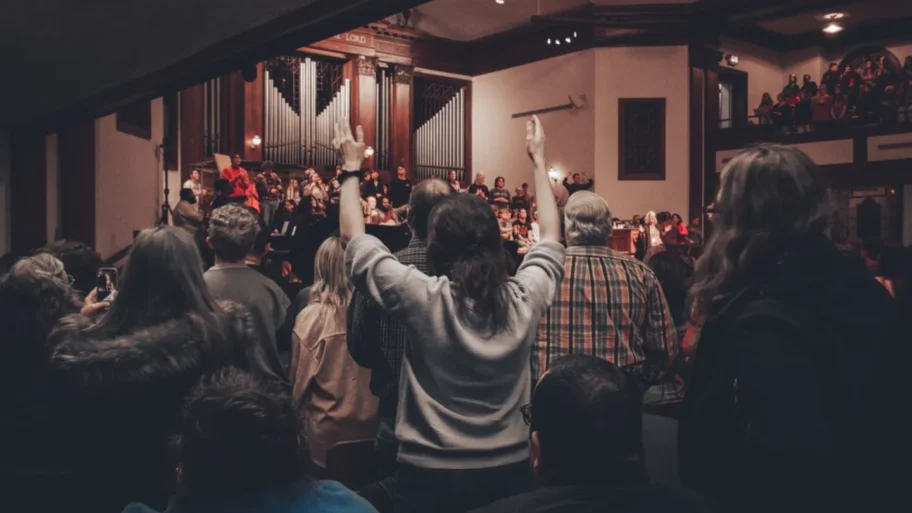
The Harvard Catholic Center wrapped up 2025 with huge news: the number of potential converts coming through its doors had doubled from the previous year. According to The Wall Street Journal “Free Expression” newsletter, the HCC is “booming,” dynamic proof that the kids are looking for something to believe in. The WSJ was only the latest to buy into the hype of a new American religious revival. Vanity Fair says twentysomethings are taking communion at a D.C. dive bar. The New York Post reported that in Greenwich Village, the number of adults interested in converting to Catholicism had tripled since last year. Similarly, the National Catholic Register reported that Newman Centers for Catholic college students are packed, signaling a “golden age of campus ministry.” Christian research outfit Barna says reading the Bible is back, with Millennials and Gen Z leading the charge. And that’s not all—Barna also says Gen Z now leads in church attendance. Over at The Free Press, the “Faith” section is explicitly dedicated to covering what it matter-of-factly calls “the new religious revival.”
But it’s hardly clear that this talk of religious “revival,” while nice wish fulfillment for many, is backed up by the evidence. The Harvard Catholic Center revival consists of eighty students. With Harvard’s graduate and undergraduate population of over 24,000, many thousands of whom are Roman Catholic, that’s a pretty capacious definition of “booming.” The tripled number of conversion candidates in Greenwich Village comes to a modest 130. Now, in the grand sweep of history, eighty new Catholics in Cambridge, Mass., is not nothing. And 130 more practicing Catholics, especially converts in first blush of religiosity, will make a difference to the spiritual life of Greenwich Village, or at least certain apartments there. But is something stirring in the hearts of young Americans outside of college campuses and trendy urban enclaves? Are we actually on the threshold of a new Great Awakening? Probably not. As religion demographer Ryan Burge (who teaches at the Danforth Center, which produces Arc) never tires of pointing out, accounts of America’s great religious revival have been greatly exaggerated.
“About 25 percent of Americans report attending a house of worship on a typical weekend,” Burge wrote recently in Deseret News. “If that rose by even three points—a small but noticeable increase—that would mean 10 to 12 million more people in church today than just six months ago. That’s hard to imagine, given that there are only about 350,000 houses of worship nationwide.”
For every breathless headline about churchgoing youths, there is a caveat. “Millennials and Gen Z constitute the biggest churchgoing group of all!” But dig deeper and you’ll see that they’re only going once or twice a month (an average of 1.9, only slightly above the U.S. churchgoer average attendance of 1.6/month). By the standards of Notre Dame’s Church Life Journal, this level of church attendance technically counts as religious disaffiliation. Kids are buying Bibles (a trend led by young men!), but barely more than one-third of Americans think its principles are totally accurate. Even among Christians, the number willing to affirm the Bible’s total accuracy sits at less than half.
Are we actually on the threshold of a new Great Awakening? Probably not.
The current media revival narrative seems to have first taken shape in earnest with the 2023 Asbury revival at Asbury University in Wilmore, Kentucky. What began with a group of students gathered in the chapel to pray quickly gained traction with outsiders. Days later, the students were still there, and people were showing up—not just from campus but from around the world—to join in worship. A news cycle was born. Nevermind that Asbury had a track record for this kind of thing—something novel was happening with young people. A few years later, no one talks much (or at all) about the much-ballyhooed Asbury Revival. In his Deseret piece, Burge noted that there was actually no lasting increase in religiosity at the churches located around the evangelical university.
Kaitlyn McCracken is a recent Asbury alum, the daughter and granddaughter of Asbury alumni who were present for campus revivals in the 1990s and 1970s. “It was pretty chaotic,” she says of her own experience. “A lot of people were pretty uneasy.” Aside from concerns about a potential measles outbreak and an incoming crop of freshmen excited about the prospect of a sequel, she didn’t see much of a lasting impact. McCracken’s outstanding memories are of the administration and faculty, who she says went to great lengths to help the student body feel safe, some even inviting them into their homes. Afterward, she says faculty spoke less of a revival per se. Many deployed the term “outpouring” to refer to what happened. Comparing her experience to the revivals of her parents’ and grandparents’ times, she said that while those earlier events brought in new Christians, what she saw on campus in 2023 was more of a spiritual juke for young Christians who had become lukewarm.
But the Asbury articles led to more trend pieces, many popping up as pandemic restrictions ended, which profiled young people drawn to religion, especially its more traditional forms. From the edgelord cool cats of Dimes Square, converting to Catholicism, to the Orthobros suddenly attending church each Sunday, from the young women wearing veils at Mass to the photogenic Christian families taking up homesteading, there was clearly a traditionalist religious trend, even if empirical evidence of its widespread traction was lacking.
The narrative itself may have catalyzed a kind of feedback loop among committed Christians, excited about the headlines and a few new young faces on Sunday. “I wonder if the revival language is just coming from Christians who are feeling that sense of being personally refueled in their faith practice,” said McCracken. “I’m seeing a lot of Christians talk about revival with a lot of hope, because they felt personally revived.”
The killing of Charlie Kirk in September launched the most recent round of revival discourse. People who hadn’t previously attended church vowed on social media to attend a service in his memory. And I don’t think the “Charlie Kirk Effect” was just an internet phenomenon. My family in deep red Texas reported a clear increase of folks in the pews on the Sundays that followed his death. But so far, there is no evidence that the trend has continued.
In fairness, numbers showing both Christianity’s steady decline and the exponential growth of the religiously unaffiliated “nones” seem to have slowed, or even halted, for now. But the same religious outlets with optimistic headlines about the great American youth revival seem to have forgotten their previous handwringing about the rise of the nones. A leveling-off of decline does not a revival make. After all, across the United States, thousands of churches still appear poised for closure.
Rather than discount the lived experience of priests at dozens of Newman Centers around the country, it’s worth acknowledging that there are, undeniably, young people showing up in greater numbers at some churches. However, there are distinctions between a trend and a no-kidding revival.
Gen Xers and elder Millennials have been conditioned to think of religion as manifestly uncool, but different spiritualities and faith traditions have gone in and out of vogue throughout America’s history. I’ve written about the young progressive women of TikTok converting to Islam in the 2020s. In the second half of the twentieth century, Erhard Seminar Training, Buddhism, Hinduism, and New Age spiritualities all enjoyed popular interest. In the 1950s, just after World War II and just before the social unrest and decline in institutional trust of the 1960s, religious participation was inextricably bound up in a politics of respectability and Cold War anticommunism, which often took precedence over genuine theology. “This is precisely why I am hesitant about the sudden uptick in conversions/people returning to Church,” one Catholic priest wrote on X. “I am, of course, grateful. But we must always be asking in a very deep fashion, ‘Why is this happening?’”
There are undeniably young people showing up in greater numbers at some churches.
Historically, American revivals have taken place at times of great social change. The first Great Awakening corresponded with the decades leading up to the American Revolution. The second Great Awakening lasted from the late eighteen to mid-nineteen century, taking place against the backdrop of westward expansion, increased immigration, and industrial and economic innovation. Together with the prominence of charismatic preachers and personalities, these are recognizable characteristics of our current moment where religion is prominent. But there is one aspect of the first two great awakenings that appears to be missing this time: a spirit of repentance.
“I hesitate to call it a revival,” said John Fea, a professor of American history at the interdenominational Christian Messiah University.
During the First Great Awakening, the Methodist John Wesley and company brought to America a brand of Christianity that fused personal introspection with community-oriented action. Wesley’s methodical approach to intense personal spirituality stoked a widespread desire for self-transformation that led to social action. “Laypeople reorienting their lives according to Scripture fanned the flames of revival,” said Fea. Although social change was the result—abolition, temperance, women’s rights—“it all started with this deep spirituality.”
By contrast, Fea said, the order today seems to be reversed. Politics and a desire for preferred policy outcomes are bringing young people to church, instead of the other way around. “Especially conservative men are looking for places where they can be accepted,” he said. “A lot of evangelical churches who have fairly conservative views on the relationship and roles of men and women are attracting these men.” But no previous revival has been driven by males, Fea notes. And at present, Christian young men are starting to outpace women in church attendance, a trend that maps pretty neatly onto the liberal-conservative political split between Gen Z women and men respectively.
The political component of the uptick in Gen Z Christianity makes its future suspect to Ross Douthat, who in his New York Times column cautioned Christians bullish on a post–Charlie Kirk revival that the memorial was “a fundamentally right-wing and Republican affair” that might alienate prospective converts. The perceived connection between Christian revival and the American right has even united former rivals Sohrab Amari and David French. In an October New York Times op-ed, French expressed his discomfort with a Christian revival with partisan overtones at a time when elements of the Christian right were preaching against “the sin of empathy” in politics.
Taking it back to the source, even Jesus seemed skeptical of vibey revivals, telling his followers in Matthew 7, “Not everyone who says to me, ‘Lord, Lord,’ will enter the kingdom of heaven.” Even the ones who perform miracles and drive out demons aren’t safe if they don’t follow the rest of the divine program: “I will declare to them solemnly, ‘I never knew you.” The authentic follower he says, will be evident by the good fruit they produce in their lives.
One supposes that for most Christians, the same must hold true for authentic religious revivals. McCracken said that is why some Asbury faculty members and administrators refrained from calling what happened in 2023 a revival. “Seeing those fruits was a key part,” she said, “They didn’t feel like they could see them immediately.”
One year after their famous revival, Asbury University held a commemorative service in its chapel on February 8, 2024. The tone of the coverage in the college paper was decidedly ambivalent, reflecting a student body in which some remembered that time fondly, but others recalled their annoyance with the noise and attention, and even their fear as thousands descended on campus. Student reporter Kaitlyn McCracken described the mood on campus as complex and “just as messy as during the midst of it all.” She quoted university chaplain-in-residence Zach Meerkreebs reflecting publicly on the difficulty and challenges of the past year. “It was hard,” he told the students at the service. “It has been disorienting, but it doesn’t mean it was a bad thing that happened.”
Hardly an unambiguous celebration. After the emotions had died down, Meerkreebs urged students to “[f]all back in love with the ordinary.” Even with twelve months’ hindsight, it was hard to tell what it all meant.
“All anyone can seem to agree on is that it happened,” McCracken wrote.
A national religious revival would suit both the religious, worried about decline and its consequences, and the secular, worried about theological mission creep into politics. And in a tale as old as time, a religious revival also suits grifters and opportunists. But unlike the recent Asbury revival, people can’t even agree that one is happening, at least all that much. It’s Schrodinger’s religious revival, at once happening and not. What it means, if it means anything at all, remains to be seen.