


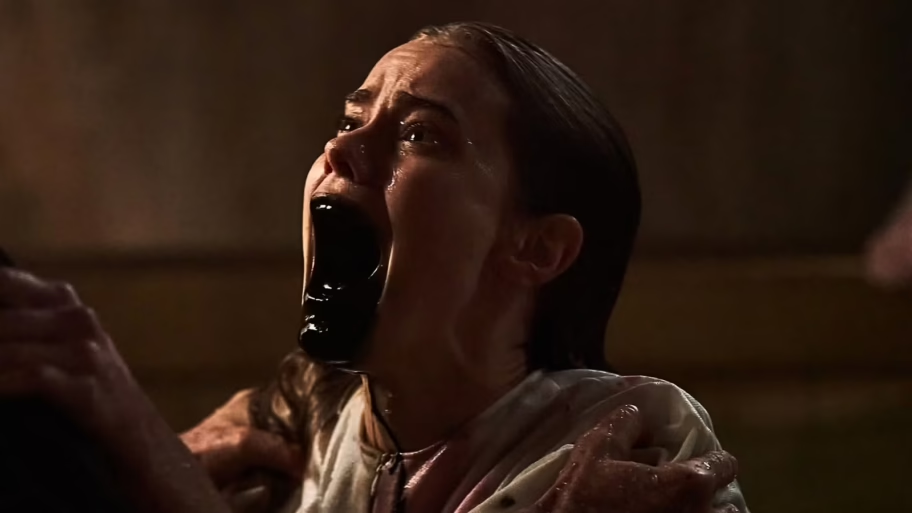
Elise can’t stop digging.
In the new Australian horror flick Diabolic, released in February, the protagonist is possessed—literally by a witch, but also by the memories she has repressed of her childhood in Warren Jeffs’s polygamous group, the Fundamentalist Church of Jesus Christ of Latter-Day Saints, or FLDS. To heal from her childhood trauma in what the movie labels the FLDS “cult”—and to stop inexplicable episodes of uncontrolled backyard digging—Elise must unearth her experiences and exorcise her not quite metaphorical demons.
Diabolic’s focus on the FLDS is not unique. Although it’s the first horror movie to feature the group, fundamentalist Mormonism has long captured the imagination of filmmakers. And just as Diabolic’s emphasis on uncovering and healing from religious trauma reflects distinctively contemporary concerns, the FLDS’s previous on-screen appearances provide insights into the filmmakers’—and society’s—assumptions about proper authority, both religious and secular.
After the mainstream LDS Church formally disavowed plural marriage in 1890, fundamentalists refusing to do likewise have periodically become national spectacles, beginning in 1935, when an Arizona prosecutor arrested a small handful of polygamists in the Utah-Arizona border community of Short Creek.
The discovery of polygamous holdouts in the desert southwest quickly attracted Hollywood’s notice. Polygamy, released in 1936, is explicit in arguing that fundamentalist Mormonism stands well outside the proper bounds of civilized American religion. The opening title card warns viewers, “‘Polygamy’ is not a religion. It is a ‘cult’ carrying on outside the laws of God and man.” Set in Short Creek, the film portrays a group of women who scheme with the elders of the Temple of Celestial Marriage to force their leader, Bishop Miller, into arranging the marriage of his daughter, Ruth, to one of the sect’s elders.
Re-released in 1939 with the misleading title Child Marriage (Ruth’s mother, the film tells us, died 24 years ago), the movie pits the well-spoken, clean-shaven, secretly monogamous Bishop Miller against the dour, nagging women and unkempt, brutish elders seeking to uphold polygamy. Caught in the middle is the naïve Ruth, standing in for the virtuous women whom Americans long believed polygamy threatened.
Even so, the title card’s explicit condemnation of polygamy and the film’s new title point to a tension. Polygamy was exotic and titillating, more often associated with “barbarians” from Asia and Africa; its discovery in the Old West, a mythologized space White Americans had supposedly civilized decades earlier, raised questions about the effectiveness of that civilizing project, just as the old certainties were collapsing amid the economic crisis of the Great Depression. As communism and fascism presented alternative pathways for social organization, Mormon fundamentalists now posed less of a threat to American values than state overreach, and Polygamy/Child Marriage’s strident reminder of plural marriage’s dangers provides evidence of the fraying consensus it scrambles to reinforce.
Polygamy’s move from threatening to grudgingly tolerated certainly took Arizona governor Howard Pyle by surprise. When, in 1953, he authorized a massive child-removal operation in Short Creek, on the grounds that polygamists disobeying state law were insurrectionists, the backlash was swift and costly, ending his political career, even as investigators did find evidence of underage marriage and statutory rape.
The events made national news and eventually inspired the TV movie Child Bride of Short Creek, which aired on NBC in 1981, after another shift in how Americans viewed new and alternative religions. If polygamy obtained tacit toleration in the mid-twentieth century because ending it threatened constitutional protections, the Jonestown massacre of 1978 raised questions of how much tolerance potentially dangerous religions, now widely envisioned as “cults,” should receive.
Polygamy was exotic and titillating, more often associated with “barbarians” from Asia and Africa; its discovery in the Old West, a mythologized space White Americans had supposedly civilized decades earlier, raised questions about the effectiveness of that civilizing project.
In Child Bride of Short Creek, notable for the early-career appearance of stars Diane Lane and Helen Hunt, 15-year-old Jessica Jacobs falls in love with returning Korean War hero Isaac, son of the group’s president, Frank King, who also has his eyes on Jessica. The young couple hopes to escape before Jessica is forced to marry the elder King, but Arizona’s raid interferes.
Another movie-opening title card informs us that the story “is a dramatization based on true events.” The film is broadly sympathetic toward the group, especially its women and children, as they struggle to navigate a restrictive culture, and it takes an ambivalent stance toward the state’s actions. Isaac fumes about the system his father has established in God’s name, insisting that “polygamy is cruel,” and the only way to escape it is running away or relying on a raid to “bust this whole town up.” Yet when that happens, Short Creekers peacefully sing patriotic hymns outside the schoolhouse, after which a sheriff’s deputy addresses the women and children: “I’m sorry. I didn’t know it would be like this.” In the film’s final scene, however, Jessica tearfully hugs her mother, whose parting words are, “Best run while you can.”
This ambivalence—the dangers of an oppressive, sexually deviant religious group, on the one hand, and a power-hungry and ham-handed state, on the other—was reinforced by public perceptions of Texas’s massive 2008 raid of the FLDS. Removing more than 430 children from the Yearning for Zion Ranch was roundly condemned as an overreach, especially once appellate courts ruled against it, but evidence seized in the raid led to the convictions of a ten men for serious crimes, including sexual abuse of children.
The 2016 sci-fi drama Midnight Special emphasizes that ambiguity. In it, a boy with enigmatic supernatural powers is pursued both by the FBI and the religious group to which his parents belong—nameless, yet housed on a ranch in West Texas with women who wear prairie dresses and intricately braided hair, à la the FLDS. In the film’s telling, state and sect alike are threats to the child’s safety; they each want him to help maintain the hegemonic power they wield. The only trustworthy group, the movie tells us, is family, not a hierarchical structure—religious or political—interested in its own self-preservation. Midnight Special thus reflects the weakening of institutional authority that has been a hallmark of the twenty-first century.
The only trustworthy group, the movie tells us, is family, not a hierarchical structure—religious or political—interested in its own self-preservation.
Today, that message may still resonate, but the FLDS’s darkness has only grown. Since Jeffs’s 2011 conviction for raping two girls, one of them just 12 when he married her and recorded his wedding-night assault, his mental state has deteriorated. Hundreds of members have been expelled or left the group, and reports from his own defecting children have detailed his increasingly erratic rule. A host of documentaries, notably Netflix’s Keep Sweet: Pray and Obey, have built on the international notoriety of the 2008 raid to make Jeffs’s name, if not the FLDS itself, synonymous with isolation, authoritarianism, and child abuse.
Real horrors occurred at the YFZ Ranch, but these are not depicted among the shocking events in the movie Diabolic. As punishment for her sin—which the film later reveals is her romance with another girl—Elise must undergo a baptism for the dead in the opening scene, but one of those dead is a witch who possesses her.
The ceremony takes place at what the movie’s marketing calls a “compound,” but it’s really just a creepy cabin in the woods. The iconic FLDS prairie dresses and coiffures eventually appear, as does a portrait of Jeffs, but Diabolic could be about any so-called “cult,” drawing on various genre tropes without much regard for historical or theological accuracy. This approach itself reflects today’s milieu, where spiritual seekers create individualized religions featuring a pastiche of traits, beliefs, and practices.
Nevertheless, Diabolic’s dark portrayal of the FLDS matches society’s increasingly suspicious view of the group—and of “cults” as a whole—in the era of #MeToo and its cousin, Church Too, when women’s testimony of abuse at the hands of religious leaders is taken more seriously. The movie argues that even those leaving such groups physically remain captive in some crucial way, maybe even possessed by the memories, the ghosts, of what they experienced.
If previous portrayals of the FLDS featured hillbilly polygamists and lecherous Short Creek bishops to distinguish fundamentalist Mormonism from true monogamous religion, more recent approaches, like Diabolic, reflecting our more suspicious times, have used the idea of the FLDS to suggest that children can be threatened by all kinds of religious and political authority. Protection, in this telling, cannot be entrusted to the state with its own nefarious agenda; only families and individuals can truly dig out and be free.
In that case, who will save traumatized young women like Elise, not to mention her long-forgotten girlfriend, from the horrors they experience? Typical for the genre, law enforcement is absent. Instead, Elise relies on her boyfriend and best friend for support as she returns to the site of her trauma, yet even they prove unreliable. Ultimately, she’s alone in her religious journey—and so, the film suggests, are we all.