


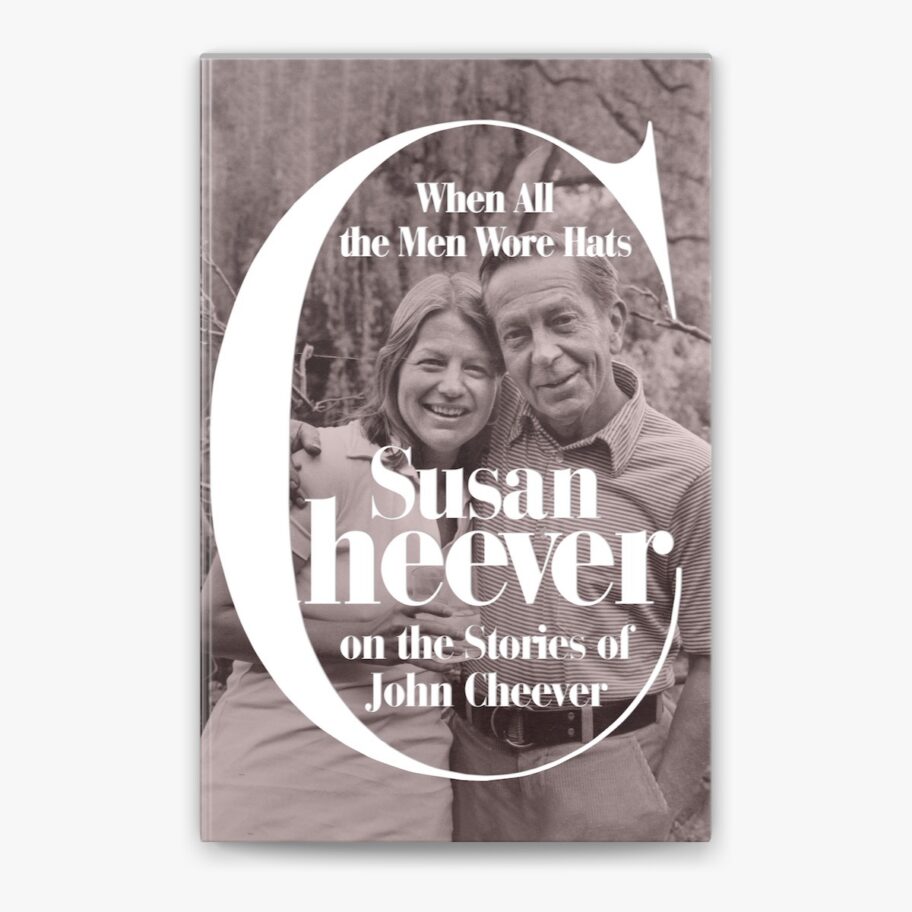
The 1978 bestselling publication of The Stories of John Cheever took the U.S. literary world by storm, its huge success defying conventional publishing wisdom while winning its author the money and fame he had long coveted. By then, John Cheever had spent four decades portraying the lives of well-off New Yorkers, via deftly-wrought stories set in Manhattan and later in the bucolic precincts of Westchester and the Hudson Valley. His was a world of cocktail parties around swimming pools, commuter trains tracing the gleaming river, the routines of career and domestic life, all depicted with a mastery of the short-story form that earned him the accolade “Chekhov of the suburbs.” Clocking in at 700 pages and containing no fewer than sixty-one stories, the Big Orange Book, as I always thought of it, conferred on Cheever’s fiction a prominence other short-story writers could only dream of.
In the prologue to her new book about her father’s career, When All the Men Wore Hats (Farrar, Straus & Giroux, 2025), Susan Cheever traces the ripples sent out by that collection to far shores of the culture—like the hilarious Seinfeld episode in which George’s fiancée discovers a cache of long-ago love letters from Cheever to her father, or the “wild swimming” movement in the U.K., inspired by Cheever’s story, “The Swimmer.” More famously, Mad Men creator Matthew Weiner used Cheever’s fiction as a primary source for his blockbuster TV series. “I am Sally Draper twice removed,” Susan Cheever proudly notes.
Her book is a companion piece to her 1984 memoir, Home Before Dark (Houghton Mifflin, 1984), and together the two cover the classic subjects of a literary biographer: the life and the work. When All the Men Wore Hats charts John Cheever’s long and sometimes vexed relationship with The New Yorker, and evokes his daily life as a homebody writer—first, in a rented cottage on the Hudson estate of the wealthy Vanderlip family, and later in the gracious house in Ossining that Cheever managed to buy (with editor Malcolm Cowley guaranteeing the mortgage). Susan Cheever describes how her father’s childhood in a downwardly mobile Boston Brahmin family sparked lifelong insecurity about money and status, and explores the basis of his fictions in his family relationships—with his brother Fred, his long-suffering wife Mary, and with Susan herself. Sporting chapter titles that are alternately biographical and thematic—“Becoming a Writer”; “My Parents’ Marriage”; “Sexual Punishment”—the book has an unusual format, part memoir, part critical study, part mini-anthology. It reprints six of Cheever’s best-known stories, all written in a dozen-year stretch from the early fifties to the mid-sixties: “Goodbye, My Brother”; “The Sorrows of Gin”; “The Five Forty-Eight”; “The Housebreaker of Shady Hill”; “The Swimmer”; and “Reunion.”
Forty years ago, in Home Before Dark, Susan Cheever laid bare her father’s demons—his raging guilt and denial over his sexual ambivalence; his titanic struggles with alcohol and depression—and found herself pilloried by critics for besmirching him. (“Blatant exploitation,” a dyspeptic Roger Kimball railed in The New Criterion; “essentially an exercise in gossip.”) To my mind, Home Before Dark seemed just what Susan Cheever called it, “a book born in love and anguish,” and, in its attitude toward John Cheever, essentially kind.
Not so the current book. Whatever animus she was keeping in check the first time round, this time Cheever gives herself free rein. Her list of complaints is lengthy. The baseball mitt her father buys her in fourth grade is “cheap” and “sleazy,” and schoolmates sneer. The dog he finally gets her, after years of her begging for one, is not the frolicsome black lab of his fiction, but a mere poodle. He selfishly refuses to get her braces, because it will force him to write a short story for the cash, while he is trying to write a novel: “My crooked teeth,” she comments, “were compromising his transcendent vision.” It’s unsettling to encounter the kinds of gripes typically aired by twenty-somethings set down so bitterly by an eighty-two-year-old.
This is not to say Susan lacked real grievances. She resents Cheever for using the family in his stories, then upbraiding them when their feelings were hurt. There was her father’s deception about his gayness—a “lifelong lie,” she says, that damaged the family, and that she discovered only after his death, when she delved into his voluminous journals. One senses that a still graver sin was his inattentiveness. Looking back at the month she spent reading those journals, she notes that “in the millions of words he wrote, I was mentioned less than a dozen times.” Clearly, it still hurts. “I frequently encounter readers who assume that my father—an excellent and inspired writer—must also have been an excellent and inspired father,” she tells us. “Talking to these people is difficult; inside I am shouting obscenities.”
Anger vibrates throughout When All the Men Wore Hats, and nowhere more than in the astonishing choice of her all-time favorite among her father’s stories, “Reunion,” in which the middle-aged protagonist, seen through his teenager’s eyes, is revealed as a pompous, boorish drunk—“exactly a portrait of my father as we all experienced him,” Susan Cheever reports, praising the story for revealing her father as “the perp” he was in life. What to make of this assessment? “Good writing is often done by bad people,” she sums up, blandly and bluntly.

It’s unsettling to encounter the kinds of gripes typically aired by twenty-somethings set down so bitterly by an eighty-two-year-old.
The truth is that over his long career (which began at age eighteen, when Malcolm Cowley picked a story of his out of the slush pile at The New Republic), her father produced not just good writing, but great writing. Cheever’s best stories are cordial, gripping narratives that propel his mostly male protagonists toward implacable punishments and unexpected exhilarations. To mid-century readers, he was an avatar of the wealthy WASP sensibility of The New Yorker, which published a remarkable 121 of his stories. And indeed, some of those stories present a buttoned-up, buttoned-down aspect—like “The Bus to St. James” (1956), which evokes the Evan Connell of the novels Mr. and Mrs. Bridge, its decorous formality infused with quiet irony. Yet “The Bus to St. James” does not remain a gentle satire, but rather ends with an explosion, its marital disaffection deepening into an annihilating intimation of emptiness. Repeatedly in his stories, Cheever put forth some version of this annihilation. His daughter notes that his descriptions of “the comforting veneer of suburban lives” made him “famous for his surfaces: the leafy streets and charming houses, the buzz of gaiety coming from the neighbors’ cocktail parties, Daddy’s daily homecoming on the commuter train to his adoring children.” But that veneer of comfort was a mirage, she tells us; “these surfaces were just bait for the traps he laid for his readers—traps that, with a dreadful snap, often catapulted them into the darkness of secrets, misery and death.”
Secrets, misery and death: Susan traces the dark strain in her father’s fiction to his tormented gayness, citing stories that “run on the energy of illicit sex and unwanted desires” and culminate “in shame for the men who feel those desires.” She excoriates him for disguising his own sexual torments as marital unhappiness, and it’s fair to say that his stories are steeped in marital rancor. “You have no idea how much you hate me,” Julia tells her spouse in “The Country Husband” (1954), even as he arrives at his own realization of an “intolerable bleakness” that “no amount of cheerfulness or hopefulness or valor or perseverance” can dispel. Such stories of domestic resentment “paint the pastel watercolors of the suburbs,” Susan Cheever notes, and then “descend into horror.” Indeed, “The Hartleys” (1949)—in which an unhappy couple on a family ski vacation explodes in drunken despair and recrimination (“Why in Christ’s name did we ever begin such a wretched thing? Why isn’t there an end to it?”)—becomes an actual horror story, via the gruesome death of the couple’s seven-year-old daughter in a ski-lift accident and the closing image of a hearse carrying her corpse away from the resort.
This kind of grim melodrama—call it Hudson Gothic—was the exception in Cheever. More typical were stories like “The Season of Divorce,” which sets up a glum stasis in a couple’s marriage, explodes it with an eruption of acrimony, and ultimately lapses back into an even more deeply resigned unhappiness. Cheever’s friend and fellow bard of the suburbs, John Updike, construed marriage as a fertile field of contending desires, in which infidelity and even divorce presented, along with guilt, openings for new life. For Cheever, in contrast, marriage was a prison, with no escape possible—only confinement and despair, mitigated by intermittent, evanescent blisses.
Those blisses figure in a 1977 appearance Updike and Cheever made on The Dick Cavett Show. Wryly noting that the two Johns were often confused with one another, Cavett asked for their take on each other as writers. Updike’s insightful answer zeroed in on a defining quality of Cheever. “John is more of a transcendentalist than I am,” he commented. “There’s a kind of radiance that he feels and conveys that I’m not sure I do.” This was something coming from the writer of a novel like Rabbit Run, which labored to endow its inarticulate jock-hero with precisely the hope of transcendence. Updike, however, meant transcendence not as Cheever’s subject, but his sensibility. Indeed, one of the great thrills of Cheever’s stories is their capacity for Joycean epiphanies—hallelujahs that seem to come from nowhere to create some of the greatest closing lines in all of American literature. Consider the jolt of myth that ends “The Country Husband”: “[I]t is a night where kings in golden suits ride elephants over the mountains.” Or the rapture at the close of “Goodbye, My Brother,” whose middle-aged narrator, after a holiday weekend spent with squabbling siblings, takes an early morning calm-me-down walk past the beach, cueing up a luminous vision:
The sea that morning was iridescent and dark. My wife and my sister were swimming—Diana and Helen—and I saw their uncovered heads, black and gold in the dark water. I saw them come out and I saw that they were naked, unshy, beautiful, and full of grace, and I watched the naked women walk out of the sea.
One source of Cheever’s powerful appeal to readers is the almost bipolar aspect of his fiction—the way it mires us in unhappiness, only to rescue us with an exalted intimation of light, joy, and the sublime. Cheever was a faithful churchgoer (Updike once described him as “a regular, indeed compulsive, communicant at Episcopal morning Mass”), and one senses a gleam of Christian redemptionism in the vicissitudes of his fiction. His stories offer a vicarious salvation—damning us and then saving us again and again, at the literal last second, via a kind of writerly Hail Mary.
As his daughter makes clear, those vicissitudes were no mere writerly strategy, but the emotional chiaroscuro of a man so familiar with depression, he had pet names for it (“depresh,” “the megrims,” “cafar”). “Life for my father was either unbearable or transcendent,” Susan Cheever observed in Home Before Dark. “Sometimes he was too depressed by the banality of his life to work, and other times he was ecstatic.” Cheever’s journals were the arena where he wrestled with his demons—fighting “bloody battles,” his daughter reports. But they were also where he dallied with his angels. A typical passage evokes the beauty of a summer night near the Hudson that he had experienced years before as a younger man. The sound of a freighter passing on the river; a plane overhead, “with all her gaudy landing lights still burning”; tree frogs singing; a cat “that began to howl like a demented child”; a presentiment of winter cold on a hot night: “whatever it was,” Cheever wrote, “I seemed to step into a pleasant atmosphere of goodness, a turning in the path that seemed to state clearly; Joy to the world, lasting Joy.” Such romantic effusions read like an urgent attempt at rescue, in his fictions and in his life.
In an insightful 1973 essay in The New York Review of Books, the critic Alfred Kazin pegged Cheever’s fictional habitat as “a prosperous suburban world whose subject is internal depression, the Saturday night party, and the post-martini bitterness”—a world of “amazing sadness [and] futility,” in which “loneliness is the dirty little secret, a personal drive so urgent and confusing that it comes out a vice.” A decade before the posthumous revelation of Cheever’s closeted sexuality, Kazin was onto his abiding unhappiness and the way in which that unhappiness powered his fiction, bestowing the special quality of radiance that Updike referred to. “My deepest feeling about Cheever is that his marvelous brightness is an effort to cheer himself up,” Kazin wrote. “Feeling alone is the air his characters breathe.”
Along with sadness comes another underappreciated quality of Cheever’s fiction: strangeness. A look at the stories Susan Cheever includes in her mini-anthology—chronologically arranged, like most of those in the Big Orange Book—gives us a map of where John Cheever came from as a writer, and where he ended up. One way to understand his evolution might be to say that he began as Hemingway, became Fitzgerald, and ended as Faulkner.
Hemingway was surely a complicated role model for “a gay man leading the fictional life of a nonfictional straight man and writing fiction about straight men,” as Susan describes her father. Yet Cheever worshiped him nonetheless, like many male writers of his generation. The early story published in The New Republic, “Expelled” (1930)—a fictionalized account of his own expulsion from prep school—reads like Hemingway apprentice fiction, its compact sentences straight out of In Our Time, which had been published just six years earlier:
It was very nice outside of his room. He had his window pushed open halfway and one could see the lawns pulling down to the road behind the trees and the bushes. The gravy-colored curtains were too heavy to move about in the wind, but some papers shifted around on his desk. In a little while I got up and walked out. He turned and started to work again. I went back to my next class.
Cheever quickly moved on from this apprenticeship. “Goodbye, My Brother” (1951) captures him in Fitzgerald mode. The story relates the gathering of four grown siblings, the Pommeroys, and their elderly mother at the family’s summer home on an island off the New England coast, a weekend complicated by the abrasive presence of one brother, Lawrence, whom everyone else can’t stand. Argumentative and moralistic, Lawrence spoils the siblings’ plummy weekend fun with doomful pronouncements (“this house will be in the sea in five years”) and denunciatory comments on everything ranging from their drinking to their avidity for ferociously competitive backgammon.
“Goodbye, My Brother” features a Fitzgerald-like attraction to wealth and the sparkling lifestyle it sponsors. And, like The Great Gatsby, the story rewards rereading. Susan Cheever notes that “one of my father’s great talents was to write a scene that could be understood in many ways,” and “Goodbye” is a story that opens up new levels of meaning each time you read it. At first go, a reader is likely to be persuaded by the serenely articulate narrator and his annoyance at a brother who “could make a grievance out of anything.”Eventually, though, one begins to wonder about the extravagant judgments he imputes to his brother at every turn. “I think that Lawrence felt that in watching our backgammon he was observing the progress of a mordant tragedy,” he ruminates. “How dramatic the board, in its ring of light, and the quiet players and the crash of the sea outside must have seemed to him! Here was spiritual cannibalism made visible.”
Spiritual cannibalism? Cheever’s unnamed narrator is an inverted Nick Carraway, an observer-narrator who uses this kind of imputation—what his brother must have felt, what he must have thought—not to ennoble, as in Gatsby, but to vilify. Gradually, alongside the narrative of an obnoxious brother, there emerges a contending reality, one that showcases a relentless, even outrageous scapegoating. When the story culminates in a Cain and Abel–like confrontation and an act of physical violence committed by the narrator, we are left uncertain: have we just witnessed the well-deserved comeuppance of a sullen killjoy, or character assassination by the ultimate unreliable narrator? In making his brother the vehicle of a scathing critique of the family, then provoking a definitive sibling break, it’s as if the narrator is exorcising some demon in himself—a dark prospect that Cheever complicates still further with the gorgeousness of the story’s close and the narrator’s shining vision of the naked women in the sea. Nimbly conflating ugliness and beauty, “Goodbye, My Brother” is a perfectly calibrated exercise in ambiguity, a narrative that elicits our sympathies, then destabilizes them. With its psychological subtlety and its nuance of language, character and situation, it is the kind of story that won Cheever his reputation as a realist of extraordinary skill.
Later stories show him moving into more adventurous realms. “The Housebreaker of Shady Hill” (1958) is told by Johnny Hake, a businessman who goes broke and resorts to burgling the homes of his wealthy neighbors. The story contains some classic Cheever, its romance of New York City yielding to lurches of despair on the way to a redemptive ending. Before that ending happens, however, “Housebreaker” takes a surprising turn. Hake’s transgressions induce a guilty mindset, and as he walks around Manhattan, everything he sees seems to rebuke him: a customer in a diner pockets a tip left by a prior patron, a friend urges a business deal by calling it “a steal,” the afternoon newspaper reports breathlessly on a bank robbery. “What frightened me,” Johnny confesses, “was that by becoming a thief I seemed to have surrounded myself with thieves and operators.” Susan Cheever cites Edgar Allan Poe’s “The Fall of the House of Usher” and Henry James’s “The Turn of the Screw” as influences on the story, and one can see why. This narrator’s unreliability isn’t just selfish or narcissistic, as in “Goodbye, My Brother,” but delusional, and as he proceeds further into that delusion, bit by bit, the story acquires the slightly surreal tinge of a referential mania.
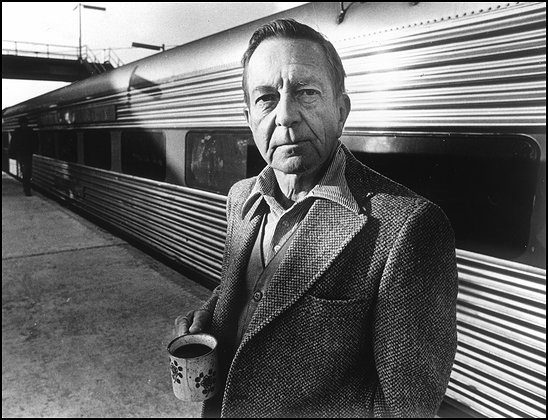
Susan Cheever calls “The Housebreaker of Shady Hill” a “seminal story” in her father’s career, and in its surreal tinge we sense the mid-career Cheever opening up a new dimension in his fiction. Increasingly, his stories would be guided less by events without than events within—dreams, fantasies, fears, and other psychological states merging with reality in potent new admixtures. It is the same world of cocktail parties, walks with the dog, and sumptuous sunsets over the river, but now these elements are arrayed for purposes other than strict realism. Take, for instance, “The Swimmer,” published in 1964. Cheever’s most celebrated story finds its protagonist, Neddy Merrill, at a boisterous party around a friend’s swimming pool; buoyed by a few drinks and an exalted sense of the world’s “clemency” and “beneficence,” he conceives an undertaking of pure whimsy—to travel home nautically, covering the eight miles by linking a series of no fewer than fifteen swimming pools.
Playfully, the story deploys mythic metaphors of exploration, relaying Neddy’s giddy sense of himself as “a pilgrim, an explorer, a man with a destiny.” Swimming past a grinning homeowner on his rubber raft; getting jeered at from a passing car as he stands wet and shivering in a trash-strewn road; being rudely ousted by a lifeguard at the public pool; interrupting a friendly elderly couple sitting naked and reading The New York Times: the story unfolds in dreamlike fashion—and as it does, its jaunty high spirits gradually acquire a somber undertone, via passing hints that suggest that Neddy and his family may have suffered some significant crisis or financial setback. “He could not go back,” the narrator reflects at one point in Neddy’s natatory odyssey; “he had covered a distance that made his return impossible.” Through such ambiguities, Cheever turns “The Swimmer” into an entire life journey, and an unsettling one at that, ending with an exhausted Neddy arriving at his house as night falls, only to find it dark and seemingly abandoned. A miraculous story that begins in drunken party hijinks, proceeds as a fable, and ends in nightmare, “The Swimmer” is ecstatic and ominous, genial and haunting in equal measure. It’s as if Cheever finally found the form to suit his deepest self—“this brilliant alchemy of narrative threads from myth, literature and local gossip,” Susan Cheever writes, “whose magic … is still mysterious.”
“The Swimmer” presents a corrective for anyone who thinks of Cheever as merely a writer of elegant realism. But Cheever was never quite that anyway. This is, after all, the same man who wrote “The Enormous Radio,” in which a couple acquires a radio that mysteriously transmits the private conversations, and thus the secret griefs, of neighbors in their New York apartment; and “Torch Song,” in which an angel of death patrols the streets of Manhattan. Such stories, as novelist Paul Harding noted in a perceptive 2013 piece in The Atlantic, anticipated magical realism, belying what Harding calls Cheever’s “unfortunate reputation” as a suburban realist and revealing him as a “fabulist”—Harding compares him to Italo Calvino—whose stories “have the mystery and weight of folktales or old legends.” In his later fiction especially, Harding observes, Cheever “trades the principles of verisimilitude for his own inner, wonderfully imaginative logic.”
That inner logic runs rampant in the final story contained in the Big Orange Book, “The Jewels of the Cabots.” Published in 1972 in Playboy—Cheever’s long marriage to The New Yorker was on the rocks by then—this remarkable story presents the rambling monologue of a journalist ruminating on his relationship with a wealthy family over several decades. It proceeds by febrile free association, wandering promiscuously among timeframes, serving up strange and hilarious parentheticals while invoking a surreal cast of characters—from a male prostitute named Doris, to an exhibitionist known as Uncle Peepee Marshmallow, to a “misshapen dwarf” who answers the door at the narrator’s long-ago girlfriend’s house in Connecticut, to a woman screaming profanely in a courtyard in Rome, and finally to a corrupt Egyptian colonel lunching in Luxor. With extraordinary figures massing at every turn, the story resembles the crowded dreamscapes of Hieronymus Bosch.
It’s a demanding read, but a rewarding one, and though Susan Cheever mentions “Jewels” only briefly, it’s an important story for understanding Cheever’s growth as a writer, the way his vision expanded and his language loosened to accommodate it. Critic Benjamin DeMott once called Cheever’s stories “dense in inexplicables,” and that’s nowhere truer than in “Jewels.” Occasioned by the death of the family patriarch and a related jewel heist, the story is technically a whodunit, yet its real subject is nothing less than the drama of consciousness, its unruly and at times hallucinatory prose deployed in service of a sprawling narrative whose ultimate objects are the workings of the mind itself. “The Jewels of the Cabots” seems to show Cheever belatedly becoming a modernist in the manner of Joyce or Faulkner. Its profuse interiority, Paul Harding says, offers a lesson in how to inhabit a fictional character by capturing “not only the events of his life but his interpretations of them”—and in so doing, how to convey “life in its full range, irreducible, in its full, heartbreaking complexity.”
When All the Men Wore Hats captures this complexity as it appeared in John Cheever himself: his moodiness, his outbursts of petulance, and his capacity for impulsive delight, routinely boxed in by a rigidly enforced conventionality. With amusement, Susan Cheever recalls that in 1957, when she was thirteen and her father’s novel The Wapshot Chronicle was published, not only did he forbid her from reading it (marital strife, adultery), but he scorned the paperback cover art (a man and a woman intertwined) as “suggestive,” and tore the cover off any copy that came into the house. When the ensuing decade saw the collapse of censorship in American fiction, and writers suddenly found themselves allowed to write almost anything, Cheever was irked, and complained in a sarcastic 1968 journal entry: “Great progress in this kind of writing has been made in the last few years, while I persevere in trying to write a novel without a four-letter word. Donleavy, Mailer, Roth, Updike, some of the most important men we have are writing about cocks and cunts and arseholes while I describe the summer dawn.”
The abiding need to hide his sexuality fostered a performative aspect in John Cheever’s self and in his life. Susan Cheever doesn’t mention it, but there’s a startling moment in his 1976 interview with The Paris Review when the interviewer, Annette Grant, reports that during a post-interview walk in the woods, Cheever stripped and jumped naked into a pond. Why? Was he slyly and showily enacting his own most famous story? Was he attempting—in the presence of a young female interviewer—to demonstrate his virility? Whatever the explanation, one senses that the impulsive-seeming action was not exactly organic. Cheever’s first-person fictions often convey the sense of narrators not only telling stories but performing: putting constructs of the self out there, either to camouflage or distract, or to atone, or to persuade themselves by a kind of fake-it-till-you-make-it effort. Susan Cheever pays a lot of attention to how her father cadged from the family for his stories, and in so doing blurred the line between life and fiction. But it seems clear that this action went in both directions. Cheever wrote autobiographically, but he also lived fictionally.
“Great progress in this kind of writing has been made in the last few years, while I persevere in trying to write a novel without a four-letter word. Donleavy, Mailer, Roth, Updike, some of the most important men we have are writing about cocks and cunts and arseholes while I describe the summer dawn.”
To soothe and subdue his conflicted self, he resorted to alcohol, and though in his final years (he died in 1982) he managed to dry himself out, he spent decades as a desperate alcoholic. There is a staggering amount of drinking on display in When All the Men Wore Hats. Susan recalls that the adults in her parents’ world “were drunk most of the time”; she evokes cocktail party fires started by the drunken lighting of the wrong end of a cigarette, clothes spotted with burn holes, and a father whose “tantrums … [were] fueled by an afternoon drink or two or seven.” She laments the ruin that John Cheever made of his marriage and criticizes what she views as his chronically unfair account of that ruin in his fiction. “For years the war between my parents raged,” she writes, “and my father’s stories reflected it in a crowd of dreadful women married to sweet, great-hearted men who sometimes had a little drinking problem.”
And yet some of those stories portrayed much more than a little problem—and none more acutely than the aptly-named “The Sorrows of Gin” (1953). In it, a father’s alcoholism is observed through the eyes of his young daughter, who watches disdainfully as he searches the house for his mislaid drink, circling from living room to patio and back again, checking places two and three times (he has left it on the mantelpiece) before finally giving up and pouring himself another. In his journals, Cheever was searingly honest about his own failings; and in describing in grimly vivid detail how an alcoholic father would look to a watchful young daughter, he applied that same lacerating scrutiny to a fictional alter ego, creating a story that captures the baleful reality of alcoholism with a power reminiscent of The Lost Weekend or The Days of Wine and Roses.
Susan Cheever’s comments on “The Sorrows of Gin” point us toward a banal yet profound truth about writers: one reason many of them write is that in the act of writing, and in the fictions that result, they are their best selves. Cheever may have barely mentioned his daughter in his journals—he may have been the “inattentive and negligent” father she says he was—but in his fiction, she concedes that “my father saw what it was like to be me,” and three quarters of a century later she remains awed by her father’s ability to inhabit the viewpoint of a nine-year-old girl. “His understanding was uncanny,” she reports; “it feels as if he knew what it was like to be me better than I did.”
The insights Susan Cheever provides into her father’s stories makes When All the Men Wore Hats a treasure trove for Cheever readers. Regarding “Goodbye, My Brother,” for instance, she notes that the obdurately unlikeable brother, Lawrence, was drawn not from John Cheever’s own brother, Fred—whom he revered—but from his ambivalence about himself. Reporting that her father “felt like two men”—an aesthete, prone to delight and exuberance, but also “a gloomy, aging complainer”—she discovers the theme of doubleness not only in Lawrence, who is both scold and truth teller, but in the narrator, whose serene affect and buried rage reflects “my father’s own confusion between light and dark.”
That confusion created chaos in Cheever’s life, even as it sponsored splendor in his work; and despite her personal resentments, Susan Cheever is ultimately able to arrive at a fair and even gracious reckoning with her father, an appraisal that illuminates the central, animating paradox of John Cheever and portrays him in his misery and glory. “My father lived often in darkness, although his prose is filled with light,” she writes. “Truth was his great enemy; at the same time, he found a way to tell the truth of the human heart.”