


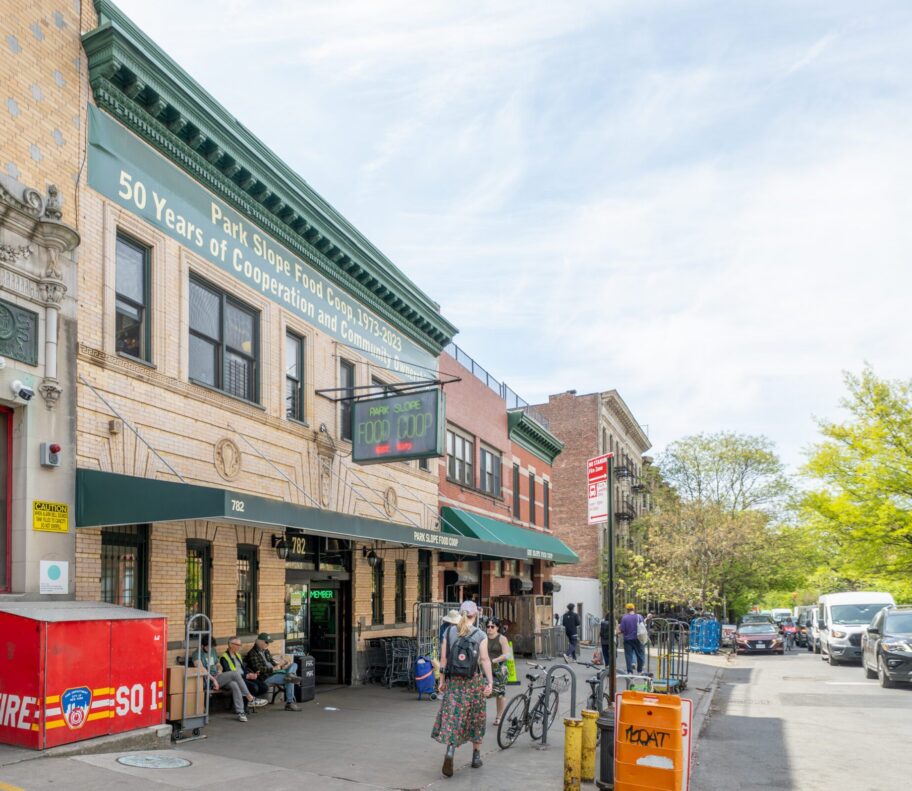
My relationship with the Park Slope Food Coop (pronounced “co-op”), on Union Street in Brooklyn, outlasted my marriage. I was pregnant when I joined in 2004, and there was no doubt that my husband and I, who lived a block away, would take advantage of this treasure of organic and gourmet foods as we planned for our new arrival. We separated in 2019, and in the unspoken divorce arrangement, I got the Coop, and he left as soon as he could.
Founded in 1973, the 17,000-member Park Slope Food Coop requires all members to work a two-hour, 45-minute shift every six weeks, in return for a 30-40 percent savings on groceries, as compared to retail. It has more than $60 million in annual sales, and over 75 employees.
Unlike the situation at other co-ops, you can’t buy your way out of a shift, and only members can shop. Its location on a major thoroughfare of the Slope makes it the most iconic institution in the neighborhood. Well before Uber and Lyft, if you called a car service and said you wanted a Coop pickup, you never even had to say the address.
No matter where you live, you may have already heard of the Coop, not because of the international news it made in May, but because it has been satirized to death. And it’s actually funny. For example, our meat buyer is a vegan. As it happens, I am one of the only writers who has managed to be both comical and accurate about the Coop (in my novel Prospect Park West) though many have tried. Most fail due to lack of specificity. The Coop has been fodder for web series, pilot scripts, a Broad City episode, a Daily Show bit, and naturally, a French documentary. Journalists covering it for the first time usually use a phrase like “Stalinesque rules,” a descriptor that has become far less accurate since COVID, when member labor stopped (temporarily), paid staffers and minimum-wage workers kept the Coop going, and our shift requirement loosened from every four weeks to every six.
It’s the kind of place where, when paging on the intercom system, members don’t say, “Do you carry harissa?” We say, “Do we carry harissa?” The fool who opens with a “you” will be corrected by whoever answers the page, and anyone can answer a page, not only our staffers. If you ask if we carry “paella rice” you’ll hear a dozen pages in response, philosophizing on the different types of rice that can be employed in making paella.
After I wrote a novel based on the Coop, the Coop sold the novel. I’ve shopped tipsy. I’ve cried there. There were months I couldn’t go in because of my mood, and months when going in saved me from despair. I met a guy there who was my boyfriend for three years. I haven’t lived in the Slope since 2013, but I have stayed a member. For many of us, the Coop is the closest thing we have to a religion. We are many different types of people, races, and income brackets, all trying to get along. It’s one of the few truly diverse spaces left in brownstone Brooklyn. We have a high quotient of crazy, but for 53 years, for the most part, our members have lived and let live.
Until recently.
Beginning around 2009, Coop members began to float the idea of joining the Boycott, Divestment and Sanctions (BDS) movement, founded by Palestinians in 2005. The international movement aims to compel the Israeli government to change its policies toward Palestinians and withdraw from Palestinian territories, but the movement’s founder, Omar Barghouti, has said, “We oppose a Jewish state in any part of Palestine,” and that if the occupation were to end, it would not end his calls for BDS.
In 2012, the Coop’s pro-BDS members got a vote on the floor, at a membership meeting, to send a boycott motion to referendum, which, if passed, would let the entire membership vote on a boycott by email. Nearly two thousand members, including me, gathered in the Brooklyn Technical High School auditorium (one of the only nearby spaces large enough to accommodate us) to vote on paper ballots.
At the time, the Coop sold fewer than ten Israeli-made products, including SodaStream, paprika, kosher marshmallows, tapenades, and pestos. By a vote of 1,005 to 653, we collectively voted not to bring the item to referendum. I was one of the no votes. I had expected BDS to lose, but not by nearly two-to-one.
Even for a radical food co-op with largely progressive members, in 2012, BDS went too far. And among the many friends and fellow members I spoke to that evening, the association between BDS and antisemitism was broadly understood, even if people could not tell you Omar Barghouti’s name. For a while, BDS at the Coop appeared a dead letter.
But by the early 2020s, and before October 7, 2023, that changed.
Spurred by a mix of old Coop members of the Baby Boom generation, younger people, and—according to one BDS opponent, substantial funding, the BDSniks grew organized. The new group was called PSFC Members for Palestine. They collected names and emails. There was a petition. An email I received from a Coop 4 Unity member said 45 people on the BDS side worked on it full time. They won seats on the board and on powerful committees like the Agenda Committee.
Then came the pogrom of October 7, and the Israel-Palestine war. Every time I went in, I’d see a handful of shoppers in keffiyot. There was flyering outside. People exchanged words. I saw one woman come in wearing head-to-toe blue and white with a huge Israel-blue Jewish star. The Coop began to feel like a sendup of itself, and not in a good way. By 2024, a smaller Brooklyn co-op, Greene Hill Food Coop, had voted for a boycott.
An effort (by BDS) for hybrid meetings succeeded. A new BDS motion was going to make it to the floor in Spring 2026. According to an email from General Manager Joe Szladek, at an April meeting (partly online and partly at the Picnic House in Brooklyn’s Prospect Park) someone said, “We can’t keep making the same mistakes we did with the Nazis and what we did with other hateful, racist groups. Jewish supremacism is a problem in this country, and we will move forward as a country with or without this Coop.” People in the room applauded.
And then the vote was set. On May 26, 2026, in a hybrid meeting, members would vote on two proposals from the BDS people: first, to lower the threshold for a boycott from 75 percent to simple majority, and, second, to implement a boycott of goods produced in Israel until Israel complies with international law by stopping “unlawful discriminatory practices in its treatment of Palestinians.” By the day before the meeting, nearly 7,000 of our 17,000 members had registered for the meeting, and hence, to vote.
A few weeks before the May meeting, I received a video sermon in my email showing Congregation Beth Elohim’s Rabbi Rachel Timoner at a Shabbat service urging people to vote no on the Coop’s BDS referendum. Congregation Beth Elohim is a storied Reform congregation, a stone’s throw from the Coop. In recent years it has been thriving, with 1,300 families, maybe 2,000 adults or more.
I am not a member of CBE, but I subscribe to the emails. For the last year, I’ve been synagogue-hopping, which both is and isn’t about October 7. I feel a renewed sense of identity as a Jew, and I also want to belong somewhere. I want to be in community.
It’s not about God. If Goldberg goes to shul to talk to God, and Greenberg goes to talk to Goldberg, I’m definitely the Greenberg in the equation. I am a divorced empty-nester, and my boyfriend is with his kids on Fridays, and sometimes the weekends feel long.
The association between BDS and antisemitism was broadly understood.
For the past few years, I have been trying out different shuls in Brooklyn, including CBE. When I make my way to the kiddush table after services (where we pray over the wine and bread), people come up to me, introduce themselves, and ask, “Are you a member?” or “How long have you been a member?” I explain that I’m not in fact a member, and this results in my interlocutor telling me how long she or he has been a member, and how, and why.
For a while, I found this talk of membership off-putting. You don’t have to belong to a synagogue to go to services. I complained about all this member-talk to a friend, a former president of his Conservative synagogue. “A synagogue is a club,” he said. “We love our club, and we’re proud of it, but we also want you to commit.”
I got it: synagogue members are proselytizers. They don’t want looky-loos. They want believers. Beth Elohim is such a club that it even has a swimming pool. (We used to call it the shul with the pool.)
In the sermon I received in my inbox, Rabbi Timoner said BDS was a proxy war for antisemitism and that Barghouti has stated he seeks the elimination of the state of Israel. She said if the Coop passed a boycott, she would leave the co-op. For the first time, it occurred to me that if BDS passed, I might leave too. I had only considered one option—sucking it up—but now I realized I had agency.
After hearing the sermon, however, I believed that BDS would fail. Timoner was popular and well-loved. She is a queer rabbi who was arrested last year in a pro-Palestinian humanitarian aid protest; she was on Mayor Mamdani’s transition team. She seemed the perfect voice to urge a “no” vote.
Surely many of those 2,000-or-so CBE member adults also belonged to the Coop and would vote no on BDS. There were too many Jews in Park Slope uncomfortable with antisemitism for BDS to win.
The day before the meeting, Memorial Day, my refrigerator was empty, and my daughter, 20, was soon to return from college for the summer. I took a long walk with my boyfriend, who is Jewish. We talk a lot about being Jewish at this post-Mamdani moment. It’s a strange new thing for me to have this kind of bond. After our walk, I made my way to the Coop.
Warned of chaos in front of the store, I was relieved to find only around five people outside, and two tables with posters, PSFC Members for Palestine and Coop 4 Unity. The scene appeared calm. The two groups ignored each other, focusing on the entering and exiting shoppers.
For the first time, it occurred to me that if BDS passed, I might leave too.
I took a Coop 4 Unity flier, which urged me to vote no on the two proposals and yes on any referendum proposed at the meeting. A referendum would allow all Coop members to vote on a proposal, by email, which we do for board elections, and the thinking was that a referendum would kill BDS. In 2012, the anti-boycott contingent had voted against a referendum. But in 2026, it seemed, that same contingent was for it, wanting more people to vote.
Inside the Coop, it was less crowded than I thought it would be, mostly dads and their kids sent out post-holiday by moms to “Get a few things for the morning while I unpack.” (You can spot the clueless dads, because they talk too loudly to their children and don’t know where anything is.) It occurred to me that, depending on the vote, this might be my last shop. If I were strategic, I would prepper-shop, spend $350, fill my fridge for weeks. But I was sweaty from my long walk, and kept selecting items only to put them back.
Outside, a Coop 4 Unity guy told a shopper, “Vote for the health of the Coop,” and a BDSnik murmured, “Vote yes to genocide.”
A staffer I know came outside. “I’m sorry for what you guys are going through,” I said.
Staff member friends have told me they’ve been in hell because of BDS. They hate breaking up arguments in the aisles. They hate the contentious meetings. Six years post-COVID, the Coop has mandatory masking twice a week for members and staffers. The staffers hate the masks and blame the BDSniks, who, they feel, used disability justice as a front to pass hybrid meetings and BDS.
“Let’s hope it ends tomorrow,” he said. I took that to mean he had intel that the proposals would fail. I felt glad I hadn’t overshopped.
The first half of the BDS meeting was devoted to the financial and produce reports. Two staffers, General Coordinator Joe and Produce Buyer Celia, shared information on insurance, debit fees, and cherry blight, patiently and slowly with a group of people wholly uninterested in this part of the agenda.
After his report, Joe said whatever we felt about the boycott, we should vote to keep the threshold to pass a boycott at 75 percent. A moderator (all four moderators were members receiving shift credit for moderating) made a point of order in the chat, saying Joe should not have commented on a proposal.
The staffers hate the masks and blame the BDSniks, who, they feel, used disability justice as a front to pass hybrid meetings and BDS.
As the point of order was read, I could feel the anger simmering, unseen and unheard. We were all muted and blacked out, except the moderators. At the Picnic House meetings, resentments were on full display, keffiyot with N-95s, Palestine T-shirts, posterboards on genocide. Now the shouting was muted, but it didn’t mean it wasn’t there.
One of the moderators ruled Joe in order. Joe said that for a boycott vote, which would impact the financial health of the Coop, his opinion mattered. He said we could lose millions if members left due to a boycott.
Though he went on a few more minutes to summarize his report, he seemed to grasp that this meeting was not about the banality of finance and produce. It was about getting through that to get to the end.
The reports were Old Coop, the proposals New Coop. We were entering a new world. Something terrible had happened: after 53 years, the Coop had become unfunny.
The presentation on the “threshold” proposal (to lower the boycott threshold from 75 percent to simple majority), was given by two young men, one of whom said he was a Somali Minnesotan. They summarized the history of boycott thresholds and the co-op’s past boycotts, and likened BDS to anti-ICE protests in Minnesota.
In the chat, there was a motion to move to a referendum. This was going to be the end, I thought. The masses would vote for a referendum, and this item would be kicked into the future. Then the same thing would happen for the boycott proposal itself.
The referendum motion was put to vote. It failed by more than 20 points.
Things were moving very fast. The threshold item came on our screens, we logged our votes, and it passed by around two-to-one.
From there we moved to the boycott referendum itself, presented by a handful of self-identified Jews. I think there were slides, but my computer screen showed only black.
After the floor was opened for discussion, a man named Idris moved to end discussion. A moderator, Maribeth, said, “There hasn’t been any discussion.” Her voice was more befuddled than angry. How could you end something before it had begun?
A different moderator asked him to explain his motion. There was a pause, like he didn’t get it. “There’s no need for a discussion,” he said. “We’ve waited a long time for this. People know how they feel.”
Soon the vote to end discussion was on the screen. As people entered their votes, Maribeth said, “In fifteen years on this committee, I’ve never seen a proposal come to vote without discussion. I just want to memorialize that.”
The no-discussion motion passed by two-to-one.
Then the boycott vote came to the floor. By this point I, and everyone else, knew how it would go. I saw the tally on the screen—67 to 31 percent, 2 percent abstaining—and tapped LEAVE.
I called my boyfriend, crying. I recounted the meeting and mused about what I should do. Take a leave from the Coop but keep my investment ($200 for my household) so I could return? Resign totally, and reclaim my funds? If I did, where should I send the money instead? That night, I only half-slept. I woke up at five, depressed.
There was an email from Rabbi Timoner saying it was “a crushing night for many Jews in Park Slope.” She said she would speak about it in her sermon on Friday night. “If you’re able to come to services,” she wrote, “it would be so good to be together.”
That week, I got a bunch of emails from Jewish friends about the vote. Not one person said they were leaving. Instead they wanted to stay “and try to change things.”
These carefully worded missives rang false to me. The 4,000-plus people who voted to boycott weren’t going anywhere. We would get new members who were inspired to join by the boycott. Nothing was going to change any time soon. To stay and fight was also to stay and continue to get 30-40 percent savings on groceries, as compared to retail. To stay was the convenient choice, not the principled one.
Friday evening, I took the subway to the shul in time for the pre-Shabbat cocktail hour, one of the reasons CBE has gotten so popular in recent years. As people streamed in, there was a feeling of warmth and reunion, like at a simcha. It grew crowded, 30 people, 40, 75. Word of the sermon had apparently gotten out.
We moved into the sanctuary, a room off the lobby. A woman I know, Julia, made room for me beside her. “What are you going to do?” I asked.
“I never joined. We live in the South Slope. But I remember you wrote a book about the Coop.”
We filled all the pews, and helpers kept bringing in more chairs. The rabbi apologized but said she wanted us all to be close, and that was why she kept services in the smaller of the two sanctuaries.
The Friday-night sermon comes after the singing of “Shalom Rav.” I could feel the energy shift as people put down their siddurim, leaned forward.
The rabbi said that in the week’s Torah portion, Naso, God blesses the kohanim, or priests, and the kohanim bless the tribes. (She would publish a version of this sermon in the New York Times a few days later.) She said that after the Exodus, at the foot of Mount Sinai, God shows us we belong to God by commanding our leaders to bless us with a whole heart and lift their hands before the people. She made the Spock gesture and said, “You’ve seen this before, but it comes from the Torah,” which got a big laugh.
She said, “God is telling the Jews, ‘When the world tells you that you don’t belong, remember that you belong to one another, and you belong to me.’”
After the BDS vote on Tuesday, she said, after 11 years of working her shifts, she had resigned from the co-op. People applauded. On her resignation form she wrote, “I’m sad to leave, but I don’t belong here anymore.” She told us she was in grief. I wiped tears from my cheeks, and Julia rubbed my back.
She reminded us that the BDS founder wants to eliminate Israel. She summarized the meeting, and when she got to the part about the vote with no discussion, people moaned and shouted.
She said the feeling of not belonging was old in us, and rattled off a list of some of the 100 places from which we’ve been expelled, ending with Germany.
Then she did the thing I was hoping she wouldn’t. Just because someone voted BDS, she said, it didn’t make them antisemitic. She read emails from members who voted for BDS, one from a young woman who said she wasn’t antisemitic and had a grandmother who survived Auschwitz. All I could think was that the girl was crazy.
Though she herself had chosen to resign, the rabbi said, some of us might not want to, and that was OK too. If any Coop members in the room were feeling confused, she said, they should meet each other and talk in the lobby. She said she wasn’t sure her resignation was right, because we didn’t only belong to the Jewish people, we belonged to humanity.
The time Timoner spent equivocating (a boycott vote doesn’t make you antisemitic, I don’t know if resigning was right) felt to me to be three times as long as the first portion, when she explained the antisemitism in BDS and around the world. It was the reverse order of the Coop meeting, which had started Old Coop and ended New Coop. She was starting political and angry, and ending granular and soft.
I was frustrated by her softness. She had been fiery in the anti-BDS sermon. Now she was hedging. God forbid anyone in the room felt unseen or unheard. God forbid anyone who voted for the boycott would feel shame.
I wanted righteous anger, and, equally important, I wanted a roadmap. Sometimes, you go to hear the rabbi so the rabbi will tell you what to do, or at least offer a bit of direction.
Then she said the synagogue was launching an antisemitism working group. I thought I would join that group; I thought maybe I wanted to join it more than I wanted to join the synagogue.
She closed with the priestly blessing, the one the kohanim gave to the tribes of Israel:
Yevarechecha Adonai, v’yishmerecha. May God bless you and keep you safe.
Ya’er Adonai panav eleicha, vichoneka. May God shine on you and be kind to you.
Yisa Adonai panav eleicha, v’yasem lecha shalom. May God lift his face toward you and bring you peace.
We made our way into the lobby and, after the kiddush and hamotzi (the blessings over the wine and bread), she told the Coop members to gather in a corner. About 15 of us debated our options and shared email addresses, introducing ourselves, shaking hands, venting.
I was in community again.
I was energized by my new, strange friends in the land of those cast aside.
And yet. And yet.
This was not a community I had chosen. It had been foisted upon me through crisis. Anyway, we were not a food-buying group.
A quarter of the Coop’s members had voted for BDS, and as more people left and more pro-boycott people joined, the scales would tip further. We were outnumbered. I missed my co-op, my club, where I no longer belonged.
I slipped away from the group to find the rabbi, but she was gone.
At home I called my boyfriend and talked about the sermon. “I’m going to leave,” I said. I didn’t know I was going to until I said it. Like all big decisions in life, you feel fuzzy and confused for days or weeks, and then one moment you just know.
I told him how sad I felt and then blurted out, “I’m glad you’re Jewish.”
“I am too,” he said.
I laughed. “You’re glad you’re Jewish?”
“I mean it both ways,” he said.