


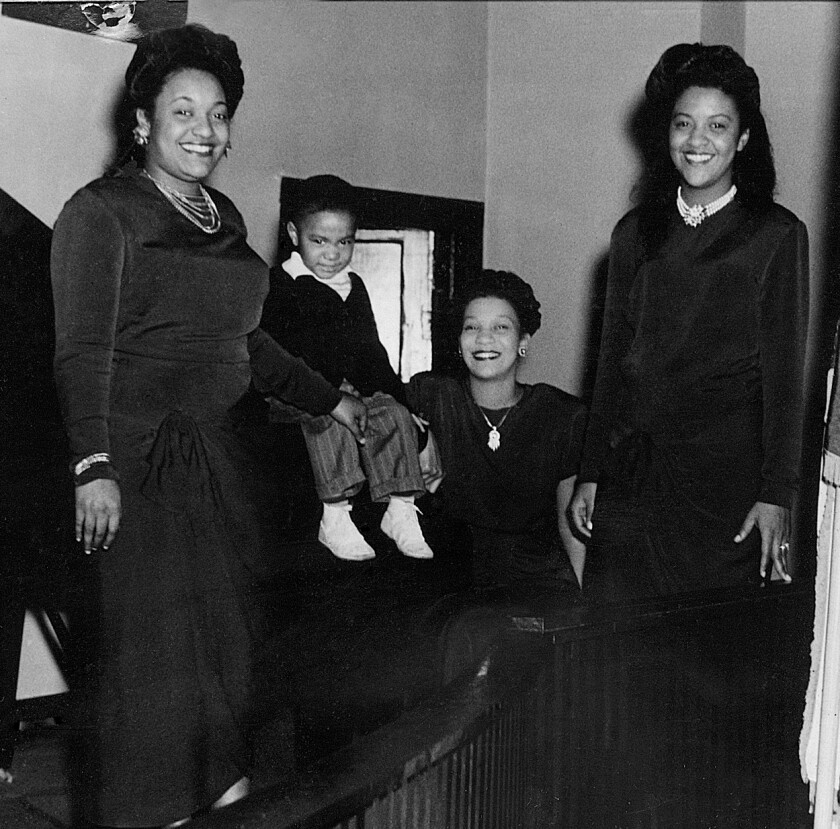
If you love gospel, meaning the 1950s and ’60s world of Mahalia Jackson, the Clara Ward Singers, and Marion Williams, you will devour Can I Get a Witness! Faith, Family, and Chicago Gospel Music (University of Chicago Press, 2026). It’s an unusual book: it’s an entirely non-academic work published by an otherwise staid academic press, and its main source is a single long interview with a Church of God in Christ (COGIC) minister, Donald Gay, conducted by Steven B. Dolins, an otherwise little-known record producer and Bradley University faculty member who furnishes the narrative. (The book is credited to “Steven B. Dolins with Gregory Donald Gay.”)
Can I Get a Witness! explores the gospel world far from major figures like Jackson, Ward, and Williams. Instead, it focuses on the mixed-success careers of the three Gay Sisters of Chicago, Evelyn, Geraldine, and Mildred, from the 1940s into the ’60s, and the Black Holiness congregations that shaped their music and faith, including the career of their decades-younger brother, Donald. No other book so successfully opens the unsettled vibrancy and breadth of what we might call second-level gospel or explores gospel’s deep connections to local Black Pentecostal-Holiness congregational life across the nation.
The Gay Sisters had their successes. Dolins and Donald Gay begin with their most spectacular, an October 1950 Carnegie Hall gospel-fest with the Sisters, Mahalia Jackson, the Clara Ward Singers, and Marion Williams, who still sang with the Ward Singers, and the five-year-old “boy preacher,” Donald Gay, in a tuxedo and top hat. If one reviewer said the biggest success was “the little kid,” the sold-out audience devoured the singers. But Donald Gay also remembers backstage tensions. Jackson broke into a jealous rage when Marion Williams preceded her and wowed the audience with a Clara Ward song, “Surely God Is Able.” Only the prayers of Evelyn and Mildred Gay calmed her down. Then there was the issue of Donald Gay’s tuxedo and top hat, which Jackson promised to pay for but never did.
The Sisters’ touring and recording careers reflected the helter-skelter life of second-level gospel. Lacking a national agent, they arranged their own appearances, usually in Black congregations and with other local gospel groups. In 1946, they appeared in back-to-back concerts at two different Black Brooklyn congregations in conjunction with an all-male group, the Chicago Crusaders. Several months later, “The Famous Gay Sisters of Chicago” appeared in a “Battle of Music” with an all-female group, the Modernaire Gospel Singers from Newark, N.J.; the Beck Temple Radio Chorus; and “Little Samuel Fletcher, the 12-Year-Old Boy Sensation,” all at the Bethel AME Church in Pittsburgh (with some proceeds going to the city’s Black radio station, WBCK). Appearances like these, with travel by train and lodging in private homes, characterized the Sisters’ touring into the 1960s.
The Sisters’ recording history spoke as much to their failures as their successes. Their biggest (and only real) hit, “God Will Take Care of You,” a 1951 Savoy recording made in New York City, sold more than 100,000 records and led to appearances in Atlanta and elsewhere. Across the decades, more than ninety other gospel singers have recorded “God Will Take Care of You,” including Aretha Franklin, on her 1972 Amazing Grace album. But although Savoy released the song on an LP with eleven other songs, for unknown reasons Savoy stopped recording with the Sisters. A short dalliance with the label Decca met the same fate. Chicago was awash in recording studios, and the Sisters recorded in many of them, for a mind-boggling number of labels, including Hummingbird, Davis, B&F, Rush, and Peacock. Some produced 45-r.p.m. singles, others not, but no recording ever approached the success of “God Will Take Care of You,” and no label ever signed them to a long-term contract.
No other book so successfully opens the unsettled vibrancy and breadth of what we might call second-level gospel or explores gospel’s deep connections to local Black Pentecostal-Holiness congregational life across the nation.
The Sisters’ success in arranging concerts with congregations across the nation stemmed from what Donald Gay termed their remarkable “networking” skills. Everywhere they went, they cultivated new relationships that led to more concerts. The impulse—skill, really—originated in their home life. The Gays lived in a small two-story residence on South Champlain Avenue, built on one of Chicago’s famous fifty-foot (wide) lots. Donald Gay remembers it as perpetually stuffed with people—the Sisters’ gospel friends, singers, pianists, their brother’s jazz friends, especially pianists, Holiness church friends. They were drawn not only by the Sisters’ personal magnetism but by their mother, Fannie, who famously prayed for everyone. Donald Gay quipped that “she would wear out the wooden floors by kneeling on them.” Clara Ward stopped by to tell Fannie she wanted to travel more, and Fannie responded, “Lord, you can make a way for Clara. And keep her safe as she goes to and fro along the highways.” Mahalia Jackson stopped by frequently, and her biographer, Laurraine Goreau, wrote that “Fannie Gaye was known far and wide as a woman of great power with prayer. Yet she was a quiet woman, lay hands on you so nice, so soft, pray so quiet. A psychic woman. Close to God.” After completing a heroin rehabilitation in Louisville, the jazz great Sonny Rollins recovered in the Gays’ basement, where Fannie Gaye prayed for him. The Gays’ welcome had its limits, however. When Buster, Fannie’s husband, discovered that their visitors were making long-distance calls all over the country on the Gays’ telephone, he foxed them by installing a pay phone in a hallway. “You got to put a dime in,” Buster chuckled.

Prayer was the Gay Sisters’ connection to the Black Holiness tradition, then ultimately to the Church of God in Christ. For years, the Gays worshiped at Chicago’s Sanctified Holiness Church. But when its head, the aging elder Peter Favor, suffered serious health setbacks, the congregation declined, and the Gays joined St. Paul Church of God in Christ, where Geraldine had also become Sunday pianist.

The Church of God in Christ movement began in the 1890s among disaffected Mississippi Baptists stressing Christian perfection (sanctification), the Holiness stress on living a clean, modest life, a belief in the imminent return of Christ, God’s continuing presence in the modern world, and a vivid, personal relationship with God exemplified in prayer. COGIC congregations restricted ordination to men but appointed women as missionaries and evangelists. In some denominations, such posts were perfunctory, but not in COGIC congregations. Women spoke and prayed vibrantly there and performed major leadership functions in small COGIC congregations, even if a man was named pastor—a perfect fit for the Gays.
The dual shifts offered Fannie Gay a chance to realize a longtime goal: her own congregation. She housed Fannie Gay’s Prayer Center Church of God in Christ in a cottage behind her home, then in her basement, then in a series of storefront locations. With COGIC approval, Elder Favor formally served as pastor, but Fannie, her daughters, and the former boy preacher Donald Gay managed the Center. When Favor told Fannie he could no longer perform even his perfunctory role, he suggested the former boy preacher, now grown and married, Donald Gay, and COGIC ordained him. For the next decades the Prayer Center continued as it began, small and usually in storefronts but finally in a former Baptist church, with Donald as its pastor and the sisters praying and singing.
As the Sisters’ touring declined, they began working with other Chicago musicians and pursuing individual careers. Evelyn and Geraldine were highly regarded gospel pianists and began backing up a wide variety of groups—the Lux Singers, the Gospel Songbirds, the Staple Singers, the Soul Stirrers. If 45 or long-playing records resulted, as often as not they received no credit. Evelyn and Geraldine had different styles, Evelyn more “sanctified and ‘blusier,’” Geraldine “more stylish and jazz[y].” But both were highly adaptable and worked easily with many different groups.
For a time, Geraldine played for Checker Records, while Evelyn got them contracts with small labels. They played on Chicago radio stations, and Evelyn opened as the main pianist on Chicago’s first gospel television program, Jubilee Showcase, only to find herself reduced to a standby pianist halfway through the first season. Still, she recorded regularly in Chicago studios for one label after another and with ever more groups and singers, including the Sirens and COGIC Bishop Gilbert Patterson. Together with Fannie, they supported Mahalia Jackson on her many Chicago visits, despite Jackson’s sometimes hurtful behind-the-scenes maneuvers.
The sisters’ personal lives were difficult, bordering on tragic. All their several husbands proved ne’er-do-wells, and Mildred and Geraldine lost sons, Mildred’s in an accident and Geraldine’s to drugs. Donald describes Geraldine as a poor mother, and her financial distress led her to transport drugs to Detroit, steal furs in Wisconsin, and cheat acquaintances out of money, with jail terms for each offense. Evelyn died in 1984, Fannie in 1999, Mildred in 2002, and Geraldine in 2010, still recording on piano through her last years. Donald Gay continued pastoring at the Prayer Center and sang with gospel groups across the country, even as the sisters’ touring declined.
Like no other book, Can I Get a Witness! reveals the richness and breadth of the gospel world below its most famous singers—the hundreds of local groups that came and went, the deep connections to Black Holiness congregations, the plethora of recording labels. The sisters persisted through gospel’s unsettledness and their own problems for decades. Can I Get a Witness! is a unique inside account of remarkable people in an extraordinary American movement.