


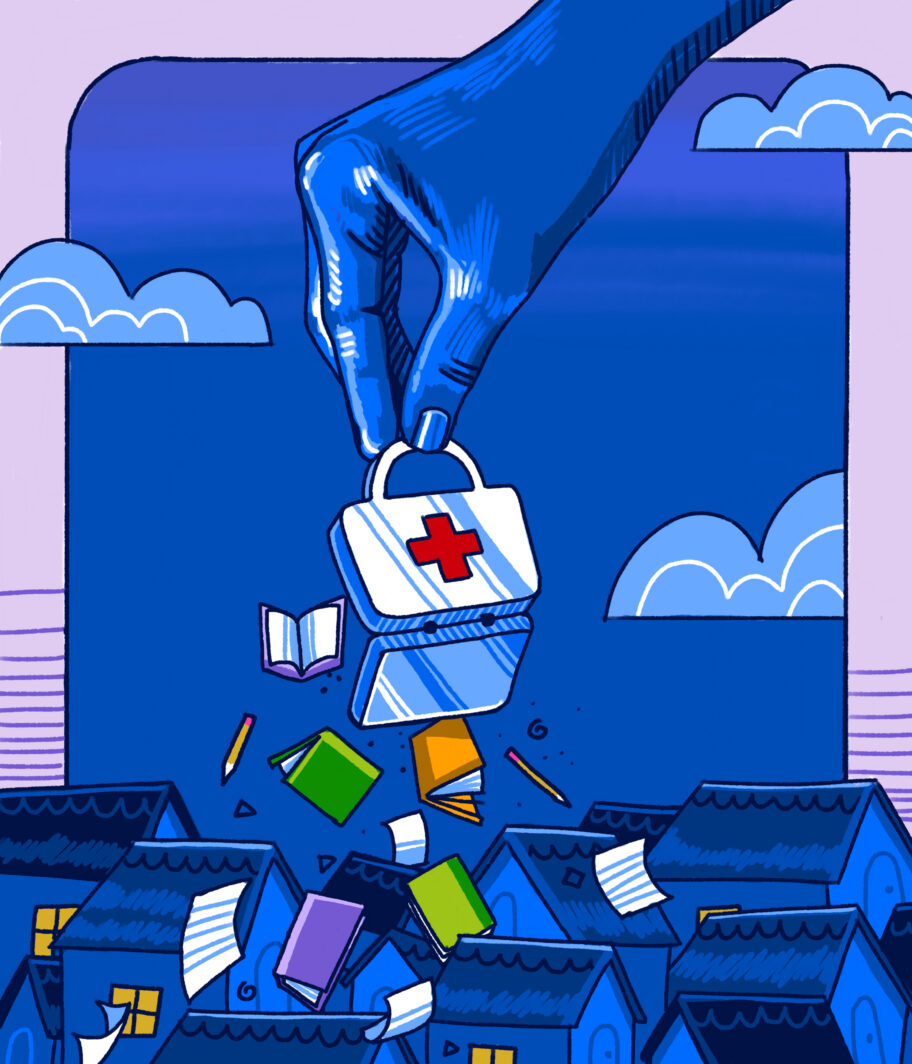
I grew up in southwest Michigan in a working-class family. My father worked as plant manager at a steel and wire factory, and my mother stayed home with the four of us children. My parents valued good education and prioritized teaching us to read at an early age. They applied for scholarships for us to attend a private Christian school for some of our elementary years. For better or for worse, Dad was continually extolling the virtues of “finishing your education before you get married and have babies.” And up we grew.
As an early reader, I found school easy. My public high school boasted a competitive speech and debate team, which I joined. This also provided a community of peers typically hailing from professional families. Among the debaters, college and graduate school were foregone conclusions; the question wasn’t, “Should I go to college?” It was, “After college, which grad school degree should I pursue?”
I studied international relations, then completed a premedical program, went to medical school, went to divinity school for my ethics degree, obtained a certificate in executive education at a business school, and have spent the last twenty years as a physician and ethicist and professor in the Ivy League. Except for international relations, which this kid from Kalamazoo always wanted to study, I could never have imagined any of it. And I’m grateful: every bit of my education opened new doors to new opportunities.
For much of my life, I took the gift of early literacy for granted. I just assumed that the richest country in the world had conquered illiteracy once and for all, and that, like smallpox, it would never plague us again. Boy, was I wrong.
Just before the COVID-19 pandemic, I was recruited to Columbia University in New York City. After serving as a frontline COVID-19 doctor in one of the nation’s pandemic epicenters, I hung out my primary care shingle and began to care for patients in the northern Manhattan neighborhood of Washington Heights. The neighborhood goes by the nickname “Little Dominican Republic” because most residents have connections to the small Caribbean island. Many are immigrants who don’t speak English well. But other local patients are native New Yorkers, often African American.
It was among these kind souls that I discovered the blight of illiteracy. Strictly speaking, “reading” refers to decoding and understanding written text, whereas “literacy” is broader and includes reading, writing, and communication skills. Some of my patients seem to struggle with both.
When it comes to reading, they might make out isolated words okay, such as drug names, but might be unable to comprehend a simple paragraph of printed instructions. Nor can some make sense of basic insurance forms or read emails in the electronic medical record longer than a brief sentence or two. I quickly realized the need for sending very short and clear messages.
When an older man for whom I’d cared for years developed a condition that rendered him wholly unable to speak, his illiteracy came into sharp relief. He could only rely on writing to express himself, yet he could hardly form letters and could not spell. And despite being a New Yorker from birth, he could not write a meaningful sentence. Our office visits were long and frustrating. I am not confident that I successfully helped him achieve his goals by the end of every office visit. Sometimes I think he just gave up and left.
Sadly, this is not an anomaly in America today. When I started investigating literacy rates in the United States, I was shocked by what I discovered. According to a 2023 assessment, only 44 percent of U.S. adults scored at levels considered fully proficient. This means that roughly 130 million adults struggle with everyday reading tasks—a number about which most literate Americans probably remain ignorant.
We might find our collective ignorance justifiable were low literacy only an ailment of the aged. But literacy is not just an adult problem. The 2024 National Assessment of Educational Progress (NAEP) found that nearly two-thirds of fourth-grade students are not proficient readers, and national reading achievement remains near historic lows. The June 2026 report card shows that while scores for nine-year-olds improved slightly in reading and mathematics in 2025 compared to 2022, scores for 13-year-olds remained stagnant when compared to 2023. Staggering numbers of American children struggle with reading and math.
The consequences of poor literacy extend far beyond the classroom. Studies link poor literacy to lower workforce participation, reduced lifetime earnings, poorer health outcomes, and diminished civic engagement. The Barbara Bush Foundation for Family Literacy estimates that low literacy costs the U.S. economy up to $2.2 trillion annually, through lost productivity, lower wages, and increased social and health care expenditures. Many are concerned that our poor literacy will negatively impact America’s competitiveness in the world. How could a rich, powerful, and technologically advanced country such as ours have left so many people behind? The ramifications are not only economic; human flourishing itself is at stake.
For much of my life, I took the gift of early literacy for granted. I just assumed that the richest country in the world had conquered illiteracy once and for all, and that, like smallpox, it would never plague us again. Boy, was I wrong.
Since antiquity, the discipline of ethics has concerned itself with questions of the good life. What does it mean for me to flourish? How ought I to live? What is right and good, and how do I pursue what is right and good?
As an ethicist and physician, I’ve thought a lot about how to help my patients flourish. Sometimes it’s a strictly physical problem, for which a cure or rehabilitation is needed. But sometimes it’s quitting a bad habit. Or finding stable employment. Or mending broken relationships. My point is that we’re prone to thinking of ethics—what we ought to do to achieve a flourishing life—in a personal way: my ethics, your ethics.
But collective ethics also exists. In fact, we might call collective ethics “politics.” Aristotle once wrote that politics is free people deliberating together about questions of the good life. Politics asks, “How ought we to order our life together?” Being able to participate fully in civic life, society, and the workforce is part of what it means for Americans to flourish. But in America, this usually requires people to be literate.
In 2025, I founded a nonprofit called Heal the Nation to begin applying my work in medical ethics to questions that affect the flourishing not only of individual patients but also of society more broadly. Given the way literacy has directly led to my own flourishing, education seemed like a sensible place to start. Through a series of roundtables, we gathered education experts to discuss different challenges in the classroom. No matter the specified theme of our meetings, my thoughts would always drift back to the scourge of low literacy.
Here’s what I learned from my colleagues in education and education policy:
First, we know how to teach basic reading. The method has been dubbed the “science of reading” and refers to more than five decades of interdisciplinary research. The science of reading focuses on five key skills necessary for effective reading and writing: phonics, phonemic awareness, comprehension, fluency, and vocabulary. It has been shown to work time and time again.
Second, money is not an issue; teaching basic literacy and mathematics does not require expensive technology. It requires teachers who are willing to teach and are supported by their school systems to do so. Moreover, spending more per pupil does not necessarily result in improved literacy and numeracy. New York City spends about $36,000 per public school student yearly, more than double the national average. Yet 43 percent of New York City students attend “failing” schools, where most students fail state exams in math, reading, or both. School systems that spend far less than New York City have much higher literacy rates because their priorities differ.
Third, since we spend more per pupil on education than at any point in U.S. history, other factors must be at play, including challenges in the home, school, and government. Substantial data show that educational attainment is higher for children living with two married parents. This is not to disparage single or divorced parents; it’s simply what the data show. Challenges at school have to do with the burgeoning youth mental health crisis, the zero-sum game with technology, staffing deficits, and goal misalignment between teachers’ unions and local authorities. And at the state and local levels, turnover among politicians who dictate education policy thwarts the ongoing implementation of successful programs.
Fourth, despite myriad obstacles, many jurisdictions have committed to helping children excel at math and reading and are reporting their successes. Houston and Detroit, as examples, boast citywide improvements in recent years. On the state level, Louisiana and Mississippi are making great progress.
Finally, since the Tenth Amendment to the U.S. Constitution effectively leaves control of education to states, governors may be best positioned to cast a vision, convene stakeholders, influence legislation, and direct resources to ensure that every American child learns to read and develops math skills. In December 2025, the George W. Bush Institute convened governors and their representatives for a Governors Forum on Reading and published guidance for how state leaders could steward their positions to improve education for the children in their states. We need more efforts like this.
Politics, or societal ethics, has substantial parallels to medical ethics. In the medical field, we physicians can find ourselves contending with diseases for which no treatment exists. In such circumstances, when a cure is not possible, we need to take a more generous view of flourishing. Maybe flourishing in the face of disease and death means reprioritizing family, or legacy work, or questions about God.
By contrast, when it comes to low literacy in America, the treatment exists; we’re just not always using it. Instead, we lower our standards for children’s education. In a study they call the “Honesty Gap,” the Collaborative for Student Success tracks how state reporting of proficiency levels differs from national reporting. In 42 states, they find that “the gap between the state and national assessment was double digits (10 percentage points or more) in at least one subject and grade level.” This dishonesty misleads parents into believing that their children are much more proficient at reading and math than they, in truth, are.
It’s not uncommon in the hospital for patients to show up to the emergency room after trying and failing to manage their illnesses at home. Medical technology is so powerful that we can usually turn most people around, no matter how advanced the illness. But sometimes patients arrive too late for us to be of much help. We must not allow this to be the case for children’s education in America. We must treat the scourge of poor literacy before it’s too late.
Education is core to the stories and successes of so many Americans, from our Founding Fathers to the formerly enslaved, the working class, and immigrants. Literacy is a critical skill for employment, community engagement, and human flourishing. It’s not too late to rewrite the story of American illiteracy. And it’s not too early to begin.