


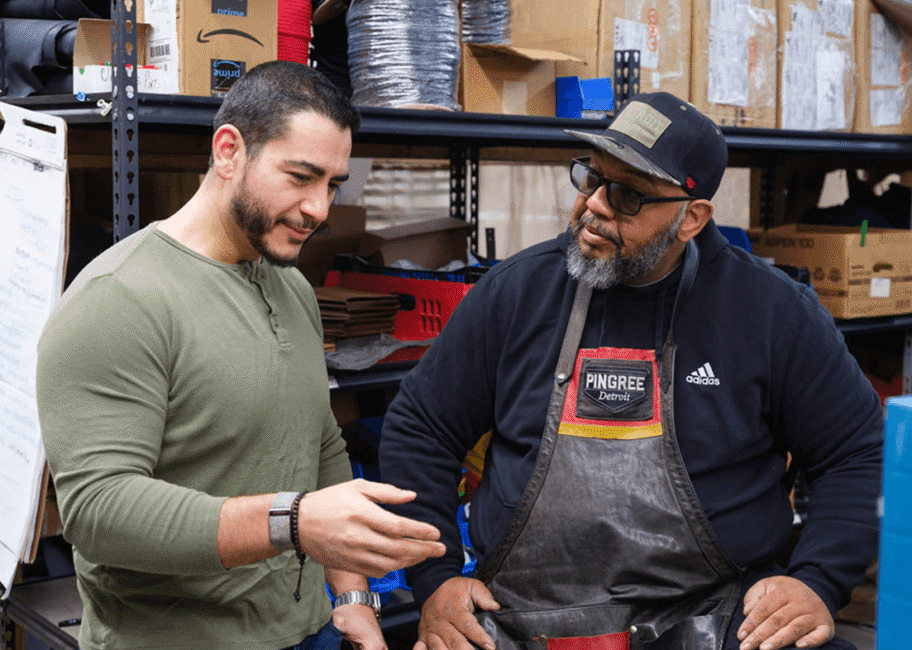
As an epidemiologist, doctor, and former football player, Abdul El-Sayed presents an unusual problem for some of his conservative critics. The Democratic candidate for U.S. Senate in Michigan works out regularly, played football and lacrosse, and has drawn plenty of online attention for his muscular physique and tight black T-shirts. In many ways, El-Sayed embodies the kind of traditional masculinity often celebrated on the political right: physical strength, athleticism, confidence, marriage, and fatherhood. But El-Sayed is a Muslim and a progressive Democrat. That combination complicates familiar stereotypes about Muslim men. And the response to El-Sayed and his family reveals something broader about the role gender plays in American Islamophobia.
Islamophobia has always been gendered. Muslim men and women have long been subjected to different, although related, stereotypes. Muslim men are often depicted as violent, threatening, and controlling. Other times, they are cast as effeminate, and incompatible with American ideals of manhood. Muslim women, particularly those who wear the hijab, face a different set of assumptions: that they are passive, oppressed, and in need of liberation. Sociologist Jasmin Zine describes this as “gendered Islamophobia,” referring to the different ways that anti-Muslim prejudice operates through ideas about gender. For visibly Muslim women, religious clothing can make them particularly recognizable targets for discrimination.
These stereotypes reinforce each other. The image of the oppressed Muslim woman depends, in part, on the image of the angry, controlling Muslim man from whom she supposedly needs rescuing. Together, these assumptions shape how Muslim men and women are understood, and what kinds of behavior are seen as compatible with American life.
El-Sayed scrambles these familiar gender roles. His athletic, gym-bro persona makes it difficult to portray him as physically weak or emasculated. But he doesn’t easily fit the stereotype of the angry, threatening Muslim man, either. His public persona combines physical strength with an emphasis on public health, family life, and progressive politics. The result has sometimes been a curious mixture of political hostility and fascination with his appearance. But the scrutiny does not stop with El-Sayed. It has also extended to his wife, Sarah Jukaku, a doctor of Indian heritage, who wears the hijab and dresses modestly. This visible Muslim identity has made her a target of attacks, including by President Donald Trump, questioning whether she represents American values.
There is a striking contradiction here. Conservative discussions of gender often celebrate marriage, motherhood, and modesty. El-Sayed and Jukaku married as undergraduates at the University of Michigan and are now raising two daughters. Yet qualities that might be praised as “traditional” in a Christian conservative family can take on a different meaning when the woman displaying them is Muslim. The hijab, in particular, is frequently interpreted not as an individual religious practice but as evidence of women’s oppression.
Anthropologist Lila Abu-Lughod argues that Western debates too often ask whether Muslim women need to be “saved,” reducing complicated lives and choices to a simple opposition between freedom and oppression. Jukaku’s own life illustrates the limits of that framework. She is a Columbia- and Oxford-educated psychiatrist. She is publicly outspoken about political causes like organized labor. She seems to be independent, fulfilled, and free, despite—she might say because of—her hijab. Yet she is portrayed by Trump and his supporters as un-American and unsuitable in a position of leadership as the wife of a potential future Senator.
The contradiction becomes even clearer when Jukaku’s treatment is compared with that of Rama Duwaji, the wife of New York City mayor Zohran Mamdani. Rather than being criticized for appearing too visibly Muslim, Duwaji, an artist, has faced backlash for a perceived lack of modesty and stylistic choices portrayed as inconsistent with her husband’s political platform. This has included commentary on whether her outfit for the Knicks parade was sufficiently dignified for a municipal First Lady. It is ironic that the same conservative critics who stoked Islamophobic fears that Mamdani would “implement Sharia law” and force women to cover up are affronted by Duwaji showing too much skin. She has also been accused of contradicting her husband’s democratic socialism by wearing designer looks during public events. The defense of Duwaji emphasizes the sustainability aspect of her sartorial choices, clarifying their status as rented or borrowed. While the criticisms of Jukaku and Duwaji arise in different contexts, taken together, they illustrate the scrutiny directed at Muslim women’s appearance. A Muslim woman can be criticized for covering too much or too little, for appearing too religious or not religious enough. Clothing becomes more than clothing: it operates as a symbol of her entire religion, her Americanness, and even her husband’s political legitimacy.

These assumptions about Muslim women are closely connected to assumptions about Muslim men. If Muslim women are imagined as oppressed by their religion, Muslim men are often imagined as the agents of that oppression. Their masculinity, sexuality, and treatment of women become measures of whether they can be seen as modern and American. Gender studies scholar Jasbir Puar’s concept of “homonationalism” helps us understand how ideas about gender and sexuality can become measures of who belongs to a modern nation. Puar examines how certain forms of acceptance of LGBTQ people can become markers of national modernity, while racialized and Muslim populations are represented as sexually backward or threatening. In post-9/11 America, representations of Muslim men as intolerant, controlling of women, and prone to violence have helped construct them as national outsiders. Gender and sexuality, in other words, become ways of deciding who belongs.
El-Sayed and Mamdani complicate these distinctions. Both are charismatic political figures with professionally accomplished Muslim wives. Both have generated considerable public commentary about their looks and likeability. But the most interesting aspect of El-Sayed’s masculinity may be his willingness to express anger. Muslim men have frequently been stereotyped as angry, violent, and threatening. That creates a particular burden in public life. Anger from a Muslim man can easily be read as confirmation of something supposedly dangerous about Muslim masculinity. For decades, Muslim public figures have faced pressure to prove that they are moderate and peaceful, especially when confronted with hostility. But El-Sayed does not seem particularly interested in accepting that constraint.
When President Trump posted photographs contrasting himself and Melania Trump with El-Sayed and his hijab-wearing wife, under the caption “Two VERY DIFFERENT Americas,” he drew on precisely the kind of assumptions about gender, religion, and national belonging that have long shaped Islamophobia. The image invited viewers to see one couple as recognizably American and the other as fundamentally different. El-Sayed did not respond by taking the high road. He hit back. He said Trump was right that the couples represented different Americas, contrasting his loving relationship with Jukaku with the Trumps’ as “two people who don’t like each other” who are united only by their “interest in making billions of dollars off of you.”
His exchanges with Vice President JD Vance have been similarly combative. He has even mocked Vance as “Low-T JD,” appropriating the testosterone-inflected language of the political right to question Vance’s own masculinity. This is the “alpha-Muslim” paradox: he claims the right to be angry. He taunts his opponents. He trades insults. And because so much of this behavior is immediately recognizable within contemporary American “bro” culture, it becomes harder to separate the supposedly dangerous masculinity of the Muslim man from the aggressive masculinity celebrated elsewhere in American political culture. In other words, El-Sayed does not challenge the stereotype by demonstrating that Muslim men are never angry. He challenges the assumption that a Muslim man’s anger necessarily tells us something about Islam.
At the same time, there is a limit to what this kind of victory can mean. If El-Sayed’s appeal lies partly in his ability to inhabit the language of American “bro” culture, it is worth questioning whether that is itself something to celebrate. Machismo and the fixation on physical appearance imply that masculinity must be confrontational and channeled through dominance. Indeed, aggressive masculinity, especially in politics, ought to be condemned rather than celebrated. El-Sayed’s ability to “clap back” and trade insults with Trump and Vance may disrupt the image of the Muslim man as inherently threatening, but it does not necessarily challenge the political and social culture that makes aggression a sign of strength in the first place. What makes El-Sayed’s alpha-male persona more interesting, then, is not that he can hold his own in a political climate replete with toxic masculinity. It is that in inhabiting that unusual space, he also offers a different account of what being a man requires: showing up for one’s family, caring for community, and fighting for policies such as universal health care. In his public persona, El-Sayed is fluent in the language of toughness, but his politics suggest that this toughness is most valuable in the service of others.
El-Sayed does not challenge the stereotype by demonstrating that Muslim men are never angry. He challenges the assumption that a Muslim man’s anger necessarily tells us something about Islam.
This does not mean that El-Sayed has escaped Islamophobia. The attacks on his name, religion, and wife demonstrate otherwise. Likewise, his ability to perform conventional masculinity should not be mistaken as the victory itself, especially not at the expense of overlooking the political values that inform his public persona. Performing aggressive masculinity does not suddenly become admirable when a Muslim man displays it. What is significant, though, is the range of behavior El-Sayed claims for himself. El-Sayed frames physical strength in terms of family and community, stating, “Don’t get me wrong. I lift every morning. But being a man is not really about how you show up in the gym. It’s how you show up for your family. It’s about how you show up for your community.” His words suggest a different way to think about masculinity: not as a performance of dominance but as a responsibility to others. This distinction matters, because it shifts the focus from El-Sayed’s capacity to embody conventional masculinity to what he believes that masculinity should accomplish.
This brings us back to the relationship between Muslim masculinity and femininity. Jukaku should not, to disprove the assumption that a woman who wears the hijab is oppressed, have to demonstrate her independence and Americanness through professional accomplishments. Nor should El-Sayed have to demonstrate that he is unusually peaceful or restrained to disprove the assumption that a Muslim man is threatening.
Gendered Islamophobia, then, is not simply about negative stereotypes of Muslim men and women. It is also about who gets the freedom to inhabit the full range of gendered behavior without their religion becoming the explanation for it. Perhaps the most striking thing about El-Sayed’s public persona is that he increasingly claims that freedom for himself: the freedom to be a doctor and a “gym bro,” empathetic and combative, a devoted husband and an aggressive political opponent. He can also be an angry Muslim man without that anger becoming evidence against his religion. Most important, his candidacy offers us an opportunity to assess and transform how masculinity is measured and valued: from a fixation on dominating others to a willingness to show up for them.