


On March 28, 2018, the Wall Street Journal made a correction to a story it had run the day before, in which it mistook a biblical mention of “a rock” for “Iraq.” In covering how the EPA had signed a deal to test a purification system developed by an Israeli water technology company, the paper had cited a promotional video for the company which quoted Prime Minister Benjamin Netanyahu as saying the company improves on Moses, who “brought water from Iraq.”
As anyone even remotely familiar with the biblical tale of Moses could tell you, Netanyahu had said “… from a rock,” a reference to a miracle in the seventeenth chapter of Exodus, in which Moses strikes a stone to provide sustenance for the Israelites, recently freed from slavery in Egypt. Iraq only became the name of a country in 1921, over three thousand years after the ancient Israelite leader died.
Along comes another watery biblical tale with the release this weekend of 20th Century Studios’s Whalefall, testing Americans’ biblical literacy once more. And it bellyflops.
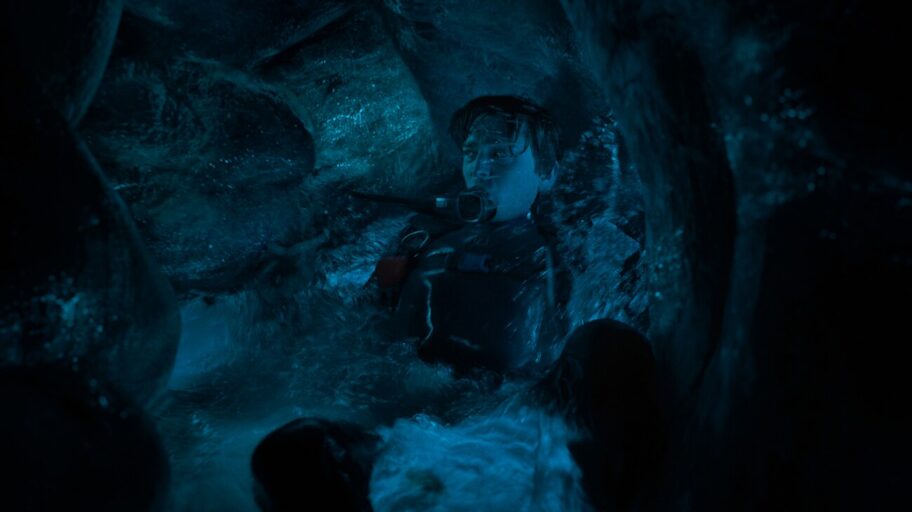
That is not to say that the movie isn’t good. It’s an edge-of-your-seat, how-did-they-film-that survivalist tale about a young man, Jay Gardiner, who, struggling with the memories of his abusive deep-sea-diving father, goes to recover his body and ends up swallowed by a whale. He then spends the better part of 106 minutes trying to escape.
Whalefall looks worth the relatively small $60 million budget for a Hollywood blockbuster, with well-cast actors deftly balancing flashbacks portraying the dynamic between father (Josh Brolin) and son (Austin Abrams) in between bone-crushing (literally), goo-filled navigation of the giant mammal’s intestines, with guest appearances by a helpful jellyfish and a not-so-helpful squid.
But it essentially ignores its obvious source material, the biblical book of Jonah.
In that tale, set in the eighth century BCE, God tells his prophet to deliver a message of rebuke to the sinful people of Nineveh, the capital of Assyria. Jonah, for reasons unexplained until the book’s final chapter, refuses the command. Instead, he boards a ship not to Nineveh but in the opposite direction, to Tarshish. God sends a storm which threatens to sink the ship until the sailors realize the source of their troubles, and toss Jonah instead, calming the waters. Jonah is swallowed by a large fish, inside of which he spends three days, praying to reconnect with God. He is spat out, relays God’s message (begrudgingly, as, it becomes clear, Jonah feels sinners should be punished), and the repentant Ninevites are spared.

It essentially ignores its obvious source material, the biblical book of Jonah.
Whalefall the novel, on which the new film is based, was published by Daniel Kraus in 2023. (Kraus subsequently won this year’s Pulitzer Prize for fiction for Angel Down.) Kraus is no rabbi, telling an interviewer, “I am not religious, but I write about it a lot. I’m fascinated by religion and the urges behind it, why people are drawn to it. It’s something I explore less to understand religion—which I don’t believe in—and more to understand people’s attraction to it. Why it’s such a balm for some people.”
Regardless of Kraus’s personal practice, he clearly knows his Bible and wrote the book as a modern midrash, a commentary on and retelling of the ancient tale. As I wrote after its release, the novel contains numerous clever tips of the cap to the Jewish story.
It is divided into two sections, “Truth” and “Mercy,” reflecting the core tension between justice and forgiveness at the center of the scriptural story. Jonah, introduced as the son of Amitai (“truth”), struggles to accept God’s decision to forgive the people of Nineveh, while Jay grapples with his complicated feelings toward his father, who was both aggressively paternalistic and capable of saving others at sea (like God, in other words, both a punishing and salvific figure).
At one point, flashbacks recount how Jay, seeking to escape his father’s psychological hold on him, flees to the home of Chloe Tarshish, a reference to the city the prophet sought to escape to.
In more than one instance, Jay’s dad is shown waking him up to go out on their boat by shouting “Sleepers arise!”—an allusion to Jonah 1:6’s description of how, when the heaven-sent storm tosses the boat of a fleeing Jonah, its captain wakes Jonah from his slumber, and cries out, “How can you be sleeping so soundly! Up, call upon your god!”
Another flashback references “Sheol Landfill,” alluding to the biblical realm of death mentioned in Jonah’s prayer in his book’s second chapter.
While The New York Times notes, both in its book review and movie review, the Jonah parallel, the film couldn’t be less interested in the obvious source material. The textual references are washed away.
The viewer is instead left to perhaps notice that Jay Gardiner’s first name is the first letter of Jonah’s, the so-subtle-it’s-barely-noticeable “Sleeper’s arise!” bits, and a sign at the beach from which Jay submerges noting the location as “Monastery Beach,” vaguely alluding to nebulous religious themes. It’s a shame. Instead of theologically rich and textually infused references, viewers are told by Jay’s father, during a brief exchange, about the pair’s shared love of Cannery Row that “Steinbeck is God.”
More Bible, it turns out, might have meant bigger receipts. Overtly religious films are hot right now, Yahoo Finance noted recently, listing releases David, King of Kings, and Daniel as having each crossed $60 million. Perhaps a more scriptural approach would have made Whalefall more successful (it grossed only $8 opening weekend).
I am certain, however, that ignorance of the Bible is bad for America. As Adam Kirsch recently wrote in The Atlantic:
Everywhere you look in American history, you will find the language, stories, and concepts of the Bible—in particular, those of the King James Version…. Harriet Tubman was known as Moses for her work with the Underground Railroad. When President Abraham Lincoln discussed the fearful losses of the Civil War in his second inaugural address, he justified them as God’s punishment for the sin of slavery, quoting Psalm 19: “The judgments of the Lord are true and righteous altogether.” …
As for literature, the titles of classic American novels are a catalog of biblical quotations: East of Eden (Genesis), Absalom, Absalom! (Samuel), The House of Mirth (Ecclesiastes), The Sun Also Rises (Ecclesiastes), Song of Solomon (the biblical book also known as “Song of Songs”). How can you understand Moby-Dick without knowing the story of Jonah and the whale, or appreciate the music of Leaves of Grass if you’ve never heard the rolling lines of the Psalms?
Jonah has sparked the intellect of a diverse array of Americans, well after Melville. Martin Luther King Jr. praised the book for its “arresting and electrifying” themes, calling reading it one of life’s greatest pleasures and admiring its author’s wit and insight. His contemporary, the Jewish theologian Abraham Joshua Heschel, emphasized the story’s moral responsibility to protect the innocent, criticizing society’s silence during the Vietnam War by asking, “Are we not all guilty of Jonah’s failure?” Salman Rushdie, meanwhile, in a 1984 essay, described his era as “whaleless,” lacking the possibility of escaping history and its “terrible unquiet fuss.”
Whalefall, then, is a missed opportunity to infuse audiences with just a bit more biblical wisdom.
No movie, of course, should expect or make demands on viewers’ individual faith, or lack thereof. But drawing from the well of a tale that has served to interest and inspire millions of readers for millennia very well might have stopped the movie from sinking.