


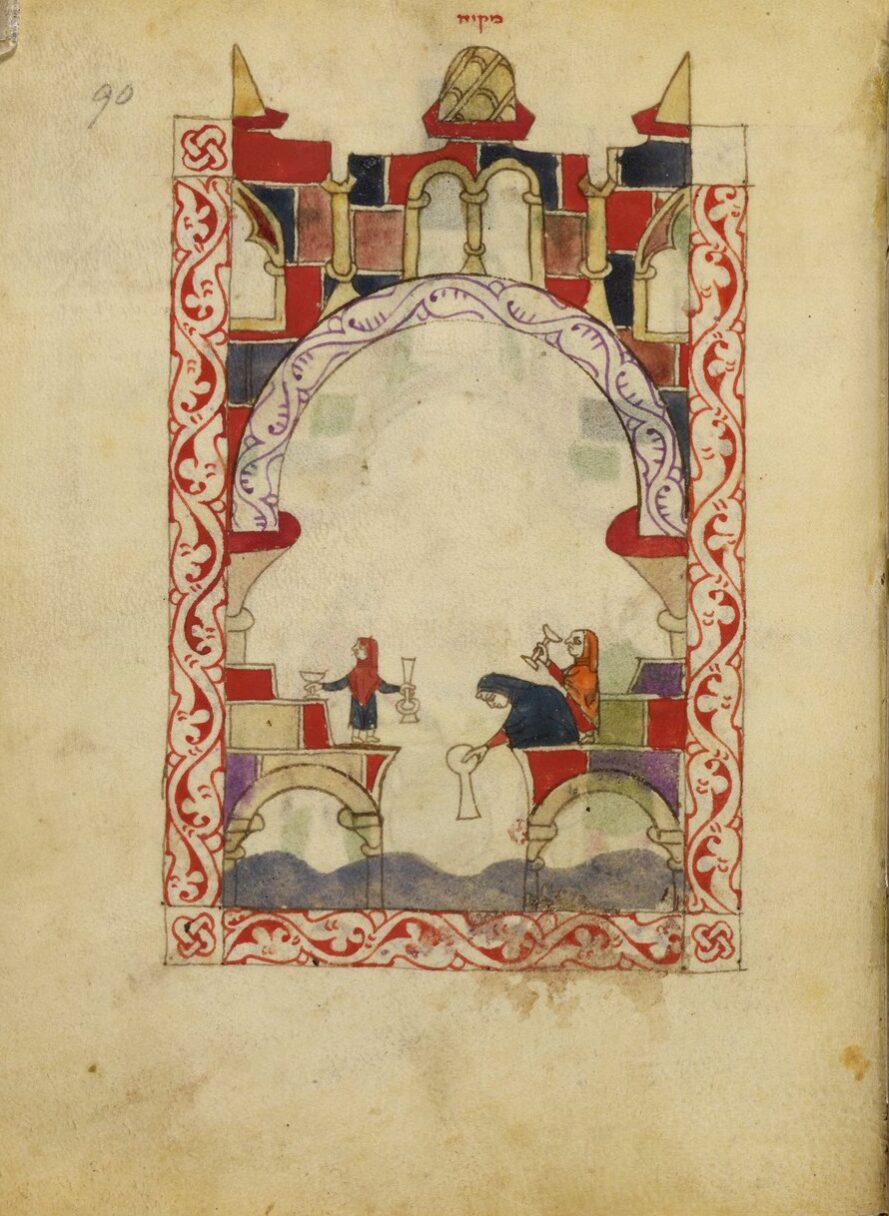
To understand how a sacred bath became one of the most contentious spaces in modern Jewish life, start with Baila Brackman. Gaze unbreaking, she speaks with piercing sincerity. “What a mikveh can do for a marriage is priceless.” The thick red of her sleeves punctuates her sharp gestures.
The Chabad rebbetzin, or rabbi’s wife, invites me into her beloved sanctuary, its prized pool porticoed by earth-toned walls and haloed in dim light. The University of Chicago’s mikveh is stunning, a subterranean jewel funded to the tune of $300,000. State-of-the-art tiling frames the space, anchored by a spiffy camel hot tub. It is the first ritual bath to open in Hyde Park since 1956. I note the triptych of other Sadies staring back at me from the flanking mirror walls, the Q-tip treasure troves stacked like matchsticks, the hair dryers galore. Through a door at the far end of the room, seven stairs descend to the pool. My feet tingle—the floor is heated.
Each mikveh night, Brackman says, is like a wedding night. During niddah—the period of menstruation and the week following—a married Jewish woman, if she is observant of these rituals, abstains from physical contact with her husband. This abstention lasts until her monthly ritual purification under taharat hamishpacha, the laws of family purity. When it’s over, she immerses in the mikveh.
“Let’s say … you meet your husband there, and you might kind of wink at each other, like ‘Oh, tonight’s our night.’ No one else knows. Every. Single. Month.”
Oct. 7, 2023 ruptured the global bedrock of modern Jewish life. Synagogue pews overflowed. But so did mikvaot (the plural of “mikveh”). At Mayyim Hayyim, Boston’s pioneering egalitarian mikveh and a bellwether for the national movement, conversions and affirmations jumped 36 percent in the year after the attack: 181 the year before, 247 the year after. Among the new dunks was a security guard who had survived the Nova Festival massacre. “Resilience is one of the key reasons people come,” says Bev Klau, Mayyim Hayyim’s director of programs, speaking alongside CEO Deb Gaffin. “It’s a place to pause and reconnect with themselves and with the divine—to just let go.” Amid collective vertigo, the surest solace on offer was two thousand years old, one body in one pool of water.
Neither Mayyim Hayyim nor UChicago’s new gem of a mikveh is sui generis. In fact, a refurbished mikveh culture with an upper-crust gloss now animates contemporary Jewish life. Liberal mikvaot like Mayyim Hayyim and its Big Apple counterpart, ImmerseNYC, are the all-in-one shampoos of ritual bath culture, welcoming visitors across denominations and genders for any watershed moment: turning forty, coming of age, navigating menopause, or spiritually renewing after loss.
Since Mayyim Hayyim opened in Newton, Mass., in 2004—founded on the then-radical premise that the mikveh belongs to all Jews, not just the Orthodox—the egalitarian ritual bath movement has snowballed into the mainstream. In 2018, Mayyim Hayyim launched the Rising Tide Network, which today spans 21 member communities across the United States, plus mikvaot in Australia, Brazil, Canada, England, Israel, and South Africa. Across denominations—and increasingly, across no denomination at all—Jews are returning to the mikveh. And the pools they’re returning to are beautiful.

A halakhically valid mikveh requires a grounded basin holding forty se’ahs (roughly 150 gallons) of unpumped “living water”—typically harvested rain or spring-fed melt. While Leviticus dictates the basic purity principles, Mishnaic and Talmudic jurisprudence codifies the basin’s volume, water flow, and structural plumbing. Traditionally, routine immersion remained an Orthodox female preserve, though men also immersed before Shabbat, Yom Kippur, or weddings, particularly within Hasidic dynasties. Today’s surge among Reform, egalitarian, and secular Jews upends a decades-old consensus. Just decades ago, non-Orthodox immersion for men was virtually unthinkable.
Beyond fueling marital sexual tension, submerging oneself in a mikveh is a holy act, a mitzvah in continuous practice since at least the first century BCE. In Jewish tradition, Brackman explains, the waters of a mikveh are used for transformation: “A convert … will go into the mikveh—they’re a Gentile. And when they come out, they’re Jewish. You go in as one person, and you come out Jewish.”
Halakha venerates the mikveh such that a community can even sell a Torah scroll to fund one. “You could even go so far as to sell your own synagogue,” Brackman says. “You don’t need to have a synagogue, but you need to have a mikveh.” Under Nazi rule, women in Polish ghettos defied curfews and risked their lives to reach clandestine ritual baths or rivers. Similarly, in Siberia, women in subzero climates sustained the tradition by cutting holes through frozen lakes. During the COVID-19 pandemic, synagogues, schools, and public spaces shuttered worldwide, but federal health departments kept mikvaot open.
A convert … will go into the mikveh—they’re a Gentile. And when they come out, they’re Jewish. You go in as one person, and you come out Jewish.
So, why are gorgeous, expensive mikvaot now opening across the globe, and why did Oct. 7 send even secular Jews sprinting toward them? To understand the mikveh’s unlikely second life, I sought out women stationed at three disparate outposts of Jewish practice: Brackman, shepherding Orthodox tradition; Sara Luria, reimagining the ritual for both the secular and the skeptical; and Stephanie Butnick, a Jewish media figure with one eye on the Torah and the other on the zeitgeist.
Luria is the Brooklyn rabbi who in 2012 spearheaded ImmerseNYC—a pluralistic, grassroots community mikveh project and one of the most visible examples of the movement’s second wind. She speaks with unmistakable lightness: “[This] clear body of living water … makes our transitions sacred.” But in her work, she’s had to scrub away decades of bad branding. When Luria taught classes, she’d ask students for their immediate reaction to the word mikveh. “People have some pretty epic stuff to say…. ‘What does purity even mean, and why for women, and is it sexist, and is it archaic?’”
Even thornier was the archetypal greeting from the “mikveh lady,” the stereotypical attendant who deems an immerser’s dunk kosher: So, what does your husband do? Innocuous as it sounds, such a question detonates a tripartite assumption: that the immerser is straight, that the husband is the breadwinner, and that the wife’s work is marginal. The liberal mikveh springs from entirely different soil.
Rooted in that new soil is a return to the mikveh’s most overlooked feature: its radical privacy. So much of Jewish ritual prides itself on communality—shivas, britot (circumcisions), baby namings, and weddings are purposefully and boisterously public. Mikveh stands apart. Rare solitude proved a headline feature for the skeptics and unobservant alike.
Across pluralistic spaces, an immerser’s safety is paramount; for Luria, it’s all in the details. “People have different levels of comfort with their naked body…. So what we do is what has been named the ‘sheet dance’ by Mayyim Hayyim…. We hold up a sheet when the person is in the water, and we really are committed; we train our volunteers to not look at the person, like, nobody wants to walk down those seven stairs into the water with someone looking at their tush!” Luria acts out the inner monologue of a skeptical first-timer: “Well, shit, I came to have the sacred experience, and now I’m reminded that I don’t belong here because my body isn’t the size of this towel! So we just give everyone a sheet, you know?” Mayyim Hayyim’s accessible pool lift is as much a philosophical statement as a practical one.
So much of Jewish ritual prides itself on communality—shivas, britot (circumcisions), baby namings, and weddings are purposefully and boisterously public. Mikveh stands apart.
Brackman, operating in an entirely different register, is no less intent on the tenderness of the experience. Participants scrupulously scrub scalps and teeth, wash between toes, and inspect breasts for lumps. “I always say, ‘This is your special time.’ It’s her holy time. I’ll always be respectful.”
Such attentiveness costs money, and the price tag shows. Stephanie Butnick, founder of the lifestyle brand GOLDA and former host of the podcast Unorthodox, shares insight into this gleaming mikveh renaissance. The walking Jewish encyclopedia details her own take on the perfect mikveh, only half-jokingly: “I love the idea of having a mikveh today that looks like you could be getting, you know, Botox in it.” She thinks of pale pinks and peach stepping stones, freeform amoebic mirrors at the doorway, the air steeped thick with crystal dust and candles a-go-go. She equally admires a modern mikveh with an old-school touch, “as though you’re walking into sort of like an ornate Torah scroll with the silver knot.”
If October 7 reduced the outside world to rubble and noise, then curating the mikveh’s tactile calm was no secondary feature. Indeed, it was the primary imperative. “We are part of a tradition that values aesthetics,” Butnick says. Ornate challah covers and candlesticks, illuminated manuscripts scrawled with date palms, doves, and leopards on gold leaf and vellum. “Hiddur mitzvah is this commandment to beautify the mitzvot … making something beautiful makes it more spiritually meaningful…. And I don’t see [new mikveh culture] as breaking away from tradition. This is a trend grounded in Jewish tradition.”
Similar to the velvet Torah covers of her childhood synagogue, the mikveh is “so holy, it has to be beautiful.” Butnick sees this phenomenon paralleled with the Mishkan, the Israelites’ post-Exodus portable desert tabernacle or sacred tent-shrine, whose construction demanded its builders bring their “finest silks and linens and gold.” Luria agrees: “We want to make it beautiful for the sake of Heaven.”
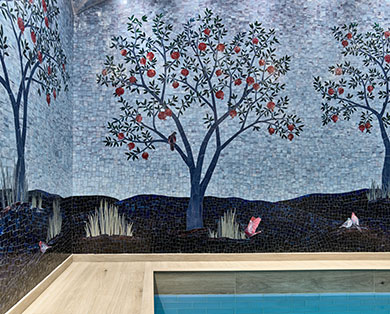
Evidence for this abounds. In Brooklyn, Crown Heights’s mikveh features 28 prep rooms and an on-site manicurist, against a backdrop of glassy mosaic pomegranate trees. Seoul’s chef-d’œuvre mikveh is teardrop-shaped, waved with aluminum paneling and royal Korean flourishes below a 3D-printed ceiling. In Carolina, Puerto Rico, wall paneling laced with delicate fish-scale shapes extends the tropical escape for visiting tourists. The hiddur imperative, it turns out, is global.
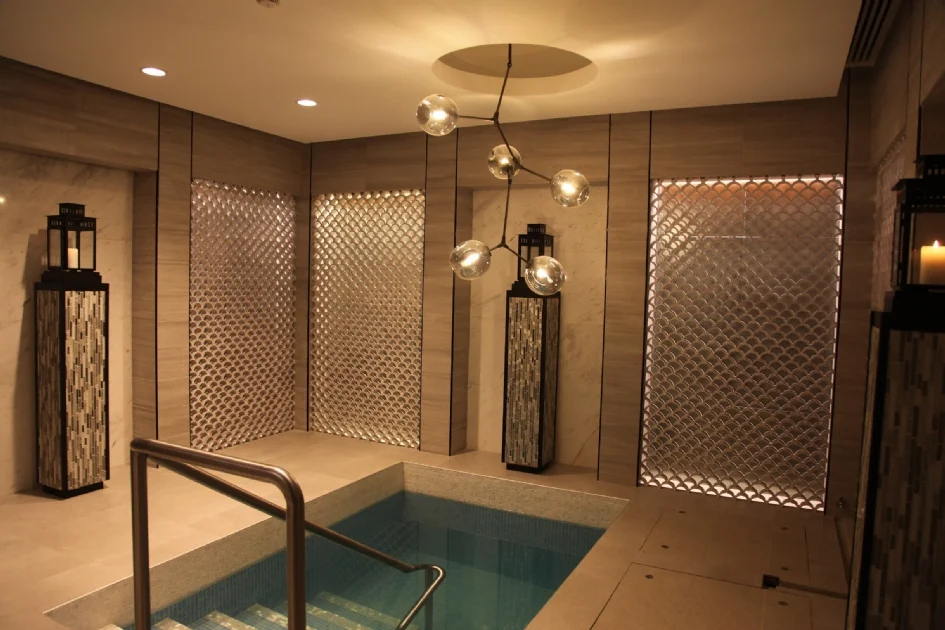
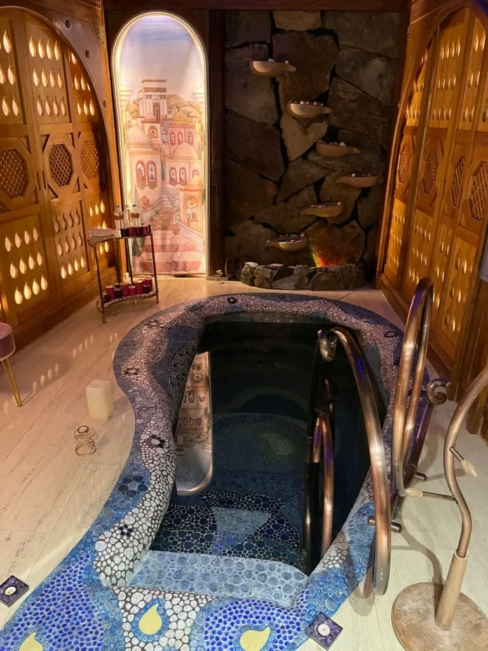
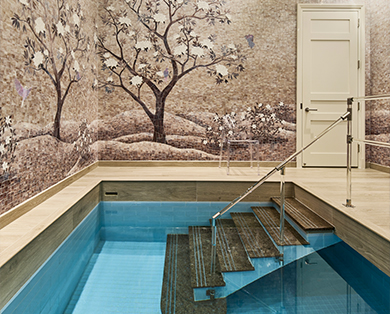
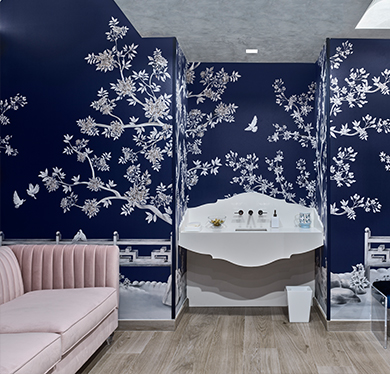
Gerry Frank and Taylor Theriault, Mayyim Hayyim’s original architects, built this imperative into the studs. “What makes a space really spiritual is light,” Frank says—chameleonic light funneled down the structure without exposing the naked inside, cascading from surprising angles so that “people didn’t quite know where that’s coming from.”
Even to the uninitiated, all of this strikes familiar chords. Ancient religious purification rites—think also Christian baptism, Shinto misogi, Ganges three-dipping—have long demonstrated a fixed feature of the human condition: we are primordially obsessed with water. Every civilization has a holy pool; the ancient Mesopotamians had their lustral basins, stone vessels of consecrated water skirting every temple gate. Ancient Greeks had the perirrhanterion, a shallow bowl you dipped your hand into before entering sacred ground.
Today, attention is a prized currency, and the mikveh revival is a market response: make it beautiful, make it accessible. “There’s a real spiritual heft to that act of making a beautiful mikveh,” says Butnick, “and there’s so much about Jewish material culture that might seem superficial, but actually runs so much deeper than that. And I think that’s why people really connect with beautiful Jewish objects or beautiful Jewish books or beautiful Jewish rituals, because they’re hitting on these aesthetic senses we have as people today, but they also carry deep Jewish meaning.”
And still the mikveh’s pull is more than aesthetic. Bruce Feiler, who devotes a chapter to Mayyim Hayyim in his book on ritual, A Time to Gather, pinpoints that atavistic underlying current. “A ritual,” he says, “is a shared, unnecessary act that makes us feel at home.” Unnecessary because you don’t have to do it. Home because, by choosing to, you become part of something that predated you and will outlast you.
Without prompting, Brackman, Luria, and Butnick each regaled me with their first immersion stories. All three women reveled in its ancientness. For Brackman, the mikveh itself embodies marriage’s sanctity, a quintessentially Jewish logic made flesh. “There’s some religions where they shun sex,” she says, pointing to celibate priests. “In Judaism, we think intimacy is the holiest thing that could happen.” She first immersed the night before her wedding. For Luria, her immersion was a binding handshake with a long line of “rabble-rousers”—people who kept kosher and kept Shabbos, rejecting assimilation even when that was seen as a “weird freaking thing to do in this day and age.” Butnick marveled at the “weighted legacy” bound up in Jewish womanhood, ruminating on the inheritance she’ll someday pass to her two daughters. A blessing, she explains, “both historic and just for me.”
Back in Boston, Mayyim Hayyim’s statistics tell their own story. Today, Gaffin and Klau’s immersion rolls are 39 percent Reform, 23 percent Conservative, and 14 percent unaffiliated, with observant Orthodox visitors accounting for fewer than 10 percent. Founder Anita Diamant’s 2004 argument that the mikveh belongs to all Jews has now largely triumphed. Gaffin and Klau point to those long parked at the edge of the Jewish tent, “living Jewish lives” without ever formalizing them, decisively crossing over and planting both feet post-Oct. 7. As Gaffin says: “I am Jewish, and I want to affirm it.” Leadership at Mayyim Hayyim sees this articulation as reclaiming ritual and belonging. “Once someone realizes that mikveh is a resource for them in their life, we hope they’ll find other entry points into meaningful Jewish experience.”
Luria sees the liberal mikveh as built for precisely this moment. “The job of a rabbi, full stop, is to take ancient wisdom and make it relevant to the people who are sitting right in front of you,” she says. “If rabbis over the centuries hadn’t been doing that, we would go the way of Zoroastrianism…. Thank you to all the people before me who said, I’ve got to make this relevant, or else it won’t be transmitted to the next generation.” She is, plainly, thrilled to be one of them today.
Every generation encounters its own crucible. On Oct. 7, 2023, the day of the Hamas attack, architects Frank and Theriault, designers of Newton’s Mayyim Hayyim, were mid-design on a new mikveh in Maine. Instructions followed swiftly: bulletproof the window screens and heavy-bolt the doors. “How do you make things secure,” Frank recalls them deliberating, “but not make it feel like you’re in prison?” Built entirely around vulnerability, the space now required fortified walls.
Beside the mikveh, before her wedding, Brackman’s mother offered her daughter an image: imagine a swimmer coming upon someone drowning. Throw them a life jacket, and they’ll live. “You’re about to be the next in a chain, the chain of Jewish women,” Brackman recalls her mother saying. “You’re doing something holy…. Don’t drown. Don’t drop it. Because if it collapses, then we drown. Jewish continuity is going to die…. Hold on to it.”
Brackman tells of a recent initiate who came to her, bewildered: “She’s in menopause already, and she started to cry, and she said, ‘Why have I been living this long and I never knew about this? How did I miss out on this in my marriage?’” An inheritance skipped her entirely; she’d unknowingly brushed past a waiting door for decades. And doubtless, the mikveh had been waiting two thousand years—through exiles and pogroms and Soviet winters and Nazi curfews and ice-breaking winters and a global pandemic. And through this decade’s particular wash of spiritual hunger and spa aesthetics and debate over who belongs and how.