


The first time I noticed something weird going on in my Australian Jewish community was a few months ago, when a local paper, The Jewish Independent, published one of my articles on Instagram. The piece I had written tackled a very hot issue: whether Australia’s Jewish community should cancel fellow Jewish speakers who are antizionist from speaking at our communal literary and cultural festivals, on topics unrelated to Israel.
My take was that this was a form of cancel culture, mirroring what we had seen directed at Zionist Jews who had been invited to publishing, comedy, arts, literary, or film festivals, only to be subsequently uninvited, or “cancelled,” because of their Zionism. I wrote that I abhorred cancel culture in all its forms and that our community was wrong to cancel an antizionist Jewish speaker for their views on Israel when they were talking about something unrelated, like Jewish comedy.
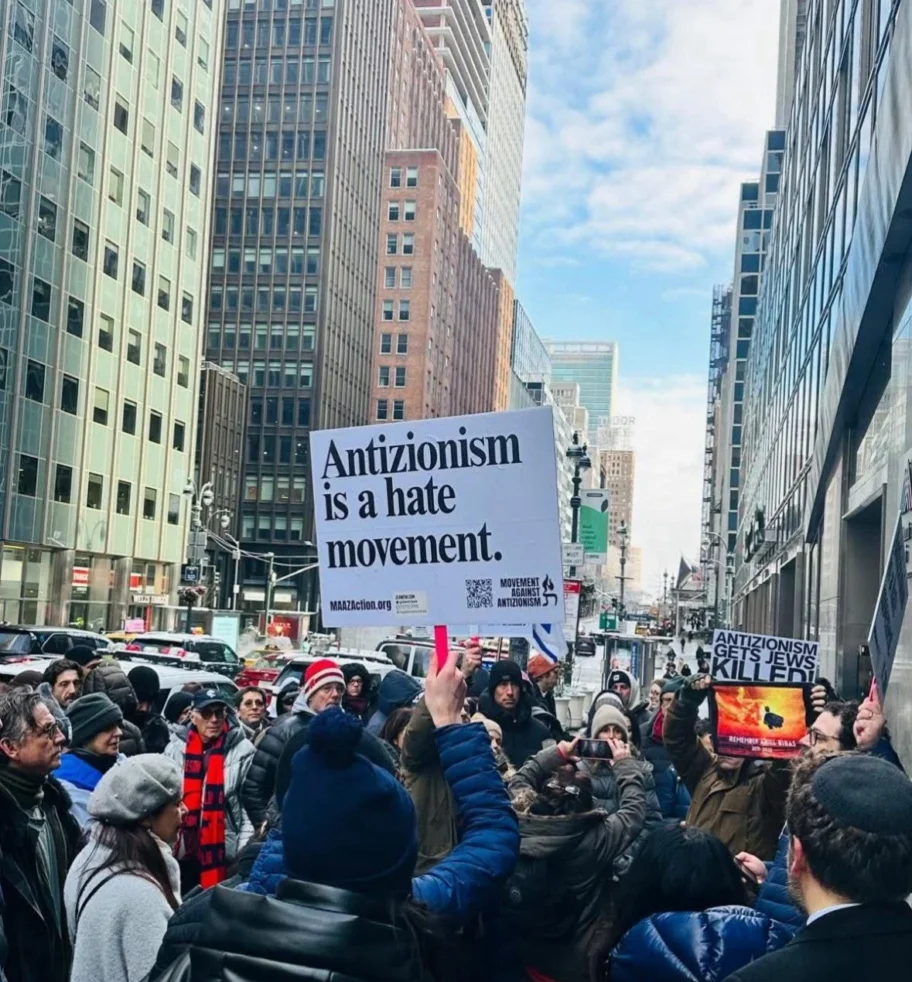
I received many comments on the piece. More than half a dozen of these were clearly copied and pasted, and did not engage with the substance of my article at all. Instead, they simply repeated the line, “Antizionism is a hate movement.”
It was clear to me that these accounts were not bots. They belonged to real Jewish community members, but their responses were too similar to be organic, too coordinated. As a journalist, my curiosity was piqued. What was going on? Who was coordinating this response?
I dug around until I found out that those responding to my post in this way—rather than engaging with the substance of what I considered to be a nuanced piece of writing—were people who had attended training offered to Australian Jews by a relatively new organization, the Movement Against Antizionism (MAAZ).
Started by McGill University doctoral student Adam Louis-Klein in 2025 and brought to Australia by Joshua Dabelstein under the guise of MAAZ AUS, it has taken off in Australia like wildfire. The group has been offering its training to synagogues, rabbinical bodies, the Reform movement’s major Australian conference, peak Australian Zionist bodies, The Australian Jewish News, and some of Australia’s largest Jewish groups, including Zionism New South Wales. Its work has been cited by Australia’s Royal Commission into Antisemitism. And this is not just happening in my country.
MAAZ and MAAZ AUS are legally separate entities, and Louis-Klein claims they are separate organizations. Yet, they share the same name, they cross-promote each other on their websites, and they regularly collaborate on social media posts, sometimes several times in the same week. Via a direct link on its website, MAAZ also offers training provided by the Australian branch, which can be run for any Jewish community around the world.

MAAZ claims that it is responding to a crisis of antizionist rhetoric that has proliferated around the world since Oct. 7, 2023. I share their concern about the rise of antizionism globally. Yet I am increasingly concerned by MAAZ’s training, rhetoric and tactics.
In its simplest form, MAAZ’s argument goes something like this: Jews should stop getting bogged down in the never-ending debate over definitions of Zionism and accusations about Israel, like colonialism, genocide, and apartheid (which MAAZ characterizes as “libels”), and instead classify antizionism, wholesale, as a hate movement. MAAZ posits that antizionism is a hate movement because it denies Jewish peoplehood and rejects the idea that Jews, like all other peoples, have a right to collective self-determination. In its training sessions, MAAZ encourages participants to confront and marginalize antizionism by responding to accusations about Israel or antizionism with the stock phrase “Antizionism is a hate movement.”
In its attempt to make antizionism taboo, MAAZ would like antizionists to be seen in the same way as those who engage in racism, homophobia, or misogyny, with a recent social media post noting, “We let antizionist stigmatization, ostracism, bullying and violence speak for itself.”
MAAZ will not disclose its funders. Louis-Klein is the son of Jonathan Klein, a co-founder of Getty Images, who retains a stake in the multimillion-dollar company he founded. A 2022 SEC filing shows Jonathan Klein as a beneficial owner of 4.5 million shares in Getty Images, including shares held through Aston Aladmax LLC. The filing states that three trusts, including the Adam Klein Trust, each hold a one-third beneficial interest in the securities held by Aston Aladmax. Adam Klein is named as the sole beneficiary of his trust.
Louis-Klein denied that his father or his trust funded his work at MAAZ. “MAAZ only recently received 501c3 status and has pursued the entirety of our work in our first year of existence for free,” he wrote in an email. Questions about MAAZ’s sources of funding appeared to strike a nerve. In a follow-up email, he wrote: “Excellent attempt to delegitimize our work though. Antizionism remains a hate movement. Best of luck with the article.”
Following the strange responses to my piece in The Jewish Independent, I decided to attend an in-person MAAZ AUS training session in my hometown of Melbourne. I sat through the training in June 2026, and was disturbed for many reasons.
MAAZ’s definition of antizionism doesn’t just capture those who deny Jewish peoplehood or openly celebrate violence (“resistance”) against Israelis; it lumps all kinds of other people together. The MAAZ definition is so wide it catches progressive diaspora Jews struggling with the policies and direction of the Israeli government, young non-Jewish activists whose politics are shaped by a human rights framework, and academics whose views on the Israeli-Palestinian conflict may be simplistic, naive, or even wrongheaded, but are not necessarily driven by a hatred of Jews. While I too am very worried by the global rise of antisemitism (and specifically in the form of antizionism), I think defining antizionism as a hate movement creates a category that is simply too broad to actually be useful. Apparently, however, my piece advocating against cancelling an antizionist Jew in Australia meant that I too was deserving of the standard response from the MAAZ playbook—namely, stigmatizing my piece (and by extension, me) with the repetition of the conversation-ending phrase “Antizionism is a hate movement.”
And here’s the problem: when an organization casts such a wide net, and lumps everyone together, it makes it harder to spot the real antisemites. At the same time, MAAZ ends up writing off people who might otherwise have been open to a conversation. Their method of refusing to engage with anyone they deem “antizionist” is a blunt tool that does not allow for nuance, much less critical thinking.
Louis-Klein has shown how broad his definition of antizionism is. He has called reports of well-documented settler violence in the West Bank “a coordinated media and propaganda stunt that was initiated by antizionist terrorists and activists.” He has called for journalists from The Washington Post who were the victims of Israeli settler violence to be investigated by Israeli police and the Israeli army, in order to determine their “contacts, including relationships with terrorist organizations, foreign antizionist radicals and extremists, and their exact role in potentially inciting or instigating or engaging in violence against Israeli civilians.”
When I asked Louis-Klein by email how he defined the parameters of antizionism, and whether there was evidence to support his methods, he responded, “Again, our trainings are focused on combatting antizionism, not classical antisemitism. Your question about ‘what MAAZ considers antizionism’ is not clear to me. You seem to be working within the antisemitism paradigm, not the antizionism one. MAAZ has changed the conversation in the Jewish community and beyond and educated large numbers of people about antizionism.”
Jewish academics are split on the effectiveness of the group.
Suzanne Rutland, a renowned Australian Jewish historian who taught at the University of Sydney, has not attended a MAAZ AUS training but thinks its role in Australia is valuable. “I think MAAZ does have an important message in highlighting the indigeneity of the Jewish people [in Israel], which is denied by antizionism, both Jewish and non-Jewish, presenting Zionism as a settler colonial movement. This is, of course, highly problematic.” She added: “I strongly support MAAZ’s general approach of focusing on antizionism and highlighting Jewish connections to the Land. At the same time, I believe that antizionism is the latest iteration of antisemitism, drawing on conspiracy theories within the broader umbrella of hatred of the Jewish people, that is antisemitism.”
But not all academics feel this way. Joshua Shanes, a historian at the University of California, Davis, is opposed to MAAZ and its tactics. “This is a shadowy organization that seems to deeply misunderstand anti-Zionism, its history and its complexity, and Zionism itself for that matter,” he said in a written statement. “This is a polemical movement attempting to silence dissent and legislate conversation. And note that it makes no distinction between Jewish anti-Zionism and anti-Zionism more broadly.”
One of the more revealing examples of MAAZ’s approach is its fixation on the hyphen in “anti-Zionism.” It teaches people to draw a rigid distinction between historical Jewish “anti-Zionism” (with a hyphen, which MAAZ simplistically asserts disappeared following the Holocaust) and contemporary “antizionism” (without one), which it defines as an inherently eliminationist ideology that cannot be understood as political critique, but only as a form of abuse.
I struggle to understand this distinction beyond its basic grammar, or grasp what it actually achieves. Redefining terms, semantically overloading words, and policing orthography does not make ideological disagreement, much less antisemitism, disappear. It simply narrows the range of views we as a community are prepared to engage with and risks creating an echo chamber devoid of critical thinking. It also sends an unfortunate message to the broader public: that the Australian and broader global Jewish community has little to no tolerance for nuance when it comes to the Israeli-Palestinian conflict. That makes it harder for allies to stand alongside us without first passing an ideological purity test. It is impossible to maintain the line that cancel culture is okay when we do it, but not okay when the other side does it.
When we collapse all criticism of Israel into the category of “eliminationist antizionism,” we lose the ability to make important distinctions. And ultimately, that leaves Jewish communities less capable of navigating the complexity of the world around us, because it teaches us to see every kind of criticism of Israel through the same lens. None of this is to suggest that antisemitic forms of antizionism do not exist. They do. The use of blood libel tropes, Holocaust inversion, and rhetoric that denies Jewish peoplehood or the right of Jews to self-determination are not legitimate political critiques, but manifestations of antisemitism.
It is impossible to maintain the line that cancel culture is okay when we do it, but not okay when the other side does it.
In addition, MAAZ’s whole methodology leans very hard on workshops and training seminars dedicated to conceptual reframings of antizionism, pedagogy designed to teach people how to “diagnose and respond” to that phenomenon. But I do not believe that you can workshop or seminar your way out of a complex and decades-old geopolitical conflict. Political opposition to Israel doesn’t happen in a vacuum. It is heavily influenced by real-world events: the war in Gaza, the policies and rhetoric of the current Israeli government, and periods of heightened violence in the West Bank, including violence involving Israeli settlers.
Casting Jews as participants in an all-encompassing crusade against antizionism may feel comforting, and even protective, at a time of genuine fear in the Australian and broader global Jewish community. But in the long run, it isolates Jews from the conversation and distracts us from the very real, very dangerous antisemitism taking root around us. And MAAZ’s approach appears to rest on the assumption that antizionism can be pushed to the margins of socially acceptable public discourse in much the same way that overt racism or homophobia increasingly have been. But whatever one thinks of the language used to describe Israel, accusations of apartheid, genocide, or colonialism, are no longer confined to the political fringe. Israel is currently defending genocide allegations before the International Court of Justice. Whatever antizionism is today, attempting to marginalize and stigmatize it will not make it go away.
Nor, despite the claims of MAAZ, is there any hard evidence for the success of what the group is attempting to achieve. That individual members of the community may feel more empowered in responding to antizionist articles on Instagram comments is not evidence that MAAZ is changing any minds. “[MAAZ] does not seem to understand that anti-Zionism can only be defeated if a substantial number of non-Jews are involved in opposing it,” Daniel Ben-Ami, a journalist and author who runs a website dedicated to rethinking antisemitism, wrote in an email to me. “The Jewish community is, sadly, far too small to succeed on its own.”
Any strategy built on cancellation, the policing of public discourse, and the ring-fencing of critical thinking may feel satisfying to a frightened community in the short term, but ultimately risks making the fight against antisemitism harder, not easier. “What the Jewish community needs—now more than ever—are knowledgeable scholars and educators nurturing intelligent conversation,” Shanes said, “not trying to shut it down based on hatemongering and lies and misinformation.”
The challenge facing Jews is real, but the MAAZ strategy is a false messiah. If Jews’ response is to treat every criticism of Israel, and every disagreement over Zionism, as part of the same threat, they risk losing the ability to tell the difference between an enemy and someone we might still be able to engage.