


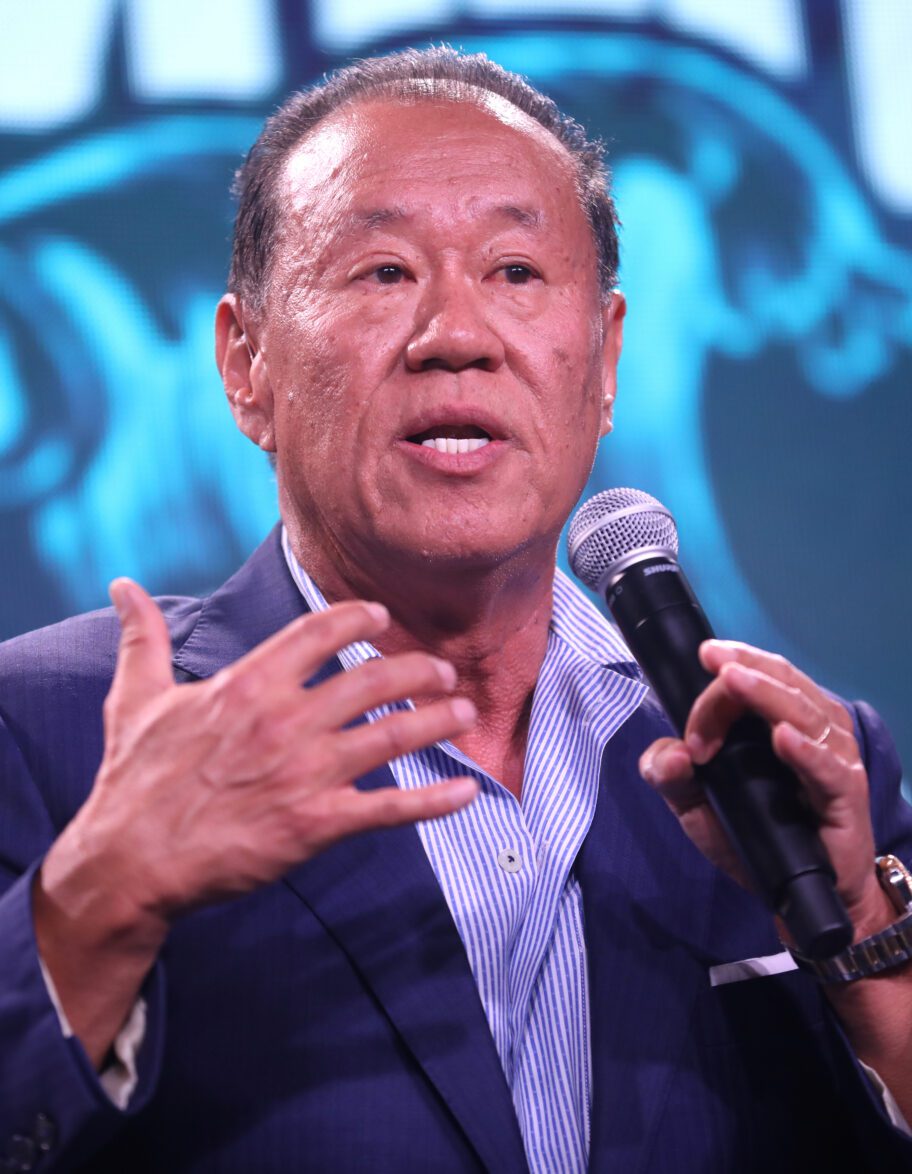
At exactly 2:22 a.m., a random Monday morning in February 2025, Ché Ahn emerged from sleep, roused by the voice of God.
Ahn, who is seventy, had heard God speak before. In the 1980s, the divine voice told him to pack up his family and move to Southern California for “a great revival and a great harvest.” Now he and his wife, Sue, lead Harvest Rock, an evangelical Christian megachurch in Pasadena, Cal., with five branches spread across the state.
But this time, Ahn recalled, God asked him to do the seemingly impossible—to run for governor of California, one of the most liberal states in the country. And do it as a Republican.
“My reaction was ‘Please God, don’t ask me to run,’” Ahn said in a Zoom call from his office. “I have been a pastor for 46 years, I have never been a politician, I love what I do, I don’t need another career.”
Ahn, a vocal supporter of President Trump, knows his chances are slim—in a state where 60 percent of voters swing Democratic and repeatedly approve left-leaning legislations, Ahn is anti-abortion, anti–gay marriage, and anti-trans, and he would like to see lots more religion in the public sphere.
So why run? It’s simple, Ahn said. “At the end of the day, I do God’s will.”
Ahn may be a political newcomer, but he’s a superstar in the “New Apostolic Reformation” (NAR), a Christian subculture known for blending evangelicalism with charismatic beliefs—speaking in tongues, performing miracles, and making prophecies. NAR churches forgo denominations and are more loosely arranged within national and international networks. Ahn founded his network, Harvest International Ministry, in 1996, and it now claims affiliated congregations in 65 countries from Canada to Kenya.
“They are actually the fastest growing Christian group in America, even though they are not well known and they are not as big as Catholics or Baptists,” said Brad Christerson, a Biola University sociologist who has studied the NAR. “And Ahn is probably in the top ten most influential people in that group.”
NAR pastors like Ahn have enjoyed more power and influence since Trump welcomed them to the White House—think televangelist Paula White Cain, leader of the White House Faith Office, and Texas pastor and podcaster Lance Wallnau, whom many credit with making a twice-divorced television celebrity with only a glancing familiarity with the inside of a church palatable to conservative Christians.
“Some of these networks of churches and their leaders have been welcomed into this president’s circle,” said Amos Yong, a Fuller Theological Seminary professor who has attended Ahn’s church but does not know him personally. “That has made it more feasible for them to engage in politics, if there is a sense that God is calling them.”
Ahn is the son of a North Korean pastor once imprisoned in his home country for his religious beliefs. The family came to the U.S. in the late 1950s. After what Ahn likes to describe as a wasted youth—drugs, fast cars, women, etc.—he was “saved” at 17. He attended Fuller Theological Seminary and then established Harvest Rock, in Pasadena, in the mid-1990s.
Ahn then became involved with the Toronto Blessing, the seemingly spontaneous eruption of “holy laughter” among a congregation of Canadian charismatic Christians. Ahn brought the holy laughter—a sign to his followers of God’s special blessing—back to Harvest Rock. His church and his profile grew quickly after that.
“At the end of the day, I do God’s will.”
In 2020, Ahn’s profile grew further when he successfully sued California governor Gavin Newsom, a Democrat, over the state’s closing of houses of worship during the global COVID-19 pandemic. The case reached the Supreme Court, which ruled in Ahn’s favor.
Molly Worthen, a historian at the University of North Carolina at Chapel Hill (and Arc contributor), said Ahn has long been more comfortable speaking publicly about politics than many of his NAR cohort—he was one of Trump’s early Christian supporters, and he spoke at the “Stop the Steal” rally that presaged the Jan. 6 storming of the U.S. Capitol—but that his COVID-19 fight seemed to supercharge him.
“I would not dismiss the possibility that he believes an outsider and truth-teller, willing to propose radical challenges to the system, could resonate with voters,” Worthen said. “In my experience, a lot of other pastors with the same ecclesiastical DNA are not quite as focused on politics. They have their views but haven’t made them a priority in the way Ché has.”
Ahn told me that when he first heard God’s instruction to run for California’s top office he was skeptical. “I know the political landscape of California,” he said. “I immediately said, ‘God, it is impossible that a pastor who is Republican and a conservative [could run for Governor], so please don’t ask me to do this.’”
So Ahn asked God for what he calls a “fleece”—a sign that this call is genuine and not “either the devil or the pizza I ate the night before.” He told God that if Trump invited him to the White House, where he had never been, he would know that he needed to run.
That same day, Ahn said, he received an email inviting him to the White House for the 2025 National Prayer Breakfast.
Other California gubernatorial candidates share Ahn’s conservative values, but none is so public about a faith-based worldview. Almost every one of his “9 Pillars” platform starts with Scripture. He would curtail women’s access to abortion, because “[o]ne of the things God hates is ‘hands that shed innocent blood,’” and he would reverse a state law that made some felonies into misdemeanors, because “Romans 13 teaches that government bears the sword to restrain evil—police authority is from God.”
This is an unusual gubernatorial race for California. The state’s June 2 primary is open, so Democrats and Republicans face off, and only the top two move on to the general election. So many Democrats have run that they’ve split their party’s vote, allowing Republicans to claim the top spots in most of the recent polls. Add to that the recent collapse of Democratic front-runner Eric Swalwell’s candidacy, amid accusations of rape and what you get is a scenario in which California—which has had only one Republican governor since the 1990s—could have only Republican candidates on the November ballot.
Ahn is unlikely to be one of them. He has yet to make a blip on any statewide poll. His war chest is just over $600,000, a little less than half of which is his own money, according to Transparency USA. And in March, a California judge ruled that Ahn will not appear on the November ballot because he failed to file some of his tax returns.
If voters—or God—want Ahn for governor, they will have to write in his name. Then again, becoming California’s next governor may not be the real measure of Ahn’s success.
“He has entered the public sphere and put a Pentecostal gloss on what were already Republican talking points,” said Richard Flory, a University of Southern California sociologist. “So even if he loses—which he will—he has gained in the sight of his followers. He doesn’t have anything to lose.”