


Six large flat-screen televisions dangle from the ceiling of the First Baptist Church of Patchogue in Long Island, where, on a recent morning in November, hundreds have taken to the pews for a daylong training called “Sharing Hope in Crisis.” A project of the Billy Graham Evangelistic Association, the training’s aim is to assist Christians interested in a faith-based approach to providing comfort to victims of natural or man-made disasters.
The TVs offer a jarring visual introduction to the training, as each screen is filled with identical photos of the smoke, fire, and exploding steel from Ground Zero in New York City in the wake of the attacks of September 11, 2001.
Josh “Jack” Holland, international director of the Billy Graham Rapid Response Team and Specialized Ministries, takes to the altar to explain what the ministry is and how it came to be. He describes a 9/11 fallout scenario with Christians wanting to comfort first responders but not knowing where to begin or where to find footing with an organization aligned with their faith affinities. Enter Billy Graham.
Holland projects an approach to his ministry that is inclusive and compassionate. And he is also clearly attuned to the delicate dance for evangelical Christians, who may be tempted to proselytize to the suffering or to convert traumatized victims by offering them entry into the kingdom of Christ along with a bottle of water. Holland wonders aloud that for people who have lost everything in hurricanes or other disasters, “Is that the time to go preach the gospel to them? No.”
The event was held against a national backdrop of enhanced interactions with federal immigration officials and American citizens. On this day, only a few removed from the Thanksgiving holiday, a representative of the country’s most storied evangelical organization is trying to do that thing liberals wish conservatives would do more of—talk about unconditional empathy to a crowd that is demonstrably pro-Trump and pro-MAGA. He is talking to conservatives—but in a region where government aid is necessary for rebuilding after hurricanes. In so doing, he exemplifies the central dilemma of faith-based disaster relief: how do you help people who you think need Jesus, but who themselves may want only food and shelter?
This region of Suffolk County, Long Island, is known for its social conservatism, though shot through with significant swaths of blue and purple, and for its outsized demonstrations of fealty to the idea of making America great again with nods to nostalgia at nearly every traffic stop. The Christmas parade in Patchogue this year was promoted as a throwback to Christmases of years past, with vintage vehicles, a colorful old-time Coca Cola truck, and a white Santa.
And in recent years—and more acutely in recent days and weeks—the resentment around perceptions of non-assimilation, communities overrun by migrant workers, and a highly provincial but by no means unserious anger over classic Long Island bacon-egg-and-cheese delis being replaced by taco shops, has been running unapologetically red-hot: around Election Day 2025, campaign signs throughout the area demanded “No Illegals in Our Classrooms.”
Holland’s approach to the training smacked of a gentle, implicit, rebuke to America First posturing over immigrants—as did the workbook that attendees received at the outset of the training. The first reference to Scripture, under the heading “A Look at Trauma and Suffering,” comes from Matthew 9:36-38, which reads in part, “The harvest is plentiful but the laborers are few.” Alas, many have been detained if not deported.
Holland wonders aloud that for people who have lost everything in hurricanes or other disasters, “Is that the time to go preach the gospel to them? No.”
The training module arrived in Long Island as crises unfolded locally and around the world. Jamaica had been pummeled by a hurricane just as the Trump administration eliminated the USAID program—which occurred with the endorsement of Franklin Graham, scion of Billy, who said that a pause on USAID was wise policy.
And in the weeks that followed the training, Immigration and Customs Enforcement agents would descend in force around Long Island and especially in Suffolk County, where Facebook posts from local media sites were replete with laughing emojis and “good riddance” commentary, even as those reports highlighted the suffering faced by deportees now hurled into crisis. Many deportees are migrant workers or other hardworking Christian immigrants, toiling in the malls and restaurants of the region’s many suburbs, or the cauliflower fields in what remains of rural Long Island.
These juxtapositions of Christian empathy, in the midst of disaster and abject cruelty, decocted locally toward brown people and especially children, suggest that the notion of opportunity in crisis, within the faith context, may require a subjective definition of crisis or disaster: one person’s man-made disaster is another’s greatest president in history. One person’s empathy for the suffering of an undocumented immigrant is another’s empathy for the ICE agent harassed by locals.
It’s a tricky line, and Holland managed to walk it, taking pains at one point to highlight the special work undertaken by this ministry, one of numerous in the Billy Graham network. At another point he ruminated that there had been some pushback within the ministry when it came to working in New Orleans following Hurricane Katrina in 2005, given that town’s reputation as “sin city.” Holland’s point: if the Black-majority city is indeed a sin city (he didn’t highlight the Black-majority part), then consider white-majority Las Vegas the same.
Regardless of the location, Holland continuously stressed that “showing up is pushing the Gospel,” and that when dealing with people and communities that are clinically and emotionally distraught, it is best to put the Scripture away.
The Graham ministry is not alone in offering faith-based comfort and assistance to communities and individuals living through disasters.
In fact, in the context of similar organizations, like the Jewish organization Nechama and the Buddhist non-governmental organization Tzu Chi, this Graham ministry is something of a newcomer. To those groups, the Graham ministry is welcome to the fray. Representatives from Nechama and Tzu Chi highlighted various urgencies unfolding in the United States and the world on issues including famines, droughts, wildfires, tsunamis, earthquakes, tornadoes, floods, and holiday- season government shutdowns.
“Disaster is everywhere now,” says Debra Boudreaux, chief international affairs officer at Tzu Chi. Founded in Taiwan in 1966 in response to disastrous flooding there, Tzu Chi is currently celebrating its sixtieth anniversary. And while Boudreaux reports that the greatest disasters in the U.S. currently have to do with food insecurity, especially in a Northeast facing a harsh winter snap, she also insists upon a narrative about her organization that is focused on their “neutral humanitarian capacity.” She stays away from any inquiry into the motivations or morality of policymakers who may have engendered the food insecurity in the first place, or who have decided that mass deportation is how you save America.
The organization has branches all over the world, including Long Island, where it offers a twice-monthly food bank that is open to all. When it comes to organizations like the Graham ministry, Boudreaux gestures toward cooperation, speaking of a faith-based network of disaster relief agencies reliant on “interfaith collaboration” and focused on a people-centered approach to delivering humanitarian relief, or even just a Dharma-informed shoulder to cry on.
As if to accentuate the point, Boudreaux was in Rome in early December at the St. Camillus Disaster Response Leadership Training. St. Camillus was a late sixteenth-century Catholic who wore a red cross on battlefields, provided comfort and aid to soldiers, and is generally if indirectly credited with giving rise to the Red Cross.
The training, notes Boudreaux, “strengthens our collective ability to coordinate, integrate faith-based strengths, and collaborate with global partners. In a borderless world, where social media connects us instantly, our actions have a global impact. Each disaster response helps us understand not only immediate needs but also the structural vulnerabilities created by climate change, poverty, and inequality.”
Recent natural disasters in Sri Lanka, Indonesia, Thailand and Jamaica, she told me via Zoom from Rome, “remind us that no community is isolated.”
The Jewish mystical principle of tikkun olam (“repairing the world”) drives Nechama—Jewish Response to Disaster, which claims to be “the only Jewish organization to offer direct services in the U.S.” following hurricanes, tornadoes, and other natural disasters.
The organization’s origin story dates to 1993, when Minneapolis resident Steve Lear watched the Mississippi and Missouri rivers flood for more than half a year (the Dan Rather reports from the time are particularly memorable) and wanted to do something. Lear didn’t just donate to the recovery but contributed his labor: the organization’s website reports that “he recruited three friends, a truck, some tools, and headed south to Iowa.”
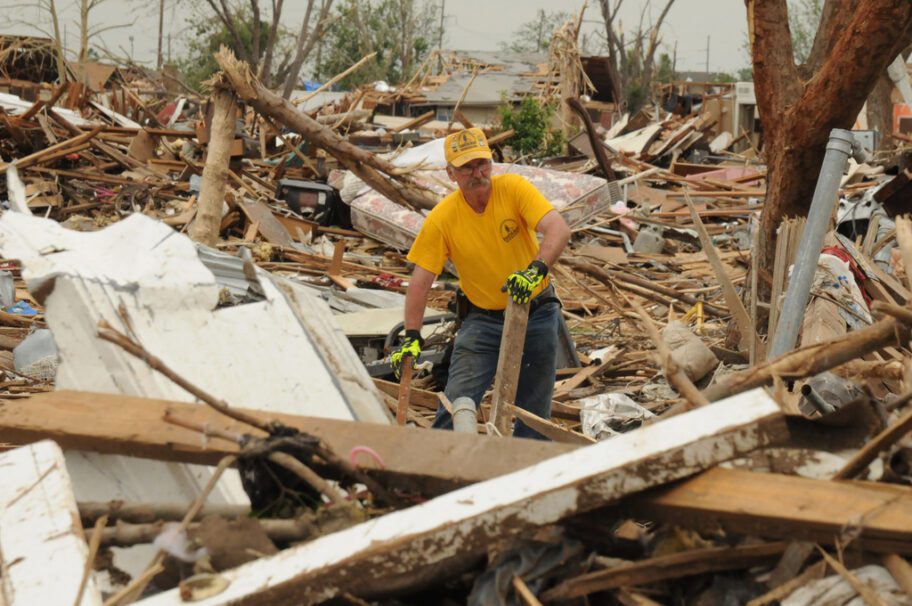
Thirty-plus years later, Nechama is still at it, now deployed to western North Carolina, where the organization (which is 70 percent Jews and 30 percent non-Jews) has been on the scene since 2024’s Hurricane Helene, and the anemic federal response. Members perform tasks such as mold remediation and home demolition, clearing debris and mud and the like. It’s heavy, dirty work that commences when teams show up in communities already on their knees in all ways after a disaster.
“They don’t even know what to think,” says Stephen Matloff, the Los Angeles-based chair of Nechama’s board of directors. “It’s overwhelming, they don’t even know what the first step is—it’s people wandering around picking up old picture frames in despair.” Matloff has been to western North Carolina three times since Helene, and he recalls once meeting a family that had gone up to their attic to avoid rising waters, only to have the terrifying experience of watching the water coming up to their first floor. “Where do you go emotionally after that?” Matloff asks, by way of highlighting the imperative of developing trust in these chaotic and demolished environments.
“A lot of trust has to build,” he says, especially given unscrupulous contractors, disaster tourists, and these shattered communities filled with people suspicious of getting ripped off or being gawked at. Enter Nechama, which has been able to assist with cleanups and demolitions free of charge, saving devastated residents thousands, even tens of thousands, of dollars.
“It’s people wandering around picking up old picture frames in despair.”
Matloff’s first exposure to Nechama was in 2012, when, through his synagogue in Los Angeles, he and others in the congregation watched Superstorm Sandy unfurl in New York and wanted to figure out a way to pitch in directly.
Matloff recollects that another congregant, a youngish former Marine, had experience with the organization Team Rubicon USA, a humanitarian organization of military veterans that has deployed in recent years to disaster hotspots such as Haiti. This veteran suggested a similar approach to the rabbis and congregants who wanted to pitch in with the Sandy relief efforts but were unsure how.
Matloff was unaware of Nechama’s existence, but after contact with the organization, he went on to work with them in the Rockaways, which had been hit especially hard by the storm.
The organization’s work has also helped to beat back a growing antisemitism, not least in the South. The focus on Nechama being a Jewish organization that is open to all “naturally fits in with the fight against antisemitism,” says Matloff, and their presence in a deeply Christian and conservative part of the country also sees the organization working shoulder to shoulder with other faith leaders.
When asked about the Graham disaster ministry, he takes a “the more the merrier” approach and says the benefits and efforts of such groups are respected and welcome.
One distinguishing element of Nechama, says Matloff, is that the organization doesn’t need to worry about volunteers trying to convert disaster victims to Judaism, historically a non-proselytizing religion. “There’s a big joke in Judaism,” he says with an attendant chuckle. “The non-Jew wants to convert. But for the rabbi, the first step is to try and convince them to not convert: ‘Are you sure you want to do this?’”