


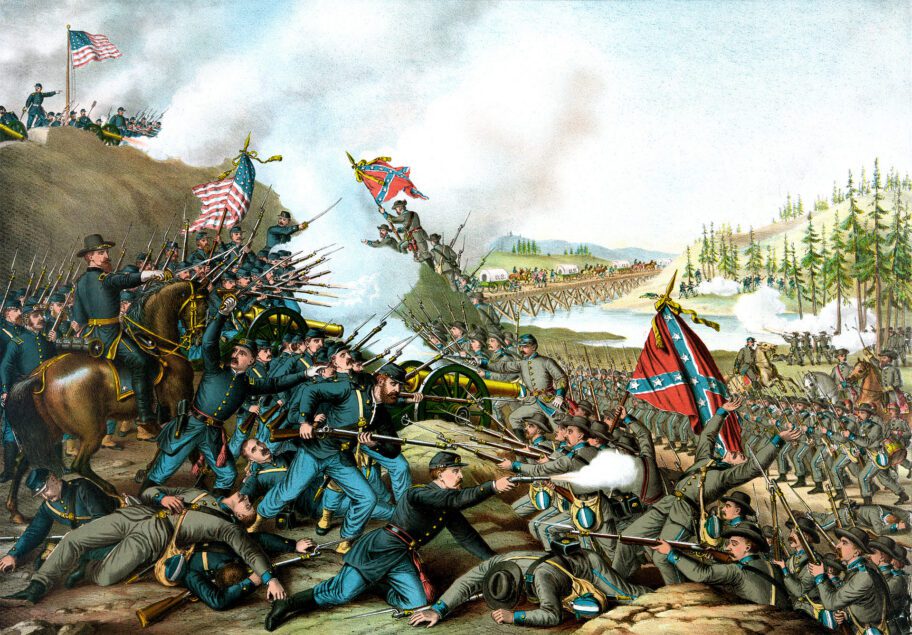
In July of 1862, Henry McNeal Turner published “The Plagues of This Country” in the Christian Recorder newspaper. Turner, born free in South Carolina in 1834, was a Methodist minister who would be appointed by the U.S. Army as the first African American chaplain in the United States Colored Troops the following year.
In the essay, Turner described the not-yet-freed slaves through the prism of the Passover story—and painted Lincoln, unable to yet let those chained people go, as Pharaoh. “Abraham Lincoln and not Jeff Davis becomes the Pharaoh of the mystic Egypt (American slavery),” Turner wrote. “And however unwilling to comply with a dispensation of liberation, nature’s God calls from heaven, echoed to by five million of mystic Israelites, (subject slaves) in peals of vivid vengeance, let my people go. Moses and Aaron, in the garb of threats for the nation’s heart-blood, stand before the mystic Pharaoh with a demand endorsed by the purposed [sic] of God, for their redemption; but, being refused, a series of plagues begins, commencing at Fort Sumter.”
The Confederacy’s victory at that battle, Turner believed, was indicative of God’s anger that the cursed institution of slavery still existed. The North would suffer through continual plagues echoing those experienced by ancient Israel’s enemies until it mustered the strength of Moses and achieved victory. The country, “with mystic Pharaoh at its head, may refuse compliance to Heaven’s demand; but the inexpressible tortures inflicted upon ancient Egypt, the cruelties of Antiochus to the Jews, the devastation of Jerusalem by the Roman Generals Titus and Vespasian … will all hardly bear a comparison to what will befall this nation” should the scourge of enslavement not end.
Turner was hardly alone in evoking the Ten Plagues in the context of the war. In fact, the punishments of the Pharaoh and his country served as an inescapable refrain for the abolitionist movement. In an 1828 issue of The Genius of Universal Emancipation, an abolitionist newspaper, its founding editor, the Quaker abolitionist Benjamin Lundy, recalled for his readers how Egypt had been struck by God with ten plagues for enslaving six hundred thousand Israelites. What punishment would America suffer, Lundy wondered, for subjecting an even greater number of souls to more wretched conditions?
Maria Stewart, who had been born to free Black parents only to serve as an indentured servant in her youth after they died, delivered an 1831 speech in Boston in which she asserted what she anticipated God’s role to be in the cause of freedom: “He will not suffer you to quell the proud, fearless and undaunted spirit of the Africans forever; for in his own time, he is able to plead his case against you, and to pour out upon you the ten plagues of Egypt.”
As John Coffey notes in his book Exodus and Liberation, The New York Independent published an eight-stanza poem, also in 1862, entitled “Let my People Go: The Song of the Slaves.” It depicts the nation in the midst of plagues of divine judgment and “War’s Red Sea,” while anticipating “full deliverance to the slave” and Israel’s “sublime march” to freedom. The New-York Evangelist, in turn, pronounced that “the hand of God” was “bringing the seven plagues upon the Southern Pharaoh, until the tyrant-hand is made willing to let the people go.”
In September of 1862, a group of clergy from Chicago composed a petition known as the Chicago Memorial of Emancipation, which was delivered to Lincoln by a delegation led by Reverends William W. Patton and John Dempster. The statement was steeped in biblical imagery. At one point, drawing from the Purim story, it read:
At the time of the national peril of the Jews, under Ahasuerus, Mordecai spoke in their name to Queen Esther, who hesitated to take the step necessary to their preservation, in these solemn words: ‘Think not with thyself that thou shalt escape in the king’s house, more than all the Jews. For if thou altogether holdest thy peace at this time, then shall there enlargement and deliverance arise to the Jews from another place; but thou and thy father’s house shall be destroyed; and who knoweth whether thou art come to the kingdom for such a time as this?’ And your memorialists believe that in Divine Providence you have been called to the Presidency to speak the word of justice and authority which shall free the bondman and save the nation. Our prayer to God is, that by such an act the name of ABRAHAM LINCOLN may go down to posterity with that of GEORGE WASHINGTON, as the second SAVIOR OF OUR COUNTRY.
The Passover imagery was also powerfully painted. The pastors stated their “claim, then, that the war is a Divine retribution upon our land for its manifold sins, and especially for the crime of oppression, against which the denunciations of God’s word are so numerous and pointed. The American nation, in this its judgement hour, must acknowledge that the cries of the slave, unheeded by man, have been heard by God [an allusion to Exodus 3:7] and answered in this terrible visitation.”
Patton and his colleagues concluded, “As Christian patriots we dare not conceal the truth, that these judgements [the deaths of tens of so many on the battlefield] mean what the divine judgements meant to Egypt. They are God’s stern command—let my people go!”
Turner was hardly alone in evoking the Ten Plagues in the context of the war. In fact, the punishments of the Pharaoh and his country served as an inescapable refrain for the abolitionist movement.
According to Edwin Stanton, Lincoln’s secretary of war, the memorial made an impression on the president. A week and a half later, Lincoln issued a preliminary form of the Emancipation Proclamation. Perhaps that was no coincidence. After all, a decade earlier, in his 1852 eulogy for the senator Henry Clay, Lincoln himself had declared that, “Pharaoh’s country was cursed with plagues, and his hosts were drowned in the Red Sea for striving to retain a captive people who had already served them more than four hundred years. May like disasters never befall us!”
Furthermore, in his Second Inaugural Address on March 4, 1865, Lincoln, nearing his conclusion, offered the following plea: “Fondly do we hope, fervently do we pray, that this mighty scourge of war may speedily pass away. Yet, if God wills that it continue, until all the wealth piled by the bond-man’s two hundred and fifty years of unrequited toil shall be sunk, and until every drop of blood drawn with the lash, shall be paid by another drawn with the sword, as was said three thousand years ago, so still it must be said ‘the judgments of the Lord, are true and righteous altogether.’” Though the verse Lincoln cites comes not from Exodus but from Psalm 19, Steven Weitzman notes that it echoes Exodus 12:12, which describes the plagues as an expression of God’s justice (“Against all the gods of Egypt I will render judgments”). Thereby, Weitzman suggests in his Disasters of Biblical Proportions, Lincoln saw a threat of more war as “a biblical prophecy of a final judgment, a new tenth plague, if the nation persisted in its hard-heartedness.”
Subsequent to the Emancipation Proclamation’s issuance, during the Senate’s debate over the passage of the slavery-abolishing Thirteenth Amendment in 1864, one of the senators exclaimed, “Oh! How many of our first-born have been smitten and fallen.” “Comparing the war to the slaying of the firstborn,” Weitzman suggests, “justified the death of children as divine retribution, terrible yet just, but may also have been meant to evoke the New Testament’s description of Christ as a ‘first born’ (as in Romans 8:29), an innocent whose sacrifice made it possible for others to be redeemed from their sins and live.”
Abolitionists, and their enemies, held a particular fascination with the “destroyer” of Exodus 12:23, said to slay the Egyptian first-borns while God passed over the houses of the Israelites.
The impending death of John Brown, the violent abolitionist executed for leading a raid of the armory at Harpers Ferry, was mourned in a poem, titled “A Message to Pharaoh,” that presented him as that avenging angel of Exodus. The poet even went so far as to declare that Brown’s life would be worthy of commemoration like the festival of Passover.
According to Eli Evans’s The Provincials: A Personal History of the Jews of Atlanta, as General William Tecumseh Sherman was on his way to burn down Atlanta in 1864, contemporary reports depicted him as the vengeful angel of God. In an echo of the salvific effect of the blood of the paschal lamb smeared on Israelite doorposts, the home of a local Jew named David Mayer was spared because he had placed an apron, symbolizing his membership in Sherman’s Masonic fraternity, on the doorpost of his home.
When Lincoln was shot on April 14, 1865, which was both Good Friday and the fifth day of Passover, both Christian and Jewish religious leaders connected the tragedy to the tenth plague. Among the biblical verses that came up repeatedly in these sermons was Exodus 12:30, “There was a great cry in Egypt, and there was not a house in which there was not one dead,” a verse that was used to describe the mourning that had spread throughout the North. Henry Ward Beecher, the famed abolitionist, observed how “every virtuous household in the land felt [Lincoln’s death] as if its first-born were gone.”
Even in victory, the Union felt like Pharaoh’s Egypt. It was now not the hundreds of thousands of battlefield casualties but rather Lincoln’s death that would redeem the nation from its sins, lighting the way through the plague of dark times towards liberation.