


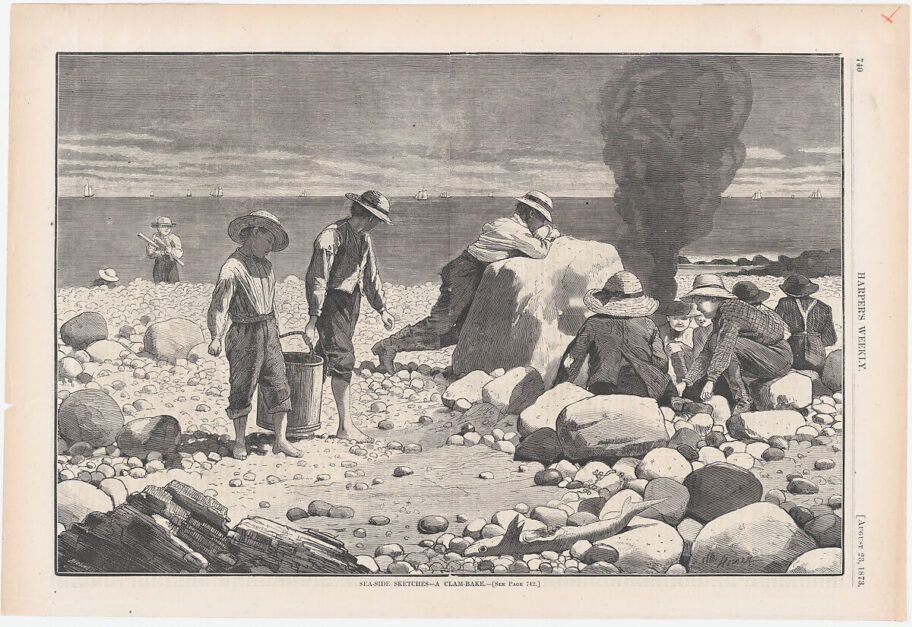
Steam billows in dense clouds, rendering the crowd invisible. The grove smells of smoke and ocean water. People gather for the spectacle of it all, pink hats craning to see workers wrestling wood-and-wire baskets of clams and vegetables from the hot seaweed. This is clambake, like a summer Christmas in my childhood memory. Every third Thursday in August, Quakers—as we are commonly known, though we more often call ourselves Friends—in Dartmouth, Massachusetts, host hundreds who have made clambake their tradition. For one day, we create a space where history meets the present and a community defines itself.
The first volunteers wake at dawn and follow the backroads through scrubby forest and stonewalls toward the bake grounds. When I read about the camp meetings that defined the Great Awakenings, I imagine they happened in a place like this. Oak trees stretch tall and thin as they search for sky, and the grass lies short, ready for the hundreds who will gather in this place. Those who arrive early start the fire, a ten-foot-long layer-cake of logs and stones that will burn for hours. The wood heats field stones, the stones heat seaweed, and the seaweed steams the food. Corn, sweet potatoes, clams, cod, sausages, and oyster stuffing cook together and carry the flavor of smoke and brine. I have never eaten anything else that tastes like this day.
I was raised Quaker, in the meeting that puts on this clambake. I struggle to figure out why this event remains so important to me, even after twenty-odd years of attending. I feel sure that it says something about Quakers and the collective, often informal, rituals that shape our identity. But I can also tell a story about this day that shows anyone, Friend or not, how to care for the world and the people in it. I’m not sure that there should be more clambakes, but there can certainly be more days like clambake, more celebrations of community when we can find collective joy. In communal rituals like clambake, we contradict narratives that rob us of our power by telling us we are isolated, atomized, and divided. The ritual involves the community in the retelling of an ongoing story built on prior iterations. Neighbors and strangers gather and, in that very act of gathering, say: “I want to be with you in this place and time.”
I remember years when a husband, a wife, and two chihuahuas drove their ice cream truck past the bake on their way from one beach to another. They were waved down by dozens of bare-footed, hot-faced children trying to barter bags of clams and foil-wrapped sweet potatoes for popsicles and rainbow snow cones. One year—not the first year, maybe the third—the husband asked us from behind his sunglasses, “What is this place?” The hesitant note of curiosity and awe gave me a glimpse of how strange and wonderful this all must look.
Clambakes aren’t uncommon where I grew up, on the coast of Massachusetts near Rhode Island. Each summer, residents of this area can at least count on the fishermen’s bake (put on by the Fishermen’s Association), the Smith Neck Friends bake (organized by a nearby Quaker meeting), and the one hosted by my own meeting: the Allen’s Neck Friends clambake. The one at Allen’s Neck is the oldest (held annually for nearly 150 years) and the largest, feeding six hundred people, a majority of whom are not Quaker.
Small differences exist clambake to clambake, but they share a process of steaming clams and vegetables over hot rocks and seaweed. Kathy Neustadt wrote the definitive—and, as far as I know, only—history of clambakes in her 1992 book Clambake: A History and Celebration of an American Tradition. Her ethnography explores clambakes as an invention of the nineteenth century, born of a new country’s desire to define ourselves. She found her way to the Allen’s Neck clambake in 1984, when she cried watching it all for the first time. She returns each year and is now affectionately called “Kathy Clambake.”
Many of the Quaker volunteers probably own a copy of her history, given that they or someone they know might be mentioned. Nevertheless, adults persist in telling children a myth, that clambakes are a way of cooking indigenous to this place—learned from the Wampanoag, they say. We pass on our history of the clambake in small fictions, folk stories that are as much a part of the tradition as the stones themselves. Those who know these stories will tell them and place themselves in the lineage: “I’ve been coming to clambake for twenty years”—or forty or sixty. After a few clambakes, volunteers learn the rhythms of what has to be done. Still, people talk about how many times they’ve been there, since rituals build themselves successively on the memory of what happened in years before.
The Allen’s Neck meeting’s Sunday school started this gathering with a small picnic on the beach in 1887 or 1888. As far as I know, Friends beyond the Massachusetts south coast do not hold clambakes, but my meeting finds a certain sacred meaning in the day. It’s the closest Friends can get to heresy: Quakers hold that everything is sacramental, so there is no sacrament. The Friends at Allen’s Neck bend this rule for clambake, a day that means something more than any other. After being told a questionable history of the event, a guest at clambake might hear the storyteller say, “No sacrament for Quakers, except clambake.” We generally refuse to ascribe elevated holiness to any substance, place, person, or event, given our belief that every person is invested with a piece of the Divine. To recognize what is sacred, we only need to look to each other. Clambake helps us see one another, which is perhaps why it feels more important than other days.
Quakers have a long history in this corner of the country. When four Friends were hanged on the Boston Common in 1660, families fled south from Massachusetts Bay Colony to Plymouth Colony, where they were not exactly welcomed but at least were not executed. Today, there are four meetinghouses within ten miles of the clambake grounds, three of which are used regularly for worship—including Allen’s Neck, where a few dozen people gather every week to wait on the still, small voice in silence with each other.
Many Americans who made it through high school history learned about Friends as social reformers, early abolitionists, and proponents of women’s rights. Most Quakers today recognize the complexities and contradictions within those stories. Condemnation of slavery throughout the Society only arrived after the slow, hard work of a few persuasive and committed individuals, some of whom were ostracized by their meetings and written off as nuisances. Measured against other Christian denominations, we do little materially in this world. We are often less committed than the Mennonites and less organized than the Catholics. But we have a way of recognizing poetry in the present moment, which can lead us to powerful, countercultural ideals.
On clambake day, however, my meeting embraces tradition. Year after year, volunteers follow each other from the prep table where vegetables get cleaned in the center of the grounds, to the 50-gallon tubs at the edge of the woods where the clams are portioned in cotton bags. We are noisy and efficient, casting off the silent, expectant stillness in which we worship. We defy our apparent nature on this day, even as we build a kind of meaning not far from the ideals of Quakers past.
To recognize what is sacred, we only need to look to each other.
Friends have no explicit doctrine, although most of us, if not all, would agree on pacifism: you cannot take a life and in the next breath profess that each person holds Divine Light within them. Quakers spend a lot of time trying to find room for this simple truth in a world that sometimes seems defined by violence. Many of us refuse to center any narrative around stories of war. Even in “times of war,” there will be room for peacemakers to do their work: teaching, harvesting, re-building, and reminding those closest to them that each person’s life is their own. We assert that there are spaces that hold more meaning than battlefields and crime scenes. Violence may impact us in significant ways, but it cannot tell us who we are. It does not offer any way to live.
A common narrative explains the alienation of individuals in our society by asking where all the “third places” went, the places where strangers became acquaintances. When people talk about third places, they often use “the bar” and “church” as examples, reflecting imaginations captured by 1950s white Christian suburbia. Instead of the “third place,” I prefer to look for a “space away,” a retreat from the determinism of societal expectation to find somewhere just strange enough—just away from it all enough—to provide room for the oddities of the self, the strange passions, habits, and experiments that might just elicit joy. It is important to me on clambake day that we are not just gathering informally but doing something that requires a particular knowledge grounded in communal memory and experience. Clambake is my favorite space away.
The space away offers room for everyday peacemakers to do their work. It may be very close to the event of violence or loss. The space away could be the gathering in the kitchen when neighbors deliver meals after a death in the family. Or it may be a physical retreat, a place apart, in the way that some people go upstate or to the islands or north or south. Except the space away must be with other people, ideally strangers, a place for chance encounters and unexpected realizations. It is easier when we are alone to say “this thing held meaning.” It is much more difficult to declare this with confidence when someone can say, “Are you sure?” Yet it feels all that more remarkable when the person next to you says, “Isn’t this incredible?” and gives voice to your thoughts before you can—moments when, as Quakers would say, “Friend speaks my mind.” Sharing those experiences makes them stronger, clearer, and deeper. We can be surprised into believing that life is easier and more joyful than we thought it could be.
At clambake, a peculiar people cook in strange ways and create unexpected beauty. No one says this explicitly, but I think those of us who come back year after year feel it to be true. Clambakes will not end wars, but for one day ours brings a strange peace to our corner of the world. And isn’t that really the only way peace can be made, in odd, surprising ways by a few people together in a place?
At the bake last August, I helped Peter set up a speaker in preparation for his blessing. He usually stands on a table and projects his sing-song voice through the glade, but he’s eightysomething and had had a fall a few weeks before. Peter is our minister—a dubious title, given that anyone can stand and preach in the silence of a meeting. Most weeks he offers the meeting a reliable, considered message, delivered like poetry with his eyes closed. Clambake contains no explicit spiritual component, except for the few words of gratitude he shares before the bake. He then calls us into the only moments of silence we will all share this day. Those who are not Quaker will sometimes clasp their hands and look toward the sky. Most Friends shut their eyes and turn their faces to the earth.
Hours before the silence breaks and we eat together, Peter tests the speaker: “Tell us the news from Washington.” With a sly grin, he pushes the microphone toward Cheryl, who is setting her family’s table next to us. “I am not doing that!” Word from the capital tells us that democracy dies, the truth is bedridden, and the divide widens, but not on the third Thursday in August in a grove on the coast of Massachusetts, where friends watch clams steam and couldn’t care less about the news from Washington—not because it doesn’t matter, but because, in this shimmering place, the day is ours to share.