When my daughter Josie was seven, she became obsessed with a battered paperback in her school library. It was an illustrated novel for children about the Triangle Factory Fire. (I know, who the heck writes an illustrated novel for children about the Triangle Factory Fire?) Josie is now 24. I asked her the other day why she loved the book so much. “I was coming out of a Titanic phase,” she reflected. “I really liked tragedy.”
I think she also liked the story of two immigrant teenage girls, one Jewish and one Italian, who defied their families’ prejudices simply by being friends, and who escaped a horrible conflagration together and vowed to build a better world. Simplistic? Sure. But the story and pictures were age-appropriate, not too scary. And when it comes to teaching kids about social justice, simple is a great foundation.
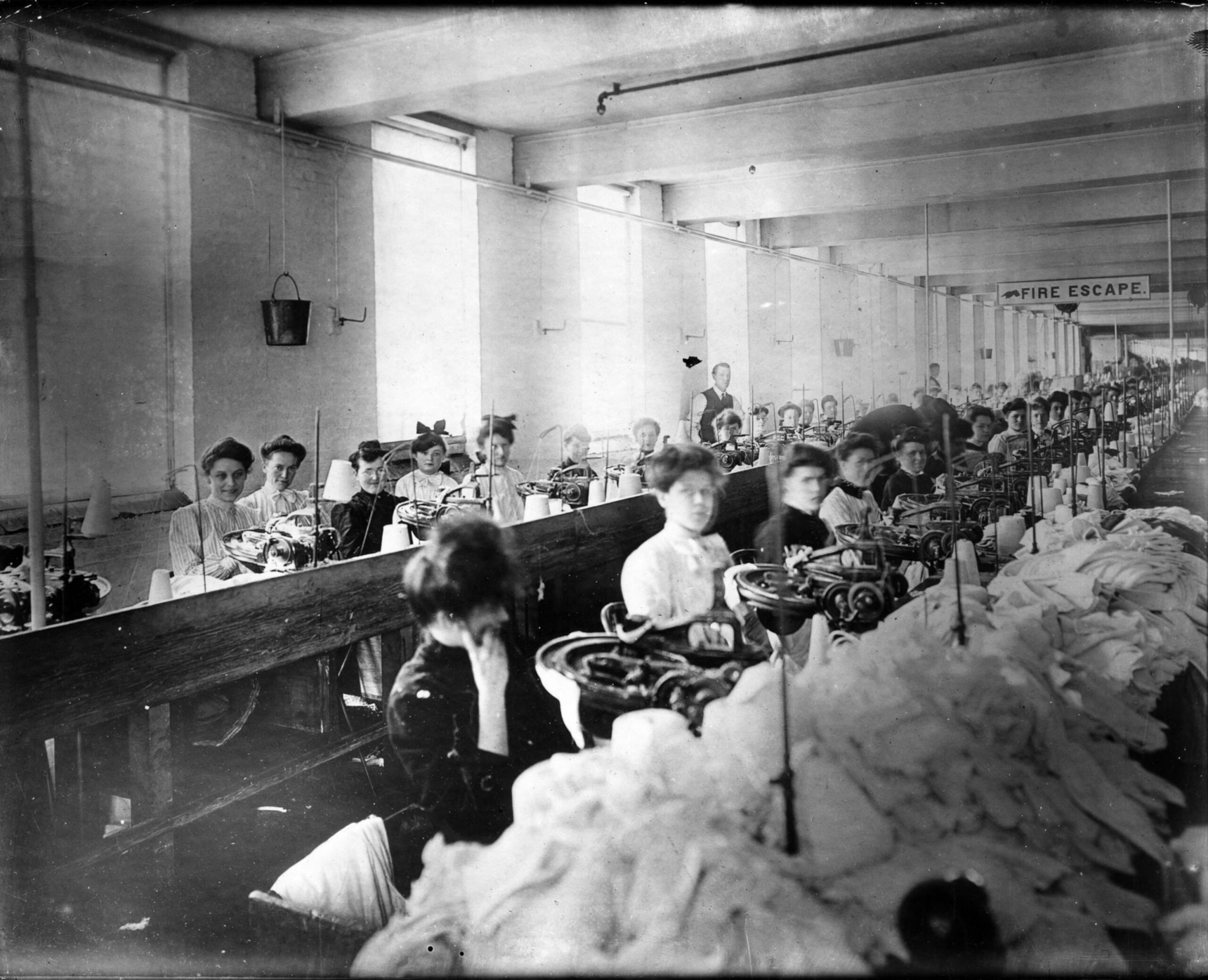
As you probably know, the Triangle Factory Fire was a turning point in the American labor movement. On March 25, 1911, a fast-moving blaze broke out on the eighth floor of a shirtwaist factory on the corner of Washington Place and Greene Street in Greenwich Village. Workers had been locked inside, presumably to prevent theft, and within 18 minutes, 146 people were dead. The ladders of the city’s fire trucks could reach only up to the sixth floor; the building’s tiny fire escape was shoddily built, collapsing quickly under the weight of the people—mostly young immigrant women—crowding out the windows. Many victims jumped rather than wait for the flames to take them. “Bodies were falling all around us,” one witness told The New York Times. “The girls just leaped wildly out of the windows and turned over and over before reaching the sidewalk.” Bodies piled up on the street, in the workroom, in the elevator shaft.
I was obsessed with the story too. I’d read David Von Drehle’s brilliant Triangle: The Fire that Changed America and Leon Stein’s earlier The Triangle Fire. (Josie comes by her addiction to sweeping non-fiction drama honestly.) When it comes to understanding overwhelming social issues, individual stories are a potent and accessible way in.
Then our across-the-street neighbor Ruth Sergel, a filmmaker, told me about CHALK, an art project she’d come up with. It was a way to simultaneously commemorate those lost in the flames and teach contemporary New Yorkers about city history and the ongoing international issue of sweatshop labor. Using a map created by Cornell University’s Kheel Center for Labor-Management Documentation & Archives and independent researcher Michael Hirsch, Ruth assigned volunteers to go to every victim’s address every year on the anniversary of the fire and write the person’s name and age in front of their former home. Participants also put up a list of names of all the victims and a flier about sweatshops today.
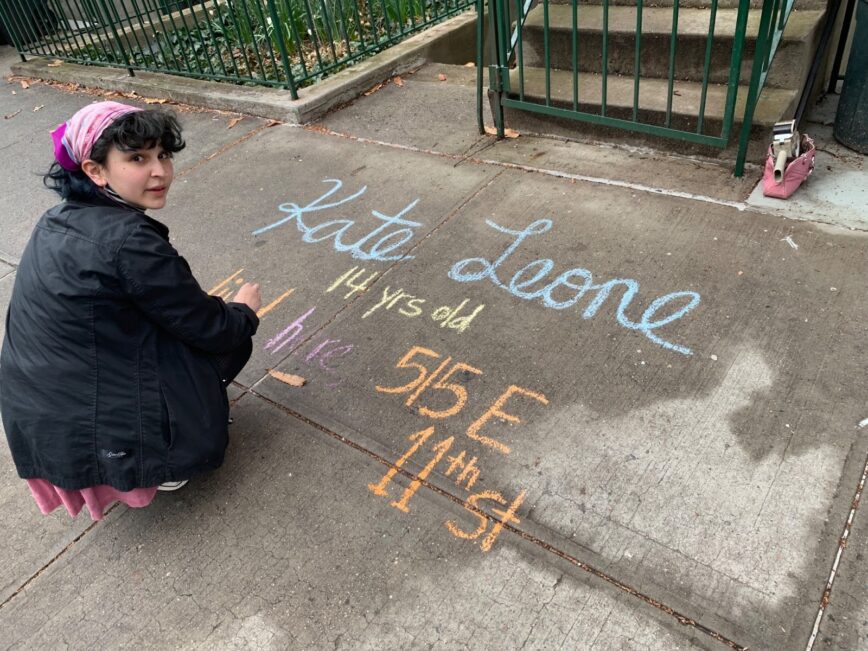
Josie immediately asked if she could chalk the name of the youngest victim, 14-year-old Kate Leone. Kate had lived near where we now lived, in the East Village. (Another 14-year-old, Rosaria Maltese, had also died in the fire, and she had also lived nearby. But she had people to commemorate her. I’d met two of her relatives, elderly men who’d gone to Josie’s elementary school. One asked me where I lived, and when I told him, he laughed, “Hey, I dated a girl on your floor!” The East Village is a small place.)
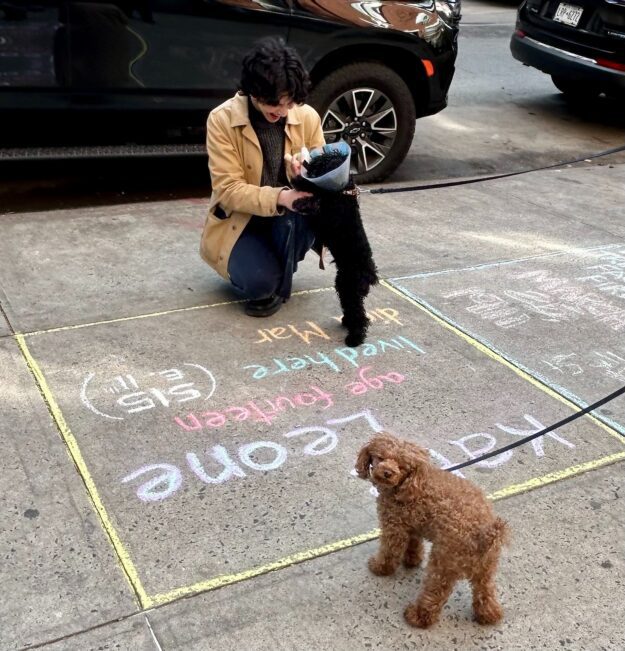
Josie first wrote Kate’s name in 2009. Every year since, on East 11th Street, my daughter has gotten down on the sidewalk to create a tribute to Kate in brilliant colors, while I’ve taped up black-and-white signs about the history of the fire and sweatshops today. Then I crouch down too, and help Josie draw flowers and vines around Kate’s name.
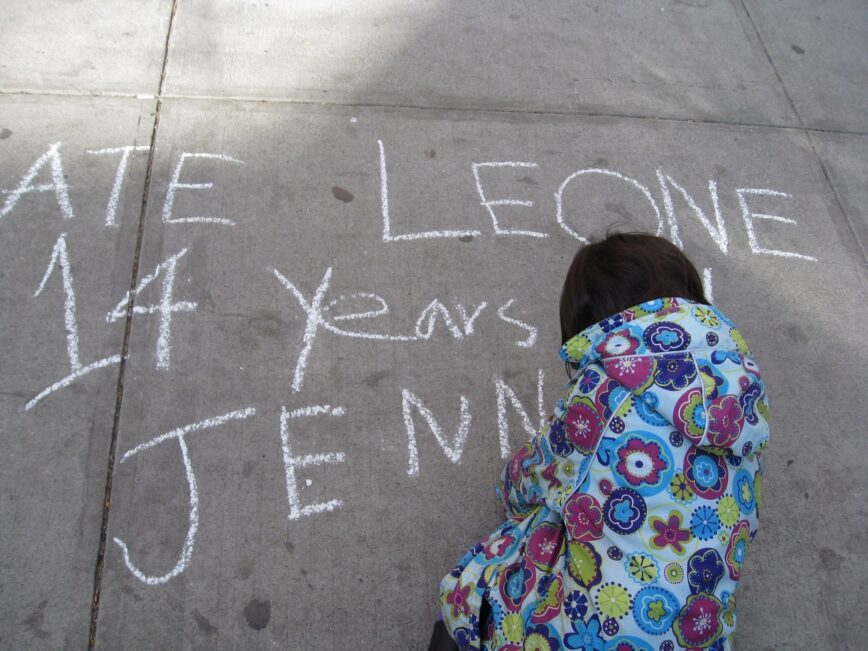
Initially, the whole endeavor felt awkward and a little undignified, crawling around on the cement, getting pink and blue and green smears on our knees, garnering hipster side-eye. But this too was part of Ruth’s vision for the project: we physically get in touch with this city where girls like Kate once lived and played. Another girl who died, 18-year-old Jennie Pildescu, lived at the same address as Kate. We see her name whenever the volunteer who chalks for her gets there before we do. We wonder whether Kate and Jennie were friends, even though Jennie was older. Maybe they walked to the factory together in the mornings. Maybe Jennie got Kate the job. Maybe Kate thought she was lucky.
We’ve been chalking for Kate for 16 years now. In the early years of the project, we wrote the names of other East Villagers, too: Clara Dockman, 19. Rose Friedman, 18. Jennie Stein, 18. Julia Oberstein, 19. But the CHALK project became more and more popular, Ruth needed fewer volunteers, and eventually Josie chalked only for Kate. (That said, a couple of victims lived deep in the Bronx—how long must it have taken them to get to work in the West Village in 1911?—and Ruth often begged for last-minute help memorializing them. During the pandemic, I took the subway an hour each way to chalk for Sarah Cooper, 16, on a cracked sidewalk in front of a chain-link fence surrounding a low-slung single-story charter school named after financier Carl Icahn.) A few years ago, Ruth moved to Berlin; last year, the Lower East Side Tenement Museum took over managing the project. Now folks clamor to participate. (But, FYI, they still need people to chalk in the Bronx.)
As we walk through the neighborhood on the anniversary of the fire and in the days afterward, we see other names, too, other chalk colors. The writing stays there, increasingly blurry, until it rains.
Seeing many cities, overlaid one atop the other, is part of the experience, too. Sometimes a victim’s home looks exactly as it did in 1911; sometimes a dead girl’s tenement has become a giant condo or a fancy boutique. There’s an actual monument now at the site of the fire, now an NYU building. (Everything in the West Village now seems to be an NYU building.) But for me there’s no immediacy to it, no sense of the way time shifts and rich people come and the neighborhood eats itself.
Seeing many cities, overlaid one atop the other, is part of the experience, too.
And participatory art is physical in a way that gazing at the side of a building can never be. Discomfort can be a virtue. Sometimes people—barking into their cellphones or plugged into their AirPods—stroll right over the words as Josie is writing them. I try not to stew. Sometimes someone stomps out of a nearby doorway, and I steel myself to get yelled at for defacing their building’s wall, caught red-handed with my big roll of packing tape and stack of hector-y literature. Truthfully, we’ve never been yelled at. But once, the owner of the beloved Italian bakery Veniero’s came out as we were writing the name of Jenne Franco, age 16, in front of his place of business. Instead of turning a hose on us and our chalk, he told us that his family had rented the apartment to the Francos. He’d always known about her. Her story was part of his family’s story.
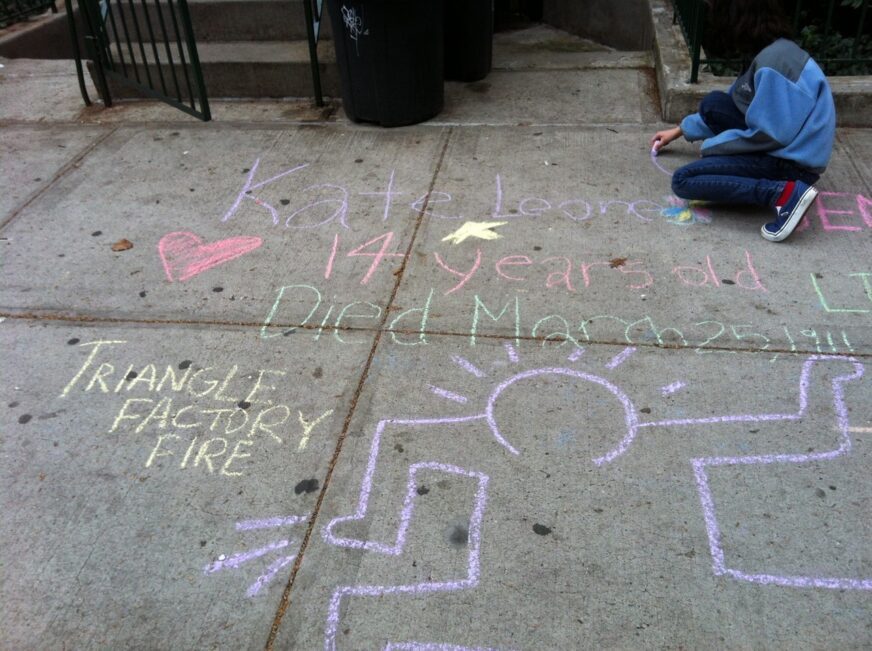
Sometimes people pause to watch Josie in her focused efforts, or they slow down, and I see them visibly deciding to ask what we’re doing. If she’s given the opening, Josie tells them about Kate and the fire. We’ve run into some of the same folks in multiple years; the same dogs, the same neighbors. When Josie was 11, Keith Haring’s former collaborator Angel Ortiz stopped to watch her work; Josie told him what she was up to, and he got down on his hands and knees with her and drew radiant babies and spiky lines all around Kate’s name.
The year Josie was nine, someone else unaccountably chalked for Kate before we arrived. Josie cried. But she rallied, and we drew flowers around Kate’s name, which the mysterious usurper had written in plain white chalk. Kate feels like Josie’s long-lost sister, but she isn’t. Her story belongs to everyone. (Still, young Josie had strong feelings about how the victims’ story is illustrated. One year she informed me that she didn’t approve of drawing flames around victims’ names. “They should have flowers,” she told me. “It’s not fair to them to only show how they died.”) When we got home, Josie decided to write Kate’s name on her hand in purple marker, so she could have it with her all day.
One year she informed me that she didn’t approve of drawing flames around victims’ names. “They should have flowers,” she told me. “It’s not fair to them to only show how they died.”
When we first started CHALKing, it was hard for me to imagine my seven-year-old ever being Kate’s age. But every year Josie got older, and Kate remained forever 14. Now Josie is a full decade older than Kate ever got to be.
Back in the day, I talked to Josie about the fire, and its aftermath, in the way a child, I hoped, could understand: a terrible event fueled the determination of people who were already hard at work trying to make life better and safer for workers. It led to real, meaningful change: child labor laws, worker protections, building safety codes, taller ladders for the fire department, unions. I got Josie and her younger brother Max a gorgeous picture book, Brave Clara, about tiny, fierce Clara Lemlich, who brought the house down at Cooper Union with her clarion call, in Yiddish, for a general strike.
As Josie and Max got older, I could add more nuance. I told them about Rose Schneiderman, who told a gathering at the Metropolitan Opera House, a week after the fire,“Public officials have only words of warning to us—warning that we must be intensely peaceable.… The strong hand of the law beats us back, when we rise, into the conditions that make life unbearable.” We talked about how activists must simultaneously push and build bridges, and how storytellers have to resist making the story of the Triangle Fire a singular tragedy. This isn’t just about one horror, but about the need to protect workers and immigrants everywhere. There have been recent sweatshop infernos in Bangladesh and Pakistan; fast-fashion behemoths like Shein and Temu are modern-day shirtwaist factories where workers reportedly work 75-hour weeks to churn out planet-destroying disposable garb gobbled up by insatiable Gen Z consumers.
Moreover, the fire and this project have become a way for me to talk to Josie and Max about what American Jewishness means to me, and what I hope it can mean to them.
My connection to Judaism has never been centered on the Holocaust or Israel, two things frequently cited as drivers of American Jewish identity. I’ve engaged with my Jewishness through Jewish texts and food and songs and prayer (I don’t even need God to enjoy singing songs Jews have sung together in community for hundreds or thousands of years!), and learning about diasporic history. I’ve worked hard to create engaging and beautiful home-based Jewish rituals to make my kids feel connected to our history and committed to our future: Shabbat candle-lighting, making hamentashen in a variety of delicious and occasionally disgusting flavors, hosting awesome seders that draw parallels every year between the Passover story and other stories of escape from narrow places. And yes, part of the Jewish identity I want for my kids involves teaching them about the American labor movement, so full of activism-minded Jews, particularly women, who fought for others. (Fun fact: people who dismissed their efforts called them “goo-goos,” for do-gooders.)
As someone who’s written a book about Jewish parenting, I don’t want to make Israel and the Holocaust the cornerstones of my children’s identity. I want them to engage with our people’s long tradition of rabble-rousing, making art, building bridges, and working to make other people’s lives better. This kind of activism, I think, is the way for them to feel joyfully connected to our collective past and to want to continue the story. And of course, talking to kids about an earlier generation of hardworking immigrant women and girls, mostly Jewish and Italian, is particularly vital as they see what’s happening to immigrants from other countries here in America.
This year, I’m devastated that I can’t participate in CHALK. I have a work conference I absolutely can’t miss. But Josie is in her second year of teaching fourth-grade history in Brooklyn. And on March 25, she’s going to give a lesson to her classes about the Triangle Factory Fire.
And then she’ll take “her” kids to chalk Kate’s name.