


Last year, the British Museum welcomed 6.5 million guests. In any given year, between 7 and 10 million travelers pass through Rome, though estimates for 2024 range up to 22 million. Near Rome, the historic site of Pompeii continues to enthrall the world—so much so that when scientists recently virtually unrolled an ashen scroll from Herculaneum for the first time, news of it went viral. Today, more students at Cambridge study the classics than in the late 1800s. Madeline Miller’s modern reinterpretations of Achilles and Circe have riveted millions, and The Odyssey was the movie event of the summer.
Are the classics in decline? Are the humanities in trouble? “You can’t think about classics without thinking about the fate of the humanities more generally,” the eminent Cambridge classicist Mary Beard writes in her latest book, Talking Classics: The Shock of the Old (University of Chicago Press, 2026). But what is that fate? Three years ago, The New Yorker pronounced “the end of the English major.” Yet at my institution, Washington University in St. Louis, the English major is larger than ever. Meanwhile, Forbes just released a study finding English to be the most versatile degree for employment in a world reshaped by AI. Could it be that the humanities are thriving?
If so, many don’t want to hear it. Instead, the news is filled with reports on the supposed lowering of standards in the humanities, while The Atlantic, in its monthly hunt for an apocalyptic headline, declares on its cover that “The Age of Reading Is Over.” Two years ago, when I pitched a story to various outlets about how the English major at WashU had grown by 60 percent in five years, and that we were not alone, I was told no one would be interested in such a story. Humanities in crisis!—that is what readers want.
It’s true, of course, that those hopeful about the humanities must also face some hard facts. Despite multiple success stories, national enrollments have dropped. And for all the ongoing interest in the classics, several classics departments still face the chopping block. Deans and provosts and presidents continue to hunt down the white whale of efficiency (sometimes at the risk of drowning the entire ship). That’s all true. Beard acknowledges as much. But in Talking Classics, she does not dwell in the difficulties. Instead, she turns to wonder.
If wonder feels a little starry-eyed and unhelpful at this particular moment, don’t worry. Beard is not interested in awe for awe’s sake. Rather, she argues that wonder offers an essential starting point and ongoing motivation for the academic journey. As Aristotle claimed, “Wonder is the beginning of wisdom.” Curiosity, interest, and the sheer confounded complexity of the world can inspire us to figure it out, to seek some further understanding, to find something new. Hence begins the work of knowledge.
Beard’s own journey attests to the hard work that follows on the heels of wonder. Part memoir, part apologia, part historiography, Talking Classics keeps winding back to wonder. The book began as the Berlin Family Lectures, delivered at the University of Chicago in 2023, and it retains the flavor of four somewhat tangential lectures on the classics, each taking up an adjacent question but not thoroughly woven into a singular argument or narrative. Instead, we find Beard reminiscing, in one chapter, about her own childhood and career, answering critics and critiques of the classics in another, musing on the lessons she’s learned from the classroom, and backing out for a broader sense of the “case for classics.” In other words, the book does not necessarily “flow,” but each essay becomes its own beautiful set piece. And each set piece belongs to the same general game: the importance of the classics and a forceful explanation (not so much a “defense”) about why they have always mattered to Mary Beard—and why it matters to study them still.
Beard is not interested in awe for awe’s sake. Rather, she argues that wonder offers an essential starting point and ongoing motivation for the academic journey.
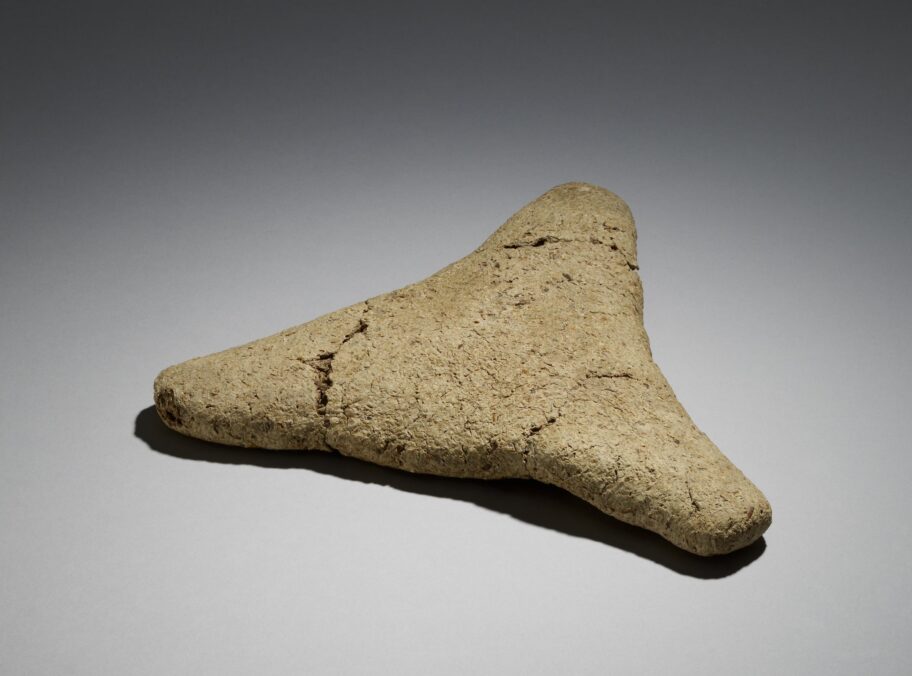
Here’s how wonder struck Beard: as a young kid, she saw a piece of bread. It wasn’t just any piece of bread, of course. It was Egyptian bread about four thousand years old, discovered near modern Luxor and preserved by dry desert heat into a solid piece of stone now held in the British Museum. When young Mary saw it, she was enthralled by its age and ordinariness. Ancient as it was, it was still just bread. A fantastically unfantastic relic. Amazingly old, it was utterly commonplace. As she states in the opening lecture, “I have never forgotten that feeling of being so perilously close to the lost world of the past, through something as familiar, and as miraculously preserved, as an ordinary piece of bread.”
Perilously close, yes, but the peril would lie in forgetting just how far away she stood. It might occasionally seem too easy to close the distance, to imagine distant peoples as just like us. The wonder, in other words, established a desire to know more about these ancient others. But drawing closer required a great deal of work. Rather than “something that stood in the way of hard thinking,” wonder became a “precondition for it.” It “signalled intellectual puzzles and problems which engaged the brain.” This wanting to know, this desire born of wondering, initiated difficult exams and long studies of language. When young Mary pressed her face to that museum glass in the 1960s, she began an astonishingly successful and hard-earned career as a classicist.
Moreover, the wonder that shaped Beard’s career took her down some paths other classicists refused to enter. Seeing an ancient piece of ordinary bread lit a question within her: “What on earth was it like to be there?” Such a question was considered “a sentimental and naïve line of enquiry, unanswerable and incompatible with proper historical rigour.” Well, she asked anyway. And many good books followed.
In pursuing her wonder, Beard did not at first consider the accusations that have since surfaced against the classics: the idea that a study of the classics abets racism and fascism. Though she clearly has little interest in writing defenses, Beard finds herself needing to defend the field from these now common accusations. With a sigh (it seems), she devotes a lecture to “Rights and Wrongs.” Yes, Mussolini loved the classics, and yes, Hitler had a lively interest as well. White supremacists still seem to have a special place in their hearts (and on their bodies) for those ancient white marbles. “Over the last few hundred years,” Beard admits, “the classical world has had some dreadful crimes (and some real rubbish) perpetrated in its name.”
Well, says Beard, one should know a small thing first and foremost: those ancient marbles were never white (they were painted in gaudy colors that have since washed away). More broadly, the classics have found themselves enlisted by crowds far different from fascists and racists. Karl Marx loved the classics. He earned his Ph.D. studying the ancient Greek philosopher Epicurus. Nelson Mandela staged Antigone on Robben Island. Meanwhile, “In nineteenth-century Britain, the prequel to the gay rights movement, the campaigns for universal (male) suffrage, and the demands for workers’ and trade union rights, all exploited the history and symbols of antiquity.”
Rather than keep score, though, Beard makes a different point: “Classics belongs to no side.” The field can be used and abused by all sorts of people for all sorts of reasons in the name of all kinds of causes. The fact of its breadth is part of what makes it interesting. The classics are not just back then; they are all the conversations about “back then” that have been happening ever since.
While insisting that the classics are beyond left and right, Beard also attempts to keep the classics in their place. In Talking Classics, she rejects claims to their singularity or superiority: “There is nothing to be gained by pretending Greece and Rome should count as the only important show in town.” In fact, she claims, “You get much more out of classics if you revere it less.” Here, Beard tangles herself a bit in knots. She clearly believes this line—the classics are not the only show in town—and yet her lectures aim to explain why they alone enthralled her. The classics are not “the well-spring of Western civilization”; but also, of course, “ancient Greece and Rome are hugely important in the mix that is western culture” and “if you chopped away the classical elements from this western cultural amalgam, you would be left with a strangely mutilated and barely comprehensible remnant.” There is no Western civilization, per se. But also, we live in it, and the classics are a huge part of it.
Beard’s larger point, however, still stands. The aim is not to adore classical forebears, but to understand them. And she rightly insists that the world is wide; wonder can run in any number of directions. It’s just that her own wonder took her here, to the classics, and the classics remain worthy of that wonder after all these years.
“Classics belongs to no side.”
Still, how do we actually know something about the classics? How do we know anything in the humanities? That’s a question that rises through these lectures, and one that humanists love to discuss and debate. Beard’s sense of knowledge depends on dialogue and humility. Scholars must tread “the tightrope between the idea that the inhabitants of the ancient past were just like us and the idea that they were incomprehensibly alien.” We draw close; they draw away. No bridge will ever bring us to the past with absolute certainty. We have only what survives, whatever rises to the surface in the river between then and now. We salvage texts and stones and statues and old pieces of bone and bread into a pile of evidence, an incomplete puzzle. Then we argue over the picture it presents. We make a claim. We counterclaim. We enter the conversation.
Always, Beard reminds us, we do so with all that we are, our full selves—our ethical commitments and our ongoing concerns, our struggles and queries and quests. It won’t get us far, Beard admits, if we simply judge the past for not being the present. But that doesn’t mean we leave our judgment aside or step outside ourselves to study the past. Disinterested objectivity is not the point. If it ever was the point in the humanities, it was misguided. “You cannot have a conversation with the classical past,” she insists, “if you allow yourself no voice in that conversation at all.” We couldn’t do otherwise, even if we wanted to. Instead, the humanities come into knowledge by taking us along—all of what and who we are.
That act of engaged knowledge, debated and improved through conversation with others, is perhaps the most important lesson taught in the humanities. As Beard puts it, the hard work of a humanities education ultimately teaches us “to argue responsibly on the basis of inadequate evidence.” We need that lesson again and again and again. Sometimes questions do not have “right answers, or any answers at all in the usual sense of the word.” That doesn’t mean the questions are invalid. It means they are too complex to be answered simply. Even where no right answer offers itself, “some arguments are better and more cogent than others, and you have to learn what those are, and why.” It means joining the conversation. And joining the conversation means studying up. And studying up, in the humanities, means (among other things) learning “to read difficult texts”—a skill made more necessary by the day. “The unashamed mission of humanities education,” Beard writes, “is to celebrate and face up to complexity, not trade in false simplicity.”
Are the humanities in crisis? Based on recent developments in higher education, perhaps. Based on how human beings spend their time and money, maybe not. The stuff of study in the humanities remains the stuff of interest among human beings. We wonder; wonder inspires us to know; knowing takes hard work. That’s why the humanities—despite dire pronouncements and renewed attacks—will never be obsolete. The well of human wonder has never yet run dry.