


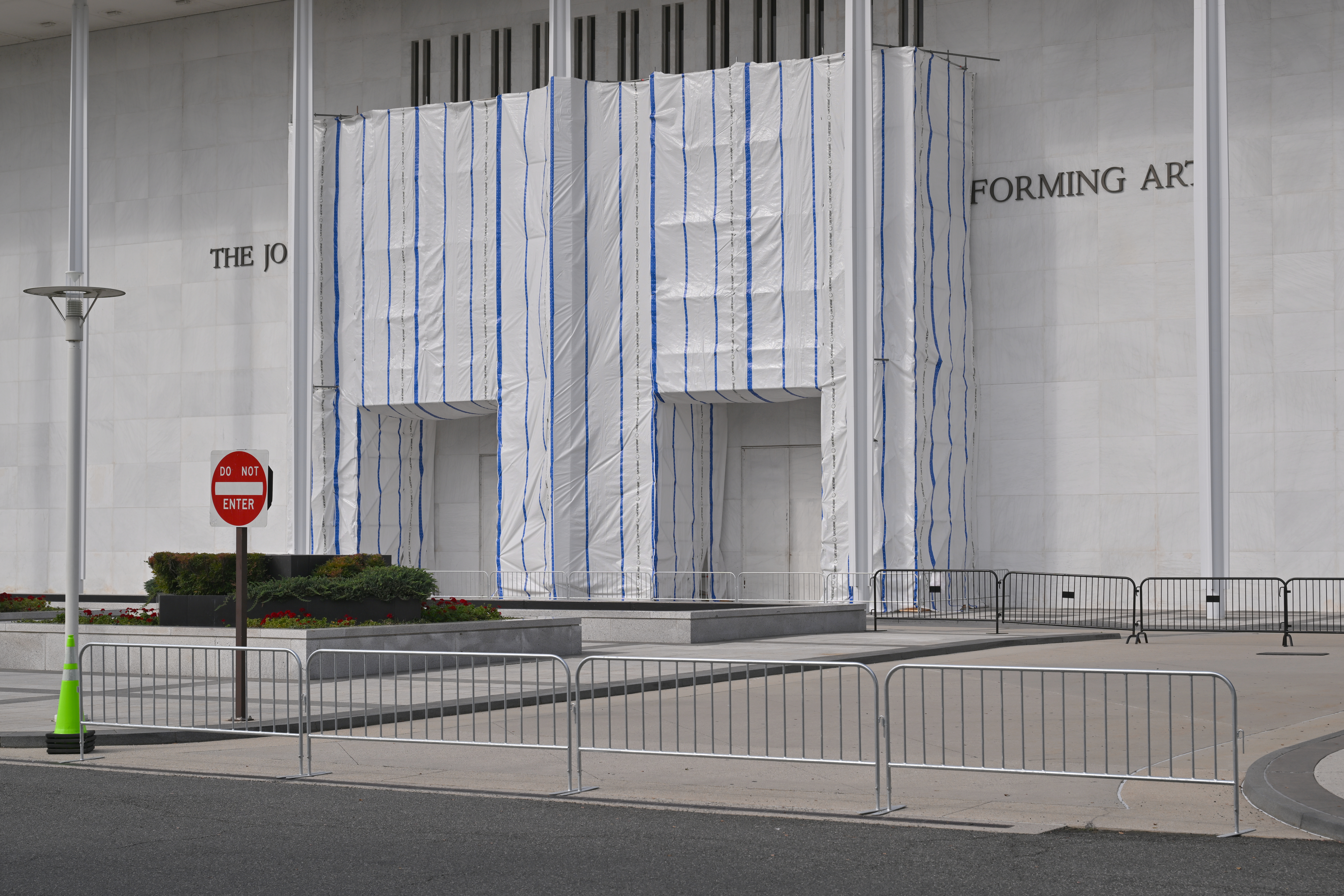
The traditional fall arts season is heating up in Washington, D.C., but for the second year in a row things look very different. The Kennedy Center is shuttered and rumors about its future swirl. Staffing cuts at The Washington Post leave residents and visitors alike without one of their essential guides to what is going on. Chatter on social media and from nascent local newsrooms compounds the sense of existential dread for the performing arts.
Personally, I’m disturbed on many levels. I regularly attend concerts and other performances. I’ve worked professionally with local presenters and serve on the board of another local arts presenter. I’ve seen close friends lose their jobs. We rely on art to help distract us or comfort us amid political and societal realities, but that arena is no longer immune.
However, I know that there has to be more to the story. I recently sat down with Jenny Bilfield, President and CEO of the venerable Washington Performing Arts. I met Jenny in New York’s classical music scene in the late 1990s, and she’s forged a career as a savvy arts administrator. I asked her for an insider’s view, particularly for the benefit of Beltway outsiders, and hopefully a bit of a reality check.
Zachary Hooper: I thought it would be really interesting to hear from the inside, especially for people who aren’t in D.C. or in the performing arts and they’re just seeing headlines about the Kennedy Center and seeing that The Washington Post is decimating their arts coverage. What’s really going on? What’s your 30,000-foot view of what the performing arts are like right now?
Jenny Bilfield: The Kennedy Center is such a visible and iconic institution. It’s not a surprise that its activities, on the best of days, get a lot of ink, but then, also, on the worst of days, also get a lot of column inches. It is 2 million square feet of space, and so a lot can happen in it, and it’s such a visible part of the landscape. And the attacks on the Kennedy Center, the complete sort of hijacking of the board, and staff, and the decimation of the organization have been a really serious grieving point, because we know that it’s a symbolic manifestation of our city and our culture. And it’s also been a home to so many organizations. Our founder worked with Mrs. Kennedy to imagine a performing arts center.
At the same time, one could argue that the reason there was an audience for the Kennedy Center was because of all the arts organizations that existed in Washington before it was built, whether it’s the opera, the symphony, the theater companies—this is an arts-based community. There were arts organizations and patrons who were ready to move in and to grow that base of performance, artistic representation, support. As we grieve the Kennedy Center, my mind goes to how we keep our arts community strong, so that we prevail through this period of time.
Whenever I run into someone, they say, “Oh, my God, the Kennedy Center.” The arts are going to be all right in Washington, as long as the individual arts organizations assert their creativity and their voice, and continue to do excellent work and earn the support of their donors. We have eighty theater companies in Washington. We have so many different performing groups, dance companies, presenters, and choirs. You can stand on a corner and run into five people who sing in different choirs. It’s a wonderfully ridiculous amount of musical and performance activity relative to the relatively small population here. So, the arts have not diminished because the Kennedy Center has gone away. The Washington National Opera is a great example of rising from the ashes.

I pulled us out of the Kennedy Center in February of 2025, when I heard that the administration and board were being sent off and fired. That, for me, was a pretty classic example of authoritarianism. You take over important buildings and you program and assert your vision accordingly. I knew that this would be a troubling, unstable time to be at the Kennedy Center.
Many members of our Black community did not want to be at the center because there were attacks on DEI popping up everywhere. It did not feel safe. We heard from colleagues over there that ICE was in the building when student groups were there, so they were looking at teachers, presumably families, and LGBTQ friends who had looked forward to being part of the pride performances there. Their organizations no longer had contracts. So for all the people who would not feel comfortable there, we felt it was time for us to relocate our performances for the following season.
ZH: Historically, you’ve had a lot of different venues where you put on programs. Was that by design or just that’s sort of fortuitous? Looking ahead to your coming season, you’ve got a lot of places where you can put on performances, which is terrific.
JB: Right. And actually, it’s kind of nice that you can do things in different geographies around the city. During my interview, there was a conversation—this is 13, 14 years ago—about how Washington Performing Arts doesn’t have a venue. “You’re coming from Stanford, you’ve just built a venue. How do you feel about that?” And I said, I think it’s a creative advantage, because you can be in many different parts of the city, different size spaces, for different artists. And I said I would say the city is our stage. And so that’s a tagline that’s stuck all these years.
I really do see it as a strategic advantage, because when an artist has a very intimate program, we can present it in an intimate venue, when they scale up and they do something really big, we can present it at a bigger venue. But this late in the planning, February of 2025, we had a lot of things scheduled in every single program. We were able to find venues for every single major program, certainly all the big things went to Strathmore, because we jumped on it really early. The announcement about the board came out on a Friday, and my colleagues and I were calling the artists and venues on Monday, and we did it very under the radar to see what would be possible if the artists were amenable. And then we worked with our board and our staff over the next two months to really map out what this would be, because a lot of organizations were like, “Oh, you’re being too preemptive. It’s too soon. How do you know? We should just wait and see.” I’m like, “I know this playbook. I’m certain of this playbook.”
What it has done is enabled us to deepen a partnership that we have with Peabody and with Johns Hopkins. It’s enabled us to bring more people to Sixth & I than before, which is a venue we love. And which, to our classical audiences, was less well known, because when we first presented performances there twenty-ish years ago, it wasn’t as built up around there.
This is a chance for independent organizations to assert their brand, separate from the Kennedy Center. If you define yourself so much by the venue that you use, that’s worrying. In my opinion, you should have a mission and vision that is portable. It could go to the Kennedy Center, could go to Strathmore, could go to Sixth & I. The container adds luster, but it shouldn’t destabilize you if you move to a different place. I mean, places get flooded. They get renovated. They’re not accessible. So, we know how to do this, but the potential departure from the Kennedy Center was a very difficult decision for all of the emotional and practical reasons as well.
I think that the story that really hasn’t been told in all of this is the impact on the local economy. Because a lot of people in the federal workforce joined the choirs, bought the theater, music, and dance tickets, and came to the performing arts performances. Many of them started to come at a time when they were beginning to think about retirement. It’s definitely decimated a lot of the regenerating base of new people who come in, whether that be new federal workers or people who work for consulting firms or businesses that deal with the federal government.
I pulled us out of the Kennedy Center in February of 2025, when I heard that the administration and board were being sent off and fired. That, for me, was a pretty classic example of authoritarianism.
ZH: Can you give me some examples of other, kind of interesting, positive collaborations, innovations that you’ve seen in the area that make you think, okay, we’re going to make it through this?
JB: I would point to Arena Stage hosting the D.C. Jazz Festival and Step Afrika as an example of a venue hosting two local organizations, one a presenter and producer, and the other essentially a dance company. They have come up with a model that fills their spaces with active arts making throughout the day.
I think what we’ve done with Johns Hopkins and Peabody has been really exciting because they have this beautiful space not far from Capitol Hill. And it’s drawn people to that part of the city—they go to the gallery, and we have artists who then do some coachings with Peabody students. So it’s a very nice kind of symbiotic relationship.
We’re collaborating with a whole host of organizations for our Dance Theatre of Harlem performance. It’s opening next season. And I think there’s a great deal of will, when you think about our arts education program and how little money is available at the D.C. public schools, for arts partnerships. Those are coming through local partnerships with Monumental Sports, with different parts of the government that support the go-go program, with 7 Drum City. So, when you get in a room, everybody wants to make something work, and then we’re like, okay, who has access to what space, who has what money, what grant money? How do we put this together? Okay, well, we can’t do all that. We’ll do this. So it’s a bit more like a charrette, like a working process because we’re trying to figure out how to reach new audiences.
ZH: That’s great. So, you’ve now been here for 13 seasons, give or take. Over that arc, how has the performing arts scene changed during that time period?
JB: A number of ways. There are an increasing number of coalitions to advocate collectively, so every year when there’s a budget that comes up for review and for consideration, many of us pull together and come up with a common platform. “These are the most important things for us to advocate for. Here are the points that present challenges for the Arts Commission, because the Arts Commission can’t advocate for itself.” They’re not allowed to rally us to advocate for them, so we advocate as constituents. We put together a bit of a platform and go before the city council to advocate for support. When I came here, the local funding was at the discretion of the mayor, so she would decide that maybe the Arts Commission would get $15 million, or maybe $18 million, or maybe $20 million, but then throughout the year, unused funds would sometimes be clawed back. It was impossible to predict what the arc of your funding might be. And these are crucial programs that serve schools and artists.
For about three years, a bunch of us advocated with the city council working with David Grosso to develop a tax-based funding model. When the fortunes are good, the money goes up, when they aren’t great, money goes down, but at least it’s tied to some economic factors. So the second year after that had been approved by the city council, the available funds went from something like $25 million to $45 million. It was a stunning amount of money. And that meant that there was a much greater awareness of the equitable distribution of funds, on capacity building, for organizations. This was right around 2020. So the question of how our wider community could support Black-founded and Black-led institutions that might be just getting a start and not have the board infrastructure or the staff infrastructure to raise money or advocate at the same level was prominent.
There was a much more interesting conversation about how a community continues to grow by recognizing the needs of the newcomers are not the same as the needs of the established ones, but they all need to coexist side by side. And I think that prompted a number of challenging conversations and bracing conversations and highly productive conversations. Money often does that. So it’s not a surprise. But I see us being more fearless in having those conversations, because if we don’t pull together, then we will not survive together.
ZH: Previously, you’ve been in New York, you’ve been in Stanford. What surprised you most about coming into this space in the DMV?
JB: I was thinking about this when I accepted the job—there were a couple friends at Stanford who were like, ‘Oh, my God, it’s so sleepy there. You’re going to be so bored.’ I’m like, Really? It’s the intersection of the civil rights movement. It’s local politics, it’s national politics, it’s policy, all the NGOs that are here—so many incredibly smart people work here. It didn’t surprise me that there was a lot of candlepower in this region. It was very exciting. I loved engaging more in policy and politics. I really love the civic piece of my role, because it’s an opportunity for me to be an ambassador with new audiences, not just to speak to the same folks who are already persuaded, but to understand what inspires and moves them, the fact that it’s a very international community exposes us to a lot of new people, cultures, holidays, and the beauty of the embassies transports you into a whole other world and community, literally. It’s very eye-opening, culturally, and eye-opening, intellectually. And so much is at stake, so much that happens in our wider world happens and starts in Washington, so that sense of the rooms where it happens. I hadn’t quite expected to feel that as strongly as I did in all those different levels.
What I was also really impressed with, and nobody ever mentioned this, coming from either New York or from Palo Alto, is that there were so many unbelievably smart, capable, talented women in leadership roles in Washington. There weren’t that many women in leadership roles at venture capital firms or heading tech firms. It was not, it was not a female-friendly place for people to work. As we’ve since learned from all the different harassment suits and whatnot the real numbers of who’s in charge and working there. But coming to Washington, I met leaders in the armed forces, corporate, nonprofits, diplomacy. It was really, really impressive and fascinating. I’ve actually found more mentoring and more interesting conversations here in that realm than I ever expected.
ZH: What are you most looking forward to in the coming season? What are you really excited about?
JB: Dance Theatre, of Harlem because Stravinsky is one of my favorites of all time, from when I was three years old. The Boston Symphony. I’m very excited about Hayato Sumino. I heard him at the Hollywood Bowl last year, and he’s such a staggeringly talented and unexpected musician. He is a piano virtuoso who creates his own tropes and interpretations of music, and it’s just, like, he goes to 11, you know? He’s fascinating, and I love the way his brain works. I’m very excited about the performances our gospel choir is doing, there are the performances that are in our catalog, but then there are a number of appearances, and collaborations that they’re doing in other areas as well, that will kind of reveal themselves over time. You have Élisabeth Pion Jelong coming back. She’s one of the artists that we first presented—she made her debut on the Hayes piano series. So there’s a long relationship there that I really love. The Boston Symphony, very wistful. This will be the antepenultimate performance that they do with Andris Nelsons. They will go from us to Carnegie Hall, back to Boston, and that will be his last performance. I know that the orchestra is going to play at the top of its powers, and that we were working on that performance for a number of years. So I feel very sentimental about that kind of coming to fruition.
ZH: Finally, for the readers who are not in D.C., what do you think is something that is important for them to know about performing arts here? Or about the performing arts more broadly?
JB: You will never experience a more vibrant, independent, nonprofit theater community, anywhere else in the country. There’s a lot of commercial theater all over, for sure. But this has such a high density of homegrown and incubated theater, that then goes off to Broadway and all over the place.
There are so many unusual places to hear music here. It can be heard for free. The variety from baroque music to contemporary to opera, to solo performance is really thrilling. The downfall and the diminution of The Washington Post coverage of music, and of the arts in general, is really unfortunate, because there actually really isn’t a publication to look at that covers all the things that are coming up. You have to go to a couple different places to get listings and source it. Anyone who loves the arts will not be disappointed.