


For secular Americans—atheists, agnostics, humanists, and those who are simply uninterested in or indifferent to religion—a central paradox these days is this: our presence has never been so significant, the stigma against us has never been so tempered, and yet our Constitutional rights have never been more imperiled. That is, just as we have become a formidable demographic chunk of American society, the very principles of secularism that we cherish, and which serve to protect us, are being undone.
Let’s start with the good news on the secular front: high numbers and improved societal acceptance. When I was born, back in 1969, only 4 percent of Americans said that they had “no religion,” but today that is up to somewhere between 22 and 29 percent—the highest rates of American irreligiosity ever recorded. Conversely, membership in religious congregations is at all all-time low, and—despite a slight post-COVID uptick—weekly church attendance is also at an all-time low. Furthermore, the percentage of Americans who say that religion is an important part of their daily life has dropped down to 49 percent, the lowest ever recorded. And despite some recent chatter of a religious resurgence among young adults, the latest Pew data “shows no clear evidence of a religious revival among young adults,” and according to PRRI’s Census of American Religion, the percentage of Americans between the ages of eighteen and twenty-nine who are unaffiliated is at nearly 40 percent—an all-time secular high.
Finally, concerning the very hallmark of religious faith in America, belief in God, that, too, is at an all-time low, with around 19 percent of Americans lacking such a belief; the percentage is probably even higher, however, for when anonymity and confidentiality are guaranteed, estimates suggest that around 25 percent of Americans may actually not believe in God.
Also good news: along with such unprecedented levels of secularity in the United States has come greater societal acceptance and decreased stigma. For example, 60 percent of Americans now say they would be willing to vote for an atheist for president—an all-time high. Around 75 percent of Americans say that they personally know someone who is an atheist, and around three quarters agree “it is possible to be moral and have good values without believing in God”—both all-time highs.
Anecdotally, more famous people are willing to come out as openly secular these days, including football players Josh Rosen and Arian Foster, Colorado governor Jared Polis, Senator John Fetterman, Rep. Jamie Raskin, author Ta-Nehisi Coates, billionaires Bill Gates and Jeff Bezos, and actors such as Brat Pitt and Jodie Foster. And on Capitol Hill, more and more members of Congress are willing to openly align themselves with the less than a decade- old Congressional Freethought Caucus.
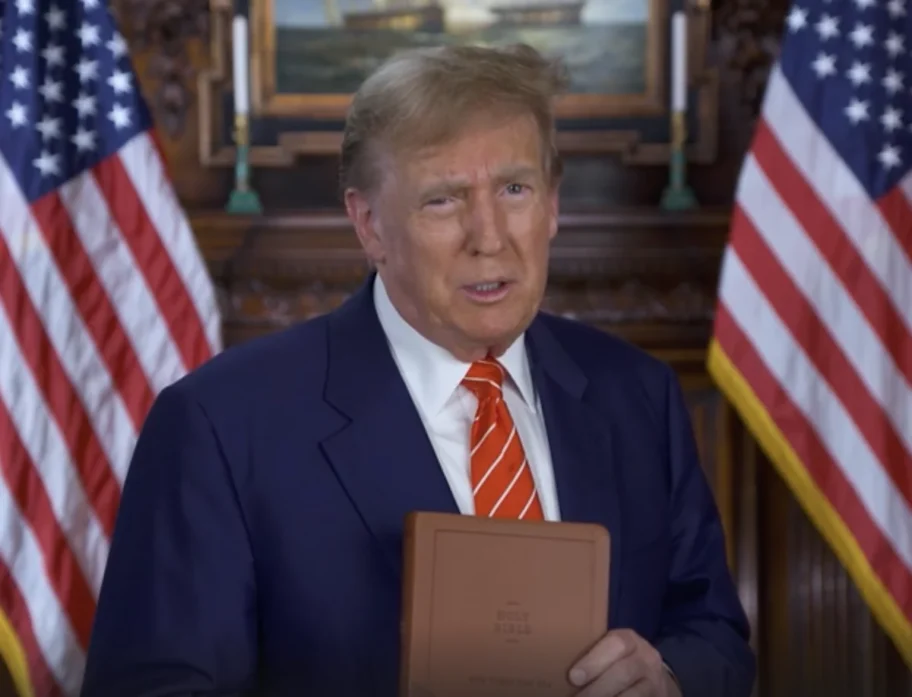
Given all that, one could justifiably assume this to be a golden moment for secular Americans. Unfortunately, thanks to the Trump regime, such is not the case. The most prominent sore spots: unprecedented governmental support for Christian nationalism coupled with multi-pronged attacks on the first clause of the first sentence of the First Amendment, which declares that Congress shall not establish religion. This visionary secular political ideal, which Thomas Jefferson explained was meant to create a wall of separation between church and state, is being bulldozed by Trump-appointed judges, Trump-aligned lawyers, and Trump-loving political and legal activists. “We want to bring God back into our beautiful USA like never before,” Trump declared last September, at the funeral of Charlie Kirk. And it wasn’t an empty threat.
Consider the following.
Trump’s numerous appointed judges to the Supreme Court have ruled with an activist’s disdain for the first clause of the First Amendment and consistently moved, in numerous cases, to weaken political secularism by expanding religious privileges. The Court’s wanton abandonment of the Constitutional “Lemon test” is perhaps the most obvious case in point; state and federal employees and publicly funded institutions can now proselytize with impunity, explicitly favor Christianity over other religions, and engage in activities that are prejudicial against or systematically disadvantage the nonreligious. Additionally, Trump’s administration has routed the Johnson Amendment, making it permissible for the leaders of religious houses of worship to publicly endorse political candidates with impunity; in other words, religious organizations that advocate politically will not have their tax-exempt status threatened or revoked, but secular organizations that do so may and—if deemed hostile to the Trump regime—will. As, for example, happened to the secular charity organization Nobelief Relief.
“We want to bring God back into our beautiful USA like never before.”
Beyond his anti-secular Supreme Court appointees, Trump has packed lower courts throughout the nation with Christian judges relatively hostile to the establishment clause and far more likely to support Christian plaintiffs in free exercise cases than Muslims or secular people. Trump has also appointed an unprecedentedly high number of Christian nationalists and prosperity gospelists as power-wielding players throughout his administration—people like Pete Hegseth, Kristi Noem (now out of a job), Paula White, Jennifer Korn, Jackson Lane, William Wolfe, and Russell Vought, who are all hostile to the establishment clause of the First Amendment or have expressed, or been aligned with, various versions of Christian dominance or supremacy.
Finally, Trump has established a White House Faith Office, a Religious Liberty Commission, and an “Anti-Christian Bias” taskforce. Most likely, these three organizations will serve to only strengthen the unconstitutional bond between government and religion, promote Christianity, and privilege Christian people and Christian beliefs, while simultaneously denigrating or seeking to erase secular people, values, and ideals. “We will always be a Christian nation,” Vice President Vance declared at AmericaFest 2025, banishing any doubts about this government’s antisecular agenda.
Of course, the apparent paradox here—fewer Americans affiliating with Christianity, while Christianity is simultaneously granted unprecedented political privilege—is part of the explanation for what is going on. It works like this: as more and more people walk away from Christianity and religion in general, faith-based hegemonic power will weaken and its cultural and political influence will wither. Realizing this, Christianity’s most ardent supporters, seeing both their numbers and influence on the decline, have been galvanized to do whatever they can to ensure their own survival, even if it means violating the Constitution.
The other explanation is realpolitik. Trump’s leadership role in this Christian-privileging pushback against secularism is, undoubtedly, strictly tactical. He’s not a faithful, practicing Christian, seeking to please his Lord. Rather, he simply takes support from wherever he can get it, and in recent years, his bedrock of support has been white Christians. They do not represent “true” Christianity, and their numbers may be fewer than more moderate Christians, yet they wield outsized political might, which Trump harnesses for his own ends. Katherine Stewart, author of The Power Worshippers and Money, Lies, and God, has been studying Christian Nationalists for years. As she explains: “Trump and his people are simply interested in tools of power. Christian nationalism is a tool of power because it helps to consolidate this base of voters. It is a way of mobilizing their support and signaling to them that he is on their side, and the surest way to signal that is to antagonize ‘liberals’ and ‘secularists’ as his base sees it.”
Will Trump’s co-opted Christian nationalists succeed in destroying secularism and establishing Christian hegemony throughout the land? No. The demographic facts are just too stubborn to overcome: both ongoing secularization and increased religious diversity will render this problematic moment of Christian political might limited and, ultimately, surmountable. Too many Americans are walking away from religion and raising their kids without religion, and the number of Americans who affiliate with religions other than Christianity is also increasing. Both of these trends will render a politically-fabricated “Christian America” unfeasible in the long run, no matter how hard those in Trump’s regime try to make it so.