


In 2008, a year after the artist Sol LeWitt died at the age of 78, I began work on his biography. I was under no illusions about the need for a biography, but perhaps I underestimated the obstacles. I would not have imagined that even in death LeWitt would remind me of what it takes to overcome them.
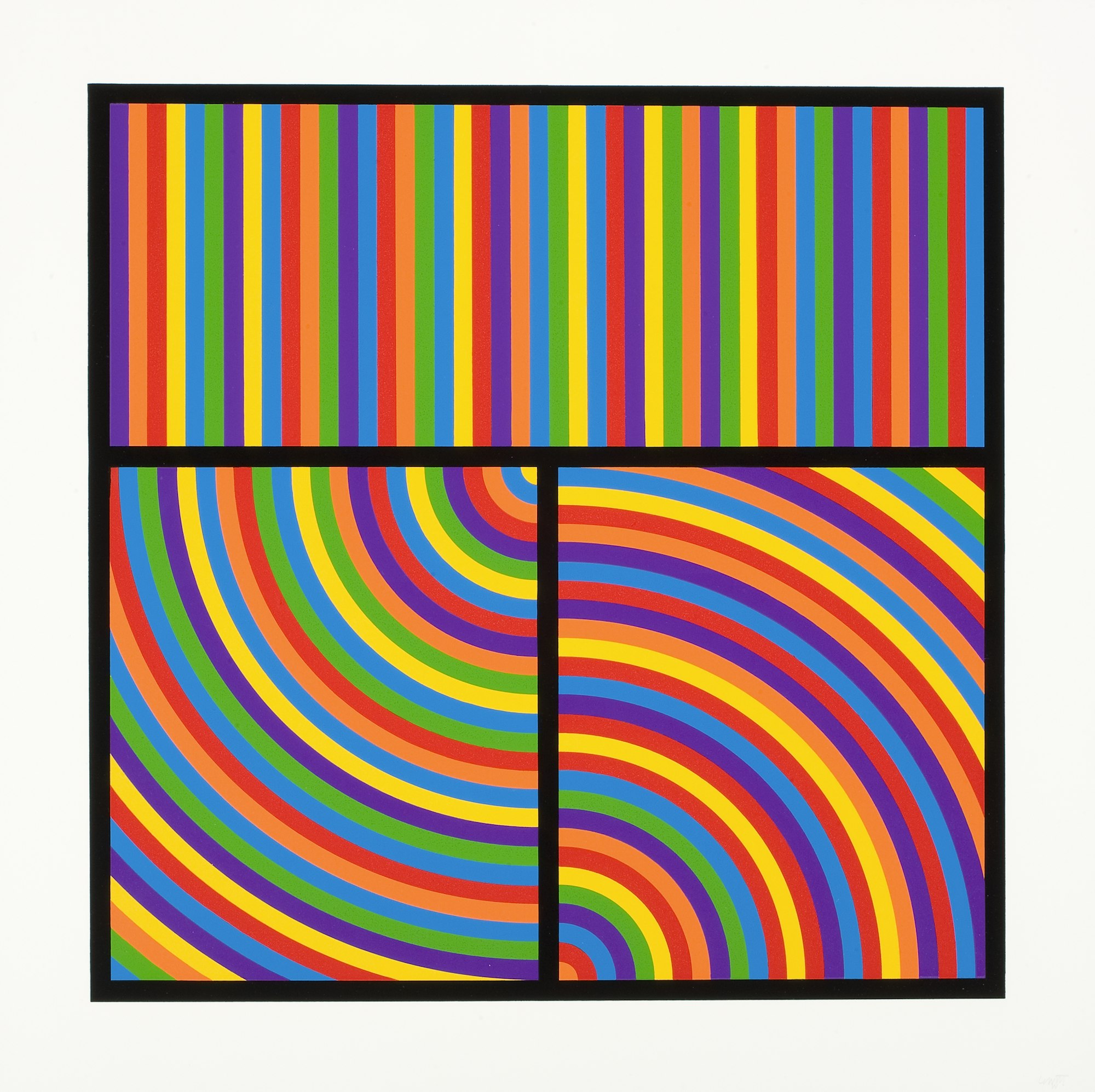
LeWitt was widely known for his huge and vibrant wall drawings, his other indoor and outdoor installations, his support of other artists, and his disdain for nose-in-the-air attitudes about creativity.
He argued that the idea of a work of art is more important than its execution, which he considered “perfunctory.” To prove the point, in 1987 Christie’s auction house broke one of its hallowed rules. Instead of putting up for bid a finished work of art, it sold just the instructions for LeWitt’s wall drawing, Ten Thousand Lines About 10 Inches (25 cm) Long, Covering a Wall Evenly. The buyer paid $26,500—and still had to hire one of LeWitt’s crews, composed mainly of young artists, to install the finished piece.
In a profession known for creating art meant to be permanent, LeWitt painted over his first-ever wall drawing, an intricate indication of what was to come, at Paula Cooper’s gallery in SoHo. It was the origin of his “now you see it, now you don’t” approach. The painting may vanish, but the idea, he argued, lasts forever.
But LeWitt had also built a wall around himself, as he disdained the culture of celebrity in favor of a life of privacy. He shooed away photographers and reporters. At exhibition openings he couldn’t avoid attending, he shunned small talk and any guest’s attempt at “art speak,” which he compared to “chewing glass.”
Yet he was by no means a loner in his field. His generosity and empathy toward fellow artists became legendary. He refused to sell pieces to collectors until they first bought work by his peers. His diary entry in March 1985 was typical: he had an income of about $11,000 that month, and spent about 90 percent of it to buy work by artists whose work he admired but who were struggling to make a living.
After all, he had struggled, too. In his art classes at Syracuse University, his grades paled when compared to those of students more gifted at representational art, which he had no interest in. That struggle continued for many years. This seemed to me a universally apt metaphor—one that could transcend the boundaries of art and deliver a message to those in any creative field who want to honor their instincts but fear they won’t measure up.
I saw all this not only as a fan but a personal friend. I had a literal foot in the door of his studio in Chester, Conn. We often met in the early mornings. We talked not about art but about life, politics (he was a fervent lefty), books (histories and philosophical tomes), classical music, and the Cleveland Indians, our mutual summertime passion.
And there was this personal stunner: though he described himself as “old, bald, deaf, fat, pig-headed, clumsy, and at times self-absorbed,” he attracted as lovers some of the most talented women in New York City and beyond. These included Mary Peacock, a founder of Ms. magazine; Mimi Wheeler, a staffer at Harper’s Bazaar; and the artists Pat Steir, Karen Gunderson, and, in The Hague, Petra de Jong. Moreover, in a time when female artists were often dismissed by critics and galleries, he championed them, inspiring them to persist and often augmenting their income—artists such as Grace Wapner, Adrian Piper, Rosemarie Castoro, and, most famously, Eva Hesse.
My effort to paint a portrait of his life stretched over a decade. And yet, at its end, the book almost was not published.
I was certainly not producing a hit job. I was not following the lead of Kitty Kelley, whose “unauthorized” biographies skewered Elizabeth Taylor, Jackie Onassis, Oprah Winfrey, and Frank Sinatra.
But even when biographies are not “unauthorized,” the journey to publication is often fraught with obstruction, as with biographies of Elvis Presley, Marilyn Monroe, Yoko Ono, and many other notables. Nevertheless, I plunged into the field of land mines, confident that my extensive nonfiction work had prepared me for the task.
My agent at the time, Lorin Rees, secured a contract with the estimable house of Farrar, Straus and Giroux, which had been the publisher for many Nobel Prize winners, including one of my mentors, Isaac Bashevis Singer. As part of the pitch, we pointed out an added asset: Carol LeWitt, Sol’s widow, who with her staff at the LeWitt Collection in Chester fervently promoted her husband’s work, was eager to use her influence in the art world to attract attention to the biography. She was connected the world over, and could help sell the book and extend her husband’s legacy in the dozens of countries that display his art.
After spending seven years at the task, conducting nearly 150 interviews, and traveling extensively, I produced an almost complete draft. I asked Carol to read it. At that point, the biography was considered authorized: developed with the cooperation and input of the family, and to be marketed with its support.
Carol had given me access to Sol’s peers and friends, including visual artists Chuck Close and Carl Andre and composers Philip Glass and Steve Reich. She had opened the LeWitt Collection, where I found his letters, notebooks, early work, and much more.
She also invited my wife, Suzanne, and me to her ancestral home on the Amalfi Coast. (She had previously volunteered to open the house in Praiano so we could host writing workshops there in 2013 and 2014.) This time, she drove us across the Italian peninsula to Bari, where she introduced us to gallerist Marilena Bonomo and her husband, Lorenzo, among the first to promote Sol’s work in Europe.
In all, there was no doubt that without Carol’s help, I would have produced a thinner manuscript. Even so, that support came at a cost—financially and psychologically.
I had been in frequent contact with my editor at FSG, Alexander Star, and to that point all had gone well. I knew of his impressive reputation, and received his encouragement and guidance. After a trip to the Netherlands for interviews with historians, gallerists, and artists, I wrote to him in August 2015:
Amsterdam proved very helpful. Excellent conversations with those who knew Sol when he was emerging in Europe, and with yet one more of his flames, a Dutch woman who comforted him on a remote island in the wake of Eva Hesse’s death.
The first draft is at this point complete, except for the epilogue. I have added a reader to the list, the art historian and curator Gabriella de Ferrari…. So it appears the thing is coming your way before too long.
Star replied quickly, calling it “great news,” and went on to praise a new exhibit of work by LeWitt and Eva Hesse at the Whitney Museum of American Art. He was clearly immersing himself in the world that had come to consume me.
At that point, I felt confident that all was well. Still, I was aware that Carol might have reservations. She had originally hoped I would collaborate with the art historian and curator Andrea Miller-Keller. I admired Andrea, but I explained that such a partnership would not be practical for either of us. I sensed Carol’s disappointment, but soldiered on.
She could still rely on a trusted art expert and friend, Jock Reynolds, director of the Yale Art Gallery for two decades and a LeWitt champion, to provide an expert assessment of my work. This arrangement, however, soon seemed untenable for me. At one point, after I had called him while he was vacationing in California, Carol called and said that I shouldn’t have bothered him while he was away. That should have been a warning—she didn’t seem to take my work as seriously as the work of those in the art world, but I brushed it off.
A month after my note to Star, Carol’s reservations surfaced more broadly. She asked me to come to downtown New Haven, to Reynolds’s office. Carol had asked him to review the draft, as I knew she would. In advance, Jock’s assistant called to ask my lunch preference; she would order takeout for the three of us. I brought my laptop, expecting we would spend an hour or two reviewing sections of the manuscript—correcting any errors, perhaps discussing aspects of Sol’s life I still didn’t fully understand.
The meeting lasted all of nine minutes.
Jock looked down at the manuscript on his desk, picked it up, and tossed it back with obvious disdain. “I don’t know anyone who would want to read this,” he said, more than implying that it was a violation of Sol’s privacy, and that it lacked artistic authority. In other words, it wasn’t dull enough.
What followed Jock’s opening statement is largely a blur; I was too busy trying to absorb the shock. I looked at Carol. She turned to me and said—just as I thought she might soften the blow—“I agree. This is not what Sol would have wanted.”
There was no point in replying that what Sol would have wanted was not the standard. This was a biography, not a press release, and it required the voice of an astute storyteller, not an art historian. The manuscript, then, had revealed a full life, one of confusions, disappointments, love affairs, contradictions, and other subjects unexplored in the many beautiful catalogues of LeWitt’s work.
The humiliation had been too much to take. I closed my laptop, and left the office. As I passed Reynolds, he said only, “Sorry.”
I was so confused that I didn’t know whether to turn left or right on the sidewalk. Later, I recognized every bit of the professional catastrophe that it was. I feared the episode would bring on another episode of clinical depression, which previously had been limited to personal crises such as the deaths of two wives, but now would soon return, as my livelihood was threatened.
I presumed that Carol would subscribe to author Janet Malcolm’s view, expressed in The Silent Woman, that biographers are “burglars,” in effect snatching their subjects’ treasures and money, although I didn’t consider myself a felon of any kind.
I was so confused that I didn’t know whether to turn left or right on the sidewalk.
As a journalist, I had always tried to pursue the truth rather than conform to a subject’s preferences. And even if I had tried to meet what Sol might have wanted, I could never be certain I had succeeded. On the other hand, I had earned his trust.
Years earlier, I had written a magazine piece after attending Sol’s surprise 70th birthday party at Hartford’s Wadsworth Atheneum. It had been an awkward affair, at a minimum. A busload of artists from New York City had arrived at the party, their personal tributes stuffed in their pockets, but he allowed none of them to speak, shouting them down when they tried. It was a stunning evening, indeed: an honoree who couldn’t stomach being singled out for praise. I knew I had to write about it in the magazine I edited, Northeast, the Sunday magazine of The Hartford Courant. Friends warned me he would object to such a piece.
So I called him at the studio to tell him that I had written it, and he responded in one word: “Why?”
I said, “I followed my instincts.”
He asked, “Do you always follow your instincts?”
This question stumped me, as I knew well that to the artist, instincts were key. Nevertheless, he surprised me. He said, “Well, if you’ve written it, the very least I can do is read it.” I went to his studio and dropped it off. I saw him a few days later at a Shabbat service, and said I decided not to publish the piece, that it would unduly embarrass him.
He replied, “Why not? I thought it was pretty good.”
Some weeks later, I would overhear Carol describe the manuscript to a friend as “lowbrow.” Still, she never specified her objections to me, though Jock did raise one on her behalf—that Sol’s elder daughter, Sofia, who had declined my requests for interviews, appeared only briefly. But I had conducted fruitful interviews with her sister Eva, herself a visual artist whose work has been displayed widely, and who told me that she looked forward to reading the biography to “find out things about my father I don’t know.”
I sent the nearly finished draft to Star, my editor. A few weeks later, he replied in a cool tone: “I’ve finished the manuscript and put my thoughts together in the attached memo. I’ll look forward to your response. Please bear in mind that even if the editorial concerns can be resolved, there remains the question of how the book could be published without the support of Jock Reynolds or the estate, particularly regarding quotations and images.”
Soon after, FSG canceled the project.
Publishers do cancel contracts when authors fail to deliver. Some biographies collapse under legal scrutiny. But I could find no comparable case in which a project was abandoned because a family member withdrew promotional support.
I wrote immediately to my agent, describing the situation. Lorin Rees suggested I reach out again to Carol. When I did, she responded warmly and even proposed speaking with Lorin. For a moment, it seemed possible that matters might be repaired.
But as I soon learned, the cancellation stood.

After the initial shock, I thought of Sol. One chapter of the biography had been titled “What Would Sol Do?” I knew the answer in this case. He would treat this as part of the work: struggle, disappointment, even outrage.
I thought of the 1965 letter he wrote to Eva Hesse to encourage her after a string of disappointments—the one so pertinent and theatrical that many decades later it would be read onstage by Benedict Cumberbatch and Andrew Scott. It reads, in part:
It will be almost a month since you wrote to me and you have possibly forgotten your state of mind (I doubt it though). You seem the same as always, and being you, hate every minute of it. Don’t! Learn to say “Fuck You” to the world once in a while. You have every right to. Just stop thinking, worrying, looking over your shoulder, wondering, doubting, fearing, hurting, hoping for some easy way out, struggling, grasping, confusing, itching, scratching, mumbling, bumbling, grumbling, humbling, stumbling, numbling, rumbling, gambling, tumbling, scumbling, scrambling, hitching, hatching, bitching, moaning, groaning, honing, boning, horse-shitting, hair-splitting, nit-picking, piss-trickling, nose sticking, ass-gouging, eyeball-poking, finger-pointing, alleyway-sneaking, long waiting, small stepping, evil-eyeing, back-scratching, searching, perching, besmirching, grinding, grinding, grinding away at yourself. Stop it and just DO!
A few days later, still reeling like Eva, I could almost hear him again: Forge ahead. Forget the outrage. Get back to work.
My agent, for all his efforts, was unsure what to do next. It seemed to me there might be a path. I had long admired Wesleyan University Press. Once, I had taught writing in Wesleyan’s graduate program, so it seemed like a natural fit. True, a university press would not offer anything like the financial terms of a major house, but it carried its own kind of prestige.
I wrote to Suzanna Tamminen, Wesleyan’s publisher, explaining candidly what had happened.
She replied within hours, expressing sympathy and interest, and asking the essential question: would the family pose legal obstacles?
More land mines, I thought. But after meeting with her, I felt a steadier footing than I had in my final exchanges with FSG.
The review process was rigorous. Suzanna sent my draft to professors of art and art history. By then, though, I felt more secure, as these reviewers of the work would be objective in their assessments. As it turned out, their suggestions, along with Suzanna’s, helped strengthen the manuscript. These readers pushed for nuance, precision, and restraint—especially in chapters where I risked overgeneralizing broader cultural conflicts.
Carol, too, was a help. She volunteered to read the final manuscript to alert me to any errors of fact. We met at a bagel shop on the Connecticut shoreline and she had a short list of mistakes to discuss, but she was charming and clearly resigned to the fact that the biography was being published.
The process of polishing and producing the book took more than a year, and in the spring of 2019, Sol LeWitt: A Life of Ideas was published. In all, it turned out to be an expensive, troublesome, and ultimately enriching project. As time passed, as readers responded from across the United States and abroad, I came to feel something closer to resolution than vindication.
One review, in The Times of London, by Patrick McCaughey, former director of the Wadsworth Atheneum, put to rest the charge that the work was “lowbrow”: “Bloom’s portrait of this exceptional man and artist is memorable and uplifting in an art world currently doused in money, status, and celebrityhood.” Bryan Wolf, the Stanford art historian, called the book “a remarkable narrative filled with history, biography, art criticism, gossip, behind-the-scenes chatter, and insight.” He said that I “present[ed] a LeWitt that most of us have never seen before: private, irreverent, passionate, generous, and deeply self-aware.”
Even so, the readership was smaller than it would have been had FSG published the book. That, too, is part of the record.
I still speak with Carol, and she with me, though never about the book. One reason I even bother with politeness is because we still belong to the same synagogue, the only public building that Sol had ever designed, Congregation Beth Shalom Rodfe Zedek, in Chester. Moreover, at my age, and in a state of general contentment otherwise, I prefer not to fritter away my psychic energy on revenge or hostility.
Unsurprisingly, Carol was not in the audience at the New Britain Museum of American Art when I gave a talk in the industrial city where Sol grew up.
That day, I read from the chapter on his childhood. And on page 13, I began to laugh. The audience looked puzzled. After a decade immersed in the manuscript, after endless revisions and the careful work of a copy editor, I had somehow missed an obvious typo: the museum’s curator had exhibited not the works of Picasso, Matisse, Chagall, Braque, and Modigliani—but, as I had written it, their words.
So, as it turned out, I was not the “burglar” that Janet Malcolm surmised we biographers are, with a balaclava and crowbar. I was something more familiar, and perhaps more forgivable: a biographer who took risks, undertook exhaustive research, told the truth as best he could, paid a price for it—and, in the end, still got a few words wrong.