


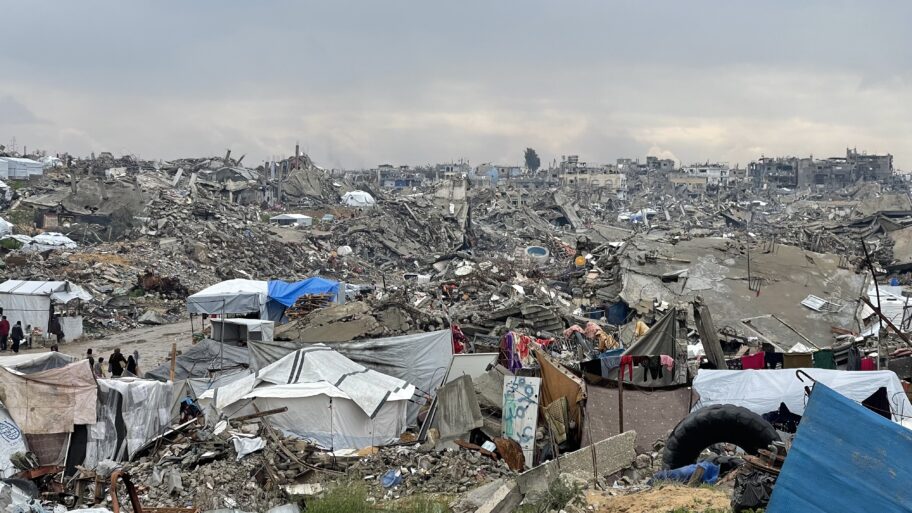
With some distance from the world-historical catastrophe that is October 7 and the destruction of Gaza, it is reasonable to assert that this moment poses a singularly great challenge to liberal Zionism, the idea that Israel can be both a Jewish and pluralistic, democratic state.
The origin of liberal Zionism is itself a separate subject. I would suggest that today’s liberal Zionism really began in the mid to late 1970s, after the Yom Kippur War. The organizations Peace Now and Americans for Peace Now were both founded in 1978. The idea reached its apex in the Oslo years in the 1990s. One of its latest institutional iterations is J-Street, founded in 2008.
October 7 and the destruction of Gaza has arguably undermined the basic tenets of liberal Zionism and its core values. There has certainly been a lot of movement among Jews after October 7 and Gaza; Jews in the center moving to the right, Jews on the left moving further to the left. Some liberal Zionists have abandoned Zionism, some have abandoned liberalism.
The liberal Zionist center remains, but it does so in a weakened state, in part because the elasticity of the liberal-Zionist symbiosis has been stretched to its limit. The notion of Israel being “Jewish and democratic” (first employed in the State Education law in 1953 and then added to the ninth Basic Law amendment in 1985), or the IDF being “the most moral army in the world” (can anyone still insist this after Gaza?), or that the country seeks a two state solution (which the moderate U.S. envoy Aaron David Miller recently referred to as an idea “from a galaxy far far away”), or the insistence that Israel is a true “partner for peace,” have all been seriously damaged in the aftermath of Israel’s destruction of Gaza. I would add that the notion of the Palestinians as being a “partner for peace” has also been seriously damaged in the wake of October 7. We seem to be in a phase today where there is no partner for peace on either side of the Israel/Palestine conflict.
What I have seen lately is a “pivot” in liberal Zionism, a series of moves expressed in essays and articles that are working toward a liberal Zionist recalibration or, in GPS nomenclature, a “rerouting.” There is no abandonment of any of its core principles but a concerted repackaging in a world where Gaza has resulted in both rightward and leftward shifts among many American Jews. Perhaps this pivot’s true target audience is young American Jews who have increasingly moved from criticizing Israel and its policies to questioning the entire Zionist project they were raised with.
Much of this comes as a response to what Yaacov Yadgar calls, in his 2024 book To Be a Jewish State, “Zionist supersessionism,” whereby Israel becomes a replacement for, and not only a companion to, Judaism for many American Jews. Israel has become a secular American Jewish dogma. This fits quite nicely with Jonathan Greenblatt’s assertion that “[a]nti-Zionism is antisemitism. Full stop.” If you live inside that supersessionist move—if Zionism has become the totality of one’s Jewishness, or if one cannot separate one’s Zionism from one’s Judaism—that equation makes some sense.
Zohran Mamdani’s campaign for mayor of New York City, and the fact that close to 70 percent of Jews under forty voted for him, was a sign of the continued collapse of the liberal Zionist center. Some saw the biting critiques of Mamdani from the very “center of the center,” including from rabbis Elliot Cosgrove and Angela Buchdahl, as a reflection of a general sense of desperation and anxiety among American Jews focused on Mamdani’s campaign. But I suggest these critiques were about much more than Mandani as a candidate. They were about the increasing belief among Americans more generally that Israel has committed war crimes or genocide in Gaza, as well as the subsequent rise of antisemitism since October 7. This is one reason, in my view, why rabbis Cosgrove and Buchdahl decided to make Mamdani such an issue—to provide a suture to address this hemorrhaging among younger Jews. In a sense, the Mamdani criticism was really a pivot to antisemitism. This is not to deny the rise of antisemitic sentiment, but to focus it on a progressive Muslim mayoral candidate who is not a Zionist and accuses Israel of genocide. I would not say it is overt Islamophobia, but it certainly feeds a particularly Islamophobic narrative.
What I have seen lately is a “pivot” in liberal Zionism, that is, a series of moves expressed in essays and articles that are working toward a liberal Zionist recalibration
Since there has been so much back and forth on these questions, I thought it best to focus on three recent essays that, I think, capture three different iterations of this liberal Zionist pivot, moving from the comfort of Zionist hegemony to a realization that liberal Zionism needs to repackage its message or rethink some of its assumptions to survive. The first I call the “tell the story better approach,” the second I call the “empathetic policing-traffic approach,” and the third I call the “resurrection approach.” Each is an attempt to repackage a weakened ideology whose narrative has been undermined, ironically, by the very object of its fidelity—Israel.
I begin with full disclosure that each of the three individuals I examine below I know quite well, respect, and have worked with.
I begin with the essay “What is the state of American Zionism today, and how did we get here?” by rabbi Elliot Cosgrove of Park Avenue Synagogue, which ran in December in the Forward. Cosgrove entered the national spotlight with a blistering critique of Zohran Mamdani (calling him a “danger to the security of the New York Jewish community”). In his essay, he tries to tell the Zionist story of Israel anew. He begins before the beginning, by asserting that the land of Israel has been a centerpiece of Jewish longing since Abraham, and identifying Zionism as a direct extension of that. It is certainly common fare among some iterations of Zionism to trace their beginnings to Abraham, though this is less popular in the liberal camp. In any case, to erase any distinction between the sanctity of the land (Abraham) and the secular nation-state (Israel) is highly dubious. Anti-Zionists like the Satmar rebbe Yoel Teitelbaum did not love the land any less than the great religious Zionist Abraham Isaac Kook. Teitelbaum is as much an heir to Abraham as any Zionist. And yet he was vociferously opposed to Zionism, here meaning the attempt to gain political sovereignty in the land according to the structures of the modern nation state. The land and the state are not identical. Abraham was not a “Zionist.”
In addition, Zionism is not rooted in the Hebrew Bible, even though Israeli prime minister David Ben-Gurion did say, somewhat problematically at the UN, that “the Bible is our mandate.” Zionism, as initially conceived, emerged as a secular western European nationalist ideology of Jewish self-determination in the Jewish homeland. Therefore, Israel, as a nation-state and UN member, is subject to the same criteria as any other form of nationalism, and arguing otherwise places Israel in an exceptionalist position. It is true that for a variety of reasons Israel is often treated unfairly in the UN. And that is wrong and should be contested. But it’s equally wrong for it to envision itself as an exception (the promise of Abraham), or to take that unfair treatment as a pretext and license to behave anomalously.
As Cosgrove describes the seemingly hegemonic nature of Zionism, he largely ignores the ways in which American Jews, from the early twentieth century until the liberal Zionist “consensus” in the 1970s (Cosgrove writes it was in the 1950s, which I think is mistaken) were quite divided on Zionism and its demands on them. He does mention Louis Finkelstein’s ambivalence about Zionism in the 1940s and his acquiescence to Zionism in the 1960s, though this purported transition is not as clear as he makes it. Cosgrove also quotes Joachim Prinz about his support for Israel. But Prinz also wrote, “We [American Jews] need a Jewish Declaration of Political Independence from the State of Israel…. This does not mean that American Jews should not take an active interest in the affairs of Israel…. But they can do this effectively only if they themselves have no political tie with any other country other than their own” [emphasis added]. Ben-Gurion made a similar comment in a famous exchange with Jacob Blaustein. How would that fare in the Zionist orbit today?
Cosgrove writes that Birthright Israel was about “Israel engagement.” But Michael Steinhardt’s expressed intent in launching Birthright in 1999 was to curb intermarriage in America, thinking that a ten-day full immersion in Israel would increase the chances of Jewish endogamy (see Shaul Kelner’s Tours that Bind: Diaspora, Pilgrimage, and Israel Birthright Tourism, from 2012). Israel was the stage, or the tool; it was not the goal.
While rightly mentioning October 7 as “a trauma beyond words,” there is not one mention of the horrific devastation of Gaza, and the need for Zionists in Israel and abroad to confront that. In fact, Cosgrove prefers to couple the “double marginalization of American Jews” that includes the events of October 7 and “the hatreds subsequent to it” (referring to the subsequent rise of antisemitism). Cosgrove somehow neglects to mention the source of at least some of that hatred. American Jews are described as being victims, whereas the Palestinians are described as being a “wedge issue.” He does mention the “horrific sufferings of Gaza,” but only in the context of “securing Israel’s defense and standing.” Yet there is no overt grappling with who is the cause of Palestinian suffering.
If this re-telling is meant to shore up the liberal Zionist vision, I am not sure how it will mollify young Jews who are horrified at what is being done in their name, something not even acknowledged in his essay. In a sincere gesture to understand, Cosgrove offers no recognition of complicity, no call for serious teshuva, no real acknowledgment that the case for Israel today can no longer ride the wave of a romantic myth we were told as children.
Yehuda Kurtzer’s “Our Fragile Tents: Community, Consent, and Care,” published this past December in Sources, takes a very different approach. Unlike Cosgrove, Kurtzer acknowledges a true “rupture” in American Jewry and blames not only the left, which has abandoned the establishment, but also the institutional center (where he places himself) for its commitment to strictly enforce borders. Kurtzer rightly asks, and I paraphrase, “Have we turned the tent into a fortress?” He certainly acknowledges complicity, just not in the devastation in Gaza, which is hardly mentioned at all—and certainly not as the center of this rupture. Jews are complicit in the rigidity and policing of their own spaces. It is true, as Kurtzer states, that this rupture has been happening for some time, but the elephant in the room remains hidden. I am not quite sure which Jewish “non- and anti-Zionist organizations fought openly against Israel’s right to defend itself” at all (even though they put much of the blame on Israel?), but yes, there are those who openly advocate for an end to the “Jewish” state—as Brit Shalom, Ihud, Martin Buber, Hannah Arendt, Judah Magnes, Yehoshua Radler-Feldman (Rav Binyamin), Hugo Samuel Bergman, Hans Kohn, and many others did.
Yes, it was a different time, but many argued for something quite like what young Jews are arguing today: a binational state of Jews and Arabs in the Jewish and Palestinian homeland. This opposition to both a Jewish and Palestinian ethnostate was once on the margins of Zionism, but is now more prominent. One could certainly argue its implausibility, but it is no less plausible, post–October 7, than the two-state solution, which remains the raison d’etre of liberal Zionism.
The question Kurtzer asks, and it is a fair one, is whether “connected critics” and the “critical outsiders” (Michael Walzer’s terms) co-exist? By this I think he means, if the Jewish community in America make space for those who are Zionist and non/anti-Zionist, for those who believe Israel is central part of Jewish identity and those who believe that Israel is not central to their identity and may even be a failed national project? He draws boundaries of admittance, yet does not seem to do so in conjunction or conversation with those “critical outsiders,” which suggests he still lives inside a hegemonic orbit. To relinquish hegemony is to concede that these new boundaries need to be negotiated with multiple sides on this issue. Every community has a right to draw boundaries for itself, but who has the right to speak for “the community”?
Kurtzer is aware of the stakes. He acknowledges that these “critical outsiders” no longer want, or need, a seat at the Zionist hegemonic table and, as Arielle Angel wrote in Jewish Currents, are already building institutions of their own. But what he is asking for is a generosity of spirit, and care. Fair enough. But I think that would resonate more strongly if he would openly acknowledge the end of Zionist hegemony, in principle and practice, among American Jews. If the American Zionist community can create space and make room for those who are not Zionists, even anti-Zionists (a term that means many things), that would indeed be a pivot of substance, and Kurtzer’s call would reach a wider audience. In fact, it would be a return to the American Jewish landscape before the Zionist consensus was formed.
Chaim Seidler-Feller’s “A Zionism for the Future,” also published in Sources, takes yet another approach, beginning with the admission that something has gone seriously wrong with Zionism. Perhaps the most honest of the three essays, he acknowledges that Zionism is in crisis, and not only because of October 7 and Gaza.
There have always been at least two forces operative in Zionism, a reactionary force and a more humanistic force, and it is clear to him that the reactionary force has prevailed. This puts liberal Zionism on the defensive. He quotes people such as Joseph Soloveitchik from the 1960s, David Hartman from the 1980s, and even religious Zionist leader Moshe Avigdor Amiel from the 1930s, among others. All are central figures in the liberal Zionist pantheon who warned of the dangers of Zionism even as they committed to it. This is an important point, because this sense of the precarity of Zionism as an ethnonational project all but disappeared in the “consensus” phase of Zionist history. The subject became Zionism writ large in its post-1970s liberal Zionist form, against its enemies, right and left.
Seidler-Feller brings back voices who were openly warning that power is contagious and can erode ethics, that there are internal enemies to the Zionist project and, Seidler-Feller admits, those “enemies” have won. The danger has always been religion, which can don a fascist cloak in the name of holiness (this is certainly true not only in Israel), but it is also, as one finds reading Abraham Kook or Menachem Froman, that religion can prod sacrilege to holiness—that is, that one can find spiritual resources in the tradition that are expansive rather than reactionary. Seidler-Feller wants to revisit those voices (more in the rabbinic rather than mystical sources), as he thinks they still have merit and can save Zionism from its descent into madness. The pivot for Seidler-Feller is to return, to revive, to resurrect.
Every community has a right to draw boundaries, but who has the right to speak for “the community”?
My question to Seidler-Feller is twofold. First, why? That is, what is so sacred about those voices that failed to take hold, and why did they fail to take hold? I fully understand that the voices Seidler-Feller wants to retrieve spoke to him (as they did to me) in the 1970s and 1980s. But we must recognize that, for a younger generation, that was half a century ago. Those voices hold no nostalgia for them, and many have not even heard of these figures, much less read them. In many ways, they come from a different time, when the brutality of the occupation was only beginning to be felt. And thus, are they any better than Buber and the other binationalists, or than Hans Kohn, who abandoned Zionism long before? I am not suggesting that any of these figures are no longer relevant. I look at history as a traditionalist. The past can always be revived. But such a revival needs an argument, and cannot simply be asserted.
Second, is there a systemic, and not simply a situational, reason why those voices failed? As noble as those voices may have been, can we consider that, in a case where ethnonationalists rule over a large minority that claims the same land as its own, morality being undermined for the sake of power is hardly surprising? Judah Magnes, speaking against partition in The New York Times in 1937, said that if a Jewish state is formed there will be perpetual war. This may even be more the case after October 7, when any remnant of empathy toward the Palestinians seems to have been replaced by a pathology of “no innocents in Gaza,” and when Israel as “Sparta” may no longer be a far-right position. It is not that those voices from the 1970s and 1980s are no longer relevant, but rather that they failed to take root in a reality that was even less volatile than our own. Reviving them requires acknowledging and coming to terms with that.
I have described three different attempts to address the conspicuous erosion of the Zionist consensus from within: re-telling the mythic story better, with a small dose of empathy but no real revision; expanding the tent while guarding the borders, while also acknowledging the rupture; and resurrecting lost voices to rebuild a religious humanism from the trauma of a massacre, a humanism that already faded (and perhaps failed) before October 7. What I see missing from all three is a deep reckoning with the destruction of Gaza and the toll that has taken on the liberal Zionist vision and on Israel as a country. It is troubling that none of the essays examined here views this as a crucial element of the liberal Zionist project moving forward. None of them speak of real teshuva for what we have done. I understand there are voices out there that are trying to use Israel’s actions in Gaza against Jews more generally, and thus there is fear that acknowledgement affirms those accusations. But as “children of the prophets,” we still must acknowledge our failings. Let us not forget that the prophets were generally not well-liked, and many were shunned by their constituencies. This lies at the very center of our tradition.
Finally, this is not the place to address the question that all this discussion begs: “what is the solution?” First, not all problems have solutions, and second, solutions are often not evident until they present themselves. “What is the solution?” should not be the condition to any argument. Here I am reminded of something Hannah Arendt wrote that “there are other people who are primarily interested in doing something, I am not. I can very well live without doing anything. But I cannot live without trying to understand whatever happens.” Sometimes one needs to try to understand without the hovering specter of solving. Sometimes understanding can produce a solution, sometimes not, but there remains an independent value in “thinking what we are doing,” As Arendt put it—for the future of Judaism and the Jewish people.
These three pivots are still in progress and are being proffered in good faith. We will see where they lead. Here I am simply trying to understand them. Yuval Noah Harari recently claimed that the destruction of Gaza was the most monumental event in Judaism since the destruction of the Temple in 70 CE. His claim is based on the fact that, for him, this is the first time in history that Jews have actually become Pharoah, thus inverting the entire story of Judaism. It is certainly a radical claim, but even if one finds it overwrought and hyperbolic, I suggest that there is now Judaism and Zionism before Gaza or after Gaza. The horrific brutality waged on Gaza, the destruction of an entire society, the vengeance, the mass death, even in the wake of the massacre of October 7, and the unending denial or justification of that horror, means that, for me, we cannot move forward until there is a collective reckoning. And I also don’t believe liberal Zionism can move forward until it directly confronts that act and its consequences.