


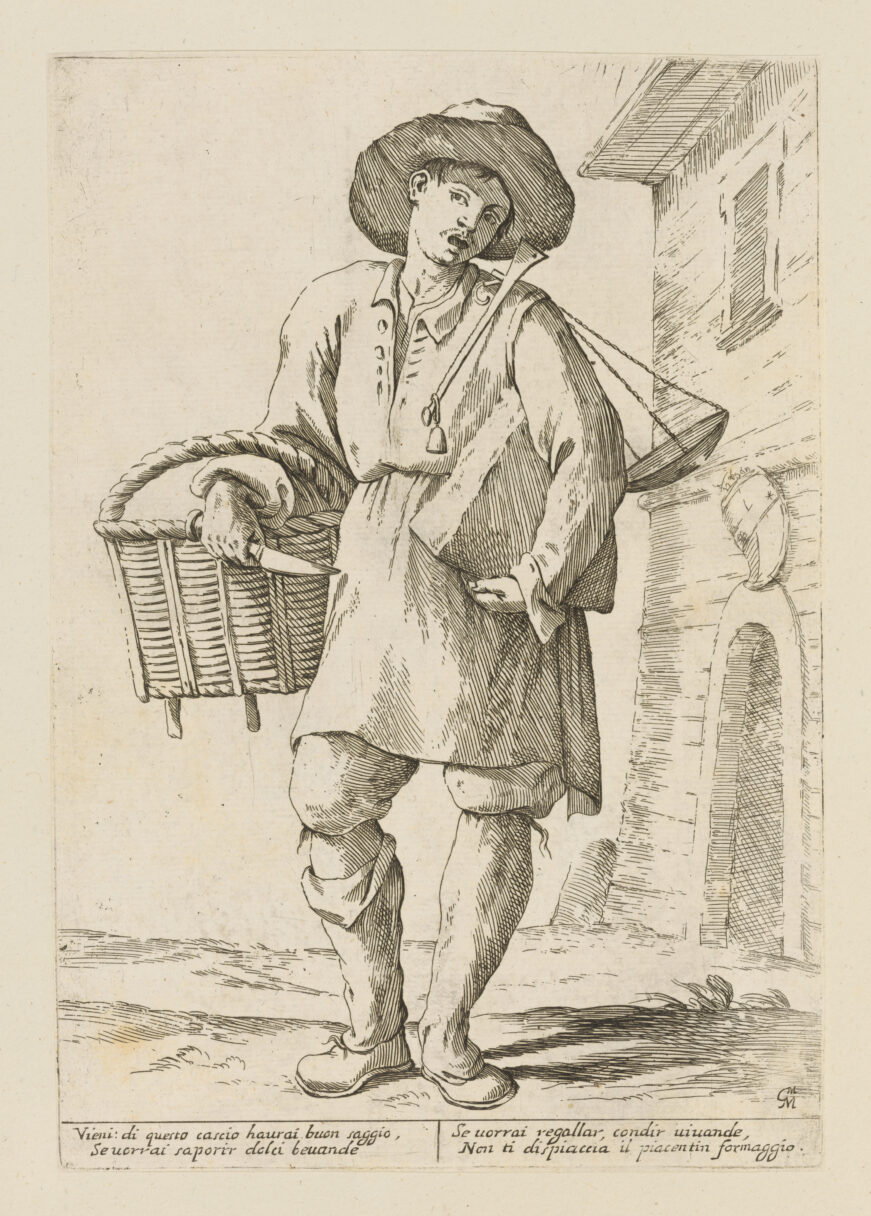
The son of Natalia and Leone Ginzburg—dissident Italian intellectuals, one of whom, Leone, died under fascist torture—Carlo Ginzburg gifted generations of students with one of the major moral documents of twentieth-century scholarship, written in honor of free thought and against intellectual coercion. The Cheese and the Worms: The Cosmos of a Sixteenth-Century Miller (1976) tells the story of Menocchio, an early modern Italian miller who became known locally for his cosmological theories. For Menocchio, God was a product of matter and not the other way around. Here is how he put it in 1584: “I have said that, in my opinion, all was chaos … and out of that bulk a mass formed—just as cheese is made out of milk and worms appeared in it, and these were the angels. The most holy majesty decreed that these should be God and the angels, and among that number of angels, there was also God, he too having been created out of that mass at the same time.” This theory was a subject on which Menocchio was effusive, seeking out conversations (or maybe monologues) about it with anyone willing to listen. At some point, he fatefully buttonholed someone quite unwilling to listen: his theories were brought to the attention of the Inquisition, with particular emphasis on their deviations from the Counter-Reformational straight and narrow. In 1599, he was burned at the stake.
Ginzburg’s book attempts to reconstruct Menocchio’s worldview through a sustained reading of his trial transcripts, and through informed guesswork about the contents of his personal library. Ginzburg extrapolates grandly from Menocchio’s case, arguing that Menocchio’s cosmology is not an exclusive product of his idiosyncrasy, but reflects an oral-folk mythological and conceptual tradition of “pagan” derivation, never fully penetrated or eliminated by the Church. Because of its argumentative structure—modest focus, big conclusion—The Cheese and the Worms is a founding text in the scholarly genre of microhistory, and it has been widely discussed and debated by historians. At the risk of exposing my ignorance of cheesemaking: there has been a steady churn of Anglophone observation on these aspects of the book ever since its English-language publication in 1980, which has coagulated over time into a firm body of scholarly comment, with a verdict more mild than sharp.
This reception began when Peter Burke, the major historian of European culture, opened his review of Il formaggio e i vermi (the book was still untranslated) by heralding Ginzburg as “one of the most gifted historians of his generation in Italy and indeed in Europe.” In his survey Historiography in the Twentieth Century, Georg Iggers names The Cheese and the Worms in particular, and the Italian microstoria tradition in general, as key factors in the turn of professional historians toward “the history of everyday life.” Historians like Ginzburg sought to reconstruct how life was experienced by ordinary people, not just map the material forces that shaped it.
Upon the fiftieth anniversary of The Cheese and the Worms (marked by the publication of a new anniversary edition by Johns Hopkins University Press), there may be little original left to say about it. It is often assigned in classrooms, but it also has a public readership. In assessing its legacy, I don’t want to take for granted the authority of its conclusions. Others are better equipped than I to assess the book’s shelf life as a theorization of European popular culture. Instead of weighing in on that scholarly debate, I want to peer over the shoulder of Ginzburg’s other readers: the students and general readers upon whom the book has had such an influence. Ginzburg has made multiple generations of busy, modern people care about the plight of an otherwise obscure Italian miller. If cornered at a cocktail party or on a game show, many of those readers might be hard-pressed to explain what a miller even does. (Hard-pressed? such a reader would wonder. Is that a mill joke?) How does Ginzburg achieve this power?
To answer this question, we need to think about the book in literary terms. Ginzburg gives ample license for doing so, especially in his 2013 preface. He credits two main sources of inspiration. The first is the flourishing Marxist historiography of popular culture then affiliated with the New Left, figures like E.P. Thompson and Natalie Zemon Davis. The second, less recognized stream is a cluster of metafictional European writers including Bertolt Brecht (the aesthetician of alienation), Raymond Queneau (whose fiction is considered a precursor to the nouveau roman), and Ginzburg’s colleague Italo Calvino, whose novel If on a Winter’s Night a Traveler (1979) is one of the century’s most beloved celebrations of the romance of reading.
The influence of Brecht in particular is on the book’s sleeve. Brecht’s Life of Galileo (1938) is a major source for the contemporary myth of Galileo as the farsighted opponent of an intellectually backward institutional Church. Like The Cheese and the Worms, Brecht’s Galileo uses early modern subject matter to tell a story bearing the stamp of twentieth-century anti-totalitarian narratives. In the United States, this part of the book’s appeal is partly a question of its audience’s prior cultural programming. Even if it happened centuries ago, Menocchio’s showdown with the Inquisition slots neatly into liberal Cold War narratives of the plucky individual versus an anonymous bureaucracy (think Orwell and Arthur Koestler). But it is also a reading that Ginzburg encourages, when he suggests a parallel between Menocchio and Galileo. To do this, Ginzburg quotes a lengthy extract from the transcript of Menocchio’s first trial, presented without comment. After Menocchio patiently explains to his benighted keepers the true nature of the Trinity and its relationship to primordial chaos, the inquisitor asks, “Who moves the chaos?” The correct answer is God, but Menocchio can’t help himself, and replies: “It moves by itself.” This assertion, followed by authorial silence, evokes Galileo’s apocryphal, under-his-breath affirmation of his own theory. E pur si muove: And yet it moves.
Even as Ginzburg situates himself amid a metatextuality-loving European literary culture, his work is equally crafted in opposition to a major feature of this culture: what Ginzburg deems its faddish epistemic fatalism. This is made clear in his criticisms of Foucault and Derrida, especially the latter for his “facile, nihilistic objections” to the work of the former in his Histoire de la folie (abridged and translated as Madness and Civilization). The Foucault of subsequent work, perhaps giving way under the criticisms of Derrida, arrives in Ginzburg’s estimation at an “irrationalism of an aesthetic nature.” In Foucault’s interpretation of the case of Pierre Rivière, a nineteenth-century French peasant who committed familicide, the fugitive Rivière becomes (quoting Foucault) “a mythical being, a monster whom it is impossible to define because he is outside any recognizable order.” For Ginzburg, Foucault’s reading “dazzl[es]” readers with “an absolute extraneousness that, in reality, results from the refusal to analyze and interpret.” Ginzburg’s rejection of Derrida’s “nihilism” about the accessibility of historical subjects is important for the way he understands what he is doing: “We have to break through the surface of [Menocchio’s] terminology in order to release the living stream of Menocchio’s deepest thoughts.”
I want to peer over the shoulder of Ginzburg’s other readers: the students and general readers upon whom the book has had such an influence.
Ginzburg is a historian, making historical claims. All the same, the literary and intellectual milieu he was a part of has its impact on The Cheese and the Worms. The book’s narration is marked by “the characteristic need to reveal how a piece of research is constructed,” as Ginzburg puts it, citing Proust and Brecht as precedents for this quality. (In Proust’s famous “madeleine” passage, the social world erupts from a teacup—not unlike the way that, for Menocchio, living creatures are spontaneously generated from a material substrate.) The frequent signposting of the research’s unfolding construction can make Ginzburg sound like a detective. One section begins: “Once again we have the impression of being in a blind alley.” Elsewhere he writes that a conclusion of his “doesn’t mean that we have to retrace our steps.” The result of Ginzburg’s twin emphases on the imperative to investigate and the desirability of showing the steps in one’s investigation is that Ginzburg becomes the book’s shadow protagonist, and a winsomely determined one.
Viewed as characters in a narrative, Menocchio and Ginzburg seem interrelated. If Menocchio is “quixotic”—as claimed by the English edition’s translators, John and Anne Tedeschi—so too is Ginzburg, in a partly overlapping way. Menocchio is like Don Quixote in his unashamed eccentricity, in the seizure of his library by employees of an Inquisition, and in his idealist’s martyrdom. The major interpreters of Cervantes’s masterpiece, among them Miguel de Unamuno, W.H. Auden, and Simon Leys, have tended to read Quixote as a saint, his death by disenchantment as a passion, and his epistemological heresies as, paradoxically, the imitatio Christi with far greater grandeur than was musterable by the gemmy hypocrites of religious officialdom.
These are also the ingredients of Menocchio’s fate. On the one hand, it would be irresponsible to read too much meaning into Menocchio’s howls under torture, as received by us through their dutiful transcription by an inquisitional scribe. On the other hand, it is impossible not to read these howls as the product of an inner awareness by Menocchio of the ironic similarity between Christ’s suffering and his own: “Oh Jesus, oh Jesus, oh poor me, oh poor me”; “Alas, alas martyr, oh Lord Jesus Christ” (emphasis mine). Ginzburg’s selection of these quotations (among others like them) from thirty minutes of available material suggests he may be of the same mind—a suggestion which is confirmed by Ginzburg’s casting, on the last page of the book, of Menocchio’s administrative executioner in the role of Pontius Pilate: “The inquisitor in the Friuli was hesitating, perhaps out of a belated impulse toward leniency.”
The most important commonality between Menocchio and Quixote is also shared by Ginzburg: a mania for interpretation. The play of Menocchio’s “artful mind,” as Ginzburg puts it, is not unlike Ginzburg’s own. The Cheese and the Worms is the history of one man’s reading life, as interpreted by another. Ginzburg claims that “Menocchio’s accounts of his readings provide us with a striking example of a relationship to the text that is totally different from that of today’s educated reader. They permit us to measure, at last, the discrepancy that Bollème quite properly suggested existed between the texts of ‘popular’ literature and the light in which they appeared to peasants and artisans.” Menocchio, like Quixote, creatively misreads his source material, with what Ginzburg calls “aggressive originality,” and with dire personal consequences.
Meanwhile, Ginzburg takes the emphases and disemphases of Menocchio’s readings as oblique, tantalizing glimpses of a lost oral culture, the existence of which he also posits in his previous book, I Benandanti (1966). Ginzburg talks about the possibility of accessing such a culture, in however indirect and highly mediated a fashion, with palpable anticipation: he is confident that using a vocabulary drawn from various origins, “Menocchio tried to express the elemental, instinctive materialism of generations of peasants.” There is a telling similarity between the way Ginzburg describes Menocchio’s findings and his own. Ginzburg uncovers “proofs, even though fragmentary and partly obliterated.” Meanwhile, on the very next page, Menocchio uses the intellectual resource of print to “express the obscure, inarticulate vision of the world that fermented within him.” The feeling of longing evoked by these passages is similar to that which must have been felt by peasant readers of the Capitolo, the “grandiose” utopian poem Ginzburg reads for its illustration of popular culture. The poem depicts a novus mundus where it rains ravioli and the “embankments are made of ricotta.” In emotional terms, and describing Ginzburg as a voice in the book rather than (necessarily) Ginzburg the historian, this lost peasant culture is Ginzburg’s El Dorado. It is not so much that he wills this world into being—he may be right, and it may have existed—as that he wills it to be, through his own acts of reading.
Ginzburg’s book positions its author as the subject of a hermeneutical drama. If his thesis is right, then he makes a contribution to the history of the European peasantry. If his thesis is wrong, then he joins Menocchio and Quixote in tragically urging the world to be as he would like it, through a sustained struggle of dynamic interpretive willpower. The tragedy of this positioning is compounded by its replication of Menocchio’s behavior. In proportion to the degree that the book fails as history, it succeeds as literature.