


During the Western Christian Holy Week of 2026, how might churchgoers repent of Christian Nationalism? How to reckon with menacing forms of Christian-ish Americana, from sea to shining sea? I have been writing about mainstream Protestantism in the U.S. for decades, and I recommend a regional accounting. Rather than encompass all Christian-adjacent contexts across this continent, consider three filmmakers who do not present a God’s-eye view. Danny McBride, Sterlin Harjo, and Mike Judge depict followers of Jesus from their own home landscapes. Each adopts a prairie-dog perspective, close to the ground and along specific terrain. Each filmmaker created what reviewers deem “love letters” to their own neighbors. I recommend these shows to better hear and tell truths about Christianity in the U.S.
The Righteous Gemstones (HBO, 2019-2025)
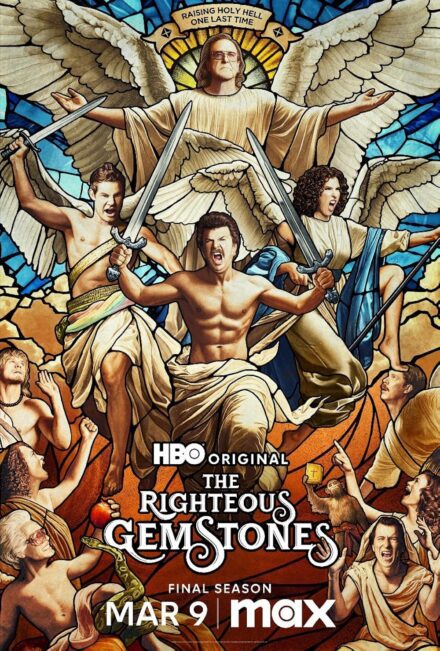
“Danny McBride sends a love letter to the South with The Righteous Gemstones,” NPR announced in May 2025. McBride grew up in Spotsylvania County in Northern Virginia and says he was formed in equal measure by his Baptist, Sunday-school-teaching mother and his time at the North Carolina School of the Arts. Friends who know that I research masculinity and evangelicalism recommended the series, but I had scant interest in humor focused on churches with poor people. Within the first ninety seconds of the show, McBride establishes the reach of what I call Christianity Incorporated Today with “five thousand people baptized!” during the “Chinese Salvation Tour” at the Chinese outpost of the “Gemstone Salvation Center,” along with a battle for “best adult baptism” between Jesse and Kelvin Gemstone. I was hooked. Key to my early research in North Carolina was a presentation by one mega-church strategist, who loudly announced onstage that “God orchestrates history!,” naming in particular “new markets in China.” He emphasized this to the hundreds of men gathered from across this NAFTA-decimated state. “Yes, I said China!”
Gemstones is a burlesque, as if a camera crew filming The Lawrence Welk Show went backstage and found The Three Stooges. McBride depicts an extended network of brand-named evangelists from the coastal Carolinas, led by the widowed Eli Gemstone (John Goodman) and his feuding sons. The first season begins and ends with the regional ramifications of what a Baptist minister in Nevada named candidly (and critically) “church poaching.” By minute 16, four neatly dressed men are sitting on a bench in the lobby of the Gemstone “Christian empire,” built on “three hundred acres of Coastal Carolina,” the “flagship campus” of the Gemstone matrix of influence. The camera slides across a visitor center display featuring photos of a dilapidated strip mall with a defunct donut shop and tax services, then moves on to a photograph of Eli’s widow, Aimee-Lee, with hand puppets and then, next slide, with Aimee-Lee holding two young Black children. Beginning in an abandoned mall space, growing to SUCCESS through old-fashioned, seemingly interracial Gospel work, the narrative tracks. McBride knows his terrain.
My Methodist heart is warmed by the fact that the spokesman for the small group of clergymen is named John Wesley Seasons, a nod to the eighteenth-century English Methodist John Wesley. The four men are there at the “flagship campus” to make an appeal on behalf of their ministries in a small town on which the Gemstones plan yet another outpost. John Wesley is obsequious, noting with gratitude that Eli Gemstone has deigned to meet with “a few podunk preachers.” Eli Gemstone replies, “Big flock, little flock, we all work for the same boss.” John Wesley makes his appeal, introducing his colleagues, who “all have churches in Locust Grove.” He gestures to his brethren, saying, “I lead a congregation of eighteen hundred. Gabe here has got one thousand at New Pentecost. Stephen from Highway Assemblies is holding strong at twelve hundred. Jeremiah is working hard. His new ministry is up to seven hundred…. We are small-town humble folks, so that operation you’re building there—that prayer center—we’re concerned that it would be a disruption.” John Wesley puts the matter straight, his voice faltering slightly on the last word: “We are scared you’re gonna run us out of our own hometown.”
Sheffield, being only an hour away from the proposed new Locust Grove location, has only one church, so why not establish a satellite campus there? Eli, standing above them on his stage, answers with stone-cold calculation: “Locust Grove has four churches—your churches. And you’re right. They are modest-sized ministries. If we were to come in, scoop up one of your churches, maybe that ain’t worth our time. But if we were to scoop up all four churches, now you’re talking. Between the four of you, you got decent numbers.” Eli’s brother-in-law, Baby Billy, later tells the “podunk” pastor, in front of his flock picnicking on the lawn at Locust Grove Baptist (after Eli has thrown a giant baked potato through the stained glass window), “We are in the Sears, and we ain’t goin’ nowhere.” Sears being bankrupt and the mall space abandoned, Baby Billy is setting up shop. By episode 9, John Wesley’s church has folded, a local church effectively destroyed.
The Gemstones and their ilk are across coastal Carolina, baptizing “success” in China and taking over a bankrupt Sears near you. This story arc ends with Eli inviting Seasons, who is now working at one of the few remaining Tru-Value Hardware stores in the South, to become part of the Gemstones’ network. “You won’t be working for us; you’ll be working with us.” Season 2 begins in “Houston!” with Eric André and Jessica Lowe as an interracial super-couple. André describes his character as “a loud, insane Texas megachurch preacher.”
In her 2025 interview with McBride, the NPR host suggested that, after all, the Gemstones fundamentally “really love the Lord.” McBride hesitated, perhaps unsure of the proper way to correct someone on NPR. Big flock. Little flock. They all work for the same boss, right? I read McBride as akin to Jane Austen, as she sent up the mores of her own eighteenth-century England. Does Mr. Collins, Anglican clergyman in Pride and Prejudice, “really love the Lord?” That misses the point.
Reservation Dogs (FX on Hulu, 2021-2023) and The Lowdown (FX on Hulu, 2025)
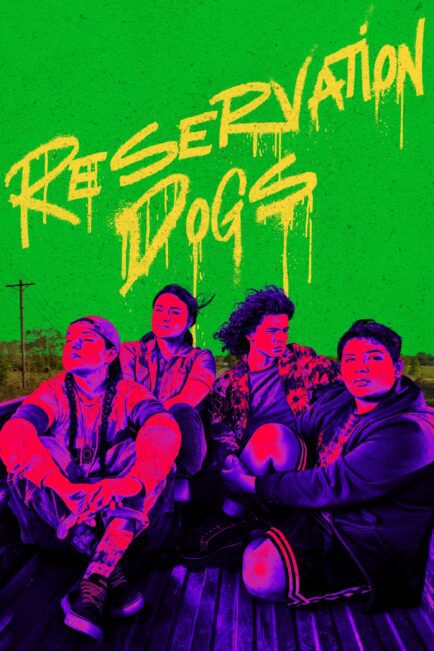
I was home alone on Christmas Day 2025. (Long story.) The Lowdown was listed among the “best movies and TV of 2025, picked for you by NPR critics,” and the trailer was enough to have me hunkered down with cheap cheese dip. I had heard a synopsis and praise for Sterlin Harjo’s mainstream television debut Reservation Dogs on the Filmsuck Podcast. Four teenagers on a reservation in Oklahoma grieve the death of their best friend. I expected the series would be depressing. (Also, if I loved the series, would saying so make me sound like that Texas white lady?) I’ve become an unabashed Sterlin Harjo evangelist.
Harjo does not introduce interlopers to home but drops us in without a map. WASPs who look to NPR for viewing recommendations are not the target audience of Reservation Dogs, which makes the series a rare gift. Journalist Sandra Hale Schulman gives the scope for Indian CountryToday: “Created by Sterlin Harjo, Seminole and Muscogee, and Taika Waititi, Maori, the show makes room for warrior spirits, UFOs, red-eyed creatures in the woods, avenging Deer Lady, and ancestors dressed in Seminole rickrack that hang out in prisons.” Fellow Oklahoman and prize-winning journalist Brandy McDonnell writes with appreciation: “Whether the characters are riding a bus home from California, taking a fishing trip that turns into a Bigfoot hunt or snacking on fried catfish with the spirit of a long-lost friend, the tight-knit, rural community of Okern, Oklahoma, is the center of the universe.” McDonnell avers: “Okern is a fictional Oklahoma reservation town, but it feels real … even when its towering trees, rolling hills and green riverbanks are viewed through a shimmering LSD haze.” She notes that this is “not only the first mainstream television show on which every writer, director and series regular performer is Indigenous, but it’s also the first full-time, scripted network TV series to film entirely in Oklahoma.”
I recommend this veracious disorientation as a means of grace for white churchgoers. In Reservation Dogs, “White Jesus” is occasionally adjacent to the action. “White Jesus” is at no point the center, but is offhandedly noted as “White Jesus” in a picture frame on a grandmother’s wall or as a statue acknowledged by the recurring Indian character William “Spirit” Knifeman in a small church balcony. Neighbors have run for shelter to the church basement, and Spirit appears next to a sacred heart statue. As Spirit eats communion wafers like potato chips, he intones to the show’s main character, Bear, that he and Jesus are “like this,” “two brown men cut down in the prime of their life.” The reference is both funny and telling. Even in a church, “Jesus” is not in focus. Jesus is background. The nephews, cousins, uncles, aunts, grandmothers, and grandfathers are the foreground, as they (and we) appreciate an impromptu poetry slam and blurring of teen grievances, waiting together for the storm to pass.
Anyone attempting to understand “masculinity” in the Southwest may begin here. Riding in a pickup with her elder named Bucky, Bear’s bestie Willie Jack explains, with a 15-year-old’s aplomb, Bear’s mood: “He’s got daddy issues.” Bear counters, “I ain’t got daddy issues.” Bucky doesn’t miss a beat, “Hey, we all got daddy issues.” A running joke is a book on string theory that has apparently become a bestseller in rural Oklahoma. Bucky delivers an impromptu homily.Bear strides off in frustration and Willie Jack watches with concern: “String theory explains [that] every element in our bodies was made inside an exploding star…. We’re like vibrating strings, you know, notes of the cosmos, and each and every one of them have their own part of the song. You take away one part, that song changes, but the song never dies.” The teens frequently turn to another elder, Brownie, who sees Spirit, including after being tossed naked into a field by the tornado, which he diverts by wielding an ax on the rooftop, shouting, “I am not afraid of you!” Sterlin Harjo conveys holiness without hokum. His combination of whimsy, absurdity, and love is unlike anything else I have viewed.
Even in a church, “Jesus” is not in focus.
Stolen land is embedded in the name and setting of the series. The friends paint “LAND BACK” on street signs, and Willie Jack’s father notes, as they hunt for deer, that “Texas Ranchers don’t give shit back.” A mother is summoned to survive her prison sentence and pass on her form of medicine by a chorus from an abiding remainder of Spirits from the Trail of Tears. The particular loss threatening to splinter the Rez Dogs is their friend’s suicide near their regular meeting place in an abandoned building. Their spot is bought and dismantled, their memorial tossed as trash, by a “Texas rancher” turning the space into a “mega-church, for white people,” as the Indian construction worker words it.
Season 2 features a Texas-sized send-up of local white-man cults of whole earth-destroying brutality. Turn on the subtitles to read the liturgy of petrochemical and piscatory copulation.
Without giving too much away, Reservation Dogs ends with a subtle remonstration of “change agent”/influencer politics. Keep this in mind when considering the shift from the reservation to Tulsa. Set there, The Lowdown follows a “truthstorian” who discombobulates everything in his wake because he is, as several non-white characters note, a “white man who cares.” Lee Raybon, played by Ethan Hawke, cares about truth, his daughter, art, and books. In that order. Raybon is based on a real person, and Tulsa-based journalist Kristi Eaton wrote about his legacy for the International Journalists’ Network: “In 2011, Lee Roy Chapman, a citizen journalist and historian in Tulsa, Oklahoma, published a groundbreaking story that would shake the city. He discovered that one of the city’s founders and most prominent residents, Tate Brady—whose name adorned an entire neighborhood district in the downtown area—was tied to the Ku Klux Klan and involved in the 1921 Tulsa Race Massacre.” Chapman founded the Center for Public Secrets and is remembered as a “recovery specialist.” The Center’s website highlights Chapman’s uncovering of public secrets, going back before Oklahoma was Oklahoma!
The 1953 musical is set a decade before the Osage murders. For a Sunday School lesson, consider the opening lines alongside the truths the “truthstorian” uncovers: “We know we belong to the land, and the land we belong to is grand!” “LAND BACK” is threaded through The Lowdown, a string theory of unlikely solidarity across the city. As a Westerner, Harjo’s show sounds as a summons. In an essay on “Geopiety” for West of 98: Living and Writing in the New American West, novelist Jim Harrison writes “there is no more otiose line in the history of American poetry than [Robert] Frost’s ‘The land was ours before we were the land’s.’” Harrison goes on to say that “the dominant responsibility of the West would be to finally totally admit what we did to our first citizens as a rag-tag invading army of soldiers and settlers.” He calls this “the true ghost in our immense closet” and tells readers that “reparations are in order to honor the long nightmare of millions who did not ask to be born on the routes of our conquest.” Harrison warns that, without this reckoning, there is little “justifiable sense of belonging where we are.”
King of the Hill (Fox, 1997-2009; Hulu, 2025)
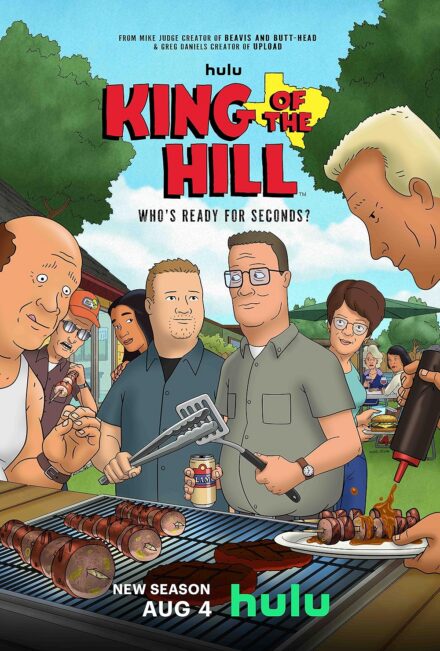
Even people who love Texas are baffled by our home’s propensity for patriotic bravado and mythical hero-worship. Lawrence Wright also grew up Methodist in Texas. He warned readers of The New Yorker that Texas is a national “bellwether.” The etymology of the word works. Brand Texas! leads sheep, possibly off a cliff. When I asked friends from back home to explain why Mike Judge’s King of the Hill is worth anyone’s time, songwriter Daniel Makins noted that Judge, “examines the weaknesses and flaws of all characters in equal measure, does so with comedic compassion—mostly, followed by redemptive resolve—usually.” There are no heroes in the series, which makes it worth a Holy Week study. This requires a reset of what “counts” for churchgoers.
If podunk clergymen matter little in the reckoning of Christianity Incorporated Today, what about a podunk clergywoman? A 2006 episode reveals a boring but important component of mainstream Christianity in Texas and, as Texas is a bellwether, for churches from California to the Carolinas. Local churches pastored by women are not exciting and, therefore, less celebrated. The setting of King of the Hill is the fictional Arlen, TX, based on Richardson, TX, a suburb of Dallas. Reverend Stroup is the first clergywoman assigned to Arlen First Methodist Church. First Methodist in Arlen does not have bells or whistles, but simply pews and hymnals and church casserole covered-dish suppers. Peggy Hill, usually practical, has had enough with Reverend Stroup’s apparent refusal to take her advice “for adding some pizzazz to that church” and suggests they move their church attendance to a 5,000-member megachurch. Peggy doubles-down on her suggestion: “They have their very own coffee shop, florist, mini-mart, bank, and a dry cleaner that accepts all competitors’ coupons.” Hank responds: “If I wanted to go that route, I could just walk around the mall and think about Jesus.” This being a predictable series, sturdy Hank and Peggy end up back at First Methodist. Podunk Christianity, facilitated by a clergywoman in sensible shoes, is a source of unremarkable but real redemption in Arlen.
Fast forward twenty years, as Mike Judge asks us to, and we return to Arlen. As Sean O’Neal writes for Texas Monthly, “Hank and Peggy Hill are back in the fictional Texas town where they raised their son, Bobby, who’s all grown up and working at a Dallas restaurant.” Sterlin Harjo has one of Bear’s many uncles tell him, “Build things, boy. Don’t tear them down.” Mike Judge does something akin in this reboot. From pandemic mask protests to book bans (and burnings) to real estate boondoggles, Judge brings Texas headlines into the non-newsworthy suburb. As Peggy and Hank walk into the Mega Lo Mart, with both of them sick of all the changes and ready to move back to their reliably pretend “Texas!” created by petrochemical dynasties in Saudi Arabia, take note. What they see in that sprawling, suburban parking lot involves Girl Scout Cookies, immigration, the dangers of “woke,” and the kismet of solidarity, a kind of miracle even at the Mega Lo Mart. May it be so.