


Every once in a while, I see a survey question that makes me say, “I wish I’d thought of that.” Not because the results are shocking, but because the question itself cuts right to the heart of something Americans have been arguing about for a very long time. Pew Research Center’s American Trends Panel recently asked a simple but theoretically loaded question: how important is it for the United States to have a culture based in Christian religious beliefs? Not whether you are Christian. Not whether you attend church. Rather: whether you think the country itself should be culturally Christian.
I like the way this is phrased, by the way. Because it even allows Jews, Muslims, and non-religious folks to nod toward the importance of Christianity in the functioning of the United States. To me, this is a question akin to one about religious importance. It’s not asking how often the respondent personally goes to church, or what they believe about Jesus and the Bible. It’s tapping something more amorphous—do you think that having a Christian culture is a net positive for the country? What’s nice about this data (hosted on the ARDA) is that it was collected not that long ago. It was fielded in August 2024, and the total number of respondents was 9,201. So we have some pretty fresh data here, and it’s a robust sample size. So, let’s dig in by looking at how the full sample responded to that question, then looking at a breakdown among the largest faith traditions.
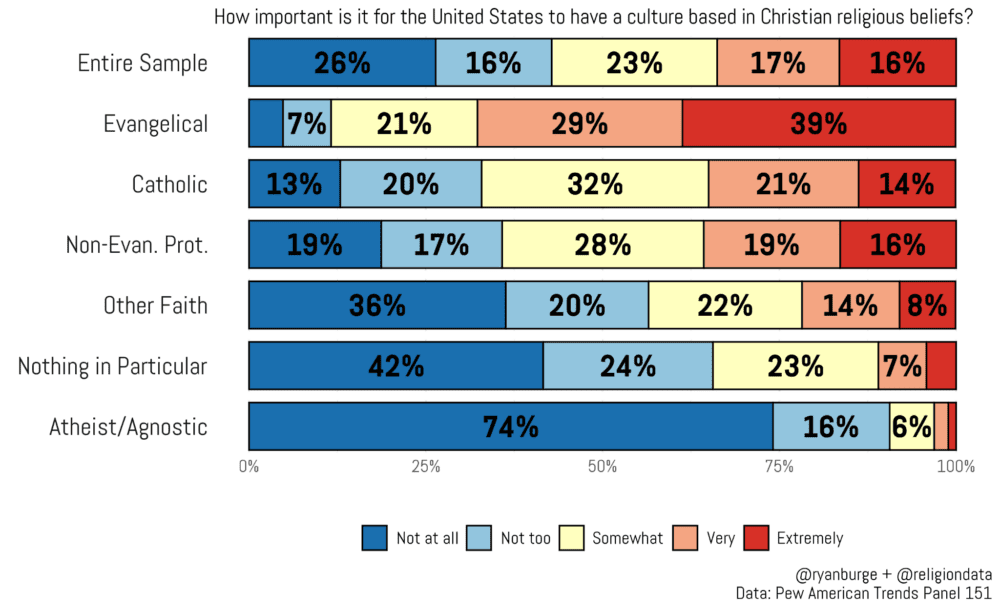
Here’s a big headline for me: the share of Americans who say that it’s “extremely” important for the United States to have a culture based in Christian religious beliefs is not that large at all, just 16 percent. It does seem that this contingent is really loud, but they aren’t that numerically large. In total, one third of Americans say it’s very/extremely important. But nearly the same share (26 percent) say it’s not important at all. 42 percent of Americans chose the not at all/not too important option, which was nine points higher than the very/extremely folks. And then, nearly a quarter of Americans chose the “somewhat” option. I just don’t get a really strong sense here that huge swaths of the country think that having a “Christian country” is that important.
Of course, the responses vary significantly by religious tradition. Evangelicals are, without question, the outlier on this one. Nearly 70 percent of them chose the very/extremely important options, and less than 10 percent said it was not at all or not too important. However, among other Christian groups the numbers are much more in line with the national average: 35 percent of Catholics chose the very/extremely option, and it was the exact same share of non-evangelical Protestants. So, the average non-evangelical Christian looks exactly like the average American on this one.
It should come as no surprise that the other faith groups and the non-religious lean much more toward the left on this question. Among atheists/agnostics, 90 percent indicate that it’s not at all/not too important for the U.S. to have a Christian culture, and it’s 68 percent of those who claim no religion in particular. I do need to point out here that the latter group is somewhat warmer to a general sense of Christianity than the former groups, though. As I’ve said many times, “The nones are not all the same.”
I just don’t get a really strong sense here that huge swaths of the country think that having a “Christian country” is that important.
What I really want to lean into for the rest of this post is that huge canyon that exists between evangelical Protestants and the other two types of Christians: non-evangelical Protestants and Catholics. As I just mentioned, those evangelicals hold a view on this topic that is far out of step with their Christian cousins. I wondered if age was playing some kind of role in driving the difference.
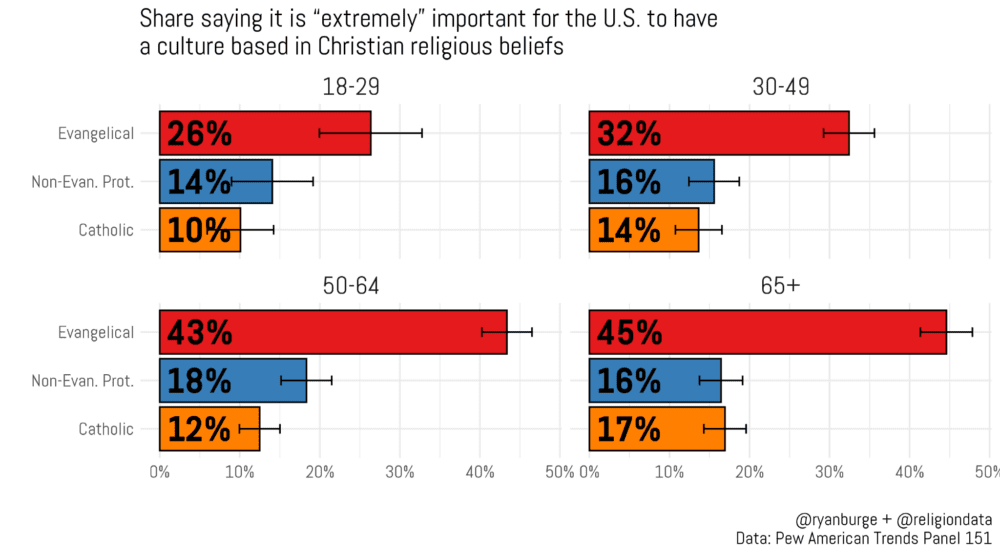
The share of older evangelicals who say that it’s extremely important that the United States have a culture based in Christian religious beliefs was 45 percent. That was nearly thirty percentage points higher than the oldest non-evangelical Christians. The gap is also large when comparing those 50–64 years old (25–30 points). It does narrow when looking at younger respondents, and among the youngest adults, it’s in the 10–15 point range. But the statistical gap persists when comparing these groups inside each age category.
However, notice something really important here: younger evangelicals don’t feel as strongly about this issue as their parents or grandparents do. I mean, compared to a retired evangelical, a young adult evangelical is about 20 percentage points less likely to say that Christian values are “extremely” important to the United States. There’s definitely something going on with age here, which I will revisit a bit later.
We also have to assume that church attendance is likely driving up responses for these Christian folks, too, right?
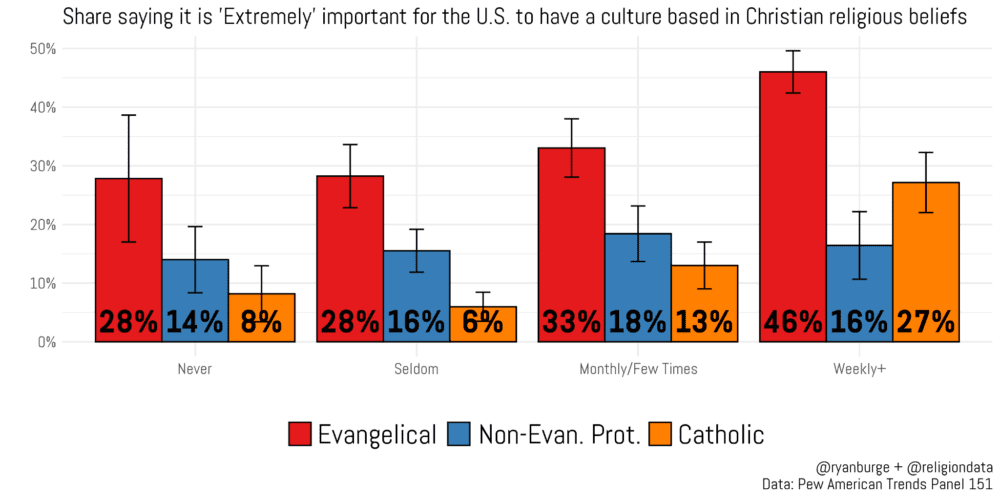
I think that the answer to the question of whether attendance has an impact on this question is, “Yes, but not nearly as much as I would have guessed.” In essence, there’s a threshold effect happening in the data. When you compare Christians who never attend church to those who go about once a month, there’s no statistical difference in the share who chose the “extremely important” option. That’s true for all three types of Christians we are examining here. Across the board, evangelicals are much higher on this metric compared to non-evangelicals and Catholics. The gap is basically the same magnitude.
But then weekly attendance is something else entirely. It pushes up the “extremely important” response option for two groups: evangelicals and Catholics. However, it has zero impact on the non-evangelical Protestants in the sample. For evangelicals, the increase was 13 points, and for Catholics it was basically the same amount, 14 points. That’s something worth flagging, by the way. The Catholic increase on this question from the bottom of the attendance spectrum to the top is a whopping 19 percentage points. That does not appear at all among non-evangelicals.
The proverbial elephant in the room, of course, is political ideology. Just a casual glance at the online discourse points to the fact that political conservatives are the ones who seem to be touting the importance of Christian values in the functioning of American democracy. Liberals don’t lean nearly as hard into that messaging, even if they are professed Christians.
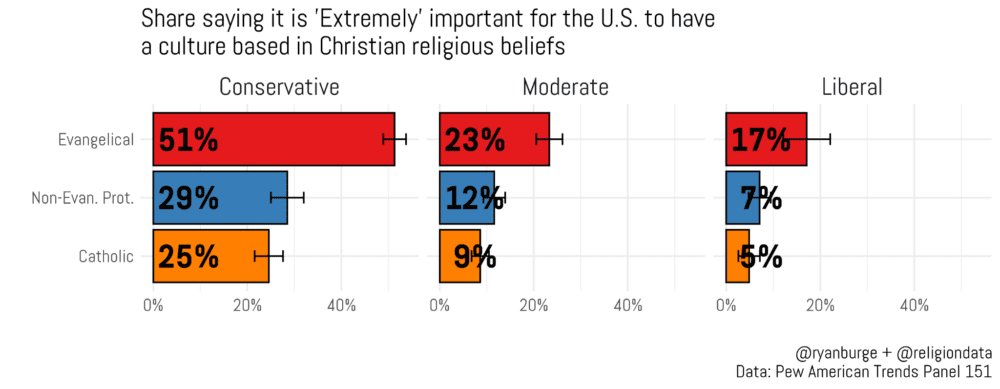
This couldn’t be more apparent in the data—politics is doing a whole lot of the work here. An ideologically conservative evangelical Protestant is over twice as likely to say that it’s extremely important for the United States to have a Christian culture as a moderate evangelical is. That huge gap is also there when comparing conservative and moderate non-evangelicals (29 percent vs. 12 percent) and Catholics (25 percent vs. 9 percent).
But I do need to highlight that there’s still a huge difference inside each ideological group. For instance, a moderate evangelical is still 14 percentage points more likely to have chosen the “extremely” important option compared to a moderate Catholic. It’s a 12-point gap when comparing liberals on this measure. It’s both things working at once: religious affiliation and ideology.
Of course, the only way we have to untangle all of these pieces is to throw a bunch of them into a regression model. The thing that we are trying to predict is whether someone says that the United States having a Christian culture is “extremely” important to the country. I’ve got all the usual suspects here: age, church attendance, ideology, education, race, and gender. I ran two models: the red circles are the evangelicals in the sample, and the blue circles are people who identify as non-evangelical Protestants and Catholics.
The interpretation is much easier when it’s presented visually. If the circle or the error bars overlap with 0 (zero), that variable has no statistically significant impact on the question at hand. If the point estimate is positive and doesn’t overlap with 0, it drives up the probability of someone choosing the “extremely” important option. If it’s negative, it drives down that likelihood.
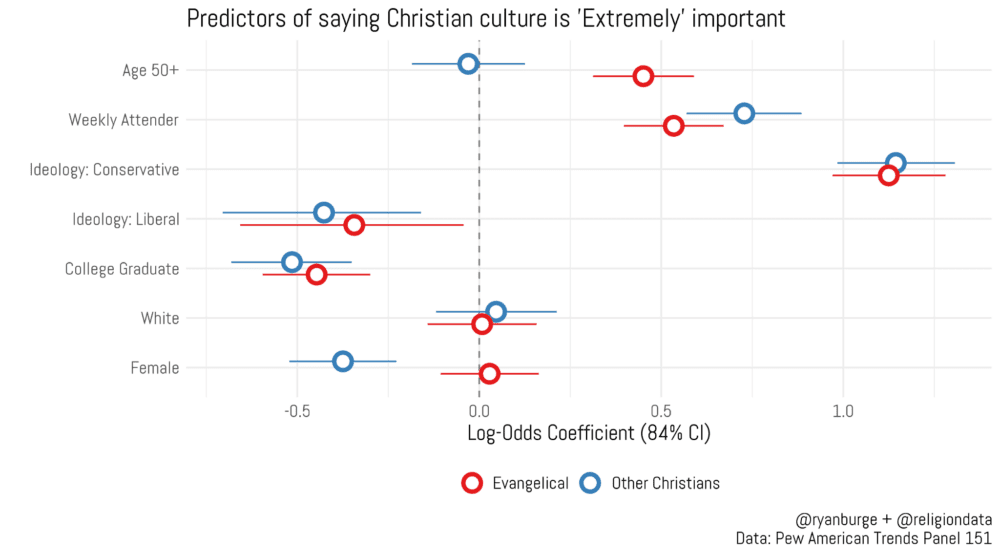
I think it’s important to note how many of these variables “work” the same for both subgroups I analyzed. For instance, being a weekly attender has statistically the same impact for evangelicals and other Christians. It drives up the log-odds by about 60 percent of choosing the “extremely” option. The impact of having a college degree is the same magnitude, but in a different direction. Holding all other factors constant, a Christian with a bachelor’s degree is about 50 percent less likely to choose the “extremely important” option.
I do want to highlight the ideology variable, though. The reference category is folks who were ideologically moderate. So an ideological liberal is less likely to say that having Christian values is extremely important for American culture, and ideological conservatives are much more likely to choose this response. In fact, of all the variables in the model, ideology was the strongest predictor of all of them. This is another instance of politics swamping religion.
There are two instances when the variables work differently for evangelicals compared to the other Christians in the sample. One is age. For evangelicals, being over 50 years old drives up the belief that Christian beliefs are extremely important to American culture. In fact, the magnitude of the effect is the same as being a weekly church attender. But what’s interesting is that age has no impact for non-evangelical Protestants and Catholics.
The one divergence between the models is gender, which really surprised me. For evangelicals, the gender of the respondent had zero impact on the likelihood of them saying that Christian values were important to American culture. For the other Christians in the sample, women were about 40 percent less likely to say it was “extremely” important compared to men in the same religious tradition. I don’t know what to make of all of that, really. But it’s worth thinking about some more.
It’s a constant refrain of mine, but I feel like I’ve got to at least mention it again: the direction of the causal arrow is impossible to determine. Are conservative evangelicals more likely to want a Christian culture, or are people who want a Christian culture sorting into conservatism? This kind of data can’t really get us to an answer.