


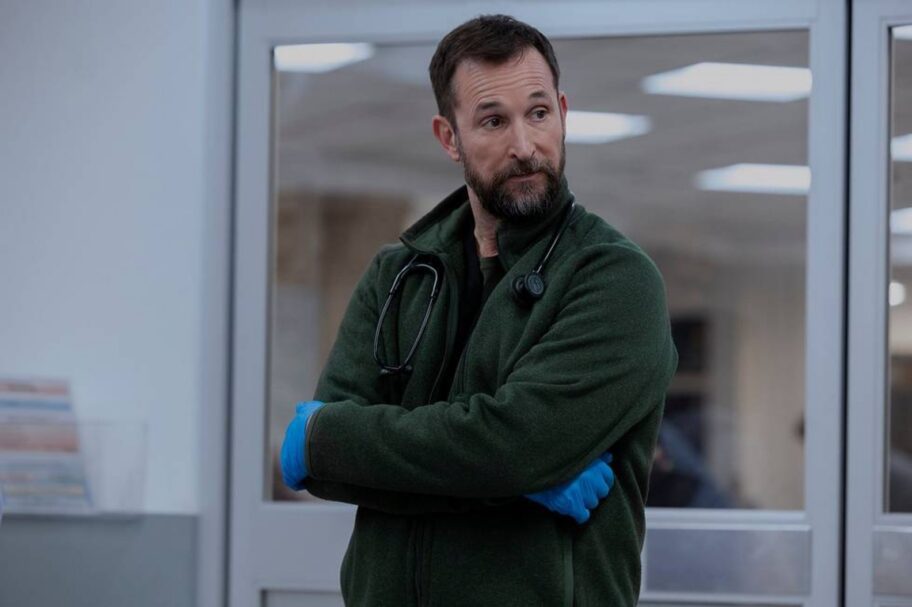
The HBO show The Pitt, about a fictional emergency room in Pittsburgh, is TV so good that it feels un-American to point out its shortcomings. Dissecting the accents of the nurses to see if any of them really nail the famous “yinzer” patois (not really) is like expressing disappointment in a small-town parade, or the performance of your first-grader’s T-ball team. Better to shut up and enjoy the stuff that makes this country great.
Nevertheless, I have been unable to shake my discomfort with a moment that arose in season two, episode three, which aired on Jan. 2. Dr. Michael “Robby” Robinavitch, played by Noah Wyle, the show’s star character—if one can pick one star out of a constellation of great performances—is treating a woman who, when she heard fireworks go off on the Fourth of July, dropped a samovar on her leg. It turns out that loud noises trigger her PTSD from having been just outside the Tree of Life synagogue on Oct. 27, 2018, when a gunman murdered 11 worshippers there.
At one point, Robby exits the room, leaving the character, Yana Kovalenko, in the care of the nurse Perlah, who is wearing a Muslim headscarf. “You are Muslim?” Yana asks. “I am,” Perlah replies. “Thank you,” Yana says, her voice full of gratitude. “After the shooting, it was the Muslims that came together for us in support and walked with us. You raised money. You paid for all the funerals.”
At this point, sitting on my sofa, eating my nightly bowl of Häagen-Dazs coffee ice cream, I turned to my wife and said, “That’s not true.”
From 2018 to 2020, I traveled to Pittsburgh over thirty times and interviewed more than two hundred people affected by the Tree of Life attack, the deadliest slaughter of Jews in American history. Of the 22 people inside the building, belonging to three different Jewish congregations that met there, half were murdered—11 Jews worshipping on the Sabbath, killed by Robert Bowers, a white supremacist who blames Jews for bringing immigrants into the country.
As I recounted in my 2021 book Squirrel Hill: The Tree of Life Synagogue Shooting and the Soul of a Neighborhood, Pittsburgh’s interfaith community did play an important role in supporting their Jewish neighbors in a time of need. Presbyterians, Roman Catholics, Black Baptists, and, yes, Muslims all stepped forward to offer their money, their emotional support, and their bodies: non-Jews offered to stand outside synagogues in the weeks after the attack, to help Jews feel safe.
But in all my reporting, I never heard that non-Jews, or Muslims in particular, “paid for all the funerals.” I knew that religious groups, including Muslims, did raise funds to support those affected by the slaughter. The Jewish Federation of Greater Pittsburgh received most of those funds, and it distributed them according to a careful formula, with some money going to survivors, some to relatives, some to the congregations, and so forth. As far as anybody has been able to report, any pots of money raised by Muslim groups went to the Jewish Federation, too, and got disbursed that way.
Based on that assumption—that Muslims did raise money to help the Jewish community, but it didn’t go directly to funeral costs—it may seem churlish to take The Pitt to task for its poetic embellishment of a basically true story. If it’s true enough to say, “After the Jews were killed, Muslims and many others gave money,” what’s wrong with a Jewish character saying to a Muslim, “You paid for all the funerals”?
Apparently, not much, as most people, including most Jews, see it. After the episode aired, there was collective gratitude in the Jewish press. The website Hey Alma ran a story with the headline, “‘The Pitt’ Highlights Jewish-Muslim Solidarity and the Tree of Life Synagogue Shooting,” in which the writer cheered, “While it’s unclear whether Yana Kovalenko is based upon a real person, her claim that the Muslim community rallied around the Pittsburgh Jewish community is true.” The Forward’s story quoted the dialogue about the funeral but didn’t question its veracity; it also included the voices of survivors who watched the show and enjoyed it. Audrey Glickman, one of the 11 survivors of the attack, told the Forward that the episode was “delightful.” “I hope it means we’re going to get past the divisions we’re having right now,” Glickman said. “We were there before. We can be there again.”
But truth matters—always. If it’s not Hollywood’s job to teach history, even less to moralize about it, it can at least refrain from distorting the facts of a real-life event, especially one in recent memory, for added pathos. In a time of rising antisemitism, it is important to get the facts of Jewish history, and Jewish current events, correct. The Pitt is set in Pittsburgh, and in general, the writers work hard to get the facts of Pittsburgh geography, history, houses of worship, and even culinary folkways correct. Recently, a character used the local idiom “jagoff,” which was a nice touch. And I had never heard about the pioneering Freedom House Ambulance Service, started by Black Pittsburghers and widely regarded as the first paramedic service, until a character told its story in an episode from The Pitt’s first season. And of course I was cheered to learn, in the Tree of Life episode, that Dr. Robby attends Rodef Shalom, the temple where my father was confirmed in 1958.
Truth matters—always.
It’s precisely that fidelity to the real Pittsburgh that could lead people to believe that Muslims paid for the funerals of all the Jews killed at Tree of Life. It sounds plausible (and is), and it is a comforting bit of lore. It gives us feel-good vibes: Jews die, Muslims step up. The problem is that history is complicated, and it’s not there for our comfort. This version of it elides the good work of Christian communities and secular neighbors, and, as it turns out, the role of the government, too.
The real story, while not as pat, offers its own rich history lesson. Before the burials, two different hevra kedishas, or Jewish burial societies, composed of anonymous Jews who donate their time and expertise, prepared many of the bodies, cleaning them according to Jewish tradition, getting them ready to be laid to rest in the traditional shroud and simple, unadorned coffin. Once the bodies were prepared, the final interments for nine of the 11 victims were overseen by Ralph Schugar Chapel, the old Pittsburgh establishment that has been doing Jewish funerals in Western Pennsylvania since 1919.
Sharon Brody, the owner of the Schugar funeral home, told me that there was, in fact, an offer of financial help from the Muslim community. Wasi Mohamed, who was then head of the Islamic Center of Pittsburgh and is now a staffer for Pittsburgh congresswoman Summer Lee, showed up at the funeral home one day after the shooting. “They had taken up a collection in his community, I think around $60,000,” Brody told me, “and he wanted to hand it to me. I said, ‘Thank you so much, but I cannot accept this.’” She was fully prepared to donate her firm’s services and was not interested in taking any money, although she was eventually compensated by a state-run victims’ fund.
The truth, then, is that some Muslims tried to help pay for the funerals, but their help was not required; the taxpayers of Pennsylvania paid. That story is good enough, on its merits. What’s curious is that, until Brody told me what happened, it had never been reported. In fact, a relative of one of the dead told me he had never heard about the Muslims’ offer to help. So, where did The Pitt’s writers get the idea that the funerals were paid for by Muslims?
Right after the attack, Wasi Mohamed, who would soon make the offer at Schugar’s funeral home (and who did not return my call or emails), launched an online crowd-funding campaign for the Jewish community, saying in a speech that “money should not be an issue … paying for a funeral, paying for medical costs.” That day, an article on Al Jazeera’s website embedded a tweet that called on Muslims to donate to the campaign to “help shooting victims with funeral expenses & medical bills.” A year later, in 2019, an op-ed in The Washington Post—by a Tree of Life synagogue member, no less—recalled Mohamed’s “raising money to pay for funeral expenses for the victims.”
It is thus not difficult to see how Noah Wyle, who wrote the episode in question, came to believe that, as he told Variety, the support from the Muslim community after the attack “was the most underreported aspect of the story, and perhaps the most hopeful moving forward.” If, in fact, the Muslims, and they alone, had stepped forward to offer financial support to underwrite the funerals of murdered Jews, it would have been a uniquely powerful example of Jewish-Muslim cooperation in America.
The truth is less powerful but, I think, no less moving: Muslims, among many others, expressed care and compassion for their Jewish neighbors in Pittsburgh; many gave money. The city’s response, from its many ethnic communities, remains a powerful rebuke to the antisemitism and other forms of hatred that are rising in our land. As the poet Keats might have said, if he’d grown up at the confluence of the Monongahela, Ohio, and Allegheny rivers, “That’s all yinz know on earth, and all yinz need to know.”