


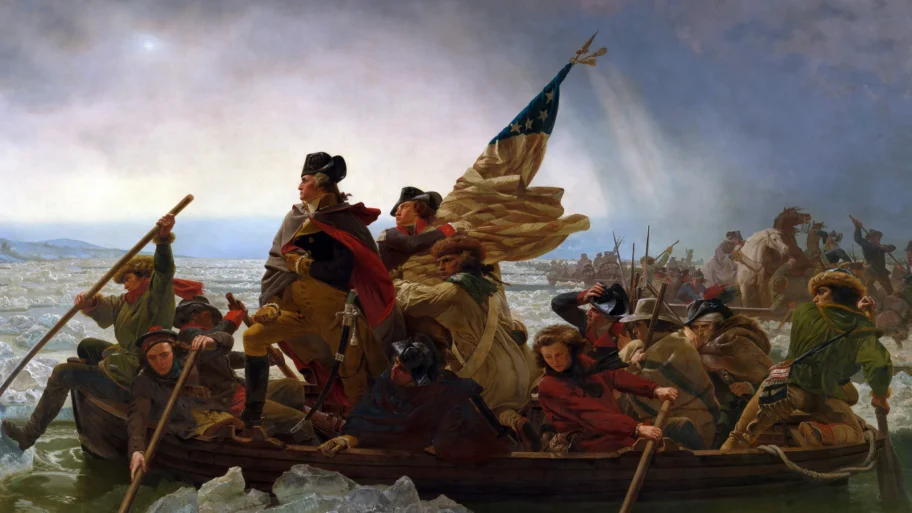
In April 1889, New York food merchants offered the Jewish community a special pre-Passover deal: for every ten pounds of matzah purchased, customers would receive a free picture of George Washington. That year, the festival coincided with a nationwide celebration marking the centennial of the inauguration of America’s first president, long considered the United States’s modern counterpart to Moses, the Pharaoh-defeating liberator. (And who doesn’t like a good deal?)
As Robert P. Hay documented in a 1969 article in American Quarterly, early Americans—basking in the afterglow of what felt like a miraculous victory over the British—had viewed their story as mirroring that of ancient Israel. Since the time of the Pilgrims, the Revolution had been described as a “miraculous deliverance from a second Egypt—another house of bondage.” In a representative July 4, 1799, speech delivered in Hebron, Conn. (one of countless American towns with a name drawn from the Bible), Cyprian Strong likened Independence Day to the moment the Hebrews “came up out of Egypt,” and insisted that “God [had] raised up a Washington,” just as he had earlier “qualified and raised up Moses.”
In hindsight, the comparison between the ancient lawgiver and America’s first commander in chief was inevitable. The founders had made explicit their view that the battle against King George III was Exodus redux. In 1776, John Adams wrote to his wife Abigail about the parallel, ruminating on what it must have been like to be Moses: “Is it not a Saying of Moses, who am I, that I should go in and out before this great People?” (It actually was not. Adams conflated Moses’ “Who am I that I should go to Pharaoh…” speech in Exodus 3:11 with King Solomon’s request in 2 Chronicles 1:10 that God “give me now wisdom and knowledge to go out and come in before this people.”)
Adams continued: “When I consider the great Events which are passed, and those greater which are rapidly advancing, and that I may have been instrumental of touching some Springs, and turning some small Wheels, which have had and will have such Effects, I feel an Awe upon my Mind, which is not easily Described.” While Moses tried to evade his mission, Adams seemed to have campaigned for the role.
Benjamin Franklin and Thomas Jefferson, appointed alongside the Moses-minded Adams on a committee to design America’s Great Seal, suggested that the newborn country’s symbol depict Pharaoh in an open chariot, a crown on his head and a sword in his hand, pursuing the Israelites through the parted Red Sea, with “Rays from a Pillar of Fire” illuminating Moses as he extended his hand over the sea to overwhelm Pharaoh. The motto would read: “Rebellion to Tyrants is Obedience to God.”
It was, of course, Washington’s achievements that ultimately earned him the starring role. Americans could hardly list the similarities between him and Moses fast enough. “As the deliverer and political saviour of our nation, he has been the same to us, as Moses was to the Children of Israel,” declared Massachusetts’s Thaddeus Fiske. John Frederic Ernst, a preacher from Cooperstown, N.Y., noted that Moses had been born in Goshen, “one of the best” provinces of Egypt. He was “from an honorable lineage,” blessed with “ancestors in a particular covenant with the Most High,” who had settled there by “invitation and divine confirmation” to escape famine.
Washington, Ernst argued, had likewise been born in a land of abundance—Virginia, a colony “well known for its profusion and wealth”—to “respectable parentage,” his ancestors having emigrated from Britain “to enjoy on this side [of] the Atlantic, greater advantages both civil and religious.” Alas, in both cases, the fathers’ lands of opportunity had become their sons’ lands of oppression. “Both our Conductors drew their first breath in countries, where their Ancestors first enjoyed perfect rational liberty,” Ernst preached, “and every blessing connected therewith, in which countries tyranny and oppression did afterwards become to them insupportable.” With God’s grace, each had defeated his Pharaoh.
In hindsight, the comparison between the ancient lawgiver and America’s first commander in chief was inevitable.
Americans also drew comfort from considering how, as with Israel’s emergence as a liberated nation, they too faced more than a few initial challenges—but ultimately emerged triumphant. New Hampshire’s Peter Folsom invoked the sea-splitting scene of Exodus 14: “Moses led the Israelites through the red sea; has not Washington conducted the Americans thro’ seas of blood?” The subsequent desert sojourn was hardly easier. “The Israelites had murmurers, who complained, and found fault with their commander,” Folsom noted. “Had not Washington the same difficulties to encounter? Yea, worse, he had Tories and traitors!”
The feeling was that the similarities the two men shared spanned their entire lifetimes. Maine preacher Jonathan Huse compromised accuracy for the sake of analogy. He noted how Moses’ mother had, by putting him in a basket to escape the Egyptian tyrant’s genocidal decree to slaughter all Jewish male babies, left the young child “to the care of Providence: He was found and preserved by the hands of Pharaoh’s daughter.” Washington, “the future hero of AMERICA,” Huse claimed, had similarly been spared. Fatherless since the age of ten, Washington had also been spared by God through his mother’s love. At fifteen, Huse claimed, Washington had become a midshipman on a British man-of-war, only to be “released from that corrupting, hazardous employment, by the earnest solicitations of his affectionate mother.” “Providence,” Huse concluded, had “snatched him from the brink of ruin, in almost as singular a manner as he did the Hebrew child.” In truth, Washington had early in his life considered a naval career but never served in the British navy.
Boston’s Jonathan Bascom also took poetic license in comparing the liberators, arguing that Washington was “nearly the age of Moses when he entered upon his divine legation, to liberate the posterity of Jacob, from the oppressions of the tyrant of Egypt.” Washington died at sixty-seven, while Moses confronted Pharaoh to demand the Israelites’ freedom at eighty.
New Jersey’s John J. Carle added that each leader had guided three million souls to liberty. Just as Moses had led Israel’s military and civilian affairs, Carle added, Washington, “by epistolary communication, afforded, unto Congress, much light and assistance, especially in cases of difficulty and perplexity; and in considerable measure guided our councils while he led our armies.” During the war, Carle noted, “there were seasons as dark and gloomy as that of the Israelites,” but “the American Moses hushed the murmurs of the people, dispelled the gloom, and opened a passage through the waters.”
Near the end of his life, Moses delivered a valedictory speech in the form of Deuteronomy. Washington had his own Farewell Address, preserving his wisdom for posterity. “Of all the dispositions and habits which lead to political prosperity, Religion and Morality are indispensable supports,” Washington stated, sentiments not too dissimilar from those of the biblical prophet. Washington reminded his listeners that both are “great pillars of human happiness,” and it was only “in vain” that anyone could “claim the tribute of patriotism” without them. Though never conventionally religious, Washington had reflected after surviving the harsh winter at Valley Forge that “Providence has a … claim to my humble and grateful thanks for its protection and direction of me.” Connecticut’s Ebenezer Gay noted that both men died with their faculties intact, “when their eyes were not dim nor their natural force abated,” echoing Deuteronomy 34:7.
Some even argued that Washington surpassed his biblical predecessor. “Moses conducted the Israelites in sight of the promised land; but, Washington has done more, he has put the Americans in full possession,” Folsom declared. Connecticut’s Frederick Hotchkiss elaborated: “The American Leader also ascended the mount [Mount Vernon] to die, but while yielding his breath, he saw his country’s glory finished. The former dies on a mount of vision and hope, but the other on a mount of possession and enjoyment.” It was Massachusetts’s Eli Forbes who took the analogy to its logical conclusion: Moses, he suggested, had been “the Washington of Israel.”
James P. Byrd has noted that some voices urged caution in making this comparison at all. In 1784, following the signing of the Treaty of Paris, Thomas Brockway, a pastor in Lebanon, Conn., reminded his audience that “we are not, my hearers, to worship the man.” Washington was “but a creature gift, a rich pledge of divine mercy; though great, he has been only to us, what God has made him.” Keep your respect for Washington within appropriate limits, Brockway urged, for “when the veneration is carried beyond this boundary, it is criminal.”
Still the juxtaposition continued. In a culture steeped in biblical imagery, Americans sought divinely sanctioned precedent for their hero. Moses, Byrd notes, “was not a warrior-king like King David but a warrior-legislator, making him a ‘safer’ vessel for monarchical yearnings in republican society.” Bruce Feiler, in America’s Prophet: How the Story of Moses Shaped America, writes that “as the reluctant leader trying to hold together an anxious population and lead his people out of subjugation and into freedom, Washington was the natural heir to the Mosaic longings of Americans.” Feiler cites historian Robert Hay, whose 1969 survey of all existing eulogies for Washington concluded that of the 120 biblical texts cited, Moses appeared in two-thirds.
It is no surprise then that a grateful Jewish community literally wrote Washington into their liturgy. In 1789, congregation Beth Shalome in Richmond, Va. tweaked the wording of the traditional prayer for the success of the government to have an acrostic of Washington’s name, in Hebrew, thread together the hymn’s middle lines.
By 1932, enthusiasm topped even the 1889 Washington picture give-away and America’s centennial, during which Rabbi Isaac Mayer Wise had claimed that Moses and Washington were “the two poles on the axis about which the history of mankind revolves.” Now, the Jewish National Fund urged American Jews to celebrate by planting half a million trees in the George Washington Forest in Palestine. As The New York Times reported, “Messages from President Hoover and other prominent persons commended the plan,” which was arranged with the enthusiastic approval of the National George Washington Bicentennial Commission. Among its supporters were Vice President Charles Curtis, Secretary of Agriculture Arthur Hyde, Henry Ford (!), and General Arthur Grenfell Wauchope, the British High Commissioner for Palestine.
The Washington-Moses comparison, so deeply rooted in the American psyche, was now planted in the soil of the land on which Scripture’s great hero never merited to step.