


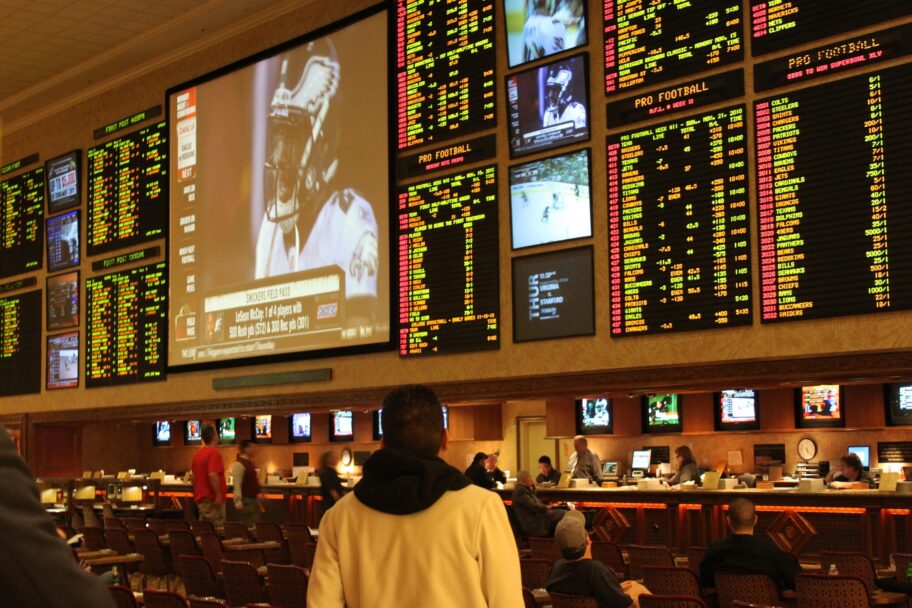
The United States is awash with vice. Over the last two decades, activities once kept in the shadows have gained a new prominence in American life. Pornography leapt from magazines and pay-per-view to high-tech streaming. Recreational marijuana became legal in 24 states. And today’s marijuana market includes high-potency products unimaginable back in the day, when you had to know a guy who knew a guy.
Then there’s gambling. Previously the preserve of Las Vegas bachelor parties or corner bookies, sports gambling is now, following a 2018 Supreme Court decision, legal in 40 states. Thirty-two states permit online gambling, allowing any adult with an internet connection to bet on everything from the NBA to Nigerian women’s table tennis. And the advent of prediction markets allows bettors to stake money on the outcome of an even broader array of events, from Taylor Swift album sales to tonight’s Mets game to whether Jesus Christ will return before the end of 2026 (current odds, 2 percent). An ad for one prediction market declares, “The world’s gone mad. Trade it.”
In the span of just a few years, gambling has become normalized, an accepted component of modern sports and modern society.
There has been almost no pushback to the sudden spread of online gambling. Most notable, as I wrote in Arc last year, has been the lack of opposition from conservative Christians. Since the 1600s, Protestant leaders had fought against all things gambling. But the arrival of frictionless sports betting provoked little more than a peep of resistance.
One might be forgiven for thinking that the Christian right had warmed to gambling, and to vice in general. After all, evangelicals have thrice supported a president whose impulses veer libertarian and libertine. Pockets of the modern GOP talk a big game when it comes to Christian nationalism, but President Trump has papered over deep intra-party divisions between tech-skeptical social conservatives and Silicon Valley executives who microdose ketamine. A silent bipartisan consensus has emerged to let people do whatever they want.
When it comes to vice, though, the question was never whether people would begin causing harm to themselves or others. The question was at what point evidence of harm would reach a breaking point that elicited blowback. Over the last year, the United States seems to have hit that point with gambling, thanks to a series of scandals involving collegiate and professional athletes, and to mounting evidence of financial harm and addiction.
The emergence of pushback to the spread of gambling is not surprising. What’s surprising has been its tone. The arguments against gambling, now that they have come, have been legalistic and technocratic. It seems that Americans are willing to debate moral questions about personal liberty only through the language of policy. Settling on the right amount of vice will require more than policy-speak. It will require a candid discussion of what is spiritually good for the nation. These days, finding that kind of discussion means looking in some unusual places.

Ohio is one of the key battlegrounds in the reckoning over gambling. In June, two Republican state lawmakers introduced the Save Ohio Sports Act, an aggressive piece of legislation that would prohibit online gambling and add a host of other restrictions. The bill was developed in partnership with a Columbus-based advocacy organization, the Center for Christian Virtue. In its advocacy for the Save Ohio Sports Act, the Center for Christian Virtue has not spent a lot of time discussing … Christian virtue. CCV policy executive director David Mahan told me this is a conscious choice, an effort—even in a reliably conservative state like Ohio—to broaden the possible base of support. He emphasized his organization’s ability to be “bilingual”—to use objective, scientific language as a vessel for the work of Christ.
The non-religious framing of CCV’s work reflects the broader disappearance from American politics of any explicit discussion of morality. Once upon a time, evangelical leaders like Jerry Falwell anointed themselves the nation’s moral arbiters and explicitly rooted their opposition to vice in their Christian values. In a 1985 resolution, the National Association of Evangelicals labeled gambling and lotteries “socially, morally and economically destructive. They are rooted in covetousness and violate the biblical work ethic.”
Modern evangelicals may share this view, but in their public statements they have become discernably less judgmental—apart from LGBTQ issues and abortion. They want people to live biblically, without telling them explicitly to do so. The National Association of Evangelicals has been mum on the rise of legal betting. Since 2018, its official statements have only referenced gambling once, as part of a longer list of “social evils” threatening the American family.
Once upon a time, evangelical leaders like Jerry Falwell anointed themselves the nation’s moral arbiters and explicitly rooted their opposition to vice in their Christian values.
Of course, with some people gambling on the rapture, maybe state-licensed sports betting should be the least of the Christian right’s worries. Prediction markets are the latest development in the spread of gambling. On one hand, they represent a new platform for the same old vice. On the other hand, prediction markets raise a host of issues that make sports betting look benign. Over a dozen bills, proposed by members of both parties, have been put forth in Congress to rein in prediction markets, from addressing their flagrant violation of state and tribal gaming law to banning their use by government officials. In April, following reports that a soldier illegally bet on the capture of Venezuelan president Nicholas Maduro, even former casino owner Donald Trump lamented that “the whole world, unfortunately, has become somewhat of a casino.” His son, Donald Jr. is an advisor and investor for the two leading prediction market companies.
Despite mounting opposition to prediction markets, only one politician has mounted a moral case against them, doing so in a Substack essay, “Prediction Markets Are the Latest Sign of Our Spiritual Disintegration.” The title is Falwell-ian. The author is not: Chris Murphy, Democratic senator from Connecticut.
Murphy’s essay goes where evangelicals have feared to tread. He acknowledges a worrying political aspect of prediction markets—the national security risks stemming from possible insider trading. But then he makes the crucial rhetorical jump: “What does it do to our soul, as human beings and as American citizens, when questions of life and death … stop being matters of morality and become ways to cash in and make money?” In an age when empathy is already in short supply, Americans should not come to see the world through the prism of gambling. When terrible things happen—whether a hurricane or a new Justin Bieber album—people’s first instinct should not be to wonder how they can make money on it. Gambling on events tied to human suffering, Murphy argues, “hollows us out in unseen ways.”
No one will confuse Murphy for a religious zealot. He told Vanity Fair that he resumed attending church in 2023, primarily to seek community in an age of disconnection. But he is sermonizing in a way that other politicians—and even religious leaders—seem unwilling to do. The implication, as he makes clear at the end of his essay, is that the challenge facing American culture is not as much political or economic as it is spiritual. And prediction markets level a “spiritual cost on our already weary nation.” We should not normalize them, he argues. Not because they violate state gaming law or are rife with insider trading, but because of what they do to their users and to American society.
The lack of moralizing from Christians has left a vacuum, the space for someone—anyone—to be a voice not just of reason but of right and wrong. The result is that the best contender for national moral compass is the junior senator from Connecticut.
Murphy embodies a needed change in the culture around vice, from resigned acceptance to healthy skepticism. As much as I appreciate that an organization like Ohio’s CCV advocates in secular language, more political leaders need to be willing to inject some moralizing into their discussions of vice. A debate about gambling is really a debate about the balance between letting people enjoy themselves and letting them potentially cause themselves harm. It should be made clear that there are consequences, not just for individual users but for society at large, when vice carries the day.
The lack of moralizing from Christians has left a vacuum, the space for someone—anyone—to be a voice not just of reason but of right and wrong.
Without such a conversation, any real pushback to the age of vice will become impossible. New generations will grow up not giving a second thought to the fact that they can bet on minor sports in far-off lands, or have high potency marijuana shipped to their home, or instantly access hardcore pornography. These will become things to endure. And they will become difficult, if not impossible, to question.
I occasionally bet on sports … among other things. In 2024, I won $150 when Arizona Cardinals kicker Matt Prater missed a 51-yard field goal to seal a week 17 loss to the Seattle Seahawks (I had bet on the Cardinals to end the season with fewer than 4.5 wins). Earlier this summer, I lost $170 on a prediction market because I incorrectly guessed that witnesses in a Senate hearing on Chinese economic espionage would say the word “drone.”
Being able to gamble like this should not be a given. People like me, who enjoy betting and believe that a certain amount of it should be legal, should be forced to make the case as to why. For better or worse, moralizing has disappeared from American politics. For years, I wished it would do just that. The idea that I might miss it now that it’s gone is a bet I never would have made.