


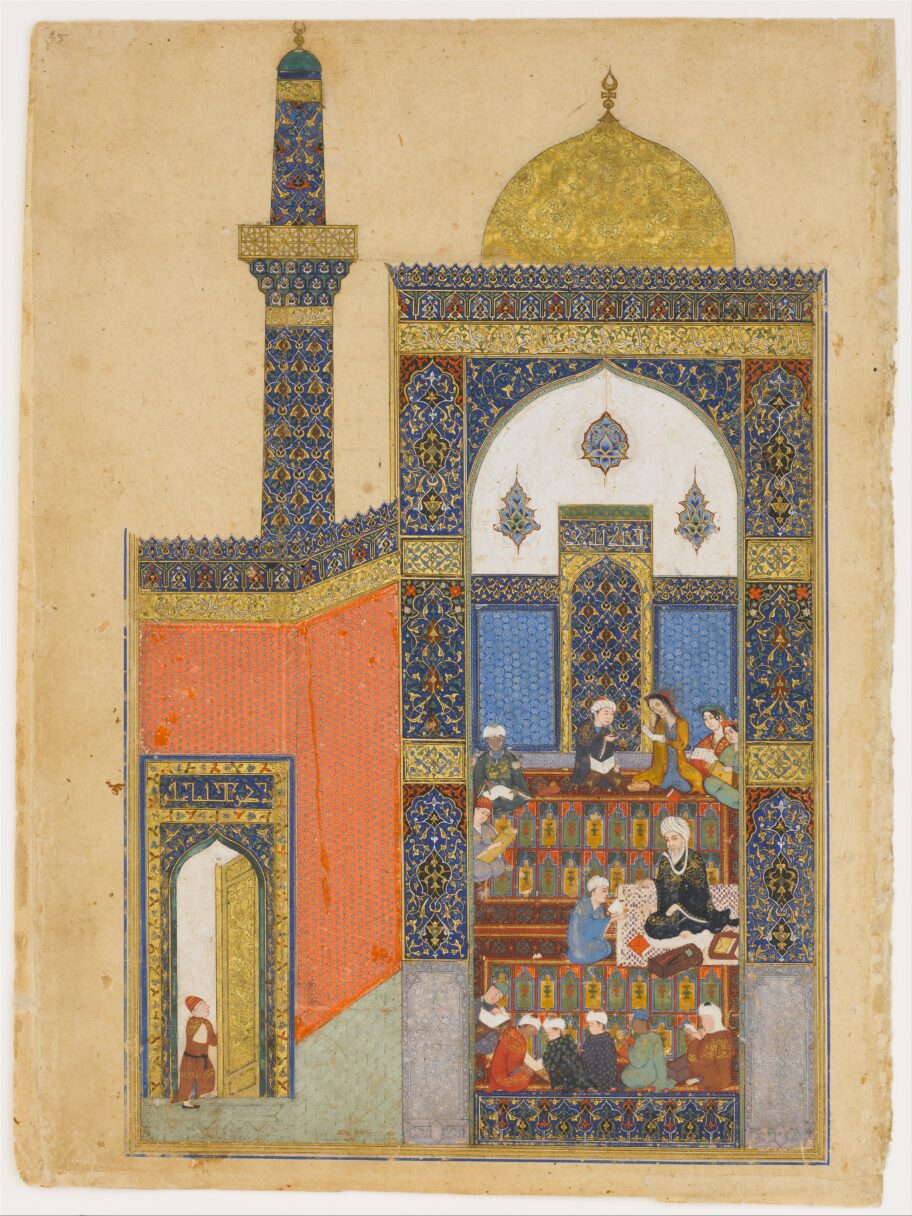
During the pandemic, our kids’ Sunday school went online. My wife and I sat through a few sessions, more than enough to know this wouldn’t cut it. Convinced our kids could not learn their religion virtually, my wife suggested I design something better. We called what emerged a “halaqa,” an Arabic term for a study circle—which, in this case, is an ongoing experiment in connecting our kids, and many of their friends and peers, to their faith tradition. My halaqas have reached dozens of Muslim students around Cincinnati, from a short-lived elementary school class with over 15 students to the culmination of that effort, what I teasingly call the AP Halaqa, with about a dozen high schoolers. While the specifics of the halaqa might be particular to American Islam, what I’ve learned speaks to some of the more urgent questions of our moment: how communities form and sustain themselves, what we owe the generations ahead of us, even the vital role faith traditions might play in redefining our relationship to technology.
Plenty of Americans accept that addictive algorithms have brainrotted us. Faith traditions, however, seem absent from many of the conversations about just what we’re supposed to do about this. That’s unfortunate. I’ve come to believe that the widespread adoption of smartphones verges on the practically idolatrous. Smartphones may not be shirk in the strict theological sense, the gravest theological sin in Islam, though if any other practice were to so distort our time and worship, replace the tasbih, the prayer beads that Catholics would call rosaries, and colonize our time in mosques, we might not consider that too far-fetched a claim.
What follows is an elaboration of how faith might be a firewall. Because something has to be.
No sooner had our first halaqa started than it had to change. It made little sense to teach these three kids together, two older girls a year apart, and a boy who was years younger. I’d started the halaqas because we were disappointed not just by virtual Islamic education but virtual education itself. Kids need to spend time with other kids (and not just their siblings). Following the logic of pandemic bubbles, I developed two halaqas: one for our daughters and their friends, nearly in high school, and another for our son and his friends, still in elementary school.
There’s a practical logic to this: when kids know they get to see their friends, they’re far more likely to show up. Procedural: it’s easier to build trust with people you know. Theological, too: Muslim worship is embodied and congregational. Existential: we are a minority. If our kids don’t know fellow Muslims, how are they going to hold onto faith in hard times, think through tough questions, inherit and sustain mosques—or, most bluntly, make more Muslims? Soon enough, our girls entered high school, and so I began to consciously model the halaqa on the high school courses they were taking.
Within a year, because many parents asked, I created a parallel halaqa for young men. But the AP Halaqa I now teach, which is still for high schoolers, is determinedly co-ed. Here’s why.
I’d set up the two parallel high school halaqas to help these students understand the foundations of their faith. But two problems emerged. First, the boys’ halaqa ended just as the girls’ began. These students knew each other; our families were friends, some of the students were even cousins. Yet the students wouldn’t even say “Salam” to each other when they passed in our hallway. Whatever the reason—adolescent awkwardness, the social atrophy of smartphones and COVID—it wasn’t hard to imagine the downstream effects for Muslim communities: how would they socialize? Find spouses? Build anything together?
There was a more immediate problem. Some of my best students started quietly quitting. At social functions, though, these same students would come over, say “Salam,” and have long conversations. It took months to realize they’d been bored. The halaqa was far less coherent than I’d realized. Some students were there to see friends. Some had parents who’d insisted, while some were there for the joy of learning. To the first, the solution seemed more obvious: make the halaqa co-ed. Make it necessary for them to learn with each other. Though our community is in the Muslim mainstream, used to gender-segregated activities, not one parent objected.
The boredom problem was harder to solve. These halaqas felt important to me, but they offered no tangible return for already very busy students. No grades, no credentials, no clear way to leverage this for college or career; I wasn’t even a coach who could dangle playing time. The only thing I could offer was difficulty itself. So I offered that. I called it the AP Halaqa—Advanced Placement for the faith. More rigorous, more selective, but with no bar to entry except aspiration. If a student wanted to be pushed, this was for her. Technology would be checked at the door, but the class would extend to ninety minutes.
To my surprise, though some students checked out, far more signed up, and many elected to continue.
I wanted my students to develop the ability to navigate Muslim conversations with confidence, to appreciate Muslim religious pluralism, and to graduate inspired to keep learning on their own. I designed the course around a close reading of a single chapter of Muhammad Iqbal’s The Reconstruction of Religious Thought in Islam; he was a thinker who’d long fascinated me and who I knew would stretch my students’ imaginations. Through his work, the students could explore history, theology, philosophy, colonialism, sovereignty, and democracy.
When I say “close reading,” I mean very close. Across eight classes, we made it through three whole paragraphs. Because it was a co-ed setting, I’d hoped they’d take the reading seriously—yes, I’d weaponized the gendered awkwardness of Muslim adolescents—and, as they grew more comfortable with each other, they began to engage difficult ideas in ways many Muslim institutions did not permit. But over that first semester, I grew dissatisfied with my own approach. Then came Christmas break, when I took 14 college students to Spain.
Technology would be checked at the door, but the class would extend to ninety minutes. To my surprise, though some students checked out, far more signed up, and many elected to continue.
I designed and led a retreat for these Muslim students, from the United States, the United Kingdom, Kuwait, and the United Arab Emirates, meant to help them grow academically, professionally and religiously. Some of them were veterans of earlier halaqas. In the first few days, the students circled each other hesitantly. A few experiences transformed the week. We went to a farm in rural Andalusia; discouraged from using their phones, the students explored the countryside instead. At dinner one evening, we placed men and women across from each other; the long table required them to talk. They started slowly. They didn’t stop. We read a poem by Iqbal in its original Urdu. They struggled. They seemed to love it.
The AP Halaqa was difficult in its own way, and this experience confirmed that that was still the right instinct. But through the first semester, the course had only been incidentally coeducational. Worse still, my curriculum itself had been designed defensively, a pedagogical rearguard action—I was teaching against technology, instead of teaching for a positive outcome. A halaqa organized around what we’re afraid of is still organized around insecurity. It was telling that not one of my students, all from religious families, had continued with the Sunday schools at our area mosques. They still went to the masjid, though. Still played on and cheered for the mosque’s basketball teams. If faith is to be the firewall, there must be something behind that wall—something sacred, serious, and sustaining.
There’s no reason for American Muslims to be naive about our challenges. But there are real indicators of optimism alongside these challenges: the diversity and youth of our communities, the big crowds that fill many mosques, the way we have meaningfully entered bigger conversations and realized more substantial platforms—from the phenomenon of New York City Mayor Zohran Mamdani, whose charisma outshines that of almost any other elected official, to the many Muslims in politics, arts, culture, and beyond, who no longer feel compelled to check their beliefs and convictions at the door. Could I lean into this newfound visibility and cultural confidence and redesign the halaqa accordingly? That question occupied me through January.
I came to wonder if the reason many of us feel so disoriented by AI is not only that we distrust the companies behind it, but because AI forces us to ask what humans are worth and for—are we means or ends?—a question that a pluralistic country would struggle to answer even in good circumstances. A faith community, at least in theory, should find it easier. I decided to design a course that would reverse-engineer religion understood richly. What does it mean to teach young men and women that their lives have purpose, and that prayer, marriage, family, generosity, and dignity are not obligations to discharge but goods to inhabit?
Brainrot alarms us because we believe our brains are fundamental to our humanity. But the Islamic tradition argues we are embodied souls. Soulrot is a thing, and though technology makes it worse, the solution is not a wary pedagogy but a celebratory, assertive alternative: an AP Halaqa that, because we are whole and ensouled, speaks to us as full people.
I’d treated removing technology as the goal. But it’s a precondition instead. It’s the beginning, not the end. The goal is what becomes possible in the cleared space, the particular vitality that our communities, at their best, still do.
For its first semester, the AP Halaqa went one whole hour, then closed with snacks and drinks. But as soon as we’d wrap up the lesson, about half the students would take out their phones and sit in corners by themselves. That was not supposed to be what was happening. So I made the class two hours and adjusted the rhythm: after half an hour of learning the grammar of Islam—memorizing supplications, vocabulary, traditional content and practice—we broke for snacks, sans smartphones. They had to talk to each other, or at least sit quietly and eat. If you’ve been to the Muslim world, you know the guest eats first and eats well.
For this second part of the session, I built in debates, discussions, even puzzles in which students worked in co-ed groups. How can young Muslims find partners, or even know what to look for, or understand how to build community and develop institutions, if their religious lives have taught them not to speak across gender? Technology already inhibited their getting to know each other, their ability to sit with and move past social discomfort. So too would a curriculum that kept them in separate rows. Knowing how to enter a room, hold a disagreement, sit with someone in pain, or be present long enough to be known is not difficult to learn. But that requires actually being with people, year in and year out, with expectations.
The AP Halaqa’s no-phone policy is not primarily about attention management. It is about practicing presence: two hours in which we invest in being with, learning from, and engaging one another. Technology is genuinely easy to grasp. Formation is hard and cannot be downloaded.
On our first day of this new semester and new model, I gave them an unexpected exercise. Islam means submission, the practice of submitting to God’s will. Most of creation, lacking moral agency, submits naturally; humans must choose. I wanted a prompt that would open them up, so I asked them to spend thirty minutes on the following: “We have two cats, Lolo and Lili. They’re Muslims. But are they Sunni or Shi’a? If Sunni, which madhhab, which school of religious law, do they follow? Explain your answer.” The lightheartedness was intentional. But what came back was remarkably nuanced. One student proposed that the cats were probably whatever madhhab her family followed, since people tend to adopt the religious orientation of the home they’re raised in.
It took a question about household pets to surface a claim about how we inherit religion, one everyone in the room already sensed but hadn’t quite let themselves say aloud.
I then asked them to take out a new sheet of paper and anonymously write the questions about Islam they’d carried unanswered. We’ve spent the rest of the semester on these. For example, for the following class, we explored a question several students had asked: if God is omnipotent and omniscient, how can free will be a thing? We held a feisty, no-holds-barred, co-ed debate around this. A few days later, I told the class I’d been reading Christopher Beha’s Why I Am Not An Atheist. Seven of the 14 students volunteered to independently read Beha’s account of his leaving and returning to Catholicism.
We’d meet at one of our area Yemeni coffee shops to discuss what it is to lose faith, and whether it’s possible to claw it back. This has been fun, inspiring, meaningful, and difficult in equal measure. But I see them only seven times a semester. Our youngest will enter high school in the fall and, with that, he’ll join the AP Halaqa, too. In four years, he’ll graduate, and this halaqa—held in our home, built around the rhythms of our family, with its particular texture of trust—will end. Yet I never believed this was really meant to scale.
Some communities only work because they’re small. Some things only work because everyone’s name is known.
As such, I’ve become wary of becoming too reliant or too fond of mega-mosques and attempts to practice and pursue religion at scale. More local, overlapping instances of shared worship and mutual commitment are more likely to reach young people and ensure adults don’t quietly exit their obligations; that might mean coaching basketball, serving food, leading hikes. For me, it means teaching philosophy on Sunday afternoons.
The work of sitting with a 14-year-old genuinely confused about whether her faith is compatible with her intelligence—refusing to give her an easy answer, though staying in the room while she finds her way through—is not something any institution can do at scale. It requires an adult who knows her name, who has been paying attention, who has learned something and knows he must give it back.
This is the central problem that religious education in a digital age keeps arriving at. We can build platforms at extraordinary scale, and they provide real things. But the work of formation, of becoming someone who can think under pressure, hold faith and doubt at the same time, and remain in community with people genuinely different from you seems to require presence, just like most of our worship and ritual do too.
What I’ve learned in these years of building these halaqas is not that our students don’t want to learn. They sought out a book I didn’t assign. One week, a two-hour class became three hours. The desire was always there. It just needed someone willing to stay in the question alongside them. The good news is that the Islamic tradition is, in this sense, structurally resistant to the logic of scale—and that resistance is intentional.
Five daily prayers, each embodied, each ideally congregational, cannot be outsourced or automated; they are a daily argument against isolation. Over time, prayer becomes part of a longer series of rituals—including remembrance, contemplation, supplication—that lay claim to stretches of our time and require us, in order to honor them, to step away from technology and into embodied solace or embodied community.
The generosity, the family bonds, the intergenerational obligations that Islam cultivates are transmitted not through content but through sustained exposure, through years of watching adults pray, give, argue, and return. Other traditions carry their own structural resistances to the thin democracy and thin community produced by thin modernity. Where the resistances of different traditions overlap, around the irreducibility of presence, the necessity of community, the claim that human beings are made for and accountable to each other, something begins to take shape larger than any single tradition: a plural humanism particular enough to mean something and shared enough to travel.
This is the unique role religion can and must play in a digital and democratic society. This is the Venn diagram I keep returning to: a plural, democratic society of overlapping circles. We will never be part of every circle, for that would dilute us to the point of meaninglessness, but we should be part of many, and no one should be left out of all.