


Ever since V. was published in 1963, novelist Thomas Pynchon has been operating in a dark funhouse of American paranoia. His books are dispatches from places where weird, unnerving, and incredible things are commonplace. From V. to The Crying of Lot 49 to his first masterpiece, Gravity’s Rainbow, through to his second masterpiece, Mason & Dixon, Pynchon has chronicled our country’s unique tangle of secret histories, conspiracies, and absurdities. He shows us that beneath the grand sweep of history lies a mess of competing ideas, dreams, and nightmares that overwhelms the effort to find order or meaning. With the release of his latest novel, Shadow Ticket, and the recent Paul Thomas Anderson movie, One Battle After Another, loosely based on his 1990 novel Vineland, Pynchon is having yet another cultural moment, which doubles as a chance to look back on his long, strange track record.
Pynchon’s place in the literary firmament is, at this point, quite fixed, in its own unique position (more on this later). Academics, literary critics, and Serious Readers know he’s important, and he has a steady cadre of diehard fans. But even the biggest diehards aren’t oblivious to the problems in his books. Not every experiment works, and not every joke lands. Not all the books are equally good. Because he writes about the military and criminal underworlds a lot, Pynchon’s settings are heavily masculine. He’s quite capable of creating fully embodied characters—Mason & Dixon’s strong suit, especially regarding the title characters and their friendship—and he indulges in some delicious forays into pansexuality now and again. But his women are often thinly drawn, and some of the less developed male characters have a horny, adolescent approach to women and sex that is perhaps a little too often played for laughs, an angle that hasn’t aged well. Finally, while his ability to create convoluted secret plans and conspiracies is very much part of the thrill of his books, he’s been at it long enough to see the political center of gravity for conspiracist thinking shift from the far left to the far right, which can complicate the way he uses conspiratorial thinking from book to book. Parts of Shadow Ticket, coming in at what might be the end of Pynchon’s body of work, seem to suggest that Pynchon has been listening to these criticisms, and sought to correct them.
But meanwhile, the absurdist and political leanings of Pynchon’s books, and their association with conspiracies, and even their sometimes sophomoric sensibility, are uncannily suited to the present. This is a moment, after all, when the serious and the absurd walk hand and hand. People are being swept off the street by masked federal agents and whisked away in unmarked cars, while the government is carrying out extrajudicial killings in the Caribbean. Meanwhile, a third of the White House is being knocked down to make way for a tacky ballroom that will dwarf its parent building while, in the streets, protestors push back against officers in riot gear by wearing inflatable frog suits.
Clearly, then, the novel and film have arrived at the right time. One Battle After Another has connected with audiences and stirred up controversy, and Shadow Ticket has been met with some good reviews. Given that movies and books have lengthy gestation periods, the timing of the movie and book’s release was probably not manufactured. Nonetheless, these Pynchonian products appear to be dominating our very Pynchonian moment. So much so that for one reviewer—Kathryn Schulz, writing in The New Yorker—the need for Pynchon to have an answer to our present condition was the driving question behind her disappointed review. She writes:
If our reigning artist of paranoid convictions, of high crimes and deep states, of the peculiar combination of depravity and absurdity found in those who lust for power—if that guy hasn’t made use of the present political moment to craft a satire or a survival manual or a swan song or even an “I told you so,” then what has he come here, after a long silence and in all likelihood for the last time, to tell us?
Shadow Ticket does have something to say along those lines, though not as directly as some might want. The plot, for much of the book, revolves around a simple and absurd enough device: it’s Milwaukee, 1932, and private investigator Hicks McTaggart is hired to retrieve Daphne Airmont, the heiress to a cheese empire who has run off with klezmer and jazz clarinetist Hop Wingdale. If this sounds to you like the makings of a romp through the speakeasies and jazz clubs of the Prohibition area, you are correct, and Pynchon delivers with energetic aplomb. But more than swinging hijinks are afoot. Milwaukee is plagued by a series of Italian anarchist-style bombings, and McTaggart learns that the police are trying to frame him for one of them. The feds are on his case, too, for some of his past misdeeds. That hometown pressure is enough for McTaggart to follow Airmont to New York City, where he learns that Airmont and Wingdale are both en route to Europe. After someone drugs one of McTaggart’s drinks, he wakes up to discover that he, too, is on his way to Europe.
McTaggart is fixated on his job, and on keeping himself out of trouble, and for most of the book Pynchon uses his protagonist’s actions to keep the plot on its curling path. But the wider, much messier world begins to creep in from the edges. We get glimpses of a decrepit police force, higher authorities who don’t seem to have much authority, and an organized-crime world that operates with near impunity. The drumbeat of political violence, in bombing after bombing, quickens. And a stopover in a Milwaukee neighborhood reveals that some of the folks in the German immigrant community might just have taken a shine to their home country’s rising leader, Adolf Hitler.
We get nearly three quarters of the way through the book, making it all the way to Hungary, before McTaggart and Airmont at last have the confrontation the story has been building toward. McTaggart wants to bring her in. Airmont doesn’t want to go. The talk gets messy. Airmont pushes back against McTaggart with a verbal exchange that sounds suddenly like Pynchon updating his sexual politics. Pheromones fly. And Airmont says she won’t leave without Wingdale, who’s gone missing. If McTaggart wants to bring Airmont back to the United States, they have to figure out where Wingdale went.
The conversation marks a sharp break in the book’s structure. The floor drops out from under the plot, and it’s not enough to simply follow McTaggart wherever he goes all the time anymore. So the novel’s focus shifts, zipping from character to character, location to location, in a breathtaking frenzy. We visit Wingdale and learn where he is—in hiding, realizing that his Jewishness has become much more of a liability than even he thought it would be. We visit an ungoverned, and perhaps ungovernable, area of Hungary for an anarchic motorcycle race, among other clandestine activities. Set piece by set piece, Pynchon ditches his straightforward detective plot for a much larger, chaotic story about people who are in over their heads. For big Pynchon fans, the moment is a return to form for one of their favorite authors. For new readers to his work, it might feel disorienting—or like a great introduction to the kinetic, chaotic way of writing a novel that Pynchon does like no one else. It turns out Pynchon’s latest novel might be the best one for a first-time Pynchon reader to start with.
At the age of eighty-eight, Pynchon occupies a rare and odd place in the literary world. On the one hand, his reputation can seem unassailable, his place in the canon secure; as fellow novelist Don DeLillo said of him in 2005,
it was as though, in some odd quantum stroke, Hemingway died one day and Pynchon was born the next. One literature bends into another. Pynchon has made American writing a broader and stronger force. He found whispers and apparitions at the edge of modern awareness but did not lessen our sense of the physicality of American prose, the shotgun vigor, the street humor, the body fluids, the put-on…. The scale of his work, large in geography and unafraid of major subjects, helped us locate our fiction not only in small anonymous corners, human and ever-essential, but out there as well, in the sprawl of high imagination and collective dreams.
On the other hand, Pynchon’s place has also always been contentious, in part because Pynchon himself keeps his distance from any apparatus of prestige. He’s never done an interview with a journalist and doesn’t show up for any literary events. There is no Pulitzer Prize for fiction for 1974 because the prize’s jurors unanimously recommended Gravity’s Rainbow, only to have the organization’s board strike the recommendation down when some board members insisted the book was “unreadable,” “turgid,” “overwritten,” and “obscene.” When Gravity’s Rainbow won the National Book Award in the same year, Pynchon sent comedian Professor Irwin Corey to accept the award on his behalf, and he rejected outright a gold medal from the National Institute of Arts and Letters and the Academy of Arts and Letters, which judged Gravity’s Rainbow the best novel written in the past five years. “The Howells Medal is a great honor, and being gold, probably a good hedge against inflation, too,” Pynchon wrote in a letter to the academy, but “I don’t want it…. Please don’t impose on me something I don’t want…. I know I should behave with more class, but there appears to be only one way to say no, and that’s no.”
Despite the less-than-collegial stance toward publishing and the academy, Pynchon continues to be taught in college classes, and his novels remain in the mountain range of Great Books that a lot of Serious Readers hope to summit before they die. His position in the literary world and academia has given a lot of people the impression that his books are difficult, and a lot of people do have difficulty with them. But some don’t; as Pynchon himself apparently said once of his readers, “every weirdo in the world is on my wavelength.”
Now’s a good time to say that I, your essayist, am one of those weirdos. I read Gravity’s Rainbow in 1997 when I was twenty-three, and my experience of reading it was less struggle than exhilaration. The kinds of books I read make people believe that I’m a Serious Reader, and I have an undergraduate degree in English from a schmancy liberal arts college, where I learned to analyze literature in the poststructuralism-saturated style of the time. But that’s not my natural state of reading; the truth is that I look at books less like accomplishments and more like music or drugs. At the age of seventeen I went on a jag of reading one transformative novel after another, fueled by Vintage International paperbacks: Gunter Grass’s The Tin Drum, a slew of Latin American literature. I wasn’t trying to decode anything. I wanted fresh experiences, new images, ideas, and perspectives. Even more than that, I wanted to see and hear people make language sing, feel the different rhythms in the cadences of their sentences. I read that way until college, and as soon as I graduated, I went right back. That summer, while working as a counselor at an Upward Bound program in southern Vermont, I read Derek Wolcott’s epic poem Omeros—a retelling of the Iliad, except about fishermen in the Caribbean—in a hazy swoon, awash in Wolcott’s tidal verses. Then I got a job teaching English in Japan, and because I don’t sleep on planes, read half of Gravity’s Rainbow on the flight over, then finished it not long after in a frenzied near-stupor of delight. It felt like freedom, like permission. It wasn’t so much that I got it as that I didn’t feel the need to get it. I was there for the ride, and what a ride it is.
Pynchon has always enjoyed playing with plot structures—the plot of Gravity’s Rainbow, for example, disintegrates about halfway through the book, like a failed satellite coming to pieces as it re-enters the atmosphere. Compared to that, Pynchon’s plot turn in Shadow Ticket is more like a controlled demolition. He takes apart his central story and follows out its loose ends to show us the darkness bubbling up all around Central Europe. Beyond the fascism taking root in Germany, Italy, and elsewhere—even beyond the ever-present but now growing antisemitism that his characters must contend with—Pynchon illustrates the general desperation underlying all the partying that followed the recovery from the Great War, in Europe and elsewhere. By 1933, the gaiety no longer provides a satisfying answer or a salve. With kaleidoscopic precision, Pynchon shows how the old order that governed Europe and global politics before the war has broken down, and how nothing has taken its place. Society’s elites are still pretending the old order exists, and are still just sheltered enough by money and prestige to believe the lies they’re telling themselves. But the people living on the margins of society know better, because they have to. At the upper echelons of politics, the leaders stepping into the power void speak in ways far more ominous than their predecessors did. Meanwhile, we get a glimpse of the multiple forces below the surface—secret services, terrorist organizations, biker gangs, political operatives, criminals, petty opportunists—gearing up for the chaos they know is coming. They see it all happening in front of them, everywhere.
“We’re in for some dark ages, kid. Dim at least,” Hop Wingdale’s booking agent tells him. “This could turn out to be thousands, tens of thousands of lives, and we’ll have to be the ones with better logistics, infrastructures of resistance in place and at hand.” He doesn’t grasp the scope yet, but he knows which way the wind is blowing. A mob lackey who won’t take on a contract to kill Jews understands that “after the War he found he couldn’t return to the U.S., something there had gone screwy, it was badlands now, to be avoided.” Pynchon’s exploration of antisemitism in Shadow Ticket comes up with the unsettling viewpoint that the latent prejudice against Jews in Central Europe, the United States, and Russia wasn’t (and isn’t) all that different; Germany may have proved to be the architect of the Holocaust, but that doesn’t mean mass killings of Jews couldn’t happen elsewhere—especially once social stability and the rule of law erode. And, in a particularly moving, troubling passage, while sampling nightlife in Hungary,
Daphne understands that she has already seen the last days of Klezmania, traveling parties of Swing Kids and Red Front fans, Jewish and otherwise, fraternizing shamelessly, who knows what expectations tumbling through their minds. The sort of thing Jew-haters don’t like to see but cops do, because it means overtime. To call yourself a Swing Kid was to count on a fight every time you went out to hear music, or dance, or even just hang around, running on little more than beer and their own adrenaline, while the Hitlerboys would be cranked up to unnatural levels of speed and force by the latest pills intended for Army use, some still under research at IG Farben. Creeping their way after the last set dazed and apprehensive, back out into the deep hours of a future where not even furtive reprises can any longer be counted on and the streetcars home are few if running at all anymore …
What to do in response? Pynchon allows Hicks McTaggart some wistfulness. “Sometimes all Hicks wants is to be back in Milwaukee,” Pynchon writes,
restored to normal life, to a country not yet gone Fascist, a place of clarity and safety, still snoozy and safe, brat smoke from a lunch wagon grill, some kid practicing accordion through an open window, first snow coming into a town off the prairie, barrooms where the smell of beer is generations deep, women in round little hats. Penny scales, newsstands run by war veterans named Sarge, everyday street doors that lead to nothing deeper than friendly speakeasies, El Productos in glass tubes, fried perch and coleslaw on Friday nights. Buttermilk crullers, goes without saying.
But other characters grasp the reality before them and find ways to act. A couple folks, in a mood reminiscent of the end of Casablanca, resolve to start smuggling Jews out of Europe. Others plan to resist in other ways. But Pynchon isn’t an ideologue. Some of his characters just want to survive, and help their friends and family along the way, and one of Pynchon’s gifts is to show how the key to survival is mental. As pilot Glow Tripforth del Vasto puts it toward the end of the novel, “whatever it is that’s just about to happen, once it’s over we’ll say, oh, well, it’s history, should have seen it coming, and right now it’s all I can do to get on with my life. I don’t care to know more than I need to about the mysteries of time.” She smirks. “You’re expecting spiritual wisdom from little G.T. del V.? You’ll be waiting a long time, sucker.” Del Vasto says this after just having rescued Daphne from some salivating Hitler youth, and after musing that she may join up against the fascists in Spain. Her statement isn’t about giving up—it’s about holding onto lightness in the face of dark times, having a feel for the absurdity of it, and not letting it pull you under, no matter how grim it gets.
It feels like a timely message. But Shadow Ticket’s resonance with our present political reality hits home not because of the surface-level stuff—say, the easy and half-inaccurate way many left-wing commentators equate the U.S. right wing with historical fascism. It instead lies in the parallels in the deeper dynamics at work: an old political order juddering to a stop, the elites of that order unable to navigate the new, uneven terrain; desperate and opportunistic grabs for power in the vacuum; a sense of being swept up into chaos and disorder as subterranean forces brewing for decades erupt to the surface. For Pynchon, this message isn’t as much timely as it is constant. If we’d been paying the right kind of attention, maybe we’d have seen it coming after all.
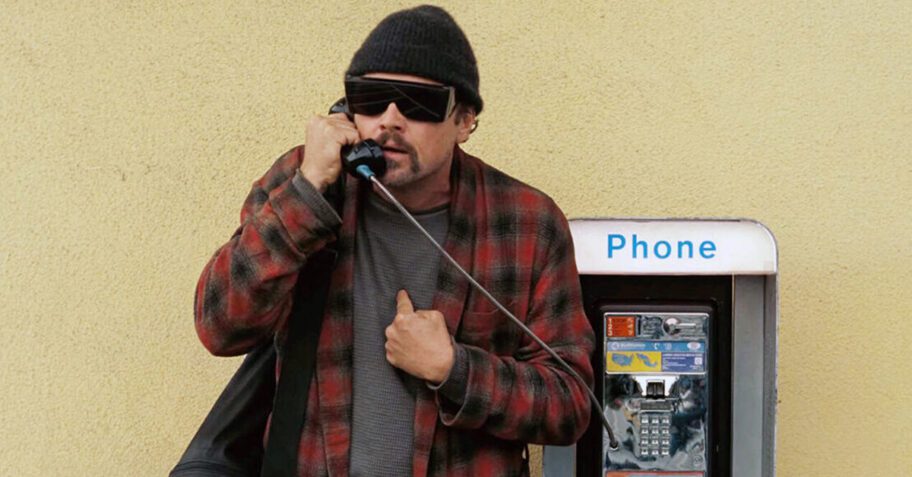
A similar angle pervades One Battle After Another, Paul Thomas Anderson’s film that is loosely based on Pynchon’s 1990 novel Vineland. The film takes more acute aim at the present day than Pynchon’s writing does, while maintaining enough distance to make larger points about the subterranean tensions that shape the surface headlines. Anderson’s movie envisions a United States just askew from ours, in which a leftist militant organization, the fictional French 75, engages in a secret war with elements from an equally virulent far right. The story centers on Bob (Leonardo DiCaprio), who at the beginning of the movie is a full-on terrorist with his partner Perfidia Beverly Hills (Teyana Taylor), raiding detention centers to free immigrants and blowing up banks. In the course of one raid, Perfidia disarms and sexually humiliates a military officer, Stephen J. Lockjaw (Sean Penn), who vows a strange, libidinous revenge. Perfidia and Bob end up with a child, Willa; shortly afterward, Perfidia is captured and cooperates with the authorities to take down the French 75, in exchange for placement in the Witness Protection Program. Bob and Willa have to go into hiding. The film moves forward sixteen years; Willa (Chase Infiniti) grows to be a sharp-eyed, strong-willed teenager, while Bob grows a healthy dose of paranoia and a raging pot habit. Lockjaw never gives up looking for them. He eventually catches a break and is back on their tail, and father and daughter are on the run again. Bob and Willa must find a way to help each other and reconcile their complex past. But in another way, the movie makes clear that what we’re seeing is another fight in an ongoing war that was raging before either of them was born and will persist long after they’re gone.
One Battle After Another shares with Shadow Ticket a sense of farce. Anderson’s script doesn’t sound like Pynchon, but the movie’s tone wears its love of its source material on its sleeve. For a tense movie about political operatives, it is often funny, finding its laughs at almost every opportunity, no matter how serious the subject matter gets. Bob is a recognizable Pynchonian protagonist, somewhat out of his depth but not totally hapless, and as the story goes on, he shows more and more vulnerability, more and more heart. There are madcap, almost Looney Tunes–style chases that Pynchon would surely appreciate, and a swarm of colorful side characters who also keep the jokes rolling, in a way that shows their strength even as things take dark turns. Most important, One Battle After Another is attuned to the places beneath the grand historical narrative—those American underbellies where things get really weird—which makes the film a more profound and unsettling depiction of the present. Anderson’s forays into the far left and far right point out that they are intergenerational, almost family businesses, and that the conflict between them continues unabated, whether it happens on the fringes or within the mainstream.
Pynchon was and still is a few steps ahead of those people looking for a quick recipe for political action. Politics—like history, like journalism—is a way of ordering and making sense of the things people do. Pynchon reminds us to be a little skeptical of that meaning-making enterprise, at every level, even if we like the message. The meanings we pull out of the chaos are impositions, and pretty clumsy ones at that. And in Pynchon’s worlds—which our real world increasingly resembles—learning to see and accept the chaos can be the key to survival. Because seeing the chaos can mean knowing when to fight or when to run, when to stand up or when to hide, when to stay on the ship or when to abandon it, and not get stuck going down with it. And because seeing the chaos lets us see that, no matter how dark it gets, there’s always a way to make light.