


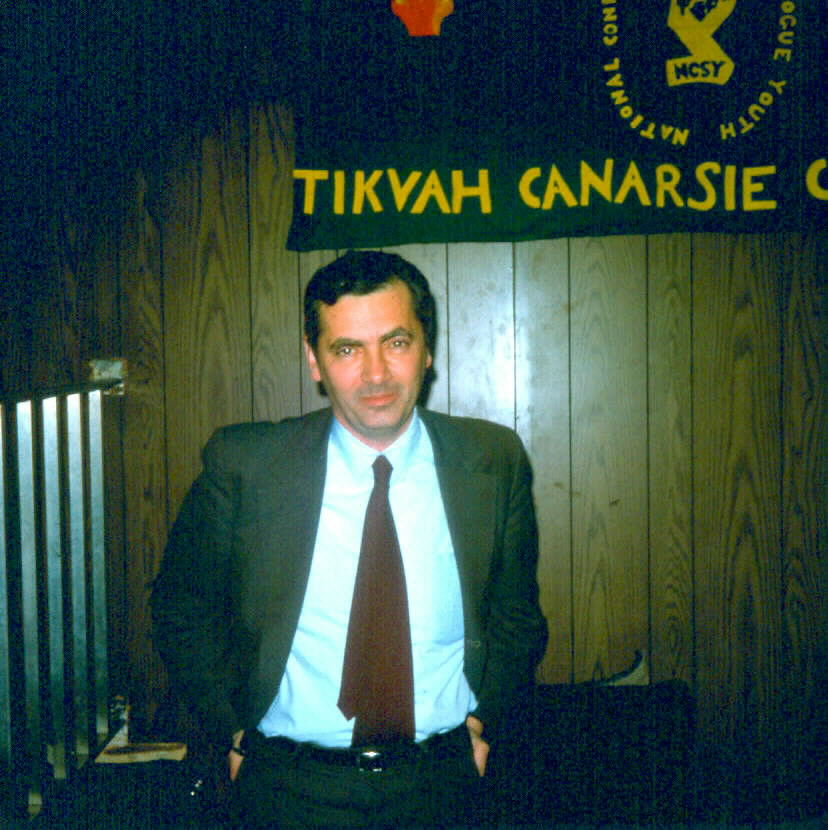
My book Meir Kahane: The Public Life and Political Thought of an American Jewish Radical (2021) examined the political career of Meir Kahane (1932-1990) as an American Jewish radical. A Hebrew edition with Am Oved Press is set to appear in early 2027, and I wrote a new introduction, giving me an opportunity to rethink some of the arguments made in the book almost a decade ago. One of the things that always interested me about Kahane as a public figure was how he was so reviled and yet at the same time so admired, especially in his formative years, and why he seemed to disappear from American Judaism. Until now.
Below I explore what I see as a ubiquitous return to “Kahanism” in America today. By “Kahanism” I do not mean the revival of one of the most maligned American rabbis in our time. Rather, I mean the adaptation of major themes of his worldview, which has resulted in a shift in American Jewry’s politics and its place in America.
In my book, I set the stage for introducing Kahane in America by claiming that from the 1950s through the end of the century, American Jewry was generally defined by liberalism. There are many studies that map that liberalism, perhaps beginning a decade earlier with the Old Left and continuing through the 1960s. Neoconservatism in the 1970s, not a Jewish movement per se but one that included many ex-liberal Jews, moved rightward from the 1960s New Left radicalism. Irving Kristol’s Neoconservatism: The Autobiography of an Idea (1995) offers a great assessment of the fault lines of postwar liberalism and its transformation into neoconservatism in the 1970s.
Kahane—or, more specifically, what I am calling “American Kahanism”—is a phenomenon that offers a critical intervention into the story of liberal American Jewry. Here is what I mean. Kahane often said that liberalism was the greatest threat to the survival of the Jews. This reactionary move was born from a variety of events in the late 1960s, when American Jews faced rising antisemitism among Black Nationalists in the urban North, when Soviet Jewry emerged as a defining issue of young American Jews, and when a new generation of children of Holocaust survivors reached adolescence and early adulthood. For Kahane, this was mixed with a strong Holocaust trauma that deeply affected his generation. Kahane noted that when he went to the Mir Yeshiva in Brooklyn, where he studied for 13 years, almost all his classmates were survivors. And almost all were anti-Zionists and made fun of him and a friend when they went to Yeshiva University to hear the Modern Orthodox, Zionist rabbi Joseph B. Soloveitchik speak.
Whereas today Kahane is known largely for his Israel career, Kahane’s 1971 breakout book Never Again! (which sold over 100,000 copies) has only one chapter on Zionism and Israel. He stated in the late 1960s that his project was “saving the Jewish dream in the Diaspora.” Kahane was always a Zionist, but until his legal troubles in the late 1960s, we don’t get a sense that his immigrating to Israel was imminent. He was a diaspora Jew.
Kahane moved to Israel in September 1971 (his family had moved a few months earlier), immediately after being convicted in a New York City court, and released with a suspended sentence, for a series of charges that included smuggling arms across state lines. When asked about the verdict, he said, “Good judge, good jury, bad verdict.” The following year, he published Time to Go Home (1972), in which he argued that America was the best country for Jews in their history, but even that great country could not prevent the rise of dangerous antisemitism. In Time to Go Home, he writes, “Those who say that America is different, and that it cannot happen here, fly in the face of historical precedent. There is a presumption that disfavors them that cries out its logical contradiction of their views.”
In the 1970s, when this was written, such sentiment was soundly rejected by the majority of American Jews, including many survivors. Today, much less so. For Kahane, the only solution was immigration to Israel. Time to Go Home was, in many ways, a swansong to America written by a diaspora Jew. Ironically, in his 1987 book Uncomfortable Questions for Comfortable Jews, largely a response to his removal from the Knesset in 1985, Kahane argued that Israel had lost its way and, because of its adopton of liberalism, rejected him (describing secular Tel Aviv Jews as “Hebrew-speaking goyim”). In doing so, they rejected the future of a true “Jewish” state. There was no possibility of Israel being a “Jewish and democratic state.” As he wrote in 1987, “Or a Jewish state, or a democratic state.” Today, after the Hamas attacks of October 7, 2023, many Israelis have become more sympathetic to that sentiment.
The only alternative for Kahane was overthrowing the state and replacing it with some form of monarchy, a Jewish kingdom. The Israeli political establishment rejected him, and by the late 1980s American Jewry had largely rejected him as well. He had fewer and fewer invitations to speak in American synagogues or community centers. To many, he was passé.
While Kahane the radical militant Jew may have been rejected in America, Kahane the Worldview never really was, and it is in ascendance in many Jewish circles today. As Kahane understood it, the ultimate failure of American Jewry would occur on two fronts: assimilation and antisemitism. The first was not new; it was a major source of anxiety for many Jewish thinkers in postwar America. For Kahane, assimilation was not only the disaffiliation of young Jews from Jewish life but also the radical politics of the New Left as a new Jewish identity. Kahane was actually in favor of radicalism, but only Jewish radicalism. That is, his radicalism was wholly exceptionalist. This is why he understood and respected the Black Panthers. He even titled a chapter in The Story of the Jewish Defense League “Jewish Panthers.” The Panthers were as antisemitic and anti-white as Kahane was racist. But Kahane believed that change was brought about by radical means. Jewish liberalism lived under the false pretense that America would, or even could, protect the Jews from nefarious forces. For many Jews today, this sounds less dissonant than it did in 1975.
Kahane’s America was influenced by the largely secular New Left and not the multiculturalism that would emerge in the 1990s, according to which the revival of Jewish life is largely the product of a “diversity” ethos that many Jews now contest as unfair to them, even antisemitic. One articulation of this early time was the chapter “From Jewish Radical to Radical Jew” in Arthur Waskow’s 1971 book The Bush Is Burning. Kahane once said to a synagogue audience that he had no problem with young Jews being radical, “they just had to have something (Jewish) to be ‘radical’ about.”
The question of antisemitism, however, was another matter. At a time when antisemitism had diminished in America (late 1950s, early 1960s), Kahane believed it would eventually rise to become a huge problem for American Jews, ending Jews’ safety here, ending the myth that America would always be safe for the Jews. America was always Kahane’s North Star. He believed antisemitism was an eternal part of Jewish history (“Esau hates Jacob”), and animus toward Jews was part of the covenantal framework that defined Jewish existence. But he rejected the rabbinic position of accepting it as part of the decree of exile. In fact, Kahane’s Judaism was often quite anti-rabbinic. The Jewish general Bar Kokhba was his hero, not the martyr Rabbi Akiva. Rabbi Akiva died for Torah; Bar Kokhba fought to save Jews. Kahane developed this revision of Jewish history in Listen World/Listen Jew (1978). Jewish quiescence was for him a product of dispersion. Jews needed to overcome that.
Kahane’s radicalism was wholly exceptionalist. This is why he understood and respected the Black Panthers.
Kahane was certainly not alone in this, but his solutions were somewhat novel. And, also, very American. Responding to antisemitism in America, Kahane believed the Jew had to adopt the tack of other radical minority groups, such as the Black Panthers and the Hispanic Young Lords. Perhaps by using violence, Jews had to make antisemites pay for lashing out against Jews. As Kahane said, “Every Jew a .22.” Today, Jews in America are buying guns in increasing numbers. For Kahane, the movement included providing security at synagogues and protesting anti-Israel events. Sound familiar?
In those years, Kahane’s advocacy of violence, even as a deterrent, was anathema to most American Jews. Jews were committed to liberalism and to the belief that America would protect them from antisemitic actors. He liked to tell a joke about two liberal Jews standing in front of a firing squad. One calls out, “My blindfold is too tight.” His friend turns to him and says, “Shush, don’t make trouble.”
In 1977, a group of neo-Nazis planned a march in Skokie, Illinois, a predominantly Jewish suburb of Chicago with large numbers of Holocaust survivors. Jewish groups protested, and the village obtained an injunction restricting the demonstration. In the landmark case National Socialist Party of America v. Village of Skokie, the U.S. Supreme Court ruled that Illinois had to provide immediate appellate review or stay the injunction; it did not decide whether the proposed demonstration was constitutionally protected. Subsequent court rulings cleared the legal obstacles, and the demonstration was rescheduled for June 25, 1978. Organizers ultimately canceled it after obtaining permission to rally in Chicago.
Kahane saw this as an opportunity, inserting himself in the debate with threats of violence if the march took place, arguing that a country that would allow Nazi rhetoric under laws of free speech was not one that would ultimately protect Jews. He was considered an outlaw by many Jews in the Skokie incident. Today he might be considered a hero.
Liberal America scoffed at Kahane’s alarmist rhetoric and his pessimism about American values, and it viewed his use of violence as embarrassing, dangerous, and un-Jewish. In our time, especially after October 7, American Jewish sentiment has undergone a transformation, perhaps beginning with the massacre at the Tree of Life synagogue in Pittsburgh in 2018 but escalating from there. American Jews have consistently, albeit not totally, moved further right. Some are drawn to right-wing ideologues such as Yoram Hazony, a self-described “Judeo-nationalist” whose books, like The Virtue of Nationalism and Conservatism: A Rediscovery, espouse a view that shares a fair amount with Kahane’s worldview. One could also look to Ruth Wisse’s Jews and Power (2007) and Liel Leibovitz’s articles in Tablet magazine. Shooting ranges in Jewish areas in South Florida are drawing Orthodox Jews, men and women, honing their shooting skills for protection. Some Jews come armed to synagogue on Shabbat for protection. Many view most criticism of Israel as antisemitic. In certain sectors of American Jewry, Kahanism has certainly returned, sometimes with a PhD.
This conservative turn actually began much earlier, arguably with Arnold Forster and Benjamin Epstein’s The New Anti-Semitism (1974); it was amplified in the 1980s by the Reagan administration and the growing influence in Washington of the Chabad and Agudat Yisrael movements. Forster and Epstein argued that the rise of antisemitism in the Muslim world, very much tied to Israel, was the next stage in the history of antisemitism. Today, that view has become normative for most Jews. But Kahane was predicting this even with the 1964 founding of the PLO. He spoke out against Ahmad Shukeiri, the first chairman of the PLO, who was considered too moderate by the organization and soon replaced by the more revolutionary Yasser Arafat. Kahane’s view is developed in his testimony to Congress on Soviet Jewry in 1967 and in his co-authored book, from the same year, The Jewish Stake in Vietnam. There Kahane drew the lines connecting Arab nationalism and North Vietnam, tying both to communism and arguing that America’s war in Southeast Asia was, in effect, the same as Israel’s war in the Middle East. Today, the communist bloc is no more, but connections between 9/11 and October 7 remain. Islamism has replaced the Red Scare.
For Kahane, a Cold War thinker, communism loomed large, and became increasingly wed to Arab nationalism and Palestinian solidarity. Today, communism is no longer a threat, but Palestinian solidarity has become an international movement, especially after the destruction of Gaza. In that sense the threat of the left, including Palestinian solidarity, has moved much of American Jewry further to the right, even those who maintain the “liberal” label, many abandoning a previously ironclad liberalism for a form of soft Jewish (neo)conservativism. Remember, neoconservatism was composed largely of refugees from the New Left.
Israel has become a wedge issue for many Jews in America in ways that Kahane cultivated. Here’s one example among many. In the late 1950s, there was an article written in The Harvard Crimson about Jewish life on campus. The article asked all kinds of Jews about their Jewish lives and identities. Many answers were given. Israel was not mentioned once. I don’t think that was unusual. Israel did not land for American Jews until after 1967. Today, the question of support for Israel is the very centrifuge of the American Jewish operating system. It is a question that is suffocating American Jewry. Kahane would have loved that.
The Jewish verbal attacks on Zohran Mamdani and Michigan Senate candidate Abdul El-Sayed remind us of Kahane’s own gadfly role in New York City politics. He mercilessly attacked liberal mayor John Lindsay for not protecting the Jews in “frontier neighborhoods” and not intervening to protect Jewish teachers in the Ocean Hill-Brownsville school strike, accusing Lindsay of antisemitism. It was one of the reasons he founded the Jewish Defense League.
The anxiety many American Jews feel today, Kahane predicted half a century ago. And the abandonment of young Jews to progressivism, both to the New Left in the 1960s and now to groups like the Democratic Socialists of America, is also something he predicted. Zionism and liberalism cannot be sustained together, according to Kahane. Zionism will break either right or left, as we readily see in our post–October 7 world. Kahane’s predictions in Time to Go Home (1972) about the collapse of Jewish security in America are widely viewed as more relevant today than when the book was written. Kahane long ago claimed all anti-Zionism was antisemitism, and now that is the mantra of the Anti-Defamation League, once a proud organ of classical liberalism. Kahane long ago claimed that liberalism was a danger, and now progressivism has risen to supplant it.
I do not write this to say “Kahane was right” but to note that this appears to be the underlying sentiment of increasing numbers of Jews in America today, often without mentioning Kahane’s name. Kahane seems like the ghost of this moment, both in America and in Israel. At least in Israel it’s overt. This does not mean that American Jews will reestablish the Jewish Defense League. It does not mean that American Jews will advocate preemptive violence in response to antisemitic threats. But it does mean that many Jews see their place in America differently than before, closer to what Kahane espoused than to the liberal promises of full integration.
Many American Jews increasingly view America as less safe and less stable for Jews than a generation ago, exactly as Kahane predicted. They are more focused on the rise of antisemitism than ever before (or maybe since the 1930s), some even comparing America in 2026 to Germany in the 1930s (a comparison that suggests a deeply misinformed understanding of Germany after 1933). This worldview includes suspicion about the diminishing numbers of Jews admitted to elite universities, horror at the election of Mamdani as mayor of one of the largest Jewish cities in the world, and anger at universities’ unwillingness to shut down free speech when it comes to criticizing Israel. Jews in America today feel less safe than at any time since World War II, even as they remain one of the most integrated and successful minorities in America.
There was a time when Kahane’s militarism was called “un-Jewish.” Now those who don’t support a state that exercises militancy over another population are considered “un-Jews.” The Reform rabbi Ammiel Hirsch has called for Hebrew Union College not to admit rabbinical students who are not Zionist. Some course syllabi at universities are being examined to determine if they include anti-Zionist content. Some professors are afraid to give courses on Israel or antisemitism for fear of retaliation.
The anxiety many American Jews feel today, Kahane predicted half a century ago.
American Jews have tacitly reconsidered Kahane’s advice without resurrecting the man. Is Time to Go Home landing for American Jews? Immigration to Israel has not increased in great numbers, as it did after 1967. In fact, more than twice as many Jews left Israel in 2025 as immigrated to Israel. But still, American Jews are feeling increasingly less confident that there is a future for them and their children in America, even as the political structures in America remain supportive of Jews and Israel, even after the Trump and Biden administrations gave Israel a blank check for its destruction of Gaza. Considering the left’s accusations of genocide in Gaza, and both the left and the right in America implicating Israel in the Iran war, there hasn’t been a time in recent memory when Jews in America have felt as uneasy. It is in these moments when Kahane’s binary thinking and dire prognosis for the diaspora are most attractive. American Jews understandably still live largely under the psychic specter of the Holocaust. Israel as the Jewish state being accused of genocide after Jews were themselves so recently victims of genocide is very dissonant, and understandably upsetting. As I understand it, this is part of the reflexive rejection of such a possibility. But Kahane might say, “If Israel needs to commit genocide, so be it.”
Kahane is too tainted a figure in American Jewry to truly return. But his ideas, his general worldview, detached from Kahane the person, and detached from his views on violence, have surfaced in the American Jewish conversation. Time to Go Home is hardly read anymore (it was never very popular when it first appeared) and neither is the early iteration of his political program in Our Challenge (1974). But if a centrist American Jew, to say nothing of someone on the center-right, read those books today, much would resonate.
Kahane had one vision for Jews in America and one vision for Jews in Israel. In America, Jews could succeed but had to fight, literally fight, to mitigate antisemitism. Ultimately, he felt they would not succeed. In Israel, Jews had to fight to maintain domination, which he believed was their birthright. In large part, they have succeeded, although October 7 may have changed that a bit, justifying an even stronger domination than Kahane advocated in the 1970s. In some way, October 7 is a confirmation of Kahanism, which is why he has returned to the political landscape. The conflict between Jews and Arabs was in Kahane’s view a zero-sum game, in part because, like Ze’ev Jabotinsky, whom he admired, he took Palestinian nationalism seriously. As Kahane said many times, echoing Jabotinsky, Arabs will not trade in their national aspirations for electricity, a washing machine, and a telephone. They are, he claimed, as “Zionist” (that is, nationalist) as the Jews.
Are we becoming “Kahane Nation”? No, not quite, but we are closer than we have ever been. We need to name that as we proceed. The waters ahead of us will require careful deliberation. With people thinking it will keep us safe, the return of “Kahanism” may be inadvertently taking us straight over the falls.