


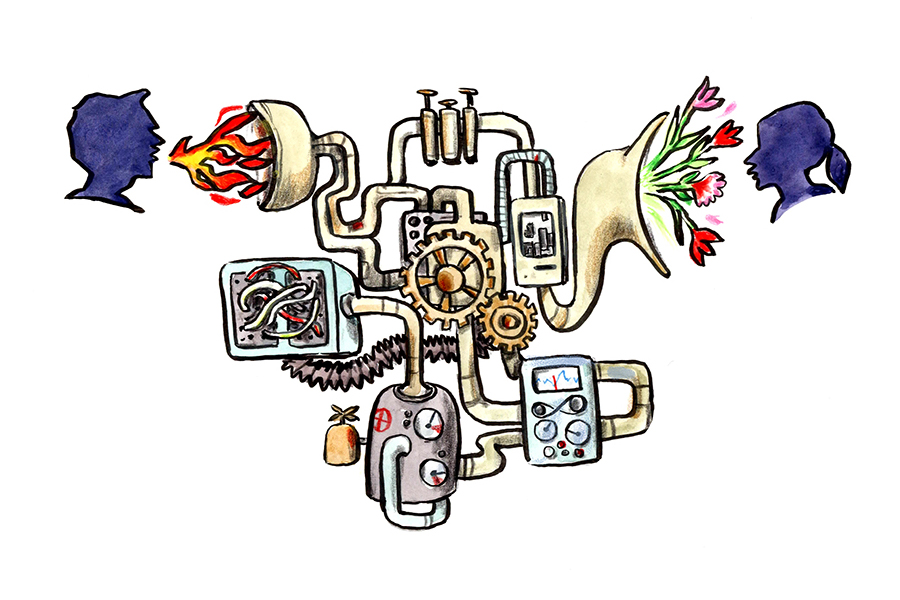
Ihave written a fair number of provocative things over the years, but nothing that’s stirred up as much evident unease in people who otherwise think highly of me as my recent post announcing the launch of my new app, Temper, which uses AI to help people de-escalate text fights. The Temper backstory, I think, is worth sharing before I get into why I think it’s proven so discomfiting.
Texting has been a great medium for me in all sorts of ways and an absolutely horrid medium for me in one highly significant way, which is that I can be an asshole when I get into fights on text. It’s too fast, too easy, and too stripped down a communicative instrument. When I get emotionally triggered on text, my most reactive and victimized self comes to play, and my guess is that I’m not the only one for whom this is true. It’s just a shitty medium in which to have conflict, and it’s also one that seems particularly ill-suited to my temperament and vulnerabilities.
In a better world, with a better me, I would just abstain. No conflict in text. Period. In this world, I need help. I’ve sought it in therapy in various forms, and that’s helped some. I take happy pills to reduce my reactivity, and they make a big difference. For the reactive remainder, however, I’ve long nursed the idea that it would be great to have some kind of protective layer built directly into the physical object—my iPhone—through which my text-based assholery conveys itself.
My fantasy version of it, which I’m pretty sure Apple wouldn’t permit, is a red stop sign icon that shows up directly on the iMessages keypad, just to the right of the emoji icon. When clicked while in a given text thread, it would prohibit you for a given period of time—15 minutes, say—from sending a text without first running it through a filter that transforms your angry text into its more constructive alter ego.
Clicking the red button wouldn’t force you to send the more mature text, but it would require you to see and actively choose to reject its gentler alternative before proceeding with your stupidity.
A few years ago I did some research to determine whether an integration like this was possible in the iOS operating system. The answer seemed to be no, but even if I’d gotten a definitive yes, it wouldn’t have mattered. I didn’t (and don’t) know how to code anything. The mechanisms for automating a smart re-framing of the text were also pretty crude. So I let it drop.
Then Claude Cowork came along, and I was reading so much about how it lets regular folks “vibe code” that I finally just decided to give it a try, with little expectation that it would get me anywhere close to a real app. Then in just a day or two of playing around with it I had a prototype of Temper working pretty well on my phone. It wasn’t quite the perfectly integrated, push-the-red-button-in-case-of-emergency version I’d originally envisioned, but it was startlingly functional, and the experience of making it was exhilarating. I felt like they’d started selling magic wands at Walgreen’s, no special wizarding license required, and I’d just walked in, dropped an Andy Jackson on the counter, and been allowed to buy one.
It was clear to me, from the start of my vibe coding journey, that if I wanted to get an app polished and reliable enough to make the Apple app store cut, I’d eventually need to bring in someone who knew how to actually code. There were obvious bugs I couldn’t fix, and it seemed safe to assume that there were subtle errors in the code that if unaddressed would render the app too janky to be usable by the masses. Just making the prototype, though, was such a power trip, and it wasn’t the only thing I made. Apps, plugins, microsites, dashboards—I “coded” ’em all.
With the exception of a few simple plugins I created just for myself, everything I’ve made in the past few months has needed or will need some work from someone who knows how to code to get it to the point where other people would want to use it. That requirement hasn’t changed from the pre-Claude days, but the barriers to collaboration have diminished so radically. In the old days, I periodically tried persuading coders I encountered to work with me on my text fight-interrupting concept, but they always said no, and I understood why. It would have been a ton of work for them, for an idea that wasn’t theirs, where the likely payoff was minimal to nonexistent. In my day job, I didn’t even entertain the idea of asking my coding colleagues to develop an app with me; their time was too scarce a resource, and what claim I could make on them, for my projects, had to go to higher priority stuff.
This time around, though, it’s been astonishingly smooth. I took my thoroughly fleshed out prototype to my friend Em, an experienced designer and web developer, and asked if he’d have any interest in collaborating. He hadn’t specifically coded apps before, but he knew how to code in general, and he knew from his own AI experimentation that he could use it to rapidly bridge the difference between what he knew and what he would need to know. So what would have been an absurd commitment, just a year ago, was now an easy yes. It wasn’t a huge time suck for him, sounded like fun, and offered him the chance to add app development to his suite of marketable skills.
A similar kind of shift has occurred in my day job. All sorts of projects have become possible in a way they wouldn’t have been before. I can iterate an idea and rapidly get it to the point where it’s evident whether it’s worth pursuing further, and if it is, it’s much easier to make the case to my supervisor and the coding team that I should get some staff time to help me finish it off. I’m asking for a fraction of the scarce staff time I would have needed before, and I have a very tangible, rather shiny prototype already in existence to illustrate why it’s worth it.
I’m not saying anything here that a million people aren’t saying constantly on Twitter every day, but it’s worth laying this sequence out because a) I’m not sure that people in the journalistic, academic, and literary space are having this experience in the way that so many people in other sectors of the symbolic capitalist universe are, and b) it helps explain why I, in particular, developed Temper. This was something I’d been wanting to create for years, well before tools like Claude Code or Codex came into the picture, and now I suddenly could. So I did.
Clicking the red button wouldn’t force you to send the more mature text, but it would require you to see and actively choose to reject its gentler alternative before proceeding with your stupidity.
If you don’t know this personal background, it makes some sense that you’d be taken aback that a good humanist like me would develop a smart phone app, which is surely one of the douchiest of all technologies. And not just any app, but an app designed to insert itself directly into the emotional lives of romantic partners. And not just insert itself, but insert itself via generative AI, a technology operating so close to the bone of what makes us feel distinctively human that it threatens to annihilate us existentially in a way that nothing else we’ve ever built has.
It just doesn’t compute. We know the type of people who would do something like this, and they don’t present like me. It’s seriously off-brand.
I get it, on multiple levels. There’s every reason to begin from the assumption that this latest product from the dark wizards of Silicon Valley will do a lot of the same damage that their previous few rounds of “advances” have done, if not more. It may further distance us from each other and ourselves, further exacerbate economic inequality, further enable surveillance, and further polarize our politics. That’s not even to mention the possibility, unique to this tech, of radical economic dislocation and even human extinction. The burden of proof is on the tech, and its corporate masters, to demonstrate that we should be more hopeful than fearful.
And yet—and the more time I spend using generative AI the stronger I feel about this—it should be possible to hold those concerns in mind and also choose, as individuals, to use such a powerful tool for our own personal, professional, intellectual, and creative ends. All these things that we could never hope to do just a year ago, as non-coders, we can suddenly do. All these ideas that we’ve had popping around in our heads that we’ve had to resign ourselves to never bringing into the world because we didn’t have access to the resources to implement them, we can now implement. All these ideas that we’ve never even bothered to have, because we didn’t possess the resources or skills to realize them, we can now have and possibly realize.
I can grant that it may not be a good idea, in the collective sense, to make magic wands suddenly available to billions of Muggles within a system of wand development and production being overseen by a bunch of stretch-faced Voldemorts. Still, though, it’s magic! You’re expecting me to leave the wand on the shelf?
The toughest (and most interesting) part of the experience of coding Temper was the development of the system prompts that guide and constrain how Claude reframes and decodes text messages in Temper.
The LLM, trained on a vast body of human text and then run through Anthropic’s various post-training regimes, seemed to me to have a deeply conditioned “desire” to hold on to far more of the semantic content of the original texts than I wanted it to. It was happy to tone down angry texts, but it had a very hard time entirely letting go of their core accusation or their deep tone of blame, despair, or catastrophe. Left entirely to its own devices, the result tended to be passive aggression, evident phoniness, or still quite angry texts that had the barest veneer of civility.
To corral these tendencies, I had to iterate over and over again with Claude a set of cautions and prohibitions intended to force it to actually do the genuinely transformative emotional reframes that I wanted. The final set includes:
- Watch for blame in disguise — “I feel unheard” points at the other person. “I’m scared I don’t matter to you” doesn’t. Always find the wish or longing underneath.
- Avoid language that suggests irreversible damage or an imminent crisis.
- Passive aggression, martyrdom, and sarcasm are masks. Find what’s underneath, don’t soften the mask.
- Sound like a person, not a workbook or therapist.
- Avoid passive voice construction as indirect blame. “This happened to me” or ”What happened really hurt me” can sometimes be a way of saying “you did this to me” without quite saying it.
- When the input expresses disorientation or loss of trust, find the underlying longing
—usually to understand or be understood—and orient the output toward that rather than the disorientation itself.
It’s worth noting that Claude couldn’t do this on its own. I couldn’t tell it what I wanted, once, and then expect it to figure out the rest. I was the driver, the thinker, the one able to consistently hold the vision for the project in mind. In fact the deeper I go into this work, the clearer it becomes to me how limited AI is in certain respects. I’m just so much better than AI at the things that I’m best at, and not just better but simply capable, in a binary sense, of doing things that it can’t do at all.
For now. These distinctions between human capacity and AI limitation may not hold for long. I don’t understand the technology, or the nature of intelligence, nearly well enough to have any confident prediction about where we’ll be in three or five or 20 years. AI may surpass us in all realms of human endeavor, and who knows what our world will be like if that happens. For now, however, the question we’re confronting is what to do, and how to be, in what is either a brief interregnum before the arrival of code that is superior to us in every significant realm or the early years of our civilizational encounter with an extremely powerful technology that isn’t different in kind from previous epochal technologies like the printing press, the mastery of electricity, or digital computing.
In either case, I don’t see much of an argument for why writers, artists, intellectuals, scholars, journalists, etc., should abstain from exploring the possibilities of the tool if it’s something that might be generative for them. They shouldn’t lie about it. They shouldn’t use it in stupid ways. They shouldn’t imagine that it can somehow bypass the law of the conservation of creative energy, which dictates that each of us has a fixed quantity of creative talent that no labor-saving device can add to. And no one should feel any more obligated to use AI than painters were obligated to drop their brushes and instantly take up photography the moment it was invented. Its existence doesn’t obviate the value of all the forms, tools, and mediums that preceded it, but nor should the inarguable worth of those pre-existing forms mean anything, one way or the other, about the value or propriety of what we do with AI. There isn’t progress in art in the way there is in science. AI will not make art more advanced, nor endow untalented people with talent. It’s just a new tool. Or maybe not just a new tool, but also a new tool.
I can grant that it may not be a good idea, in the collective sense, to make magic wands suddenly available to billions of Muggles within a system of wand development and production being overseen by a bunch of stretch-faced Voldemorts. Still, though, it’s magic! You’re expecting me to leave the wand on the shelf?
One thing that makes it so hard for us to wrap our minds around it as a tool in this traditional sense, with its own array of good and bad potentialities, is that it’s such an excellent mimic. It writes a good facsimile of good writing, and paints a good facsimile of good painting. This scares us, for understandable reasons, but it also tricks us into a kind of tunnel vision. When we think about what it might do for or to us, we default to seeing it as substitutional. It can speed up or replace our own work or the work that we might delegate or contract out to other researchers, writers, illustrators, animators, etc. It’s not as good as the best of us, or us at our best, but we see clearly the ways in which it’s often as good as the median, and in a lot of use cases it doesn’t need to be any better than that, just adequate, cheaper, and faster.
The substitution is real, and worrisome, but it points us in the wrong direction when we’re conceptualizing how to use it in our own creative and intellectual lives. Here the goal should be not to see it as a substitution for what we already do best, but as a different tool than the ones we’ve mastered. I didn’t use AI to write this post, for the simple reason that I’m better at writing than AI is. Bringing a super fast writing mimic into my process, in a linear way, can only make my writing worse. Its potential doesn’t lie in helping writers to become better writers, or filmmakers to become better filmmakers, but rather in using it the same way that artists have always used new tools: to do new kinds of things, explore new conceptual spaces.
In just a few months of playing around with this tech I’ve done enough to glimpse the kind of clearly positive sum things that AI can allow me to do. I built a simple dashboard that crunches decades of Federal Election Commission data to highlight the great quantity of money that one of my local Republican congressmen has inhaled from various industries and high net worth individuals. I gamed out a strategy for running a sting on a big corporation to reveal the ways that it routinely defrauds consumers. I built a neat little e-reader app that comes pre-stocked with a library of great books in the public domain.
These are minor projects, and I’m open to the possibility that they’d be considered “slop” by others if I let them loose in the wild, which I doubt I will. The key thing for me, though, is that they were made with integrity. I know because I made them. This says to me that there is good and great work to be done, whether or not I’ve made any of it yet or ever will.
In his recent Substack essay, “If you let AI do your writing, I will come to your house and kill you,” Sam Kriss assails a version of my argument, that AI can enable us to do good things outside our primary zone of expertise. He writes:
Sometimes people … argue that there’s no problem with AI writing, since it allows people who have interesting ideas but aren’t very good at writing to express themselves effectively…. Wrong! … If your ideas were any good, you wouldn’t need to use the machine; as it stands your sub-literate scrawlings are the best thing about you. At least they’re yours.
One never knows with Kriss how earnest he’s being—if he confessed that he’d written the above with AI, I’d only be mildly surprised—but it’s worth pointing out that this is just wrong on its face. There are plenty of brilliant thinkers out there who are mediocre writers or hypothetically good writers with such debilitating writer’s block that they may as well not be writers at all. There are excellent graphic designers who use various software tools to do excellent design. Again, AI is a tool. It can be used to glow up mediocre and bad thinking, but it can also be used thoughtfully and well.
A close friend of mine who is a wonderful therapist, and a sharp intellect, tried and failed for years to translate his subtle therapeutic vision into a book. He just couldn’t do it; the writing came too hard. He finally allowed himself to let AI assist him in writing the book, and the world is a better place for the book he (they?) wrote. It’s not a great work of literature, and it’s not as good as it would be if he were as good and fluid a writer as he is a therapist and talker. It will help people, though. It’s helping me. And in some respects it’s more interesting than Kriss’s essay, which is delightfully written but also a fairly predictable output of the Sam Kriss algorithm.
What is the principle whereby my friend shouldn’t have used AI to produce his book, or the rest of us shouldn’t allow ourselves to be engaged by what he’s created? Should we not read, or if we read make sure not to enjoy, “According to Alice,” the story that novelist Sheila Heti wrote in “collaboration” (her word) with AI?
It is absolutely true that a lot of the most fervent AI boosters and tycoons are politically horrifying people, and that is a good reason to be deeply skeptical of the industry and what it might unleash on us. And yet, at the same time, so much of the critique of AI that’s coming from its antagonists in the media and culture sectors carries with it such a payload of unacknowledged fear, disgust, and repulsion (Kriss, to his credit, owns his disgust).
AI poses a threat to our capacity to think and write clearly and well. Fear, disgust, and repulsion also pose a threat, especially when they’re insufficiently acknowledged and processed. They are the inverse, really, of the manic boosterism of the AI advocates. One side is telling you that if you don’t hop on board the AI train right now you’ll be left behind, destined to become part of the “surplus population” side of the coming sort. The other side is telling you that if you go anywhere near this tech, use it for anything more complex than a simple search or summary, you’ll be contaminated, polluted, impure. Both are trying to give you rules for what to do with your brain, and so both, if you let them in, will make you sound more like everything you say or write has been processed according to a pre-determined set of rules. They’ll make you sound like a machine, in other words. They are to be resisted.
I think we’re all struggling to mourn something right now when it comes to AI. Maybe it’s what shreds we had left of feeling as though we had some individual agency in a system that too often seems run by billionaires or simply too big or complex for anyone other than billionaires to have any noticeable impact on it. Maybe it’s the threat of our extinction as a species, or maybe, and this feels most resonant to me, it’s less a physical than a conceptual extinction that we fear. The terms by which we’ve understood who we are, and what our purpose is, seem as though they may be disintegrating before our eyes.
In the opening essay of his final collection, Imagining the End, psychoanalyst and philosopher Jonathan Lear reflects on the ways that people deal with threats of this sort, threats so vast and beyond comprehension that it’s hard to sit with how sad and scared they can make us. We can’t handle it, so we find psychological ways to deflect or re-route the fear and sadness into forms that are more digestible. The title of Lear’s essay, “We Will Not Be Missed,” is a jokey line someone in the audience delivers in response to a lecture on climate change and the existential threat it poses to human life on earth. “At the end of the talk,” Lear writes, “there was a discussion period. At one point, a young academic stood up and said simply, ‘Let me tell you something: We will not be missed!’ She then sat down. There was laughter throughout the audience.”
The joke, and the audience’s affirmation of it, clearly vexes Lear. What’s funny about humanity dying off? Why would someone make that joke, and why would others take pleasure in it? In his characteristically psychoanalytic way, Lear takes the one brief remark and uses it to work through various things it might tell us about the nature of the human psyche. Among other things, he suggests that the joke, and the laughter, are unconscious expressions of despair. They are implicit assertions that we may as well laugh about what climate change will do to us because there’s absolutely nothing we can do about it. And this despair, in turn, is a way of evading the deep sadness one might naturally feel about the damage being done to earth and the suffering and death that may result from it. It’s also a way of shutting down potential avenues for hope and creative action. Lear writes:
In the name of drawing attention to the problems we face, there is a form of discourse that discourages creativity and hope in addressing them. Despair thrives when it is not fully conscious of what it is. It portrays itself as truthfulness—as the courage to face grim reality straight on, without the wishful illusions that keep us so complacent. It does not understand its own motivated fantasy structure.
In the joke, the “we who will not be missed” deserve what is coming our way. This we, as I have suggested, must be a split-off we—separated in fantasy from all that is marvelous and good about us: our capacity for generosity and kindness, for stunning acts of creativity, for achievements of discovery and knowledge, for art and love, for our capacity to understand and appreciate self-consciously the world in which we live. If all this human goodness were present to mind, the young academic’s comment would be an occasion for overwhelming sadness, especially if combined with the poignant recognition that in some sense we have brought this destruction on ourselves. In short, it would be an occasion for mourning—for facing up to our ambivalence about our own situation and at least beginning to work through a sense of tragic loss. This is the mourning that is foreclosed in the joke. And so, there is reason to see the joke as an active refusal to mourn.
Isn’t this so much of what we’re doing right now when it comes to AI? Refusing to mourn? Mourning, in Lear’s formulation, isn’t simply experiencing loss. It’s “beginning to work through a sense of tragic loss.” It’s a creative act of making new meaning.
Imagining the End is a fascinating book, deeply thoughtful on what mourning is or can be, but it’s another, much stranger work of Lear’s that is a better guide to how we might constructively begin to think, or mourn, about the challenge AI is forcing on us. That’s his 2006 book Radical Hope: Ethics in the Face of Cultural Devastation, which begins from an enigmatic statement from Plenty Coups, the last of the Crow Tribe’s great chiefs.
“After this nothing happened,” Plenty Coups said, by which Lear takes him to mean that the end of the Crows’ traditional ways of life—hunting buffalo, counting coups—brought a decisive end to their ethical universe as well. It could no longer mean anything to be a good or bad Crow once you no longer could practice the forms of life within which those words had meaning. For the Crow, then, history had ceased (“After this nothing happened”). And the extinction of their ways of life, and ethical universe, was so complete that it was no longer even possible to imagine what a truly Crow existence or culture would look like.
In the face of that conceptual holocaust, writes Lear, Plenty Coups didn’t just grieve, though he certainly did that. Nor did he retrench into the old ways, as his rival Sitting Bull did. Instead, he began with a clear-eyed recognition that the Crow Tribe as it had been was done. From that place of tragic clarity, Plenty Coups mourned, and he also went beyond mourning into what Lear calls “radical hope.” This entailed not just thinking creatively about what could be salvaged of the old but what new practices could be adopted or adapted from the dominant culture that would keep burning the embers of the old ideals so that at some indeterminate future point–and the indeterminacy is why the hope was so radical–they could flame into a rich and comprehensive way of life that the Crow simply didn’t have the conceptual resources to imagine in the present. Plenty Coups also, and as profoundly, thought about what new story or stories the Crow could tell about themselves that would enable them to adapt to their current circumstances, and to cultivate and preserve the hope of future ones, as creatively as possible. Lear writes:
Plenty Coups had to acknowledge the destruction of a telos—that the old ways of living a good life were gone. And that acknowledgment involved the stark recognition that the traditional ways of structuring significance—of recognizing something as a happening—had been devastated. For Plenty Coups, this recognition was not an expression of despair; it was the only way to avoid it. One needs to recognize the destruction that has occurred if one is to move beyond it…. It is one thing to dance as though nothing has happened; it is another to acknowledge that something singularly awful has happened—the collapse of happenings—and then decide to dance.
We are in the midst of what threatens to be our own collapse of happenings, and it’s fucking terrifying. It’s understandable that the two dominant modes of responding to that terror are despair, on the one hand, and manic boosterism on the other. When we’re scared, after all, we tend to split.
It is easy enough to see my app, and my enthusiasm for it, as a product of that split, as a tribute to Moloch rather than as a creative act of mourning what Moloch is threatening to destroy. My only evidence to the contrary is what it has felt like to create it. I’ve been doing this art-making thing for a while now, and I’ve come to recognize what it feels like when something I’m making is alive and when it’s inert. And some, though not all, of the vibe coding has felt good. More than that, it has felt familiar. It has generated inside me the same buzz of electricity that I feel right now, writing these words. That doesn’t guarantee that the product is good. We all have misfires. But it’s the only useful test to which I can submit what I’m working on. If it feels right, then proceed. In times of great threat, and collapsing meaning, what else can we do but trust ourselves?
The magic wand of AI is an unusually powerful tool, and we should treat it with care. We should keep it out of our schools entirely, or permit it only sparingly. We should view its masters in Silicon Valley with the greatest skepticism. (Those two prior sentences could be written about computers generally.) We should be transparent about when we’re using it, and vigilant with ourselves about when we’re coming to rely on it as a crutch. Young artists in particular should be wary of falling victim to the substitutional temptation. No one should feel obligated to use it if they’re not interested in doing so. These are good guidelines. But to never use it out of fear of its power to contaminate? I guess if you don’t trust yourself.