


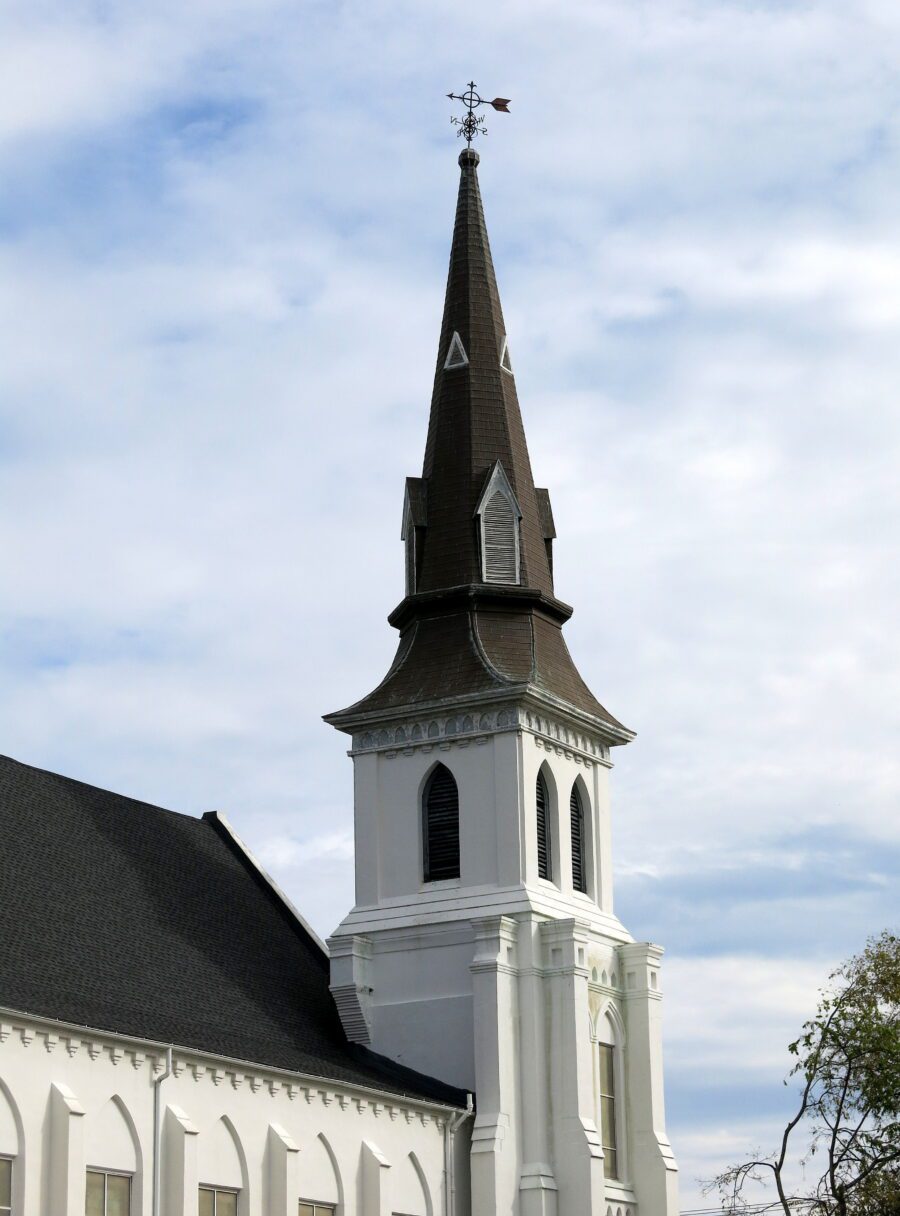
Kevin Sack’s Mother Emanuel: Two Centuries of Race, Resistance, and Forgiveness in One Charleston Church (Crown, 2025) is an elegant, sometimes gripping history of one American congregation. It is a book unlike any other, and one of the best American religious histories written in years.
Sack’s achievement is remarkable. He has tackled, with insight, empathy, and critical judgment, the harrowing two-hundred-year history of Mother Emanuel African Methodist Episcopal Church, climaxed by the 2015 shooting deaths of nine people at an evening Bible study by a 21-year-old white supremacist, Dylann Roof. Understandably, the book begins with the shooting, Roof’s conviction in a federal trial, and the forgiveness expressed by several (but not all) survivors at Roof’s federal sentencing, where he received the death penalty. But three fourths of the book probes the congregation’s determined history to escape white bigotry and brutality, buttressed by law, from the 1810s into the 2020s.
Strangely, newspaper and religious journals that have reviewed Sack’s book to date have focused on the shooting and the forgiveness of Roof expressed by several survivors, saying little about Sack’s extensive account of the congregation. But Mother Emanuel is primarily a history book, in which the author’s stunning research powers an understated narrative, sometimes sermonic but never saccharine, which reveals the two-hundred-year struggle of Charleston Blacks to worship independently, free from racial denigration.
Mother Emanuel’s fame drew Roof to the congregation. There is no evidence that Roof cared how the church achieved its stature. But if he had, he would have learned that it came from Mother Emanuel’s two centuries of resistance to slavery and white discrimination, brutality, and opposition to autonomous Black worship.
Sack spots the central conundrum of white and Black religiosity in slavery early on: “that enslaved Africans … so readily embraced the faith of their oppressors, and then so adeptly turned it into a liberation theology.” The tensions endemic to this choice stand at the heart of Black church history in America, the African Methodist Episcopal (AME) Church, and Mother Emanuel.
Mother Emanuel is primarily a history book whose stunning research powers an understated narrative, sometimes sermonic but never saccharine, which opens the two-hundred-year struggle of Charleston Blacks to worship independently, free from racial denigration.
Mother Emanuel traces its origins to a vigorous, then crushed attempt to create an independent Methodist African Church in Charleston between 1816 and 1822. Charleston whites, with the law on their side, demanded that Christianized Blacks worship with them—but sitting separately and listening to white ministers stress obedience to slaveholders as a central Christian doctrine.
In Charleston, the upstart Methodist movement of the early 1800s changed the equation, at least briefly. Only a few whites joined the Methodists, most put off by the movement’s emotionalism. But Africans flocked to the new congregations. By 1815, they overwhelmed whites 13 to one—four thousand to three hundred—in the Methodist congregations. The demographics and Methodist laxness created openings for Blacks. In some congregations, Blacks began to manage their own affairs and even preach. But when a new white Methodist overseer corralled these practices, and whites at one Methodist church destroyed a Black Methodist burying ground to build a garage for their hearse, Black Methodists rebelled. Over four thousand Blacks left Charleston’s Methodist churches in a mass exodus, to worship independently.
For four years, Black Methodists and Charleston authorities battled back and forth over separate Black worship. A free Black shoemaker, Morris Brown, purchased property, constructed a sanctuary, and secretly sought help from the newly established AME Church in Philadelphia. White authorities arrested hundreds of Blacks, including Brown, at their separate services. But after being released, Brown petitioned the legislature, promising good behavior for an independent congregation. The petition failed, and more arrests followed. A white newspaper called the worshipers “an excrescence of the body politic.”
Progress was slowed further when, in May 1822, a conversation among enslaved Blacks revealed a potential plot, allegedly led by a Methodist African Church member, Denmark Vesey, to kill white slaveholders, torch their homes and stores, and even execute the governor. White response to the “Denmark Vesey Affair” destroyed the would-be independent Black Methodist movement in Charleston and ended independent Black worship in the state until after the Civil War. White authorities hurriedly arrested, tried, and hanged Vesey and five other Blacks, then arrested more than one hundred additional Blacks several weeks later, tried and convicted seventy, hanged 35, shipped the rest to the Caribbean, closed and burned the African Church, and threatened prosecution of more of its members. Morris Brown and other Black church leaders fled north. South Carolina banned free Blacks from entering the state, demanded white guarantees for free Blacks, prohibited enslaved Blacks from contracting independent jobs, and later outlawed teaching Black literacy.
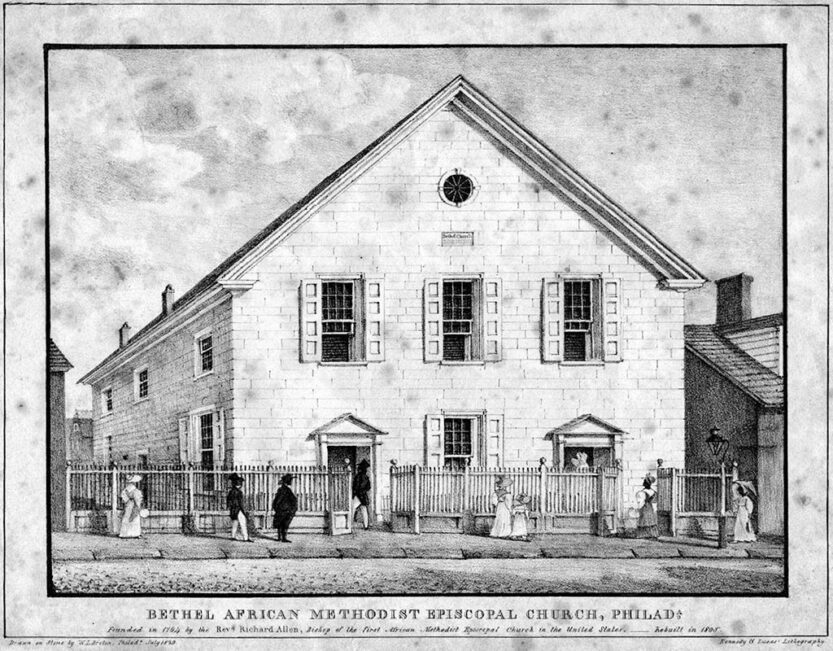
A new Black Methodist congregation emerged as the Civil War ended. Throughout the South, Blacks fled white congregations by the thousands to form Black-led Baptist, Presbyterian, Episcopal, and Methodist congregations. In Charleston, Black Methodists left their white congregations. Local leaders purchased property, welcomed a minister from Philadelphia’s AME Church, Richard Cain, and laid the cornerstone for a sanctuary seating 2,500 worshipers. Cain oversaw construction of the new sanctuary, which the congregation named Mother Emanuel, as Sack observes, “from the Hebrew name meaning ‘God with us.’”
Cain became a model for the Mother Emanuel clergy who followed. He fundraised adroitly, shepherded his impoverished worshipers into a new and vigorous congregational life, superintended AME missionaries who spread across the state and South, and spoke loudly and eloquently on the importance of establishing a discrimination-free post-slavery society. By 1868, he was running successfully for the South Carolina state senate; he won, resigned as Mother Emanuel’s minister after he was elected, and later became a U.S. congressman.
From Cain’s departure to the 1950s, 21 different clergy led Mother Emanuel. They served short terms, most two or three years and several only one—a pattern Sack regrettably does not explain. But Sack makes clear how some, perhaps many, led impressively. Norman Sterrett may have been a fashion dandy, but after an earthquake seriously damaged Mother Emanuel’s original sanctuary, Sterrett led an expensive, risky construction of a new and larger sanctuary, the gleaming white stuccoed building whose door Dylann Roof opened to enter a Bible study meeting. Sterrett’s successors burnished Mother Emanuel’s standing as a beacon for protest against the specter of lynching and Jim Crow laws that segregated every aspect of Black life in the state, from voter rolls to water fountains. The erasure of Blacks from South Carolina’s public life “only made the Black church more vital following the deconstruction of Reconstruction,” as Sack puts it.
B. J. Glover, who served Mother Emanuel from 1953 to 1965, broke the pattern of short-term clergy and made Mother Emanuel Charleston’s leading Black church, it leaders demanding full civil rights for Blacks in South Carolina. Glover made it the centerpiece for demonstrations against Woolworth, Kress, and other Charleston stores and accompanied his young daughter on two attempts to integrate Charleston elementary schools, one a failure, the second a success. Glover was arrested and jailed for protesting at the state capitol (the U.S. Supreme Court overturned his conviction), picketed Charleston stores, led Black members to cancel their store credit cards, hosted Martin Luther King Jr. on a rare visit to Charleston, and welcomed an appearance from the NAACP’s Roy Wilkins. People noticed. As one protester put it, “Emanuel was very well placed because it was so central.” Its centrality was not merely physical but also stemmed from its decades of protest, which Glover enhanced.
Across the next decades, Mother Emanuel’s fame quietly obscured changes that undermined its health. As Charlestown property values zoomed, and the white population grew, Blacks left town. By 2020 Blacks comprised fewer than a fifth of Charleston’s residents, down from half in 1960. When Clementa Pinckney arrived as Mother Emanuel’s minister in 2010, its membership had dropped to fewer than one thousand, from two to three thousand in the 1960s. Pinckney had earlier been elected to the South Carolina Senate, where he was widely respected as a thoughtful but persistent legislator. He struggled early at Mother Emanuel with a congregation famous for its discontents. But he persisted, impressing members with his fundraising and with his eloquence in proclaiming Mother Emanuel’s distinguished history. Sack describes how Pinckney “taught today’s African Methodists ‘to remember where God has brought us from’ while challenging them to hope for a better future.” Then Dylann Roof shot.
Mother Emanuel did not fare well after the shooting. It took three appointments to secure a permanent minister, Eric Manning. But Manning struggled with disgruntled worshipers, and the congregation mismanaged the unexpected outpouring of funds it received. Still, Manning hung on, the congregation righted its financial misdeeds, and survived the backlash that greeted Charleston’s sometimes violent Black Lives Matter in 2020.
Sack’s epilogue, “On Forgiveness and Grace,” elegantly records the forgiveness that some shooting survivors offered Roof. Not every survivor joined them. But the long Black Christian theological tradition of forgiveness, stretching back more than a century—through which “African American Christians have repurposed—and repurified—the faith of their enslavers,” as Sack writes—gave them a quiet freedom to speak. Most came to the sentencing with little idea what they might say or how. Diane Middleton-Brown, sister of the slain DePayne Middleton, only “knew what I didn’t want to do: I didn’t want to hate.” But Nadine Collier, daughter of the slain Ethel Lance, explained how forgiveness freed her from Roof, a sentiment others seemed to share. “Forgiveness is power,” she said. “[W]ith forgiveness I find myself rising above all challenges.”
Yet neither Sack nor the congregation could escape how deeply Roof’s attack damaged Mother Emanuel. He writes in the book’s final sentence, “The doors of the church are no longer always open.”