


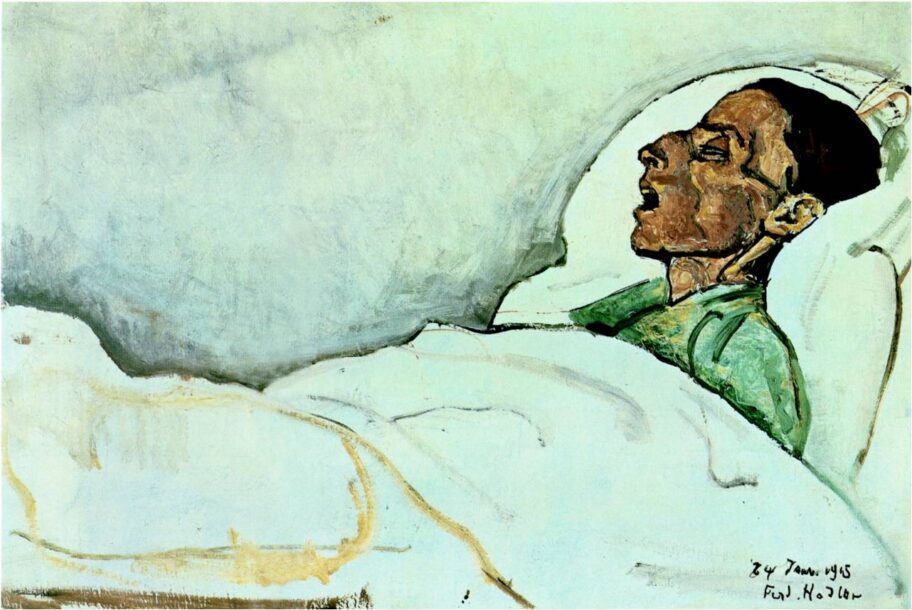
In late January of 1915, the Swiss symbolist Ferdinand Hodler painted a stunning portrait of his lover Valentine Godé-Darel shortly after she died of ovarian cancer. She lies in bed, in the painting, on top of the sheets and propped on pillows, with her hands grasping each other over her lap. Her head is tipped back, as if she were sleeping, and her mouth is open like someone trying to sleep with a bad cold. Her skin is painted in beautiful, ghostly tones of deep yellow and green; her legs shadowed in bright blue where her pale yellow bedclothes fold over themselves. The background of the painting is a vivid, warm pink with visible brush strokes and cheerful, rich red dots resembling roses floating over the scene. She lies in the posture of a saint, or even of Christ—the composition resembles Hans Holbein the Younger’s The Body of the Dead Christ in the Tomb, prone in death, swathed in a simple shroud, mouth gaping toward an unknown ceiling, or sky.
Die Tote Valentine Godé-Darel is one of eighteen paintings and at least 120 drawings that Hodler made of his lover throughout her illness and in the days surrounding her death. The portraits depict the decline of a woman he loved and so loved to paint, often in vigorous health. Hodler and Godé-Darel had met eight years earlier when she began modeling for him and became the figure of some of his most famous celebrations of the female form. She appears in his 1908 The Splendour of Lines in dynamic vitality, her back to the viewer as she moves in a kind of dancer’s step forward past the frame. A year later, in 1909, she was the subject of The Joyful Woman in a similar pose, a painting infused with a symbolist’s sense of vivacity in its rich blues and golden yellows, the musculature of her body visible under a thin dress, and the simultaneously strong and graceful motion of her arms and chest: joyful, as we know from the title, and also steady and controlled, a picture of health and strength even more than joy in its senses of happy abandon.
It seems nearly cruel that the model for these lively compositions would be diagnosed just a few years later with ovarian cancer, shortly after the birth of their daughter, Paulette, in 1913. Early in her illness Hodler began to paint very different portraits of Godé-Darel than the prior pieces, including striking frontal compositions reminiscent of the Fayum portraits painted to cover the faces of bodies mummified for burial in first-century Roman Egypt. The faces of the Fayum dead stare out directly from their boards with large black eyes and little expression but a sense of identification, a portrait of precisely that person, now recognizable to all who see the piece. Godé-Darel stares similarly at the viewer, as if the paintings were records to use to find her later. The paintings and drawings from these early days of her illness mark a turn in Hodler’s depictions of Godé-Darel, and perhaps his relation to her. Where earlier she appeared as allegorical Woman, she is now a subject of portraiture: a particular face, herself and not another, with compositional reference to the identification and commemoration of the dead.
As she got sicker, Hodler began to visit regularly, often daily, spending hours by her bedside painting and drawing her. In many of these pieces she looks directly at the viewer, or the artist, in uncomfortable gazes that seem to form a relation, or ask for it, while also fading from it. Her direct stares emphasize the distance between herself, as she suffers, and her onlooker, while also marking the onlooker’s presence with her. And the “onlooker” here seems to be Hodler more than the viewer. These are not the outward stares of a Mona Lisa or the portraits earlier in her illness that seem to look to an audience. The angle of the gaze, the pathos of her expressions, and, most of all, the agony evident on her face make it hard not to think of the person in the room who could attend to her pain. It is then hard not to imagine the eyes she was looking into, how Hodler looked back at her, and what relation was formed, or transformed, in the exchange.
Her weakness and pain become increasingly evident in these pieces as the series continues, and soon, more often, her eyes don’t meet ours, or Hodler’s: her head buries itself exhausted into the pillow, her cheeks gaunt, her hand appearing to rest, but nearly to clutch, at her heart. An article published in the Journal of Clinical Oncology describes the portraits as having “documented her wasting and eventual extinction without mercy and yet with intense sympathy,” identifying a kind of medical accuracy in what the author describes as “a series of paintings that force the viewer to face the process of dying.” The portraits may thus be “helpful to an oncologist to sense his or her reactions to these visual stages of suffering”—a curriculum of decline and death, made as the two lovers followed it themselves, in real time, together.
The angle of the gaze, the pathos of her expressions, and, most of all, the agony evident on her face make it hard not to think of the person in the room who could attend to her pain. It is then hard not to imagine the eyes she was looking into, how Hodler looked back at her, and what relation was formed, or transformed, in the exchange.
I was first captivated by Hodler’s work when I saw one of the final portraits, Valentine Godé-Darel on Her Deathbed, at the Met Breuer’s Unfinished exhibition in the summer of 2016. The composition of the painting is the same as in the painting first described above: Godé-Darel lies horizontally on the bed, her feet nearly touching the left edge of the canvas, her head just a bit farther from the right edge, propped on pillows, face tipped back, mouth open. But unlike the other painting, there is no vibrant pink background or red dots suggesting flowers floating above her, nor are the folds of her dress accented in bright blues and greens. The colors here are far more muted. The wall behind her is a slightly dirty white; the shadows showing the folds in her dress painted in quiet blue-grays, and in the sheets, a slightly grayer gray. The most saturated colors in the painting are the black of her shoes and stockings and the darker olive tones of her skin, sickly and deeply shadowed in sunken cheeks.
I was drawn to the spare composition and its vague horror from across the room, but also to its apparent “finish” in a collection of supposedly “unfinished” works, loosely collected though they were by that theme throughout the show. The didactic panel seemed written in reference to this concern, describing the piece as “executed in an incomplete and sketchy style” that “conveys [Hodler’s] silent anguish as well as a sense of finality.” It continues:
Created under extreme circumstances and at the end of an unprecedented series in which he recorded his lover’s illness and physical decline, the painting raises fundamental questions regarding the transitional nature of the moment of death and the inherent “unfinishedness” of human life.
I liked this description, though the idea of the portrait as unfinished because of its sketchy style or of life unfinished as human life is “inherently” unfinished seemed hard to defend, or define. What could it mean for life to be “inherently” unfinished? By what standards, and in whose telling—or, conversely, as opposed to what? A successfully completed life?
With respect to the piece itself, I could imagine a painter having precisely the intention to finish the painting as it appears, at this level of looseness in the brushstrokes and colors, the remnants of the compositional grid left unerased. I think these are quite interesting aspects of the painting, laudable to be intended as its “finished” state, instead of laudable at best as accidents of incompletion. I could also imagine the moment of death being captured by the painting precisely as a kind of completion, or in the words of the didactic, a “finality,” “finished” in that sense. The Fayum funerary portraits seem like potential examples of such work. The grammar of a “finished” life is still a bit odd, but it seems possible as an intention of the artist or a decent interpretation by the viewer of the painting’s subject.
It seems possible, that is, if not for learning that the artist and subject were lovers, and that the painting is part of a series of portraits painted as she was dying, not a singular memorial at her death. The possibility that it is a “finished” work—even the idea of a “finished” work—provokes a different set of questions by these lights. What would it mean for the artist to “finish” a painting of his beloved, now dead? What would it mean to want to finish it? Would that desire be a desire for a kind of relation to the relationship, to time spent with Valentine, whether with her physical body or with her in only painted form? We may desire endings of some kinds after our beloveds’ deaths, forms of closure to end forms of pain, but these desires seem far from the lover’s mind at the moment of passing. And maybe they are far from a lover’s mind altogether, qua lover, or so I want to consider here.
Learning that the artist and subject are—or were—lovers makes it hard to imagine the possibility of a “finished” version of the work because it is hard to imagine a lover seeking to exhaust their engagement with their beloved, as that might imply. Some forms of desire pursue exhaustion of certain kinds, but not the forms that bring a man to his lover’s bedside as she dies, to be with her for hours, painting and drawing her. It becomes harder to imagine any possibility of “finishing” the work in this setting, not because of an inherent “unfinishedness” of life, but because lovers desire more time together.
We might find some further suggestion of this reading by comparison, because this was not the first time Hodler had painted a deathbed scene of a lover. In fact, he painted a previous lover in death in a very similar composition around the time he first met Godé-Darel. This deathbed portrait, of Augustine Dupin, resembles even more than those of Godé-Darel Hans Holbein the Younger’s The Body of the Dead Christ in the Tomb—an unfinished life in a very different sense, depicted as such in still-open eyes and mouth, not closed by mourners nor yet reopened in the resurrection. Hodler’s portrait of Dupin in a similar pose is painted on a large, nearly square canvas, with a vast wall colored a deep ocher in the space above his figure lying in bed. At the top of the canvas, Hodler painted three bold blue lines, which he described to a friend at the time as “intended to symbolize her ascending soul.” But the verticality of ascent is thus represented horizontally, an “insistent horizontality” that some have understood to “foreshadow” his portraits of Godé-Darel.
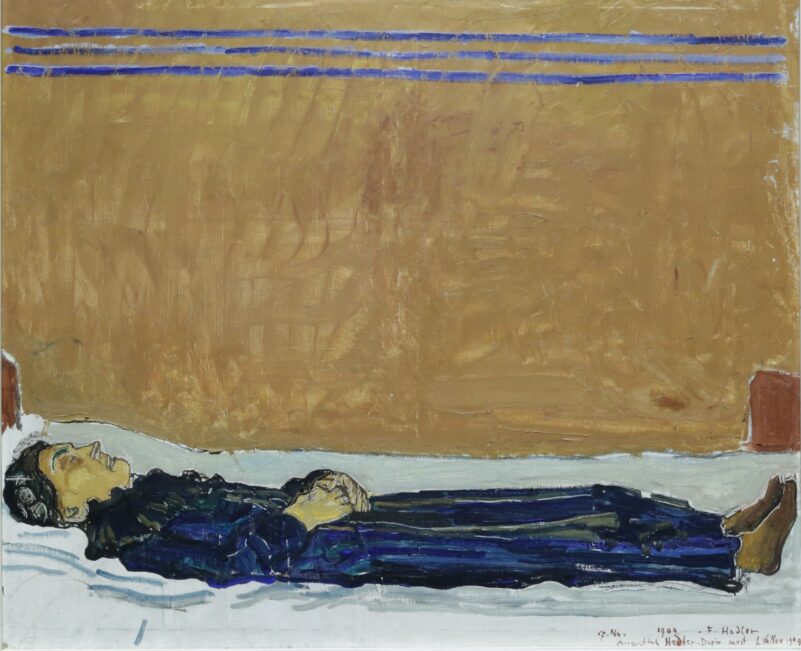
A striking painting, Hodler’s deathbed portrait of Dupin is relatively singular, with some other sketches made surrounding its development but not any extended series documenting her decline or the days and hours surrounding her death, as Hodler made of Valentine. It is also not actually quite a portrait of a lover, by all accounts, or someone with whom he was still in love. Dupin and Hodler had been romantically involved some thirty years earlier, in the 1880s, but were no longer lovers by the time of her death. The affair had produced a son, Hector, with whom Hodler was close, and thus a connection that continued past the end of the romantic relationship. It was Hector who called Hodler to her bedside, to sit with them both as she died. He may have loved her still, as the mother of his son or otherwise, but the relationship, it seems, was very different by the time of her death than the relationship he had with Valentine as she was dying.
The paintings are different as well: the paintings of Valentine in the same position are composed on more rectangular canvases, “coffin-like,” by one description, without the more ample space for the soul’s ascent. Many of the sketches are composed entirely differently, capturing strange angles of her head as she rests in pain, and seemingly drawn from different angles at her bedside. Most significantly, Hodler’s deathbed portraits of Godé-Darel represent not only his lover at the end of her life, in the tradition of deathbed portraiture undertaken also with Dupin, but the next entry in a series, and then the next, and the next—a series that doesn’t quite end at her death, as if in some disbelief or denial that the end of her life might be an end to their time together. In this way, they recast our understanding of the earlier portraits of Valentine. Where it was tempting to think primarily of the suffering and pain depicted as she becomes sicker toward death, the temporality of the portraits now comes to the fore, setting the relationship of artist and model as lovers into relief. The portraits depict a woman dying in intimate relation to the artist, her lover of nearly a decade and the father of the child she was leaving behind. We see that not in the quality of her gaze or the beauty of her depiction, in compositional choices or the vibrancy of the paint, but because they represent many hundreds of hours spent together as she rests, suffers, dies, and then lies dead. We might now imagine her suffering through the lens of these days by her bedside, Hodler’s trips back and forth between his house and hers, his drawing and painting her as her days dwindled, almost as a way of multiplying the days they had left by rendering them in oil or ink. The portraits represent time spent together, and so Hodler’s want for more time, the hours together never sufficient and the relationship always incomplete.
This was what captivated me in that initial exposure, and continues to captivate me about the series—as a series, significantly, and not as single works. Paintings notoriously struggle to depict the continuation over time that defines many relationships, but as a series, these seem to do something of the kind. They depict not just the beloved as her lover sees her, but his desire to keep looking at her, and in this sense at least, his want to spend more time with her. They are not an attempt to complete a depiction of her in some sense of mastery, having fully and finally drawn what he sees. They are the depiction of time together, and even the unsettling in that time of prior depictions. With the “melodic” movements of allegorical Woman in earlier paintings no longer under the painter’s compositional control, Hodler seems discomposed, the canvas determined on the horizontal plane by her illness, her waning strength, and eventually her death. He cannot capture that, if to capture is to control. He must be seeking to capture it, on canvas, in a different sense.
Hodler was evidently frustrated in his attempts to capture her during this period. Swiss author Hans Mühlstein, an intimate of Hodler’s at the time, describes Hodler destroying sketches of Valentine after his visits to her while she was hospitalized—exclaiming “It just doesn’t represent what I have seen!”—and later “kicking one of his paintings of the sick Valentine in frustration.” Drawing on Mühlstein’s records, the historian Jill Lloyd describes Hodler in this period “bitterly disappointed by the two-dimensional insubstantiality of his drawings and paintings,” apparent in his turn briefly and uncharacteristically to sculpture in 1914 to attempt a better rendition. He produced a small bronze bust of Valentine showing her sunken cheeks and thinning face, in what Lloyd calls “a desperate attempt to duplicate the reality he knew was slipping away from him.” He returned to painting, however, as she grew closer to death, the pace of the paintings and drawings quickening and the repetition of their compositions suggesting repetition itself as a response to the inadequacy of the two-dimensional form.
As a series, then, they also suggest a lover’s defiance of reducing the beloved to some set of valuable qualities and characteristics, information about her grasped and held. Hodler paints and paints, draws and draws, without letting any one piece be the full and final depiction of Godé-Darel. Her irreducible particularity seems displayed in the repetition, each piece losing its claim with the next to being the depiction of her. It is as if each painting, as part of a series, ends with Alexander Nehamas’s “and so on”—of our loved ones, there is always more to say, and somehow something always still left out.