


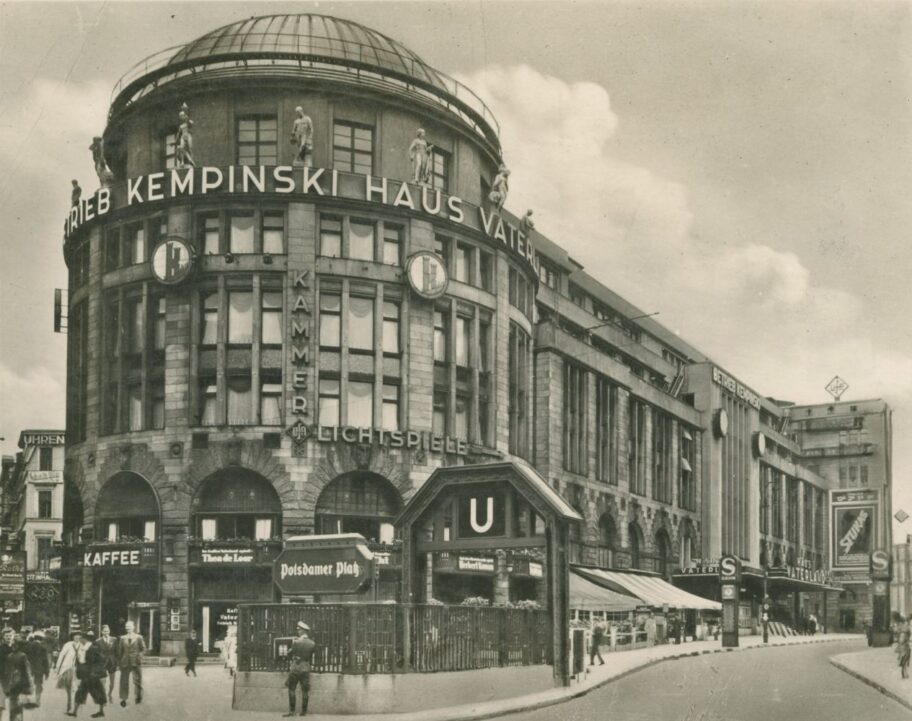
In the conclusion of Stay Alive: Berlin, 1939–1945 (Penguin Press, 2026), Ian Buruma’s engrossing and disturbing chronicle of civilian life under the Nazis’ murderous wartime regime, Buruma makes explicit what is a mostly unspoken undercurrent in the book. “The new world of hope did not turn out so well,” he writes of the lessons unlearned in the aftermath of World War II. “The thaw in relations [after 1989] between the former Cold War adversaries froze over again in a new state of even more dangerous hostility, with an aggressive war spilling across European borders. Dangerous demagogues are once again threatening even some of the oldest democracies. The world is not yet done with dictators.”
Buruma, a prolific historian and journalist, takes pains to warn that when it comes to political tyranny, you lose your freedoms first gradually and then suddenly. When threatened by authoritarians, complacency and wishful thinking spell the death knell of democracy. Stay Alive reminds us that once a dictatorship controls the mechanisms of the modern state, resistance, no matter how heroic, is futile. As the political philosopher Judith Shklar, a Holocaust survivor, wrote in her classic essay “The Liberalism of Fear”: “The fear and favor that have always inhibited freedom are overwhelmingly generated by governments, both formal and informal. And while the sources of social oppression are indeed numerous, none has the deadly effect of those who, as agents of the modern state, have unique resources of physical might and persuasion at their disposal.”
Buruma’s book is a harrowing catalogue of the resources deployed by the Nazis as the Allies dropped more than sixty-five thousand tons of bombs on Berlin to both destroy the war-making ability of the Germans and demoralize the civilian population. Whether one despises such a totalitarian regime or clings desperately, as many Germans did, to a sense of misplaced patriotism in the hope that some modus vivendi will emerge, mere survival inevitably becomes the imperative. You do what you must, or you perish, and this choice usually entails making decisions of daunting moral ambiguity. Buruma does not excuse those who betrayed or exploited others in such circumstances, nor does he judge those who committed suicide or the countless number who had to submit to sexual coercion, or worse, to stay alive. Sex becomes a common currency in desperate times. But he implicitly asks the obvious question: what would you have done in such a life-or-death situation? Choices made in such circumstances, he writes, are “difficult to condemn, especially if one was never faced with such moral dilemmas oneself.”
My father-in-law, Max Horst Segall, was arrested by the Gestapo in October 1938, along with seventeen thousand other “Polish” Jews, and put on a train to Poland. He was 22 years old and lived in Prenzlauer Berg, in northeast Berlin. He had been born in Berlin, but his “stateless” status, according to the Nazis, was determined by the nationality of his biological father, who had been born in a disputed area between Germany and Poland. Max worked as a banker, and, in accordance with the Nuremberg racial laws implemented that year, his work permit was withdrawn in 1935. He remained unemployed until being deported.
Poland refused to accept the refugees, leaving them stranded at the border, many for almost a year. It is not clear when or how Max found himself in Warsaw, but he ended up in the Warsaw Ghetto after the Germans invaded Poland the following year. Thanks to the help of a sympathetic German soldier, whose benevolence he would vouch for to authorities after the war, he escaped from the ghetto, not once, but twice. He was briefly incarcerated in a concentration camp in Poland, but again managed to escape, aided by friends in the resistance. At some point, he was joined by the woman who would become his wife, Frieda Esther Lopatka. In an extraordinary act of devotion, Esther, the daughter of a Jewish father and a Protestant mother, converted to Judaism in 1936, despite the Nazi determination to rid Germany of every Jew.
Using false papers, the couple hid in Poland for nearly two years, helped by Esther’s excellent command of the Polish language. On Easter Sunday in 1944, as the German defeat was becoming increasingly obvious and the Russians were marching through Poland, Max and Esther made the extraordinary decision to return to Germany, taking a train from Warsaw to Berlin. As Max explained his reasoning to me, he understood the Germans better than the Russians, and his expectation was that the German police would be careless on the Easter holiday. It is likely, but not certain, that his false identity papers were provided by Esther’s brother-in-law, a German Lutheran exempt from military duty because of a medical condition. Arriving in Berlin, Max and Esther walked many miles to the suburb of Fichtenwalde, where they were given refuge in a hidden attic room. Their son was born in the attic in the final weeks of the war. As the Russians advanced on Berlin, Max and Esther abandoned the attic and made their way to the British occupation zone. When the fighting finally stopped, Max went to Berlin in hopes of finding out the fate of his stepfather and mother. They had been deported to Poland in the early years of the war. Incredibly, they also had survived, and were back in the apartment the Nazis had confiscated after expelling them from Berlin. In December 1949, they all emigrated to the United States. They were directed by the Jewish relocation agency to Chicago, where my wife was born in 1952.
Like most Holocaust survivors, Max and Esther rarely spoke about the war. I once did ask Max how the Nazis could have taken over Germany. “People went crazy,” was all he was willing to say. Why, I wondered, didn’t he and Esther go to Israel after the war? “We had already enough excitement in our life,” he explained with a wry smile. He did not go into any details of how they survived, although he liked to tell the story about having a troublesome tooth removed by a dentist in Chicago. “I’ll take that,” he said as the dentist prepared to discard the tooth. It contained a diamond. Could the Allies or the underground resistance movements have done more to stop the Nazi mass killings? Max was adamant on that question. Only the military defeat and unconditional surrender of Germany would stop the Nazis, he insisted.
In 1943, with the Netherlands under Nazi occupation, Ian Buruma’s father, Leo, a twenty-year-old Dutch law student, chose to be sent to Berlin as a forced laborer in a brake and machine gun factory. It wasn’t much of a choice. Leo either had to “volunteer” or he would be “severely” punished and his parents arrested. At that time, when most able-bodied German men had been conscripted into the Army, there were more than four hundred thousand foreign workers in Berlin. By the end of the war, there were six hundred thousand. They labored under increasingly terrible conditions, with workers from supposedly Aryan nations such as the Netherlands and Denmark treated marginally better than those from Poland and Ukraine, who were regarded as racially inferior “vermin.”
Those Jews remaining in Berlin, confined to “Jew houses” because their property and belongings had been appropriated, were treated even worse. As Buruma emphasizes throughout Stay Alive, few civilians living under the Nazis’ violent regime had much of a choice about anything, and Jews, as well as the Nazis’ perceived political enemies, were in constant danger of being shipped off to concentration camps and likely death. Leo survived near-starvation conditions as well as terrifying saturation bombing by the British and Americans, before he was liberated by Soviet troops in 1945. For the rest of his life, he remained shaken by any loud blast, such as fireworks.
When Leo spoke about his wartime experiences, he did so in a measured tone. Some of his countrymen had condemned his decision to work in Germany as a kind of collaboration. But as “he also learned quickly from experience,” Buruma writes, “life under dictatorship and occupation throws up all kinds of moral dilemmas. Not everyone is cut out to be a hero; and even heroes are not always morally pure. Compromises come with a price, however, some of which are more acceptable than others.” Almost executed by Russian soldiers as a suspected Nazi in the war’s final days, Leo’s own life was saved by the intervention of a Russian officer who happened to speak English.
Like native Berliners, when he was not working or avoiding bombardment, Leo could attend movies, concerts, the theater, and even professional soccer games. While most Berliners “averted their eyes” when confronted with the regime’s crimes, “some Germans managed to remain decent, when decency could be very dangerous.” Nazi propaganda minister Joseph Goebbels, who along with his wife would poison their six children before taking their own lives in the final days of the Third Reich, was determined to sustain civilian morale and support for the war even as the looming catastrophe of defeat and occupation edged closer and closer. Movies, and of course the radio, were essential tools for the regime in that regard. Even as late as 1944, Goebbels poured millions into movies aimed at sustaining support for the war and devotion to the Führer. Kolberg, a movie released in January 1945, tellingly dispensed with the antisemitism so pervasive in Goebbels’s earlier propaganda films and instead celebrated “a desperate exultation in battling to the death.”
Reading between the lines, Buruma makes good use of the carefully euphemistic letters his father sent back to his parents in the Netherlands during the war. Such correspondence was of course first read by Nazi censors. Tens of thousands of German civilians were killed by the Allied bombing, and nearly two million fled the city. Yet, as Buruma explains with almost clinical detachment, those who remained tried to carry on normal lives, and were careful to avoid unnecessary encounters with the Nazi authorities.
Buruma deploys a large cast of characters in the story he wants to tell. Some of their names and testimonies were well known in their time, others not. He makes good use of the Berlin Diary (1941) of William Shirer, the CBS Radio correspondent who would go on to write the bestselling The Rise and Fall of the Third Reich (1960). Goebbels’s own self-deluded and preening Diaries provide an invaluable look into the murderous Nazi mania. The Prussian aristocrat Helmuth James von Moltke, an anti-Nazi patriot who nevertheless worked for German counterintelligence during the war, was hanged for his connection to the failed assassination attempt against Hitler on July 20, 1944. He was one of more than five thousand Germans executed in Hitler’s reprisals. Moltke’s letters to his wife, Freya, quoted by Buruma, are especially poignant.
Even as late as 1944, Goebbels poured millions into movies aimed at sustaining support for the war and devotion to the Führer.
The Russian aristocrat Marie Vassiltchikov’s famous Berlin Diaries are also used to show how difficult it was, as Buruma puts it, to “remain decent in a criminal state.” After working for the German government as a translator, she survived by escaping to Vienna in the last days of the war. Christabel Bielenberg, author of The Past Is Myself & the Road Ahead: An Englishwoman’s Life in Berlin Under the Nazis, was a British citizen married to an anti-Nazi German lawyer. Knowing the consequences for her family if they were discovered hiding Jews, Christabel nevertheless writes of how she “loathed myself utterly” when she refused to offer such sanctuary. Like Moltke, Christabel’s husband was arrested on suspicion of having a connection to the assassination plot. Buruma writes admiringly of Christabel’s bravery when, with a mixture of flattery and deceit, she persuades his jailer, a former concentration camp commander, to release him.
Among lesser-known survivors were Ruth Andreas-Friedrich, a journalist, and her Russian-German husband Leo Borchard, a musician and conductor. They were part of a resistance group, and according to Buruma, helped to save dozens of Jews. Another survivor, “Coco” Schumann, was a jazz guitarist. His mother was Jewish and his father a convert to Judaism. He managed to elude discovery and deportation for much of the war while entertaining Berliners at various venues, some sanctioned and others illicit. Goebbels had a habit of repeatedly closing and then reopening nightclubs and dance halls. American jazz, although condemned by the Nazis as degenerate, remained enormously popular with Berliners. Schumann survived the war despite eventually being sent to Auschwitz, where he was forced to play for those heading to the gas chambers. Buruma suggests that Schumann’s youthful brazenness helped him escape the SS on more than one occasion.
Those who considered themselves German-Jewish patriots were put in an especially paradoxical position. Erich Alenfeld, a German banker and World War I veteran, astonishingly hoped to rejoin the Army as World War II commenced. The Nazis considered him to be Jewish, since his parents and grandparents were. But he was baptized a Lutheran and “felt German, and only German, and was not about to let a change in circumstances force him out of his native country,” Buruma writes. Some Jews, like Alenfeld, simply could not imagine leaving.
Stay Alive is most harrowing in its description of the final days of the war, a time of “apathy and hedonism,” when squads of fanatical SS men and other dead-enders rampaged through the city, killing thousands of suspected “defeatists.” Hitler refused to surrender, demanding that boys and elderly men be conscripted into a People’s Militia and ordered to fight to the death. “Who promotes measures that weaken our resistance, or even tolerates them, is a traitor!” Hitler proclaimed. “He must be shot or hanged on the spot!” It was during these final weeks of the war that Esther’s brother-in-law was murdered, presumably by one such gang.
Buruma, who has written skeptically about the dangers of mixing politics and religion, provides a few examples of Germans who, out of religious conviction, opposed the Nazis and helped Jews. He mentions Clemens August Graf von Galen, the Catholic bishop of Münster, who objected to the euthanizing of handicapped and mentally ill people. The Nazis reluctantly ceased such operations. The Catholic Church as a whole, however, didn’t resist, but “learned to live with the Nazis in a state of mutual distrust.”
There were some heroic exceptions, such as Bernhard Lichtenberg, dean of St. Hedwig’s Cathedral, who publicly objected to the treatment of the Jews. He was murdered by the Gestapo. The Protestant minister Martin Niemöller’s objections to Nazi persecution of Jewish converts to Christianity are mentioned, but curiously not Niemöller’s relationship to Dietrich Bonhoeffer and the Reformed theologian Karl Barth as one of the founders of the anti-Nazi Confessing Church. The Confessing Church rejected the effort to eliminate the Hebrew Scriptures from the Christian Bible. Niemöller, who was a political conservative and possessed traditional antisemitic views, was initially a supporter of Hitler. He ended up in Dachau for objecting to Nazi racial policy on religious conversions. He survived the war and repudiated his earlier views. Bonhoeffer was the well-known anti-Nazi Lutheran theologian executed, like Moltke, for his association with some of the July 20 plotters. Both Niemöller and Bonhoeffer are good examples of the personal contradictions and impossible dilemmas faced by those trying to remain decent in a criminal state.
Given his determination to complicate our understanding of the tortuous choices Berliners faced, the fact that Buruma does not discuss the much-debated plight of Leo Baeck, the chief rabbi of Berlin, seems like a lost opportunity. The Nazis compelled Jewish leaders to help organize deportations, while forcing Jews to pay for the deportations themselves. Fearing panic among the Jewish population, believing that resistance would only bring more immediate Nazi retribution, Baeck withheld from the refugees his knowledge of their likely fate in gas vans and the camps. Baeck himself was eventually incarcerated in the Theresienstadt concentration camp but survived the war.
Nor does Buruma mention Friedrich Percyval Reck-Malleczewen’s remarkable Diary of a Man in Despair. The diary was secretly written during Hitler’s years in power and published posthumously in 1947. Reck was a conservative Prussian aristocrat and a monarchist. In some ways he was an erudite crank, although one with a keen sense of honor and a willingness to die for what he believed. In the face of Nazi barbarity, he thought martyrdom was inevitable. He lived on a six-hundred-year-old estate ninety kilometers outside of Munich, although he spent a fair amount of time in Berlin, whose cosmopolitan culture he disdained. He “hated” the Nazis and blamed the Prussian “industrial oligarchy,” conglomerates such as Krupp & Co. and IG Farben, for empowering them. His son was serving in the German Army on the Russian front, but Reck barely made a secret of his political views. He was arrested in October 1944 for “undermining the morale of the Armed Forces” and executed in Dachau a few months later.
Reck was classically educated and trained as a medical student, and he held strong Protestant views. He blamed the rise of the Nazis on the emergence of “mass man,” a population easily seduced by cheap consumer goods—“the cult of the ugly”—and stupefied by senseless entertainments and Goebbels’s pervasive, inane propaganda. From the very beginning, he refused to acknowledge the legitimacy of Hitler’s regime, which he condemned as “born in chicanery, blackmail, and swindle.” Well before the war, he was condemning “this erasure of a feeling of honor, this ethical defect, this Godless denial that boundaries exist between right and wrong that forces me to believe in the final and ignominious depth of the German spirit.”
After Hitler invades Poland, Reck writes, “I am far from making the mistake of thinking that nothing but devils live here, while nothing but angels live over there. Nevertheless, I cannot overlook the fact that a European psychosis is nearing its end in the dance of death that is going on in Germany, the psychosis of nationalism, and that Europe must now decide either to destroy it, or be itself destroyed.” Learning of the July 20 attempt on Hitler’s life by those who had previously served the Reich government, he is unimpressed. “Ah, now, really, gentlemen, this is a little late. You made this monster, and as long as things were going well you gave him whatever he wanted.”
The triumph of the Nazis could not be explained by economics, sociology, or psychology. It was, Reck was convinced, the result of a demonic reality brought on by the banishment of God from European society, the rejection of tradition, and a technology-driven worship of rationalism that ultimately unleashed irrationalism. People, as my father-in-law succinctly put it, went “crazy.” “There is a stunting of the feeling for the metaphysical, a feeling nature placed in man at the beginning of time,” Reck wrote. “There is no metaphysical focal point today, around which all the varieties of human experience can crystallize.”
Reck’s is a passionate voice of resistance and lament, while Buruma’s is one of careful, even cool analysis and sober warning. We need not choose one or the other set of convictions when coming to grips with the eruption of human evil on a scale that defies explanation. Reck’s fierce metaphysical moralism is needed as much as Buruma’s empathetic humanism. “The great danger of our long stay here,” Buruma’s father wrote to his parents in 1944, “is that we become skeptical of everything to do with politics.” Both religious believers and unbelievers must resist such skepticism, especially in these perilous times, lest we find ourselves at the mercy of a criminal state of our own. What Shklar called the liberalism of fear does not countenance any libertarian fantasies that government itself is superfluous. “The fear it does want to prevent,” she wrote, “is that which is created by arbitrary, unexpected, unnecessary, and unlicensed acts of force and by habitual and pervasive acts of cruelty and torture performed by military, paramilitary, and police agents in any regime.”
Amen.