


Trends come and go; that’s their nature. Yet there are exceptions, and some things come to stay. Cast your mind back to 2023—let’s say—and some of the conversation starters, like “girl dinner,” or men thinking about the Roman Empire once a day, still find their way into conversation from time to time. And then there are trends that started then, and got bigger. One example: for the social media team at the Richard Nixon Foundation, 2023 was Year Zero.
“Since late 2023, we made a real decision to up our social media game and lean into the moment,” said Chris Barber, acting marketing and communications director for the Nixon Foundation, in an email. “It starts with creating what we call ‘hype’ edits—short, cinematic, music-driven pieces that reframe Nixon for a generation that didn’t grow up with the Watergate caricature.” Recently, a vaporwavy hype edit from 2024 made the rounds on X, where there is something of a Mad Men rewatch trend at the moment. “It’s just taking off,” Barber wrote of the video, “We’re talking millions of views.”
In 2026, we might not have Nixon to kick around anymore, but we have the memes. And they’re awesome.
For at least the past year, I’ve been noticing a plethora of affectionate fan edits about Richard Milhous Nixon on social media. According to the researcher I keep on-call for online trend pieces (my 13-year-old), Nixon’s name has even found its way into the memeified patois of middle-school boyspeak, in which one might hear the occasional “Nixon was right” (an adaptation of a revisionist online slogan about X-Men villain Magneto). Is this all an op paid for by the Nixon estate? Barber insists it’s serendipity, and the Nixon Foundation is simply riding a wave. He is familiar with the popular X account Pictures of Nixon, the Nixonettes of social media, and the “Nixon was right” meme. “They can be taken satirically,” he acknowledged, but he remains optimistic about Nixon’s legacy. “We see all of that as part of the same broader cultural reappraisal, and we love that it’s happening organically alongside what we’re doing.”
It is possible that the originators of the current online Nixon trend were mostly Millennials like me, putting their own spin on the Watergate jokes and references we grew up with. I was born nearly two decades after Watergate, too young to remember the real Richard Nixon. Nevertheless, I can’t think of a time when I didn’t know his name. Nineties kids knew what to expect when Nixon popped up in a TV show or late night monologue, because his media caricature hewed closely to a familiar archetype: the fool. For my generation, he existed less as a person from history than a punchline, almost a stock figure right out of the commedia dell’arte. By turns villainous, comically ambitious, and sympathetic, Nixon was Scaramouche. That perception appears to be changing for young Americans. But why—and which perception will prevail—are still very much open questions.
“Nixon and pop culture will always be BFFs,” wrote Washington Post reporter Jaime Fuller in a 2014 piece commemorating the fortieth anniversary of Watergate. The Simpsons and Animaniacs dropped his name. Futurama portrayed him as humorless, disembodied head pining for his “flabby, pasty-skinned” body (“riddled with phlebitis,” cartoon Nixon recollects fondly, “a good Republican body”). There was Dick, an entire Kirstin Dunst comedy vehicle about Watergate that came out in 1999. The Big Lebowski has an iconic gag featuring a bowling Nixon.
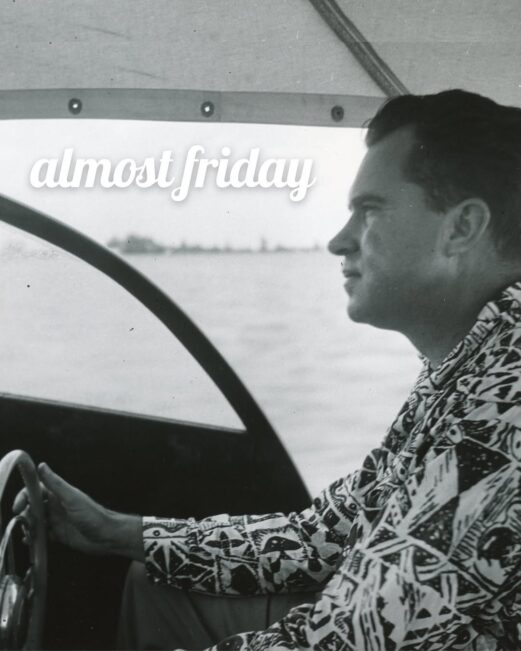
Beyond the Nixon Foundation’s own cheeky posts (“Your Month: Your Nixon Era”; “Almost Friday,” featuring Nixon on a boat), there are slick Nixon edits set to pop music to be found in the wild. Are they simply the latest generation of ironic Nixonalia? A different question might be: more than a half century on from Watergate, why does America still have a generational Nixon content–generating cycle?
The answer may lie in the tone of most Nixonposting, which feels qualitatively different from its cultural predecessors. Unlike the Boomer and Gen X-era “I am not a crook!” jokes, an underlying layer of genuine appreciation can usually be detected beneath the self-aware irony. On its surface, a 2024 montage that juxtaposes clips from the Kennedy-Nixon race set to Chappell Roan’s “Good Luck Babe”—a spurned gay lover’s bitter sendoff to an ex who has chosen a life of repressive heteronormativity—is mildly amusing. There’s really no need to analyze it: the idea of a homoerotic rivalry between JFK and Tricky Dick is just funny. But there’s also the underlying pathos of the conventional wisdom about the race: Nixon’s obvious insecurities lost out to Kennedy’s confident privilege. Suddenly the idea that Nixon might have had a tortured admiration for Kennedy seems kind of plausible, and poignant.
The Nixon Foundation’s Mad Men hype edit about the Kennedy-Nixon race is a succinct distillation of how they are lining up their comms approach with the online zeitgeist that surrounds their principal. It begins with a clip of Don Draper contrasting the two 1960 presidential candidates. “Nixon is from nothing,” Don says with his trademark conviction, “a self-made man, the Abe Lincoln of California who was vice president of the United States six years after getting out of the Navy. Kennedy, I see a silver spoon. Nixon, I see myself.” Cut to: picture after picture of young Richard Nixon as vintage audio plays over a Drake song. “Believe me,” Nixon says in the recording, “when you’ve gone through the fires of having to work your way through school, of having to fight campaigns with no money, of having to do it all on your own, you come out a pretty strong man.” At the time of this writing, it’s garnered over fifteen thousand likes on Instagram. A sampling of the comments: “Nixon is one of the most underrated presidents.” “We may have been too harsh on Nixon.” “Real Man shit is knowing Nixon was awesome.” And from one iconoclast: “I respect him for making the EPA.”
The anonymous admin behind the Instagram account Kawaii Richard Nixon (Kawaii is a trendy Japanese pop art style, centered on cuteness) tells me they are in their early twenties. They started the account simply to make kawaii edits of presidents, skewing heavily toward Nixon as their handle suggests. They didn’t realize they were part of a growing online Nixon trend until returning to Instagram from a hiatus and seeing their account named in a recent Vanity Fair article on the subject. Although not a total Nixon booster, the admin thinks that Watergate has obscured some of the more positive aspects of his presidency. “Although Watergate was wrong, it barely compares to some of the things going on today,” they told me. “His rise and fall is interesting. He came from nothing and then became the president all for it to crumble beneath him,” they continued. “His politics is symbolic of the past. It is much different than now. He did have some liberal policies like the EPA, OSHA, cancer research, etc.” They estimate most of their followers are Zoomers of high school and college age.
“The response from younger audiences has blown us away,” wrote Barber, himself on the young end of the Millennial era.“What’s been really striking is the comments. Some people come in skeptical (understandably), with the version of Nixon they got from a high school textbook, and they walk away saying, ‘Wait, I had no idea.’”
The Nixon Foundation account has been tapping into this vibe. Most of the retail offerings at the Richard Nixon Library Museum online store will be familiar to anyone who has visited a national park: replicas of the Declaration of Independence, political biographies and histories, various patriotic tschoschkes for home and office.
So far, so Father’s Day.
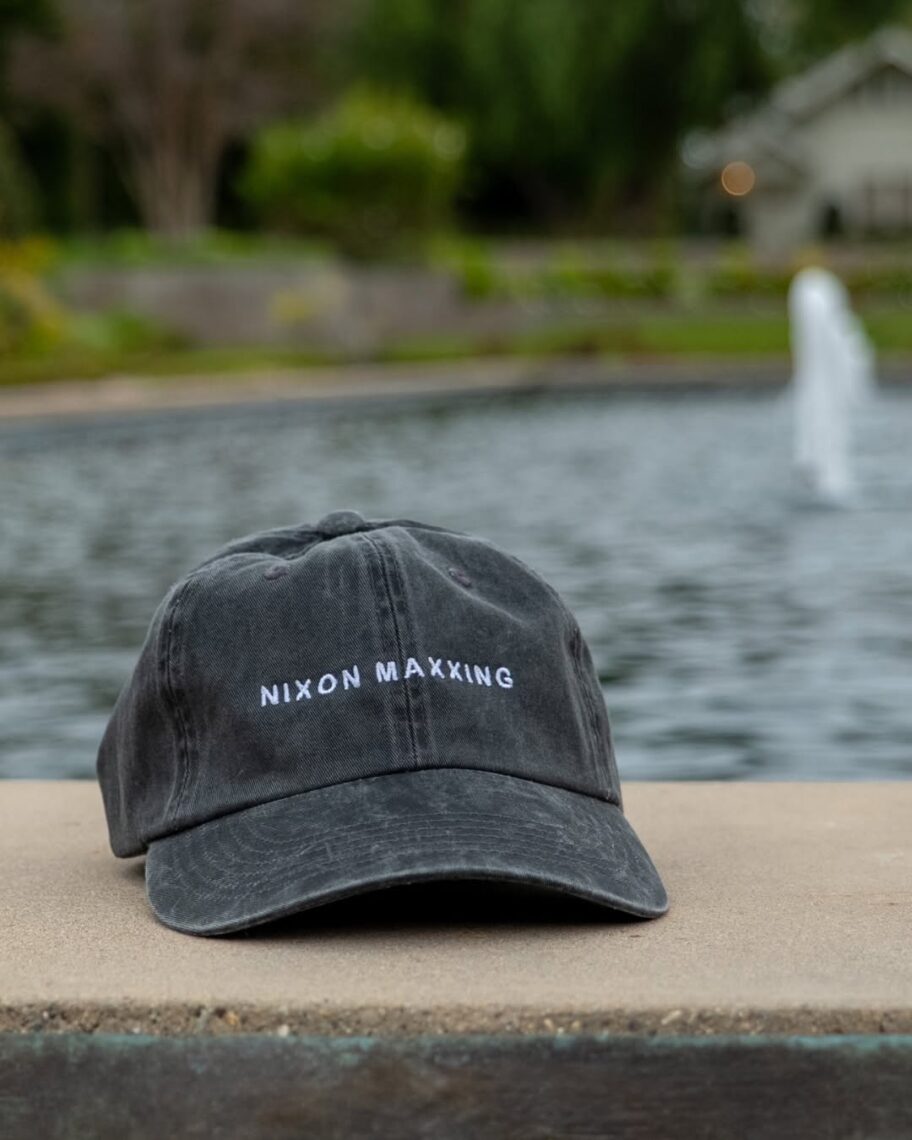
But keep clicking forward and there’s the “NOW MORE THAN EVER” baseball cap. A Zoomer-beige fanny pack embroidered with the phrase, “TANNED, RESTED AND READY,” the slogan that augured Nixon’s triumphant return to the hustings in the 1968 presidential election. The Instagram account periodically announces merch drops for “Nixon Maxxing” hats and “Pretty Girls for Nixon” canvas totes (restocked after selling out).
In 2026, we might not have Nixon to kick around anymore, but we have the memes. And they’re awesome.
To be sure, Nixon still has haters. They show up reliably in the replies to most Nixon edits and posts across platforms, inevitably bringing up the whole DNC wiretapping scandal at the Watergate. Others direct viewers to the White House Tapes audio. But even Nixon’s candidly unsavory musings from those recordings have become something of a meme format on X, where Nixonposting also crops up.
X account “Pictures of Nixon” has over fourteen thousand followers. On May 7 of this year, when Pastor Mark Burns proudly announced a 22-foot-tall golden Donald Trump statue at Trump National Doral Miami, Pictures of Nixon reposted it with an uncaptioned black and white photo of an aged Nixon, eyes downcast, unassumingly stirring his coffee at a nondescript diner counter. There was no caption, but it was commentary all the same.
“Honestly, I started the account because I thought contextless pictures of Nixon was a funny concept,” the anonymous admin said when I reached out via direct message on X. The admin said he understands why Nixon resonates: “The man is a compelling character and for me, one of the great survivors of all time. You could knock him down but he’d just pick himself up again and go back into battle.”
This perspective on Nixon the man could be said to represent in microcosm this entire social media joking-but-not phenomenon in microcosm. “That’s the part that matters most to us. Yes, we’re racking up impressions, but we’re legitimately involved in the process of changing minds,” wrote Barber.
https://t.co/fC4xACCupK pic.twitter.com/GaZjsrPLKk
— Pictures of Nixon (@picturesofnixon) May 9, 2026
But where does an online, grassroots Nixon Restoration movement go three decades after his death? The answer may lie in four discernable, vaguely interrelated phenomena.
At the most basic level, the inherent absurdity of quirky Nixon videos set to pop music is similar to the meme-ification of the late Charlie Kirk. Barely a year after his death, Kirk the real person has already become a kind of mythical internet creation, a Dadaist Slenderman. His last name became its own slang intensifier (i.e. “genkirkuinely”). The AI music tribute video “We Are Charlie Kirk” became another punchline. The audio from his assasination has been used to accompany the jump cuts in social media outfit transformation videos. A sign of irony-poisoning and wider youth desensitization to violence, certainly. But we may derive some comfort from the possibility that at least some of these kids may not realize Charlie Kirk actually existed.
For the more politically engaged (and humane), something else may also be at work.
As Trump hemorrhages the support from young voters that helped him win in 2024, it may feel like the rightward “vibe shift” we heard so much about has evaporated. But what if the vibe has simply detached from Trump and his administration, and gone off in search of a new host? The “Nixon ’88” merch sales at the Young Republicans National Convention are an instructive antecedent. While the seriousness of the Nixon restoration movement in the late 1980s was and is debatable, with it, these young conservatives relayed a kind of tongue-in-cheek nostalgia for a time when the Young Republicans membership was on the upswing, helping to pave the way for the halcyon days of the Reagan Revolution. Few Zoomers seem eager to revive twentieth-century fusionism, which may be why there is a visible Nixon nostalgia trend but not a Reagan one. By today’s standards, Nixon was a political maverick of a kind many Zoomers, sick of the traditional partisan binary, might be willing to support. In addition to establishing the EPA, Roe v. Wade was decided on his watch in 1973, with three of his appointees voting with the 7-2 majority to find a Constitutional right to abortion. And for the conservative movement’s shadow side, he offers his extremely rightwing (read: racist) personal views.
Truly, Nixon offers something for everyone, including a chance to stick it to that most reviled of generational cohorts: the Baby Boomers. Millennials and Zoomers lay the blame for everything, from housing prices to climate change, at the Boomers’ feet. Since they started the generational Nixon hate, it makes sense that a Nixon Restoration may be at least in part an exercise in repudiating their views.
Finally, there’s the factor of declining institutional trust. The consensus for roughly the past fifty years was that Watergate was a scandal so profound that “-gate” had to be the media’s go-to suffix for political scandals. But even that conventional wisdom is crumbling.
After Robert Redford died in September of last year, popular X poster Ben Crew encouraged his followers to watch All the President’s Men. The next day, he posted the following: “Don’t know how to process the replies and quotes saying Watergate was made up. It is 2025, one of the few men to look good with a moustache [sic] just passed and you’re choosing to go to bat for RICHARD MILHOUS NIXON?”
It’s revisionist history, albeit of a different kind than Americans accustomed to Howard Zinn and Nikole Hannah-Jones are used to. “Watergate was made up” is one way to describe a position, long held by some in the conservative establishment, that The Washington Post’s reporting on the scandal was sloppy and the federal agents involved were motivated by principles other than patriotism. That was never a mainstream view, but with trust in both the media and the government at a pretty low ebb, it makes sense there would be people willing to give the orthodoxy surrounding Watergate a second look.
In 2026, much of Nixon’s story seems compelling. Those wistful Nixon-Kennedy videos, for example, remind the viewer that there was a time when partisan politics took place within the 40-yard lines. And there is something almost inconceivable today about a president resigning in disgrace, citing the dignity of the office and the need to preserve the country from the protracted rancor of impeachment proceedings, saying he must “put America first”—before himself. A sense of both honor and shame still has the capacity to arrest our attention, perhaps because both are in such short supply.
When he stepped down voluntarily from the pedestal of the executive office into myth, Nixon relinquished any and all control of his own brand. Accordingly, he spent the rest of his days portrayed alternately as one of the twentieth century’s greatest buffoons or villains. As the custodians of his legacy, the Nixon Foundation is hopeful those perceptions are beginning to change. “Nixon’s career spans decades,” Barber reminded me in his email, quoting Bill Clinton’s wish for Nixon’s legacy at the latter’s funeral in 1994: “May the day of judging President Nixon on anything less than his entire life and career come to a close.”