


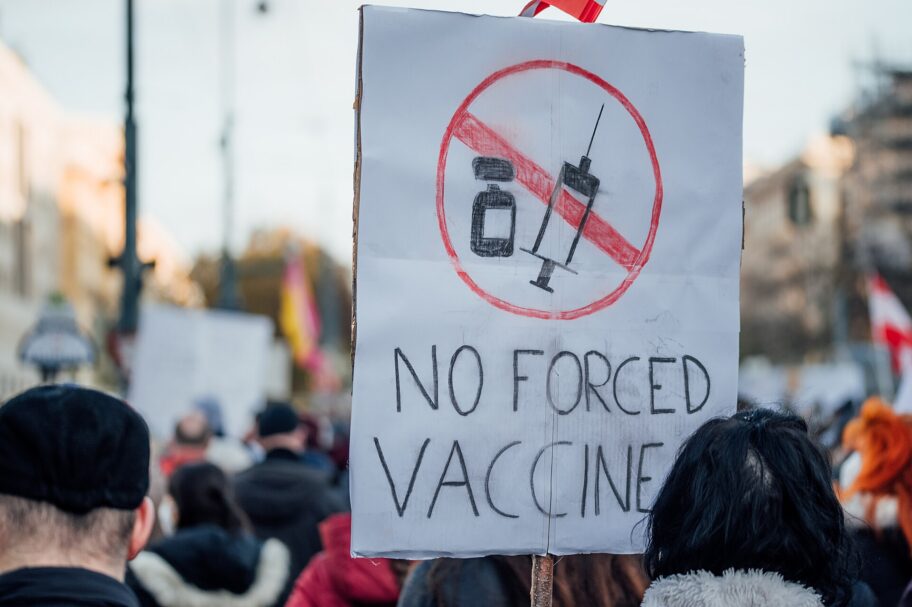
After a spate of recent, high-profile vaccine outbreaks in religious enclaves, and amidst increasing Republican skepticism about vaccination benefits, it might seem likely that religious beliefs play a significant role in vaccine hesitancy. However, there are very few examples of indisputably religious vaccine hesitancy in Kira Ganger Kieffer’s timely new study, Unvaccinated Under God: Religion and Vaccine Hesitancy in Modern America (Princeton University Press, 2026). Among these are evangelical Christians who thought the Covid-19 vaccine could be “the mark of the beast,” Christian Scientists who believe that “with full faith in the healing power of Jesus, there [is] no need for external medical care,” and parents who have faith in the divine goodness of nature. Most of the book instead reclassifies what appear to be hybrid or fully secular cases of vaccine hesitancy, by describing key features of those cases with terms drawn from religious studies: conversion narratives, the practice of witnessing, theodicy, and myth.
The process of reclassification stretches the terms a bit too far. Take Maryl Levine, the mother of a severely brain-damaged child. After watching an anti-vaccine documentary, she concludes her child’s condition was caused by a vaccine. Along with her husband, she becomes an activist, telling the story of her child as a warning to others. On Kieffer’s analysis, Maryl and her husband underwent a “conversion,” they offer “testimony,” and they resolve the mystery of their child’s illness with a “plausible theodicy.”
But is religion really the right lens here? After all, the Levines actively eschew popular religious theodicies—“everything happens for a reason” or “God only gives you what you can handle”—instead choosing a story in which secular authorities, medical and political, are to blame. As Kieffer writes: “For Maryl, the belief that her son suffered an injury from the DPT vaccine was far more plausible than if his illness was due to a random act of God or genetic malfunction.” If the Levines underwent a “conversion,” then anyone whose worldview is changed by a traumatic experience has been “converted,” and telling the story of their experience would count as witnessing or testimony. If a few similar stories are woven together, they become myths, capaciously defined as “coherent narratives that validate … worldviews.” So defined, the conversion genre would, as the book acknowledges, apply to “social reform movements” when people “woke up” to systemic injustices.
It doesn’t matter, though. This rigorous documentation of modern American vaccine hesitancy allows a different, equally important argument to emerge: medical expertise and empirical arguments have achieved near-total hegemony in political discourse, especially when it comes to health-related issues. Consequently, any alternative values, reasons, or persuasive genres are forbidden from the public square, a prohibition once reserved for explicitly theological claims. Not only that, but defending such alternative values against government authority requires invoking legal protections typically extended to traditional religions.
Kieffer’s insightful and paradoxical discussion of vaccine-hesitant haredi (ultra-orthodox) Jewish mothers helpfully illustrates this dynamic. In the wake of measles outbreaks in New York City haredi enclaves, journalists “interviewed prominent Jewish authorities who attested that vaccination did not violate Jewish law.” Instead of seeking out traditional religious authorities who viewed Jewish law differently, vaccine-hesitant mothers actually “violated strict haredi norms against using modern technology,” scouring the internet for mainstream vaccine-hesitant sources and sharing their findings in anonymous WhatsApp groups.
Like other secular, vaccine-hesitant demographics, haredi Jews resisted vaccines for secular reasons. They resented “the patronizing sentiment from the city and its media elites,” which reinforced their sense of “separateness and division from mainstream authority structures.” Distrust of authority and the desire for empowerment and autonomy—not theology—were the factors that fueled vaccine-hesitancy. And yet: in a medical technocracy, distrust of authority and the inherent value of empowerment and autonomy might as well be theological reasons. Unless there’s a peer-reviewed study that shows feeling empowered saves lives (or money!), it has the same status as feeling blessed.
Is religion really the right lens here?
The book’s account of racially-coded vaccine hesitancy drives this point home. “Black Americans had long been victims of medical racism,” writes Kieffer, “their experiences mythologized in family stories and communal wisdom. The speed with which vaccines were available triggered collective concerns that they were experimental and therefore could be dangerous.” By contrast, some low-income, politically conservative white Americans believed that accepting government-based health recommendations amounted to accepting social services, which “was demeaning because doing so would imply that they were similar to racial minorities, especially Black Americans.”
There’s nothing religious in distrust of the medical system because of past trauma, or because of a racist desire to be distinct from Black Americans. Indeed, they have almost nothing in common with theological positions, save for the fact that they are considered “illegitimate” when it comes to refusing vaccines. Not because they are right or wrong, but because, like religious reasons, they do not fit into the paradigm of medical expertise or empirical reasoning. The same is true for a litany of other reasons discussed throughout the book, such as the desire to safeguard personal liberty or the importance of parental sovereignty. How does one quantify the value of personal liberty? By the number of lives it saves?
One of Kieffer’s most nuanced chapters deals with objections to the HPV (human papillomavirus) vaccine, and here too the “religion” lens serves to reveal a different set of issues. Largely opposed by conservative Christians, the HPV vaccine, which guards against a sexually transmitted disease, was viewed by Christian opponents as giving “tacit approval to premarital sex,” while supporters felt it was “medically progressive, even feminist, because it destigmatized women’s sexuality and reproductive healthcare.” Kieffer doesn’t explicitly characterize support for the vaccine as religious, likely because religious people weren’t behind it. But the broadness of her approach forces precisely that characterization. Merck, the vaccine manufacturer, launched an ad campaign that implied “Gardasil was for cool girls.” A story in the service of ideology—in other words, a myth.
How does one quantify the value of personal liberty? By the number of lives it saves?
Throughout the book, vaccine-hesitant people find that they must exploit the protections afforded to traditional religion, despite their objections not being religious. “Vaccine choice proponents valued individualism and freedom of conscience,” observes Kieffer. Securing these secular goals was simply easier if they were reframed religiously. “Our religious exemption was just taken away in New York,” wrote one vaccine-hesitant mother on a blog. “As we all know, a medical exemption is almost impossible to come by.”
Here, then, is the problem: the lack of resources for defending oneself against forced medical interventions, outside the language and logic of medicine and empiricism. The deeply felt need to resist that language and logic, and policies that follow from it, is what really unites the vaccine-hesitant in Unvaccinated Under God. “The new vaccine safety activists argued that science and biomedicine were unworthy of unmitigated faith,” writes Kieffer. This forces them to use rhetorical techniques like powerful anecdotes of suffering and conspiratorial critiques of the government. Are these “historically religious strategies,” as Kieffer argues? Not unless terms like “myth” are stretched to their breaking point. But that’s neither here nor there. The strategies aren’t united by their inherent religiosity, but by the purpose they serve, namely to “[usurp] power from traditional medical authority figures and systems.”
What emerges from this valuable analysis of modern American vaccine hesitancy isn’t a neglected religious thread that runs through it all. To the contrary, the surprising element of the book is how it illuminates the extent to which even explicitly religious groups have non-religious reasons for resisting government mandated vaccination. Religion is not (usually) the explanation of their positions. Rather, it is the category into which any resistance to medical authority ends up getting put, and the category upon which anyone must lean if they hope to be successful in their resistance. If one is concerned about vaccine hesitancy, as I am, the lesson here is that perhaps the hegemonic dominance of medical expertise and empirical reasoning may be creating the problems that it is meant to resolve.
For medicine to be more effective, it must also be more humble. Human goods are not all measurable with randomized controlled trials, nor describable in the clinical language of data and scientific writing. If policy makers and medical experts insist otherwise, we can expect more “religious” resistance—which is really just insistence that important parts of our humanity can’t, and shouldn’t, be quantified.