


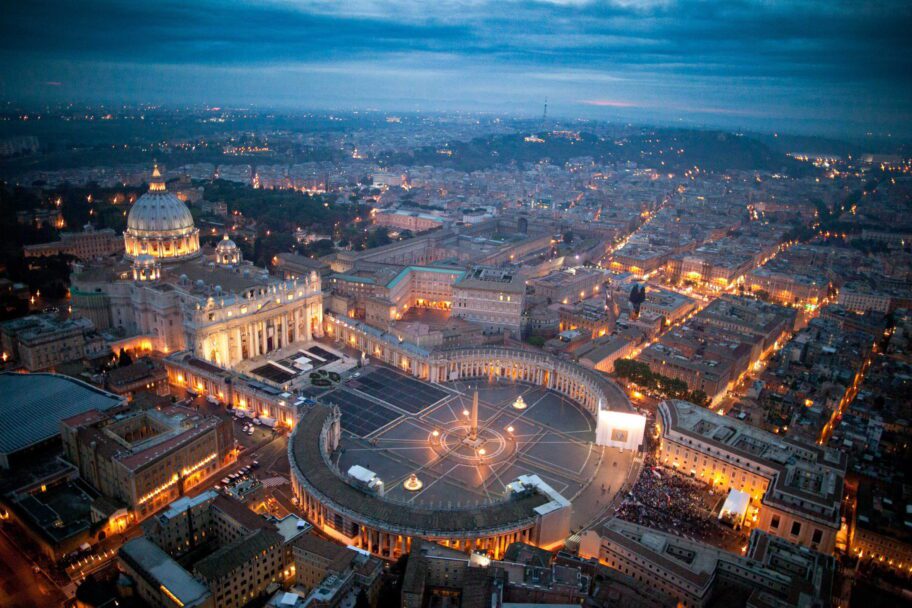
Last October, about fifty representatives from academia, think tanks, and the tech industry gathered in Vatican City to take up a charge issued by Pope Leo XIV four months prior: to help the church “contribute to a serene and informed discussion of [the] pressing questions” raised by the sudden pervasiveness of artificial intelligence.
At conference’s end, the group—of course—produced a statement on artificial intelligence ethics through the lens of Catholic teachings. But perhaps the real significance of this convening is its signaling that, like all facets of society, spiritual communities are grappling with what the omnipresence of AI means for us humans and our relationship to each other, and to the divine.
Its “extraordinary potential to benefit the human family” notwithstanding, the rapid development of AI “also raises deeper questions concerning the proper use of such technology in generating a more authentically just and human global society,” Leo said last summer. “This entails taking into account the well-being of the human person not only materially, but also intellectually and spiritually; it means safeguarding the inviolable dignity of each human person and respecting the cultural and spiritual riches and diversity of the world’s peoples.”
Participants in October’s “Digital Rerum Novarum: Artificial Intelligence for Peace, Social Justice, and Integral Human Development,” co-sponsored by the Pontifical Academy of Social Sciences (PASS) and Notre Dame Law School, spent two days discussing topics that dominate every conversation about AI, secular or spiritual: its regulation, or lack thereof, and its effects on education, work, the environment. Underlying each of these conversations was the pope’s charge: to ensure that the development of AI is consistent with Catholic social teaching.
Paolo Carozza, a professor of law at Notre Dame and member of PASS, was a principal organizer of the seminar. He began to study AI issues a few years ago and soon “came to a conviction,” he said in an interview after the event, “that the church needed to catch up to the times. The basic principles of the church’s social thinking and teaching about the human person is true and valuable and important, but at a level of generality that made it hard to apply them to the current circumstances of the world, and in particular in the technology space.
“We needed to do some work,” Carozza said, “both to figure out how those principles might have something to say to the world but also how the church might need to learn from observation of the changing social reality around us and push its own understanding of what its principles and teachings require.”
“Together with its extraordinary potential to benefit the human family, the rapid development of AI also raises deeper questions concerning the proper use of such technology in generating a more authentically just and human global society.”
Plans for the conference were already underway when Leo assumed the papacy. “All of a sudden what we were already doing acquires an added dimension to it,” Carozza said, “because it’s very clear right from his first day that he’s intent on doing exactly what we’re hoping that the church would do, which is step into this area quite forcefully and … try to provide moral and principled leadership for the world.”
Leo’s focus on AI doubles down on that of his predecessor, Pope Francis, who, shortly before his death last year, approved Antiqua et Nova, a doctrinal note on AI that asserted that while “technological progress is part of God’s plan for creation,” it must complement, not replace, human intelligence. The new pope also drew a direct line to his namesake, Leo XIII: in 1891, spurred by the societal changes wrought by the Industrial Revolution, Leo XIII released the encyclical Rerum Novarum (“Of New Things”). It called for a “remedy for … the misery and wretchedness pressing so unjustly” on working people, caused by “the hardheartedness of employers and the greed of unchecked competition,” and asserted workers’ rights to fair wages and safe conditions.
In his first speech to the College of Cardinals, days after his election as pope, Leo XIV explained that he was resurrecting not just the previous Leo’s name but also his deep concern with effects of technology. “In our own day, the Church offers to everyone the treasury of her social teaching in response to another industrial revolution and to developments in the field of artificial intelligence that pose new challenges for the defense of human dignity, justice, and labor,” he said.
The original Rerum Novarum shaped much of modern Catholic social teaching, which is grounded in recognition of intrinsic human dignity and a responsibility to advance a common good. Carozza sees Leo as extending those teachings to consider questions beyond what his namesake could even fathom in the late nineteenth century: “He’s really emphasizing that what is at stake is our understanding of the human being.”
For Carozza, that means a consideration of the ways that technologies like AI “are very quickly displacing fundamental human capacities of reason, freedom, judgment, discretion and choice, our understanding of truth and falsity,” he said. “All of those things are being, in the mildest sense, influenced by that. In a stronger sense, being displaced by that. And in the strongest sense, being manipulated by that.”
Cory Andrew Labrecque, a bioethicist at Université Laval in Quebec City and a member of the Pontifical Academy for Life, spoke at a session on human dignity in the digital age at the October seminar. While tools like AI can be used to advance a common good, he said in an interview, “sometimes these tools become more important than the [people] who use it. And that’s where the church is worried about dignity and what is lost in the applications of these kinds of technologies.”
Tech-based advancements should be accompanied by questions about what might be lost in the process, Labrecque said. “What do we lose in terms of human expertise? Are we okay with the way that we are shaping civilization, in the way that we’re shaping humankind with the digitization of work, for instance? … The first thing the church will ask is: are you replacing invaluable human acts, or are you assisting them?”
Stereotypes notwithstanding, “the church is actually very pro-science and pro-technology,” Labrecque continued, “understanding, of course, that our definition of progress in the church is different. In the sciences, we talk about progress as more mastery or dominion over the material world around us. But the church says it’s not progress if it does not contribute to human solidarity.”
Philip Larrey, a professor of philosophy at Boston College, has studied and written about the philosophical implications of artificial intelligence for thirty years. He sees the church as well positioned to advance conversations about AI, in the absence of uniform regulations by nations. “There is no universal consensus on the ethical or philosophical implications of artificial intelligence,” Larrey told Arc. “There are too many state interests involved that it’s going to be nearly impossible to arrive at a universal consensus. The only state or country that doesn’t have a special interest is the Vatican.… That is why I think the voice of Pope Leo is so important. Leo is obviously a universal leader in terms of ethics and morality.”
In putting together the conference, Carozza said, organizers strove to find a middle ground between a “naive celebration of techno-utopianism, where technology is going to solve all our moral problems” and a doom-filled assertion that technology will lead to the extinction of humanity. “As Pope Leo himself has said, technology is the fruit of human creativity…. There are all sorts of examples of how technology can be used to pursue the common good.”
Lisa Schirch, professor of peace studies at Notre Dame, spoke at the conference at a session on using digital tools to advance peace. She points, by way of example, to deliberative platforms that employ AI to synthesize public input to help shape decision-making, such as the Alliance for Middle East Peace. “It allows the public to actually frame the conversation,” she said in an interview after the conference. “It gives them the agency to suggest things and to listen to other people’s views.”
AI can also help navigate complex negotiations, such as at the UN’s recent COP30 climate meeting, she said. “There’s so many trade-offs, so many calculations, and so much data that having a mathematical assistant to help you weigh the trade-offs and the policy options can be really helpful.”
But Schirch has her share of concerns: environmental harms, exploitative labor practices, AI models trained on biased data. She advocates for a system of ethics-based ratings to help consumers make informed decisions. “We do that now for food and for car safety,” she said. “But we don’t have that for our technology platforms.”
The conference concluded with a statement on AI ethics, signed by participants. In some respects, the statement, with its calls for accuracy, transparency, and security, reads like similar statements from universities, policymakers, and nonprofits. Where it differs is in its assertions that “it is incumbent, not only on companies and governments, but on people of faith, who number more than 6 billion worldwide, to respect, protect, and advance human dignity, rights, and flourishing by ensuring that AI is—and remains—secure, safe, ethical, and under human control.”
Carozza described the statement as a useful summary of the topics and principles discussed at the seminar. “But to be honest, just speaking for myself, there are a lot of statements on AI,” he said “There are a lot of conferences, there are a lot of events, and it often feels like each one is just starting over from ground zero. Even within the context of the church, there are a lot of different voices weighing in. Ours is one, and I think it was an important and valuable one. But what’s really critical right now is to bring some unity to that.”
He hopes that unity will come in the form of an overarching statement from Leo. “All of us are eagerly … waiting for some sort of magisterial statement from the pope, because that would be some sort of unified judgment that brings the scattered pieces into dialogue with one another.”