


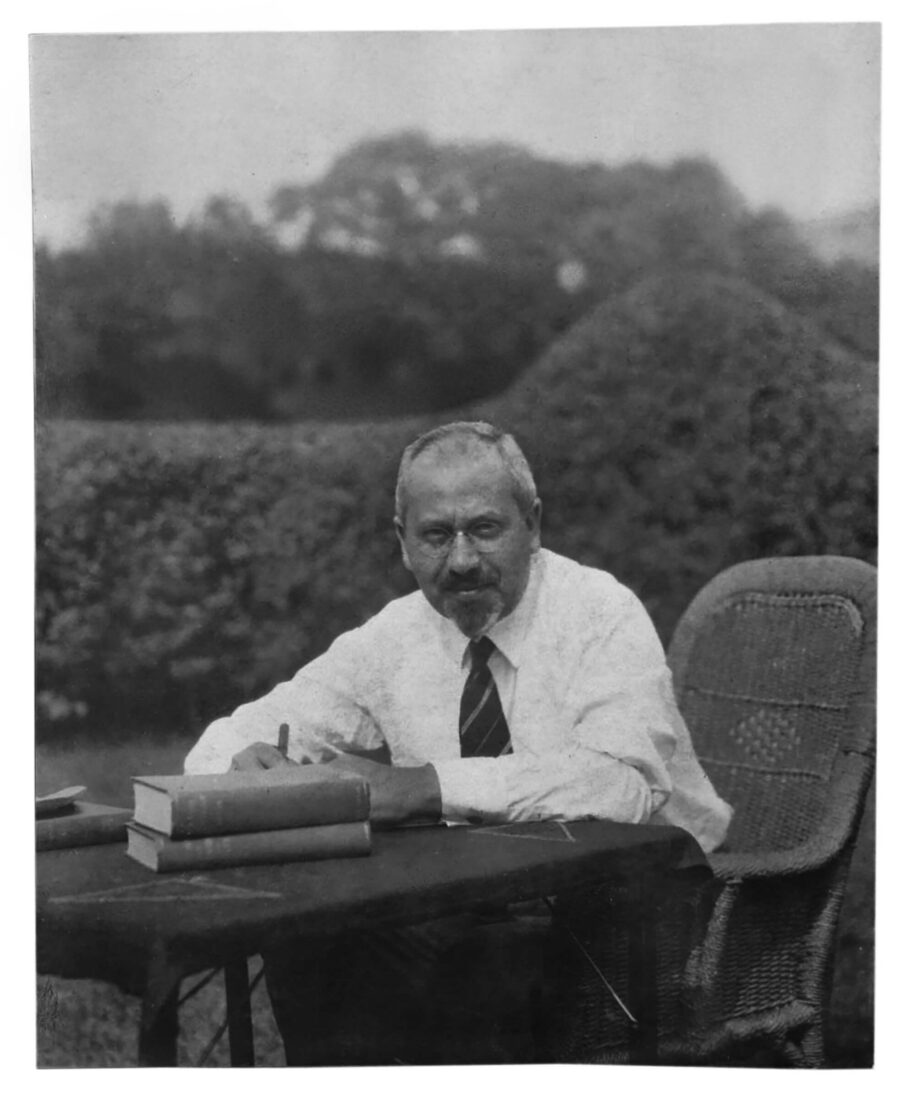
Mordecai Kaplan (1881–1983) shook things up. A self-styled “theological maverick,” the rabbi and founder of the Reconstructionist movement within Judaism challenged American Jews of the twentieth century to think differently, more expansively and fluidly: out with blind faith and sentimentality, in with reason and intentionality. Best known for his magisterial Judaism as a Civilization (1934), he reached even more people through his sermonizing. In this excerpt from my new biography of Kaplan, I go behind the scenes to look at his way with words.
At his best and most relaxed when prepared, Kaplan preferred to rely on notes, outlines, and a fully elaborated text when giving an address. No matter the venue—classroom, sanctuary, huppah, banquet, cemetery, faculty meeting—or the subject matter—student affairs, the biblical portion of the week, God, Zionism, love or death—his peace of mind insisted on advance preparation. Speaking off the cuff, extemporaneously, was not for him. Troubled by his inability to go from “sentence to sentence” on the fly, he was tempted now and then to give it a whirl, but winging it made him too anxious—his palms became sweaty, his heart pounded—lest he meander or forget an important point.
It’s not that Kaplan didn’t trust himself or lacked faith in what he had to say; that was never it. Rather, he trusted too much in the power of the pulpit, in speech and in words, to treat them casually. With a rich, plummy, booming voice like that of Basil Rathbone, or so it was said, he’d propel volleys of intricate sentences into the air. Bursting with ideas and “more than two-syllable words,” they enthralled his audiences, especially those whose “grammar creaked.”
Kaplan-the-preacher took great pains with his verbal presentations, subjecting them to multiple revisions and often resenting the amount of time and midnight oil it took him to get them into tip-top shape so that their contents might leap off the page. “What a nuisance preaching is! I feel it in my bones every time I have to work on a sermon,” he acknowledged, wondering whether it was worth the effort. It was. Though he might not want to admit it, Kaplan relished delivering sermons—the practice sustained and kept him in circulation—preaching long after most of his colleagues had called it quits. Eulogies and cheery salutes to the bride and groom, though, were something else again: de rigueur but disdained. It was of little moment whether the invitation to speak came at the behest of a family member, a congregant, the board of trustees, a colleague, or even a friend; the prospect of having to indulge in sentiment rather than substance, in pieties rather than ideas, made Kaplan uncomfortable, ill at ease. He was none too keen, either, on ceremonial remarks, especially the kind he dubbed “after-dinner speeches without the dinner.” Though he delivered more than his fair share, the genre’s characteristically fleet and glib sentiments left him cold. “I am absolutely unable to repeat platitudes,” Kaplan once confessed. “My memory simply rebels against them.”
Monitoring his words, Kaplan also monitored the size of his audience. As if a contestant in a popularity contest, he routinely took note of whether he drew a full house, a decent crowd, or a meager one. He even recorded the number of those who showed up: “about 400,” “over 500,” “under 110,” or “at least 125.” Behind the lectern, his sociological imagination was also in full swing, prompting him to pay close attention to the audience’s composition, to its gender, age, physical appearance, and literacy, and how these variables affected their reception of him. Were his listeners held rapt? Or bored silly? Nodding along or nodding off? Time after time, Kaplan believed that his performances were not up to snuff, his manner too stilted and preachy, his remarks more rant than balm. He worried that he had overdone it, speaking so fast “as almost to bowl people over,” and acknowledged that in the course of one speech he had “stormed and raged and thumped the pulpit with such vigor that my hand hurt me all day.”
But then Kaplan was just as quick, and eager, to share the blame with his listeners, especially American Jews at the grass roots. In his estimation, they rarely rose to the occasion—their knowledge too shallow, their perspective too frivolous—testing his resolve. “I might as well have tried to talk on higher mathematics to six-year-olds,” he lamented shortly after delivering a speech on American Jewish life to the members of a Midwestern synagogue in the 1940s.