


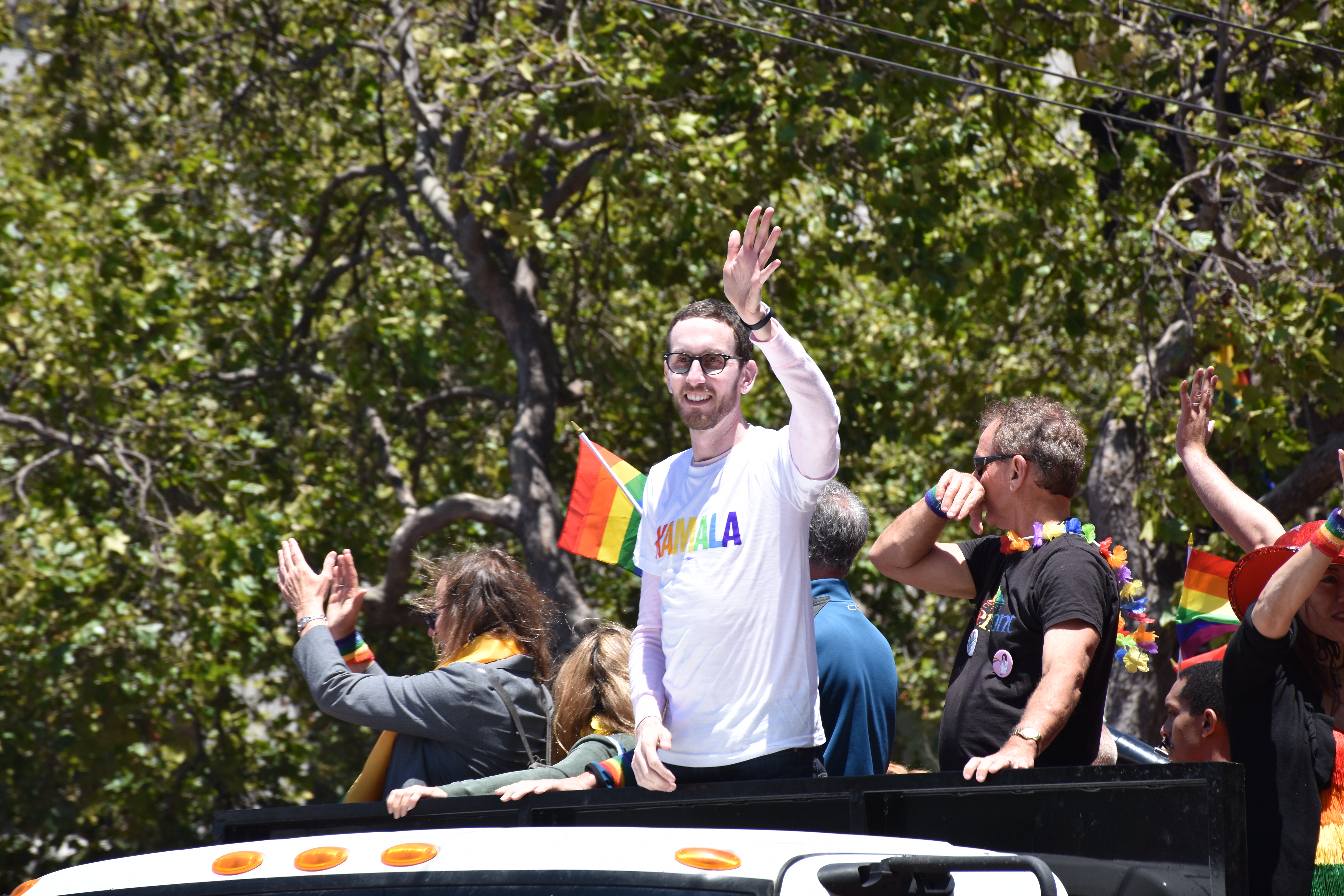
On June 26, 2026, California state senator Scott Wiener walked into San Francisco’s Dolores Park to attend a Shabbat gathering ahead of the city’s annual Trans March. It would have been his 23rd year attending the event.
His longstanding involvement reflected a career of LGBTQ+ advocacy. The 56-year-old legislator had previously sat on the board of the Human Rights Campaign and had been elected to the seat Harvey Milk once held on the San Francisco Board of Supervisors. The LGBTQ+-oriented legislation Wiener has either introduced or sponsored since being elected to the state senate in 2016 includes establishing California as a refuge state for queer and trans youth, eliminating the prescription requirement to access PrEP, and repealing HIV-related felonies, among other measures. As a result of these and other actions, the state’s largest LGBTQ+ civil rights group, Equality California, endorsed Wiener in his current campaign to take over the congressional seat held by Nancy Pelosi. All of which is to say, Wiener’s presence at the city’s pride programming was hardly a mercenary campaign hit.
Yet that Friday in June, Wiener was followed onto the grounds of the march by an activist named Dimitry Yakoushkin, who filmed himself heckling Wiener about his (alleged) stance on the ongoing hostilities in Gaza. Audible in Yakoushkin’s video is the voice of another protester, who tells Wiener, “You stopped being queer the moment you started supporting Israel.” Claiming he feared for his safety, Wiener left Dolores Park. The video circulated widely on X, where it received eleven million views.
To be clear, for local politicians, even progressive ones, being performatively ejected from the Trans March was nothing new. In years past it had happened to Ed Lee, Mark Leno, and now-mayor Daniel Lurie. And starting in 2016, the organizers of the march, at least according to the Harvey Milk Club, had asked politicians not to attend the march going forward—a request, by their telling, that Wiener ignored.
What was new was the (stated) reason for Wiener’s ejection. It was by any measure an astonishing moment. How, for starters, does one stop being queer? What actions are required to suspend one’s queerness? And what, likewise, does it mean to say that Wiener had once started supporting Israel?
A look at Wiener’s record suggests that all three terms in the protester’s assertion—“started,” “supporting,” and “Israel”—are misleading.
So what is Wiener’s history with Israel? In 2021, he indicated that the pogroms his family faced in Eastern Europe had given him a sense of Israel’s importance as a safe haven for Jews and the importance, likewise, of there being a Jewish state somewhere in the world. In the same statement, however, Wiener called for the formal existence of a Palestinian state and criticized Netanyahu specifically, whom Wiener has elsewhere called a “cancer,” for escalating conflict in the region. In the days after the massacre of Oct. 7, 2023, Wiener called for the complete elimination of Hamas, but also began—by Oct, 13—vocally opposing Netanyahu’s retaliatory strikes in Gaza. By Nov. 17, Wiener had joined calls for a ceasefire. Over the coming years, Wiener would call the invasions of Gaza “abhorrent and unacceptable” and refer to Netanyahu’s actions in Gaza as a “moral stain.” Though Wiener initially declined to refer to Israel’s actions in Gaza as a “genocide,” at a candidate forum at UC Law San Francisco on Jan. 7, 2026, he reversed his position and, on Jan. 11, posted a video to his social media channels in which he said that he could not avoid the word “genocide” any longer, and that the actions of the Netanyahu government warranted it. As a result of this pivot, Wiener stepped down from his role as the co-chair of the California Legislative Jewish Caucus.
It’s therefore more than a little distorted to say that Wiener “started supporting Israel.” If anything, the story of the last five years has been one of his growing disenchantment with the country—at least this Israel under this government—as a steward of the kind of peace-oriented, post-Holocaust haven Wiener, like many American Jews, believes in.
All of which leaves us with the stranger half of the protester’s statement: that Wiener could have stopped being queer. What does that actually mean? It’s hard to avoid the insistence—made by Wiener himself, among others—that, in the minds of protesters like those at Dolores Park, the thing imperiling Wiener’s putative queerness wasn’t his “support” for “Israel,” let alone what figures like Peter Beinart have characterized as the legislator’s liberal Zionism, whatever that term is (now) taken to mean. No. It’s Wiener’s Jewishness that imperils his queerness, or at least what the heckler reads into that Jewishness.
It’s the Jewishness, to a certain kind of activist, that’s now seen as incompatible with queerness—his legislative and community-facing record be damned. What think pieces surrounding the incident have yet to address themselves to is an analysis of the cryptic logic underlying the specific utterance that presented itself to this heckler—why, that is, punishment for (Wiener’s) Jewishness should take the particular form of expulsion from queerness, why this distinct grammar of alienation seemed so intuitive to this person, so ready-made for the moment.
The heckler’s grammar is worth attention. Calling the statement antisemitic, as San Francisco mayor Lurie immediately and rightly did, doesn’t really clarify why support for Israel “stops” queerness. If conceptually incoherent, that formulation is also a lucid window into some of the more surprising dynamics that undergird contemporary, largely unconscious, architectures of antisemitism today. Failing to plumb them now would cost us the ability to schematize those animating drives, convergences, and forces, all of which connect back to—even as they re-articulate—longstanding traditions in anti-Jewish discourse.
All of which leaves us with the stranger half of the protester’s statement: that Wiener could have stopped being queer. What does that actually mean?
The heckler’s statement gives voice to a powerful urge: namely, to separate not just Wiener or Israel specifically, but Jewishness generally, from what is meant by and envisioned for queerness. It seeks to exclude Jewishness from the commonwealth of queerness. For certain speakers, including, one suspects, Wiener’s heckler, the latter term signifies not just sexuality but authenticity and solidarity as such, maybe even liberty as such. Especially telling, for me, is the heckler’s verb choice: stop(ped). If (one’s) queerness can be “stopped,” then it must come from and be parceled out by an external agency, in the way that a motorist can be stopped by the police. Such a verb implies that Wiener’s queerness was never fully his to begin with—just as roadway access is not a right to motorists, but a privilege accorded to those who follow the rules of the road. Wiener’s queerness was always just a loan, a borrowed authenticity, and one not indexed to Wiener’s legislative or community work.
And thus, even as the protester’s statement originates from within a marginalized community—or at least one suspects it does; little is known about the man’s identity—it converges with a view of Jewishness that has historically operated within, and ostensibly on behalf of, reactionary social formations that are themselves fully heteronormative.
None of the foregoing means or requires taking Scott Wiener as a political hero. After all, he quickly monetized the incident in a fundraising email that earned the ire of the Harvey Milk Club. What I’m interested in, instead, is showing how the origin point for what happened at Dolores Park isn’t October 7, 2023; it isn’t the Six Day War of 1967; and it isn’t even 1948, the year of Israel’s founding. It dates at least to the nineteenth century, and in all likelihood, to the fourteenth. It’s across that much wider expanse that we see, in the Western imagination, Jewish sexuality depicted as aberrant across or by means of two axes that would seem, logically, to cancel each other out, yet which, finally, only reinforce each other. In the one, the Jew is insatiable; in the other, he is sterile. The apparent contradiction between these two beliefs, however, is not a bug in the discourse of antisemitism; it’s a feature of it. Excess, after all, can only contaminate what surrounds it. Appetite without generation—energy, in the case of the body—can only take from what’s nearby, ad infinitum. This is the logic of cancer, a word Wiener had himself reached for when describing Netanyahu.
In our American present—weird and getting weirder—these two political fantasies have cleaved off in almost partisan terms. The harder, more online right increasingly sees Jewishness through the old paradigm of sexual excess. Nowhere, perhaps, is the endurance of this pattern more evident than in the endurance of the trope that Jews run the porn-industrial complex, which they use to peddle perversity to Impressionable Young Men. It’s a narrative pushed by figures including the shooter at Poway Chabad, David Duke, and Wisconsin congressional hopeful Paul Nehlen. At the same time, a fringe of the activist left unwittingly (perhaps) embraces the premise of Jewish sexual deficiency—often but not always narrated through the logic of the fake, the counterfeit. Less obvious than its right-wing counterpart, this is a discourse that has cropped up in spaces like the Chicago and DC Dyke Marches of 2017 and 2019, when, in both cases, Jewish marchers were ejected for carrying rainbow flags emblazoned with Stars of David. Unlike Wiener, these women weren’t told they weren’t queer. What was implied, instead—and to the same effect—was simply that their queerness wasn’t real, wasn’t enough.
As scholars from Sander Gilman to Daniel Boyarin, Josh Lambert, and George Mosse have shown, the Jew—especially the Jewish man—has been cast in one form or another, from the medieval period through the Nazi propaganda of Der Stürmer, as a rapacious seducer. This trope, in fact, has seeped so deeply into Western culture that it occasionally consumes Jewish authors themselves. One might think here of the spectrum running from Sigmund Freud to texts like Philip Roth’s Portnoy’s Complaint (1969). Yet it is in Otto Weininger’s Sex and Character (1903) that this rhetoric reaches its most systematic form. Weininger, a Jew who converted to Protestantism and then shot himself at 23 in the house where Beethoven died, is almost too perfect a distillation of these two strands coming together. Sex and Character depicts the Jewish man drowning in lust and yet incapable of channeling that drive productively. He is feminine, passive, and receptive, and thus perverse, broken, wrong.
This fantasy wasn’t confined to the Jews either. The modern reactionary imagination subjects homosexuality to a markedly similar logic: appetite without generation. Gay men like Wiener, in particular, have been cast (especially but not only during historical flashpoints like the HIV/AIDS pandemic) as profligately sexual and promiscuous. The medicalizing of homosexuality as a distinct species of “degeneracy” derives from the work of the French psychiatrist Bénédict Morel, which would eventually be picked up by the criminologist Cesare Lombroso and the Zionist theoretician Max Nordau. From there, the figure reappears explicitly in the sexology of Richard von Krafft-Ebing, and then again, later, in Heinrich Himmler’s 1937 Bad Tölz speech to SS officers, and then in the 1950 Senate report Employment of Homosexuals and Other Sex Perverts in Government, before blossoming into the grooming panics of the present. This, needless to say, is a wildly truncated portrait of a genealogy to which scholars like Eve Sedgwick, Simon Watney, and Lee Edelman, among many others, have devoted many years and pages.
So it seems odd to say that Wiener’s Jewishness, which has been coded as sexually appetitive, would be in conflict—perhaps, actually, in contradiction—with his queerness. If anything, the two would seem synonymous in a certain kind of reactionary mind. Wiener’s Jewishness ought to make him more (recognizably) queer, not less. In fact, the apparent convergence one might expect to—but does not—find in contemporary left politics reaches back to the fourteenth century, where it finds its originary iteration in Dante’s Inferno. Into the seventh circle of Hell, the Italian poet places both the usurers and sodomites. Both, according to Dante’s scholastic reasoning, have committed sins against nature, against the making of life. The usurer breeds only profit, and the sodomite breeds nothing at all. It’s not really a leap to find this same logic seven centuries later in a mug currently for sale in Tucker Carlson’s web store, one reading “Nation Building Is Gay.” Or a hat available in the same store emblazoned with the statement, “Neocons Are Gay for Israel.” In making this joke, Carlson locates himself comfortably in the right-wing understanding of a synchrony between Jewishness and queerness. Wiener’s heckler does the reverse. For him, Jewishness cancels queerness rather than intensifying it.
If its logic seems harder to discern, this style of progressive antisemitism is no less historically derived and internally logical than its reactionary, Carlsonian sibling. If the latter derives primarily from the historical association of both queerness and Jewishness with a hyperbolic libido, the former derives from an adjacent historical rhetoric: one according to which Jewish sexuality is simultaneously, if paradoxically, deficient. If, that is to say, the Jew is excessively libidinous, he is also—allegedly—weak and sterile. His drive, though superabundant, is not of the vigorous and productive variety. It is enervated. It produces not healthy stock but disease—neurotic if not venereal.
This counter-trope of sterility and sexual deficiency has a deep pedigree in its own right. Though it’s worth pausing to clarify that “sterile” here means less the absence of generation or production as such than it means the production of fakes, phonies, and counterfeits: the production of things that look real but aren’t, that look healthy but are fundamentally weak, diseased. It’s a discourse that runs from Paul to Augustine on a “carnal Israel,” and forward from there to the grotesque Jewish bodies of later European literature in the work of writers from Shakespeare to Dickens.
By the nineteenth century, this theological and literary concept had, like so many others under the unique pressures of the era, become biologized. Max Nordau, already mentioned above, also contributes to this mythos of sexual deficiency. Within a few years of publishing Entartung, the book that would make “degeneration” a mainstream diagnosis across Western Europe, Nordau turned that terminology on his own community in his attempt to taxonomize the ghetto Jew—sickly, anxious, stunted, his body destroyed by centuries indoors, reading, studying, thinking. His proposed remedy eventually took on the name Muskeljudentum: a muscular Jewishness to be developed through exercise, discipline, and soil. Nordau, in other words, didn’t exempt his own stock from his degeneration thesis. If anything, they epitomized it. Nordau’s stunted Jew is picked up a few decades later in the Stalinist figure of “rootless cosmopolitanism”—“rootless,” that is, implying both the lack of belonging and the lack of growing.
Nothing consummates this logic quite so well as the Great Replacement Theory, which presents Jews as requiring the services of (other) immigrants to “replace” what those on the new right increasingly call “legacy Americans,” presumably because they—the Jews—cannot biologically manage this replacement themselves. In other words, the Great Replacement fantasy assigns Jews to a very specific role in the process of replacement. They are the cerebral managers of the enterprise; but for the actual breeding, they need fecund bodies from elsewhere. As Gilman and Boyarin have shown repeatedly, this discourse, like its cousin—in the trope of excessive libido—was often so powerful as to shape the thinking of Jewish intellectuals themselves.
I’m not saying Wiener’s heckler is a student of nineteenth-century antisemitic pseudoscience, its roots in fourteenth-century Italian verse, or its twentieth-century offshoots in Soviet propaganda or psychoanalysis. I’m not saying he’s even aware of them. I’m saying that he absorbed, as if through cultural osmosis, a portable unit of thought, what the late Fredric Jameson might have called an ideologeme, a piece of ideological machinery durable enough to withstand the disappearance of the era that brought it into being.
It’s this discourse, of sterility rather than of excess, that makes sense of Wiener’s heckling, but its cohesion requires us to be clearer about what, exactly, the heckler is implying. If, in other words, Jews have been cast as unproductive over the same period of time in which queerness has cast itself, as a point of pride, as outside the circuits of (biological) production—thereby, in that disavowal, turning an alleged pathology into a politics, laying claim to experimental and possibly even revolutionary ways of living—then the convergence of these tropes ought to make someone like Wiener more queer, not less. But Wiener’s heckler isn’t telling the legislator that he doesn’t (like the revolutionary queer subject) produce nothing. He’s saying that what Wiener produces is wrong, fake, phony: counterfeit. He’s not doing queerness—the refusal of production—the real way, the true way. What happened in Dolores Park in June, then, represents a moment in which the historical assault on Jewish sexuality as deficient, fake, wrong, finds itself taken up, embraced and repurposed, within certain fringe segments of the contemporary left.
Indeed, I’m inclined to note here the strange moment almost two months to the day after the events at Dolores Park, when another progressive Jewish politician was ejected from an activist event. I’m thinking of Brad Lander’s eviction from an anti–Hindu nationalist protest outside Madison Square Garden on August 29. There, Lander was called a “Zionist ballsack,” and, for clarity, told he “looked like a scrotum.” While the anatomical comparison on some level merely recycles the venerable “ugly Jew” trope, I’m reluctant to let the ascription disappear into our collective, sucking memory-hole so quietly.
Lander, if anything, has been even more critical of Israel than Wiener, and for longer. It is broadly understood that he won his primary over Dan Goldman, despite their nearly identical policy platforms, entirely due to his more decisive brand positioning on Gaza. And yet—perhaps because he still residually calls himself a “liberal Zionist”—even that, even the literal embrace of Zohran Mamdani, has not been sufficient to grandfather him into the reciprocal solidarity of his own “base.” That Lander would be derided at an event protesting exclusionary nationalism in terms that reduce him to his genitals, that reduce him to the most fragile part of the male body that is, ironically, also the site of its fecundity, is almost too perfectly pathetic a conclusion to the cryptic narrative I’ve tried to trace here.
I want to emphasize the marginality of this position in no uncertain terms, as I have no interest in suggesting that this pattern characterizes the left, the queer community, or even the queer left specifically. But it does exist, and it’s worth naming. When a presumably queer person attempts, through a verbal speech act, to banish a gay man from the auspices of queerness—despite that gay man’s proven commitment to the flourishing of queer life—because of his Jewishness, then what we are seeing is a reprise of stories that depict Jewish sexuality, even in its non-heterosexual expressions, as insufficient, wanting, failed.
It’s worth pausing, here, to at least try to understand Wiener’s as-yet anonymous heckler on his own terms—to reconstruct his imagined intention in terms more robust than he selected. In this account, he—the heckler—imagines queerness not as a demographic or even necessarily erotic position. Instead, it is a political movement—one that reaches back to the Gay Liberation Front and the Third World Gay Revolution, ACT UP and Queer Nation. Queerness, then, names an oppositional relation to state power at home and empire abroad. It is an intersectional commitment to the wretched of the earth wherever they endure, not a sexual object choice. This is the framework that gives rise to the accusation of “pinkwashing”—i.e., the way in which certain states afford conspicuous protections to their own LGBTQ+ populations as a means, allegedly, of laundering their participation in reactionary politics. These are states, then, that may be “pro-gay” but are definitively anti-queer. Thus could Wiener’s “support” [sic] for Israel “stop” him from “being queer,” despite no change in his interior life.
If queerness is a credential, as the foregoing requires, then it must be subject to forms of audit, inspection, quality control: what in the corporate world is ominously euphemized as “alignment.” It must, too, require public avowals. Truths held privately cannot be audited. And the audit must be indefinite. Because a credential immune from revocation is no credential at all. Wiener ultimately embraced the terminology of “genocide.” The problem is that it took him two years to get there—years, according to his critics, he should never have needed.
This is where the two antisemitic traditions I’ve traced above, held separate, reconverge. The old nationalist trope of “divided loyalty” proposes a secret allegiance, confessed to no one, possibly undetectable: a cancer lodged invisibly in the heart of the state. The position sketched above gets at the same anxiety from a different direction. Here it is not the state but ideology whose integrity is menaced by an indigestible particularism within. Jewishness can never meet this standard, if only because it is an attachment that is imposed at birth, not a creedal choice frictionlessly made or surrendered. The message of Wiener’s heckler, then, isn’t so different from the one emblazoned on Tucker’s hat: both imply a disqualifying Jewish remainder.
I want to stop here on the stoppage that opened this essay. For me, the most interesting thing about what happened at the Trans March isn’t that a famously gay Jewish man was deemed insufficiently queer. It’s that the statement presents queerness as externally authenticated, ratified. Read thus, queerness emerges as an asset—even, in both of its semantic valences, a security—provisionally extended to the Jewish subject yet always subject to withdrawal when his Jewishness becomes too much. The heckler didn’t need to know any of the history I’ve presented here. That ignorance is what makes this story as scary as it is: the sentence sleeps lightly, always ready to hand.