


A thud at the front door introduced me to Brook Wilensky-Lanford’s A God-Shaped Nation: Five Hundred Years of Religion in America (Grove, 2026). It is a 672-page brick of a book whose tightly bound pages resist lying flat for reading. It may be the second-longest one-volume history of American religion after Sydney Ahlstrom’s classic 1972 tome A Religious History of the American People, which ran 1,158 pages and received the National Book Award.
Wilensky-Lanford stands in a long line of historians deciphering American religion, a lineage stretching back to Hannah Adams’s Alphabetical Compendium of 1784. True, Adams also covered “the various sects which have appeared in the world from the beginning of the Christian era to the present.” But her principal focus was the astonishing range of religious groups that had already made Britain’s American colonies wildly pluralistic, far beyond anything known in Europe. Adams may have been one of the few who remembered the “Keithian Baptists,” a tiny Quaker dissident group that had already disbanded eighty years before Adams wrote.
Many modern historians of American religion have produced one-volume histories of their subject. In 2003, I wrote a third of one, with Grant Wacker and Randall Balmer. The latest, Thomas Tweed’s Religion in the Lands that Became America (2025), is only a few pages shorter than Wilensky-Lanford’s book, but it begins with indigenous worship 11,000 years ago in what’s now Texas.
Length and subtitle suggest A God-Shaped Nation might be in this revisionist tradition. It is and it isn’t. It covers religion in what became the United States from European settlement to the present. Wilensky-Lanford is especially interested in religious encounters created by the astonishing number of “prophets,” a term she uses in the loosest fashion, who thrived in America and inserted new religious configurations into a restless nation.
Yet despite the book’s size, Wilensky-Lanford insists she does “not have room to discuss” many American “religious scenes, people and ideas.” Regrettably, she keeps her word. It is hard to explain how a nearly 700–page book on American religion could ignore William Penn, Pennsylvania’s Quakers, the Baptist, Presbyterian, and Quaker denominational institutions born in Philadelphia, and the German denominations and sects that settled rural Pennsylvania; say little about white religion in colonial Maryland, Virginia, and the Carolinas (except for John Wesley and the revivalist George Whitefield); and miss New York City’s quirky early pluralism, which vexed Governor Thomas Dongan in 1697.
Wilensky-Lanford also pursues some questionable interpretations. She writes that “separation of church and state was written into the First Amendment,” but she acknowledges that the notion first appeared in Thomas Jefferson’s 1802 letter to Connecticut Baptists, a decade after the Amendment was ratified, a notion of mixed observance, at best, and now all but dumped by the Roberts Court. Wilensky-Lanford also suggests that “independence from the Church of England” was among the major causes of the American Revolution. Revolutionary colonists had misgivings about the church headed by the British monarch, but the grievance was buried far behind others in the Declaration of Independence.
Despite the book’s size, Wilensky-Lanford insists she does “not have room to discuss” many American “religious scenes, people and ideas.” Regrettably, she keeps her word.
Still, A God-Shaped Nation gives us much to savor. Once past the Revolution, it soars, thriving on multiple accounts of imported and native-grown religions that have flourished in America’s spiritual hothouse and tackling, with relish and insight, the nation’s twentieth- and twenty-first-century religious, cultural, and political engagements, all at a time when secularization seemed always to be threatening.

Wilensky-Lanford’s capacity for concision and storytelling turns her early “Burned Over” chapter into a tour de force. In just one chapter she treats the Cane Ridge revivals, Shakers, Methodists, Richard Allen’s African Methodist Episcopal Church, Jarena Lee, Denmark Vesey’s failed Charleston rebellion, the white repression that followed, and the origins of Joseph Smith’s Book of Mormon without the slightest strain, a feat she maintains all the way to the book’s end.
Her account of Nat Turner’s bloody 1831 slave rebellion in Virginia is a particularly fine example of fashioning moving accounts in few words. She sets out the rebellion itself, then William Lloyd Garrison’s religious shock at Turner’s violence, Turner’s biblically-fused account in The Confessions of Nat Turner by the proslavery lawyer Thomas Gray, Turner’s quick trial and hanging, and the white repression of Black congregations in Virginia, achieving an impact missed in many full books on the event.
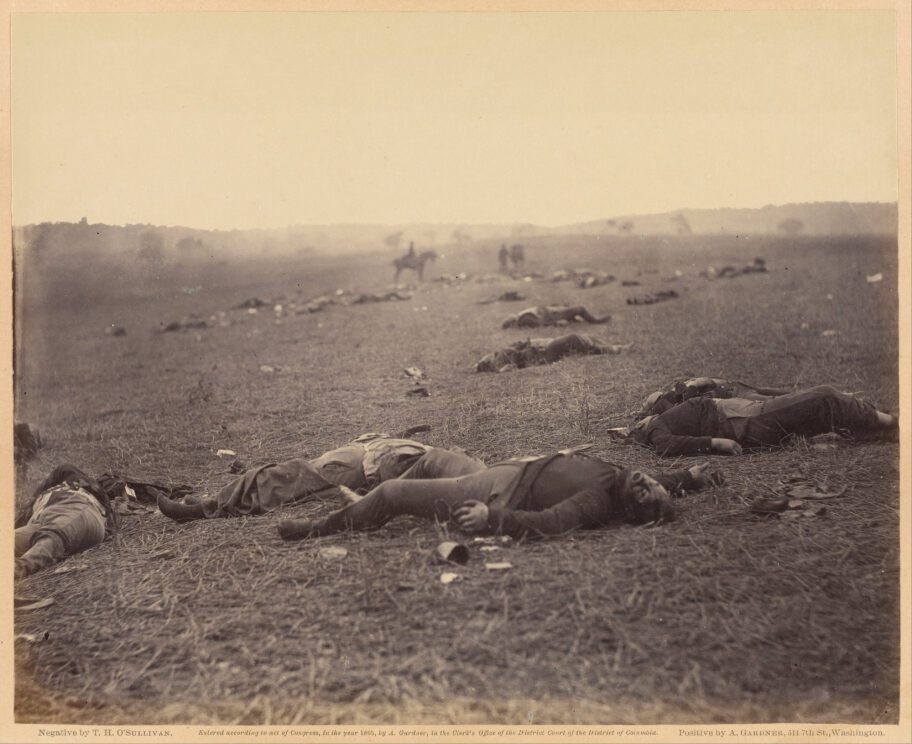
Death hovers everywhere in “The Good Death,” her Civil War chapter. The war “broke all the rules of a good death” for soldiers, who died “painfully, far from their homes and loved ones, without the chance to say any last words to anyone.” She writes that “Americans collectively, desperately, questioned everything they thought they knew about death.” The massive funeral for Lincoln’s son, Willie, who died of typhoid fever; Lincoln’s Gettysburg Address; his martyrdom; the national outpouring of grief; and the massive Civil War cemeteries together transformed the American meaning of death. “A good death was no longer defined individually—based on the last words, the state of one’s soul—but collectively, nationally.”
Wilensky-Lanford covers a dizzying number of religious groups and would-be prophets across the next chapters, from the 1860s to the 1930s. The chapter “A Place to Put Their Gods” deftly combines accounts of the Buddhism, Confucianism and Taoism brought by thousands of Chinese immigrants brought to complete America’s railroads, the advance of Mormonism in Utah, “Indian Removal” and the Sun Dance reaction, and Ku Klux Klan violence in the South. Wilensky-Lanford gets the Parliaments of Religion, part of the 1893 Chicago World’s Fair, just right. She understands its superficiality, especially its designation of ten world religions, from Confucianism and Taoism to Judaism, Christianity, and Islam, as the ones that count. But she documents how talks from the great diversity of America’s multiple Christian groups, including its dissenting Black denominations, already-splintering Jewish groups, American Indians, and even Muslims, confirmed the Parliament’s stress on pluralism but broadened it far beyond the official count of ten.
Wilensky-Lanford’s twentieth- and twenty-first-century chapters offer a powerful refutation of the secularization theme that dominates much modern American history, often focusing on the fusion of religion with liberal and conservative politics. She writes eloquently about the depth of religious conviction fueling the civil rights movement and the persistence and slow triumph of conservative evangelical Protestant activists.
It is not as though religion itself is ignored. She writes with warmth and insight about the rise of Pentecostalism and fundamentalism and about liberals, from Dorothy Day and Rabbi Stephen Wise to Martin Luther King, Jr. and Mary Daly, who are presented with vibrant portraits. Here too are conservative Christian businessmen’s organizations and the National Prayer Breakfast; the deaths of Jim Jones and his nine hundred followers in Guyana and David Koresh’s Branch Davidians in Waco; Sikhs killed for resembling Muslims; Native American religion and the passage of the Religious Freedom Restoration Act (RFRA); Jack Kerouac and Zen Buddhism; America’s diversifying Muslim communities; civil rights and the murder of four girls at Birmingham’s Sixteenth Street Baptist Church; Allen Ginsberg’s “Human Be-In”; Richard Dawkins’s, Sam Harris’s, and Christopher Hitchens’s proselytizing for atheism; the ordination of women; Jerry Falwell, Paul Weyrich, and the turn of evangelicals to elective politics; and the Trump administration’s promotion of conservative white Christianity.
If it seems impossible to stuff all these episodes and more into successful, tightly packed chapters, Wilensky-Lanford comes closer than most any author might dare to hope. A God-shaped nation indeed! Once we get into the nineteenth century, most readers will find her book a fascinating, often exhilarating read.