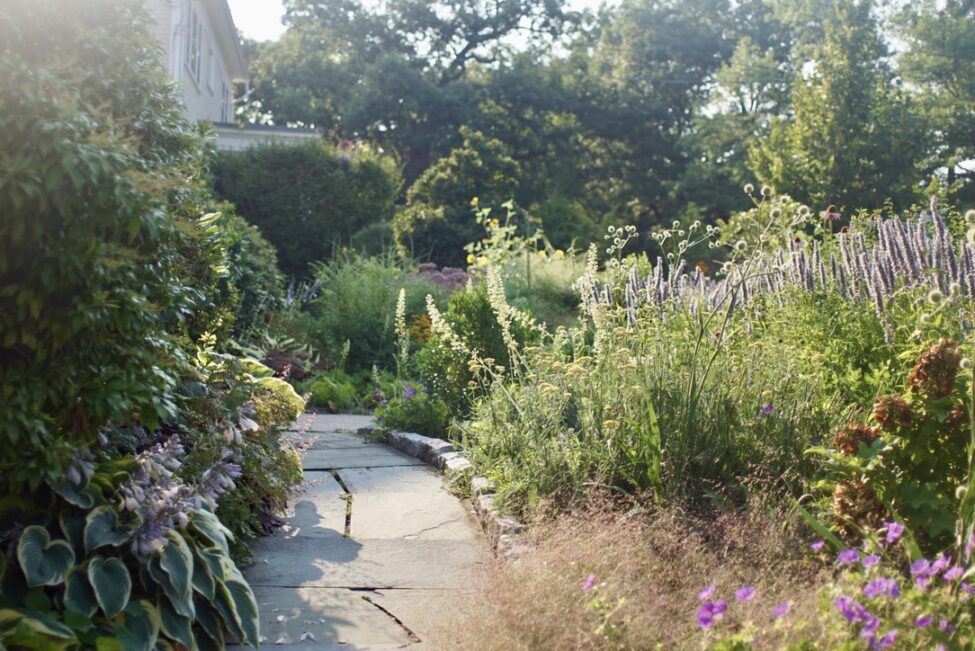


There is a garden across from my apartment that, 150 years ago, was an ash heap. People would bring spent coal from their stoves and dump it in a pile that, today, is covered with grass and bright with flowers.
I thought about that history as Chris Freimuth showed me around the garden he planned and planted outside Yale Divinity School, where he received his master of divinity in 2025. “There’s so much harm,” he explained, as we walked the lush landscape full of native trees and flowers. “From the seventeenth century, when the British came and took over the land and basically wiped out the Quinnipiac, all the way through the land of the divinity school being owned by a gun manufacturer, the divinity school has all kinds of complicated history.” That history informed and inspired Chris’s work of transforming what had been a small quad walled in by brick buildings into a flowering site of contemplation—work he did to earn his degree, a Thoreauvian thesis, of sorts. He now runs CF Design, a garden company, and serves as the director of the New Haven Pride Center.
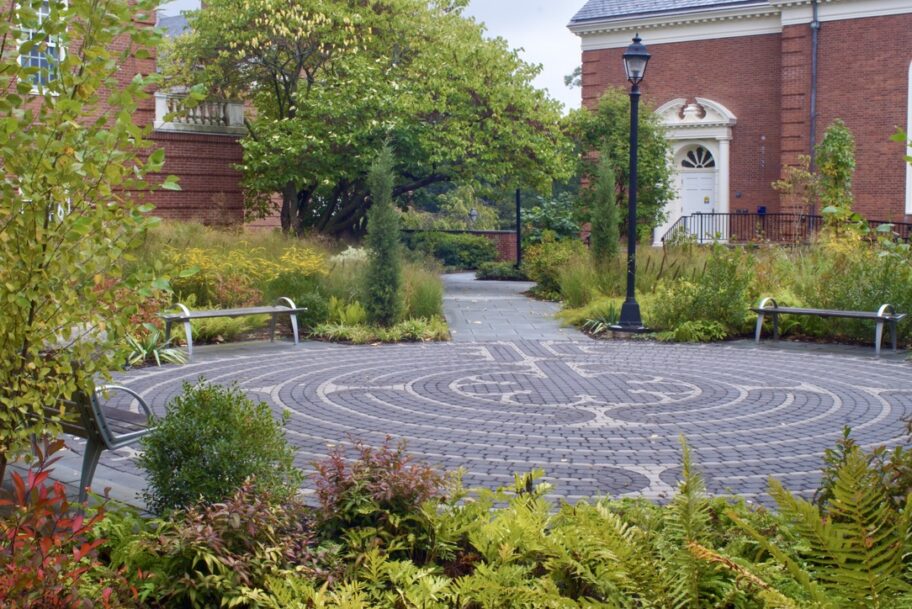
We met in the Yale Divinity School garden—crepe myrtles, oak trees, switchgrass taller than the benches, a stone labyrinth—and then again via video call. The following conversation, about gardening, god, and paying attention, has been edited for clarity and concision.
David Sugarman: Before we talk about gardening, let’s talk about divinity school. What inspired you to go?
Chris Freimuth: I’d always wanted to go to divinity school, since I think high school. I was interested in the questions of what is love, and why does it hurt so much when we lose people, and where the hell do we go? How did we get here?
All the big questions that kids ask and then a lot of adults stop asking unless somebody dies. I actually applied to go to divinity school right after college, when I moved to California, but I knew very soon after applying that I was not a good candidate because I needed more life experience. I hadn’t had my heart broken yet. I just hadn’t been through it, and I couldn’t imagine trying to be a minister and being there for people, having not gone through the hard stuff myself.
So I said, let me go get some life experience, and I’ll come back to this after I grow up a little bit. So I did that.

DS: What kind of Christianity did your family practice?
CF: Fortunately, my mom was more of what I’ve turned into, which is spiritual but not religious. My father, who I didn’t live with but visited quite a lot, was evangelical. That created a lot of challenges for us, and for me in particular. It really messed with me.
DS: So there was a model in your mom of a Christian-adjacent, but not specifically denominational, idea of how to be spiritual and think about these questions, without being confined by any one particular box.
CF: Exactly. And my father was the opposite. He loved the box.
I never really understood my father’s religion, although he was my father and I adored him, so I tried really hard to understand it. When somebody has a perspective that’s different from mine, obviously I’m as petty as anyone else, and I think, my God, that’s ridiculous. But I also think, well, I don’t know, that person is into it. It’s not ridiculous to them. So what is it? What’s inside of that that’s touching them in such a genuine way?
I always had, and still do have, a conflicted relationship with these religions or subsets of religions that are not for me—or, I don’t want to be too strong-worded, but that are pretty damn violent. I resist them, and I’m also intrigued by them because people find genuine love and hope inside of these things. And I’m like, what is that?
DS: There’s the violence, and then there’s also immensely positive and beautiful things. If you live close to it, as you did with your father, you see how both of those things are nestled side by side.
CF: Right.
DS: So you saw how these traditions can give people access to a kind of language, and you had access to that language in certain ways and felt very connected to it. It sounds like you were trying to figure out if this was a Christian thing for you in a more traditional sense, if that was where you would end up through divinity school.
CF: In my adult life before going to div school, I never fully rejected Christianity, as so many of my peers did. They said, God, I’ve had enough. I’m out. I reject this.
I think partially it was because the reason I want to reject these people and this religion is because it rejects me. But if I’m going to do the same behavior toward these people and their belief, then am I really advancing anything? Am I getting anywhere that they didn’t already get? Why don’t I just join them if I’m doing the same thing as them?
DS: That’s incredibly high-minded.
CF: I can be a little bit of an accountability police. I really don’t like inconsistency. We’re all inconsistent, but I went to divinity school because I thought, I could just be on the edge of this. There’s no perfect system, so I could be this radical priest on the edge of the church, constantly demanding—like all of our iconic leaders. I didn’t think I would be an iconic leader, but I thought I could be in that same lineage of, “Come on, we’ve got to push for actual radical love and acceptance.”
I went to this church in San Francisco called Glide Memorial Church, and the minister there, Cecil Williams, had been doing that for decades and decades. So I thought maybe I could be like that, and use the framework of Christianity in the pursuit of love.
Then I went to divinity school, and it was very much—I’m spiritual but not religious, and I would say that divinity school is more religious and less spiritual. That’s fine. It’s an educational institution. You’re writing papers and citing sources, and sometimes you’re praying, but you’re doing a lot of heady stuff.
It’s just not what I wanted. The more I learned about the religion, the less endeared to it I was, to the point where, oddly enough, divinity school, rather than bringing me more into the fold, released me. It gave me the tools I needed to finally say, this is a beautiful thing for other people, and it’s just not for me. It could be as simple as: I don’t really like mayonnaise. I don’t like being romantic with women. Nothing’s personal. It’s just who I am.
DS: I want to come back to this “released me” stage. But first, could you talk about this feeling that you had been rejected by the church, and when in your life you began to feel that way? Was it early? Was it as a teenager?
CF: There was not a starting point. The obvious thing is I’m gay, and I grew up in the eighties and nineties, when the Christian church was really going nuts about gay people. That’s an obvious reason to feel in danger in the church that I was in.
I didn’t grow up in a church that was “God hates fags” all the time. It was a church where it was like, you know that you don’t do that, right? Don’t go there.
DS: Where was this geographically, by the way?
CF: Connecticut. I grew up in Connecticut. Part of it was that. I like accountability. I was a rule follower then. I still am, maybe less so. I didn’t want to get in trouble. I didn’t want to get hurt. I’m a pretty intuitive person. I know how to read signs, and I knew: stay in the closet, don’t make any waves, because things could get really weird.
I actually gave my life to Jesus two or three different times, because there’d be these altar calls in these evangelical spaces. I would be like, well, last time I didn’t really feel it, so let me try again.
I didn’t come out of the closet till after college, and that was all because of religion. I wasn’t actually anti-gay as a Christian kid. I was like, that’s cool if other people do it, but it’s not me, that’s for sure. I might as well have said that I had blue eyes or something. You just can’t change the color of your eyes.
The other thing that’s more universal—because some people are gay, but not everyone who’s straight felt comfortable in the church either, of course—is my spirit is not attracted to Christian teachings or frameworks or language. I just don’t connect with this thing, but I’m not really allowed to say that.
I actually gave my life to Jesus two or three different times, because there’d be these altar calls in these evangelical spaces. I would be like, well, last time I didn’t really feel it, so let me try again. I kept doing that, and I never really felt it. But I felt like there was something wrong with me for not getting it.
At divinity school, finally I was like, it’s not me. This is an institution. It’s like the way they talk about God. God is just a general word: there are millions of gods throughout time. But the Christian world that I grew up in is like, there’s one God, and it’s a capital-G God. If you don’t believe in this God, you don’t believe in anything.
I was like, I don’t believe in this God. It doesn’t mean I can’t believe in anything else. This is a discrete thing, not everything.
DS: It’s kind of amazing how you wanted to remain proximate to it, even as you were struggling with both of these reasons for not connecting with Christianity: queerness and intellectual, spiritual disconnection. You consistently showed a desire, it sounds like at least until your mid-twenties, to remain close to it. What do you think that was about, for that big portion of your life where it wasn’t working, but you wanted it to work, or wanted to keep trying?
CF: It’s because I do believe in something. I’m hardly unique in this spiritual-but-not-religious cohort. Maybe it’s like when you fall in love with someone. I don’t know if you’ve ever been crazy in love, but it’s a pretty cool experience. There’s just no way to express that feeling. You can say “I love you” a thousand times, and that just doesn’t mean anything.
That’s how I feel about spirituality or sacredness or God or meaning. I feel it so strongly, and to talk about it too much just feels a little bit tedious.
DS: During that time, was it a painful searching? When did gardening come into the mix? I’m trying to understand this chapter of your life from post-college to divinity school.
CF: My guiding mission statement was Henry David Thoreau’s, from Walden, when he says, “I went to the woods because I wished to live deliberately,” and he says, “I wanted to suck out the marrow of life.” That phrase is my John 3:16.
I was ravenous for life. I wanted to try everything. I still do, but in youth one really wants to try everything. Sex, drugs, rock and roll. I come from a family with a lot of drug and alcohol problems, so I was always pretty measured about sex, drugs, and rock and roll, but I did it, and I tried to do all of it.
As well as meditation retreats, going to church, journaling, and all of the other stuff that’s less crazy. I moved to Brazil twice with a boyfriend. In my twenties, I was a massage therapist. I moved to San Francisco right when the recession hit in 2008, so I couldn’t get a job. I was good at massage, and a friend said, why don’t you go get trained and do that?
So I did. That’s a completely nonverbal form of communication, and it’s so incredibly intimate. It’s 100 percent listening. All you have to do in massage is listen and respond. That was incredible training for me in terms of this nonverbal, super-intimate connection with another human being, and what happens. A lot of times nothing happens, but once in a while, when things click, it’s a pretty sacred experience.
Garden design feels not so different from massage therapy, in that I’m working with living things and trying to create space and beauty.
I did that for a bit, and then I moved to New York. I would have had to do a whole new training to keep doing massage in New York, and my body was getting tired of it. So I switched over to my other passion, which was gardening. I did a two-year program at the New York Botanical Garden and started my own garden design company.
It was a similar thing. I moved to New York City, and I was scared to live in such a concrete jungle. It’s not like I had never been to New York; I had just never lived there. I said, let me create a career where I can be outside as much as possible by default, because it’s such an indoor place in terms of most people’s work.
I’m also pretty stubborn, and I like to do my own thing, so I started my own company because I didn’t want to work for anyone else. Garden design feels not so different from massage therapy, in that I’m working with living things and trying to create space and beauty.
DS: Then you get to divinity school, which is very much about, as you said, texts and language and papers and putting things into words. Tell me a bit about how gardening begins to become the center of what you’re doing at div school, culminating in the garden project you did there.
CF: It started my first year, my first fall there. I was in a preaching class with Carolyn Sharp, who is the best. I was reading a book on horticultural therapy. Rather than writing a paper about it, I thought, wouldn’t it be cool if I did a project where I created a garden using the principles of horticultural therapy? Rather than writing about it, why don’t I just do it?
Again, it’s this nonverbal thing: Why don’t we just do the thing? The divinity school had this courtyard in the back that had a labyrinth in it. It was already designed by the landscape architect who put in the labyrinth years prior. It was a very modern design, very clean and simple and pretty flat and linear. It’s not my taste.
It’s a courtyard, so it’s surrounded by walls, which all have windows to the library at the divinity school. It’s very intimidating to be in that space and try to walk the labyrinth, which is a very intimate experience, but with, I think, about fifty windows with people potentially peering down at you. And not just people, but Yale people. It’s an intimidating place, regardless of who you are.
I redesigned that garden as a quick redesign for my class, to show how horticultural therapy could be used in real life in a place like a divinity school. Then I passed the idea along to an administrator. I thought, this is never going to pass muster, because Yale has lots of rules. But you can’t win if you don’t play.
They liked the idea, so I created an independent study for myself and did this whole elaborate project around the narrative of the labyrinth and the design of the garden. Then I installed it. I can’t remember, at the end of my second or third year.
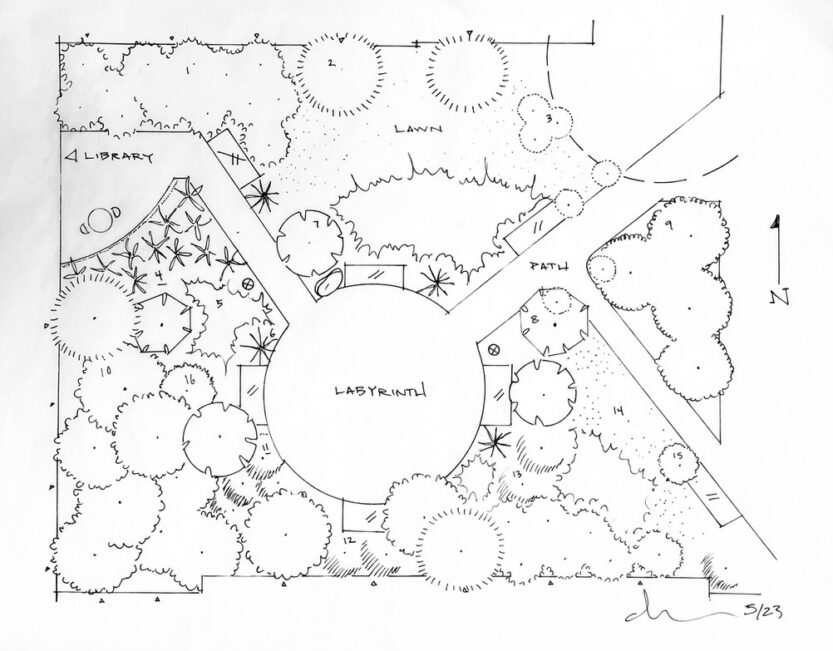
DS: When we met in the garden, we spoke a lot about the layers of history you were thinking about. I don’t think you spoke specifically about horticultural therapy, but it makes a lot of sense that that inspired this. Could you talk a bit about what you found in your research?
CF: When I think about a garden, I think, what’s actually there to start with? And it has to stay there, because we need to work with what we actually have, not with what we wish we had.
What was there in the space was a beautiful labyrinth, the building with the walls around it, and a garden that was pretty spare and could easily be changed. I said, we can change the planting plan. We’re not going to change the labyrinth, and we’re obviously not going to change the architecture. So we’ve got to work with the architecture and the labyrinth.
What is the story of the labyrinth? Fortunately, it’s a pretty awesome story. The labyrinth has many myths attached to it, and they’re all really interesting, and you can play with them all. I thought, this is just perfect.
One way to approach the labyrinth is, as you go deeper and deeper—it’s this circuitous path, not unlike mine in life—you’re walking toward the center, and you’re supposed to be mirroring a walk toward the center of your own heart. As you’re physically walking, you’re also mentally or emotionally or spiritually walking that twisty, curvy path inside of yourself. Then you get to the center of the labyrinth, and you get to the center of your heart, and you ask, what’s going on in there?
My professor and I walked the labyrinth together, and at one point she said, it’s interesting because the closer I got to the center of the labyrinth, and the closer I started to get into my deeper, darker corners, I got kind of scared. There’s the beauty and the love and all of this courage and joy, and there’s also some stuff inside that I’m probably not going to want to encounter. I thought that was so fascinating and beautiful and complicated.
Then the Greek myth of the labyrinth is that Theseus goes into the labyrinth to slay the Minotaur. The Minotaur is in there because his dad basically didn’t like who he was. That’s it. And he was born that way.
Plenty of us can relate to that. As a queer kid, I can relate to that. In the Greek myth, they’re going into the center of the labyrinth to slay the Minotaur. But I thought, what if, instead of going in to slay the Minotaur, we go in and ask the Minotaur how he’s doing? He’s so full of rage. Where did that come from? How can we sit with it?
I’m thinking of when I was a kid, and we had the projectors with the transparent sheets. You’re physically walking the labyrinth, and you’re going through the narrative with the Minotaur, walking through that labyrinth, and you’re also going through your own heart and going to the center of your heart. There are all these labyrinths layered onto each other.
I don’t see a huge difference between humans and nonhumans when it comes to biology and the natural world. Obviously, we’re all different in form, but we’re mostly made out of carbon and H₂O and all of that stuff. I don’t mean to flatten the experience, but I don’t think we’re as different as we often talk about being.
I imagine taking the labyrinth and turning it 90 degrees on its side and putting it into the ground and asking, what if we walk into the heart of the land? In the same way that I can use the metaphor of the Minotaur to so easily think about my father and myself and the ways that I’ve been hurt and need to be tended, the land has also been hurt. What is inside of the land that we haven’t been paying attention to? How is the land reacting in violent ways because of the harm that we’ve done to it in the first place?
I did all of this research into the history of the land at the divinity school, which is to say New Haven in general and the very specific site of the divinity school in particular. There’s so much harm, from the seventeenth century, when the British came and took over the land and basically wiped out the Quinnipiac, all the way through the land of the divinity school being owned by a gun manufacturer. Then the divinity school has all kinds of complicated history, as does Yale in general.
Of course we’ve done so much beautiful stuff on this land, but we’ve also done so much harm. I’m not going to pretend that a garden can spiritually heal the land, because I’m not going to make a claim that I can’t back up. I can’t back that up, even though maybe I feel that way. But I know that a garden can help the ecology of a land. And I know that when you help a person by feeding them or clothing them or giving them shelter, it does something for their spirit.
If I could reinstitute some habitat in this land, perhaps there’s a connection to its spiritual healing. So I made a habitat.
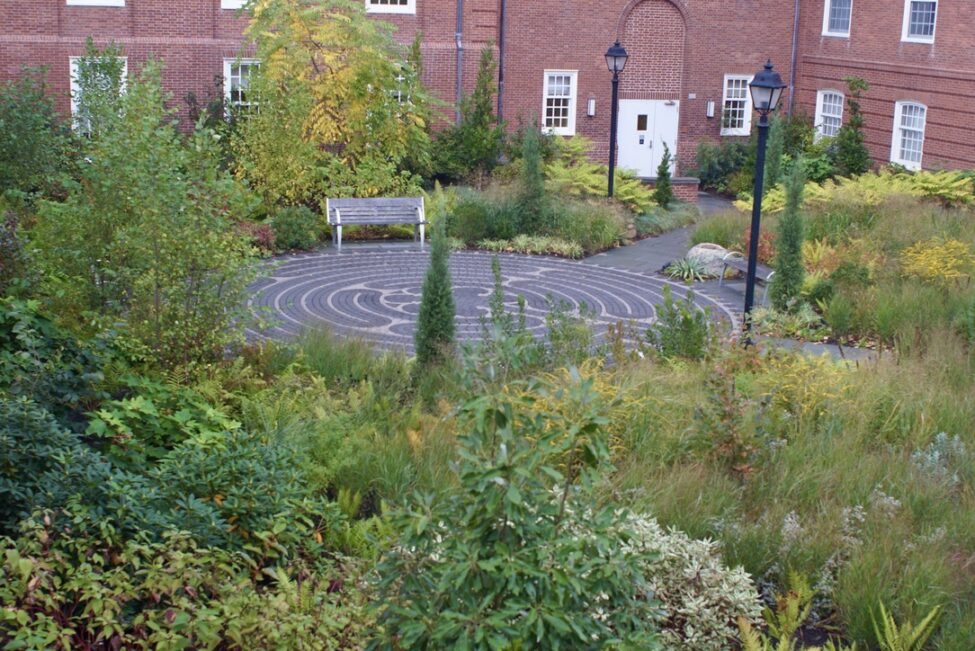
DS: Is the hope here that a garden functions as a habitat for contemplation and reflection?
CF: Absolutely. I was in a cab going downtown in the city a few years ago, and the cab driver said to me, “Hey, what do you think is the meaning of life?” I thought he was really asking, so I thought about it and said, “I think maybe paying attention.”
Then he said, “Yeah, no, it’s God.” And I was like, you got me.
But I do think you got it, for me at least. It’s paying attention, and paying attention deeply, with great generosity and courage.
DS: That story’s so funny because he obviously wasn’t paying attention to you. How does a garden help us do that, do you think?
CF: I don’t want to speak in generalizations, because it’s so easy to say, a garden draws us in, a garden helps us remember who we are. That’s not for everybody. It doesn’t draw everybody in. A lot of people hate gardens.
For those of us for whom this does work, it’s this nonverbal communication and connection. There are people who you say, hanging out with you is just as easy and enjoyable as being alone. It doesn’t take any energy to be with you. It’s a pure delight. It’s either energy-neutral or energy-giving.
That’s how a garden feels to me, and I think can feel to many people. It’s such a relief to be in a garden. You know you’re with other living things that just want to have a good time and be together and live.
DS: That’s such a good description. I got to be with you at some of the gardens you made. I’m thinking about the one you did for that family, where everything was erupting. There were flowers everywhere, and the pollinators were out of control. It was like, this is all just having a good time. That’s all this is.
CF: Totally. It’s like sex, drugs, and rock and roll.