


Our story begins with “ᴅᴇɴʏ, ᴅᴇꜰᴇɴᴅ, ᴅᴇᴘᴏꜱᴇ,” three words written on the casings of three bullets that Luigi Mangione allegedly fired at UnitedHealthcare CEO Brian Thompson on Dec. 4, 2024. Before anyone knew the identity of the shooter, these words, all verbs, made sure that the shooting wasn’t mistaken for something random or personal. They conveyed the shooter’s purpose by echoing the title of Jay Feinman’s Delay Deny Defend (2010), a book highly critical of the American health insurance industry. Becoming a meme that’s shown up on graffiti and t-shirts all over the world, well, that was a lucky byproduct.
As someone who writes about language and is fascinated by the uses of writing, I immediately wondered how to characterize the relationship between words and bullets. Not just these words and bullets (or the casings, to be precise), but between words and bullets and other projectiles more generally. What is going on here? Are there connections between words on ancient projectiles and Mangione’s bullets, and if so, what are they?
Among the challenges are figuring out what the words are imagined to deliver if they remain behind on the casing, and how they work as a message if the target can’t receive it or if the bomb explodes. Then there’s deciding which one, bullet or word, is the message, and which is the emphasis. Which is the signifier, which the signified? And which is the analog of the speech act, the writing of words or the firing of the gun? All of one’s pet semiotic and rhetorical frameworks get stumped.
Meanwhile, commentators focused on the meaning of “ᴅᴇɴʏ, ᴅᴇꜰᴇɴᴅ, ᴅᴇᴘᴏꜱᴇ,” puzzled at why someone would cram a political manifesto into such a small space. Yet they overlooked the meaning of the writing itself, as in the way that Mangione’s handwriting, however it looks (something that we’ll learn during the trial), transforms the mass-produced cartridges into something strangely personal. Because who sees other people’s handwriting anymore? And even though he’d written in permanent marker, the media kept using words like “engraved” or “carved” or “inscribed,” as if it wasn’t masculine enough to be shooting someone; a real shooter had to have hurt his bullets, too.
Ten months after the Thompson shooting, two other high-profile shootings featured bullet casings with writing on them. In text messages to his roommate, Tyler Robinson, the young man who allegedly shot Charlie Kirk in September 2025, described engraving bullets with obscure internet and gaming references. Four of the bullet casings were found, but no photos have been released. In an attack on detainees at an ICE facility in Texas, one casing had the words “Anti-ICE” markered on it (though by whom isn’t clear).
All of one’s pet semiotic and rhetorical frameworks get stumped.
Here was a trend that seemed to conveniently explain itself. Commentators in the media concluded that the shooters were writing on bullets because they were copycats who communicate with each other, exploiting social media and mainstream media as vectors for viral information. “Experts say the scrawled messages embody a new wave of online propaganda, disinformation, and misinformation wrapped in absurdist humor—a communication strategy rooted in meme culture and mockery,” wrote Alain Stephens in The Intercept. “It’s performance, not persuasion.” Jillian Snider, a fellow at the R Street Institute, wrote, “We’re going to see a lot more bullet engravings in high-profile shooting incidents in the future.”
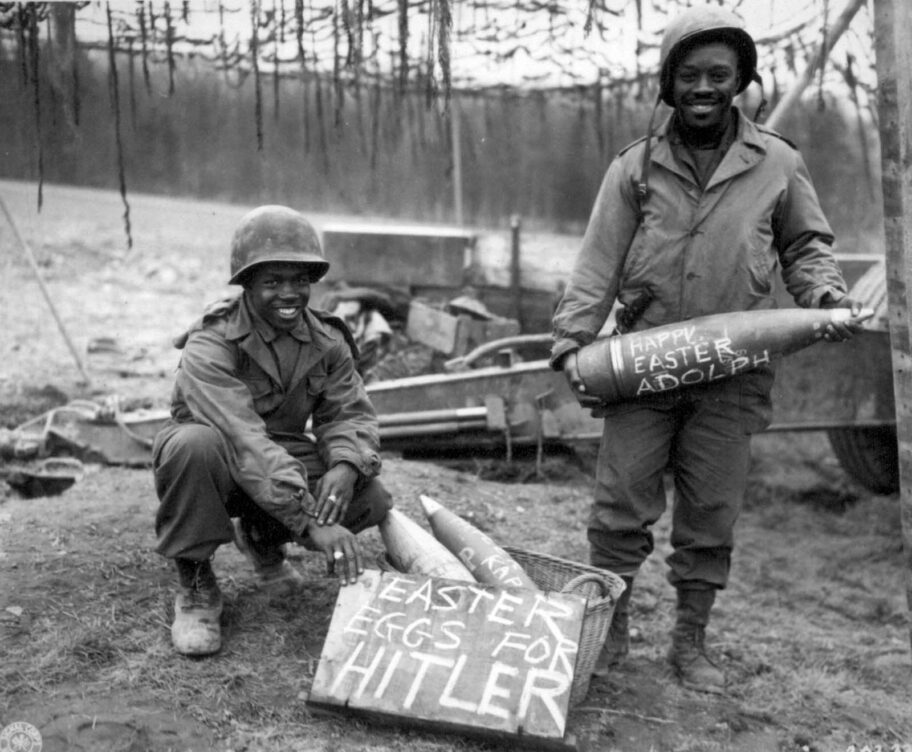
A lot of the potted histories of writing on projectiles, found in essays written after the Kirk shooting, imagined a straight line of influence between ancient Greek warriors, Yanks scrawling “Fuck Hitler” on bombs, and “ᴅᴇɴʏ, ᴅᴇꜰᴇɴᴅ, ᴅᴇᴘᴏꜱᴇ.” Yet the only way to blithely pronounce that “people have been writing on bombs as long as they’ve been throwing them,” as if the practice is somehow intrinsic to war-making, is if you don’t have to explain why most of the bombs, bullets, arrows, and other projectiles flung in human history have fulfilled their violent purpose unadorned.
As I dug further, I found a mishmash of practices, motives, and goals that overlap and inform each other, some psychological, some political, some inhumane. Some are even practical. It turns out there’s no single tradition of writing words on bullets and bombs, just as there’s no single tradition of writing words on paper. But some archaeologists’ disagreements about writing on projectiles uncover one bit of clarity: perhaps the roots of the practice lie not in messaging to an enemy but in writing to oneself.
We could begin by gently loosening our hold on the idea that words on bullets represent some magical enhancement to their power. One reason is that attested forms of practices called “bullet magic” usually involve making potential human targets bulletproof, not the bullets more lethal. This was a feature of the Boxer Rebellion in China at the dawn of the twentieth century, when leaders of martial arts organizations promised their followers immunity from Western bullets. This hope also appeared among German soldiers in World War I, in civil wars in the Congo in the 1990s, and in many more places where people in power needed a way to encourage younger people to take up arms and put themselves at risk. Why can’t bullet magic enhance both? Here we can look at narratives about “magic bullets,” such as the 1821 German opera Der Freischütz, in which the projectiles are directly imbued with the power of the one who casts them—in this case, Satan, or the Black Huntsman—not through any words or symbols inscribed on them.
It is tempting to see a similarity between words on bullets and inscriptions on other types of weapons, such as swords, guns, and cannons, but we should be careful in linking the two. Take, for instance, the belief that the magical inscriptions on everyday swords worn by men in Germany of the 1600s enhanced the blades’ power and therefore the bearers’ masculinity. This magic worked more in retrospect, in the sense that a defeated man could blame his woes on some supernatural power wielded by his enemy, leaving him defenseless, and everyone believed the charge. Interestingly, the social usefulness of sword magic waned when firearms became more common, because a man’s masculinity wasn’t at stake in the same way if he was shot.
And yes, words on bullets do seem close to the ancient Roman practice of writing curses on small sheets of lead. The lead—a material chosen partly for its symbolic value—was inscribed with a sharp object, then rolled up and deposited in a grave or thrown into wells or bodies of water. These “curse tablets” called upon the souls of the dead or the gods of the underworld to, say, tie the tongue of an opponent’s attorney or compel a lover not to stray. The target of the curse never had to come in contact with the lead.
But this isn’t the most salient point of comparison with words on bullets. It turns out that contemporary gun enthusiasts write on ammunition quite frequently, and there’s nothing magical, sinister, or particularly referential to it.
“You can find all sorts of chatter on reloader forums”—where people discuss DIY cartridge-making—“about people marking bullet casings with light etchings or engravings, either to differentiate between different loads or merely for aesthetic purposes,” says Mark Valentine, the co-editor of Campus Carry (2020). Competitive sport shooters also put marks on their casings in order to keep track of how many times they’ve loaded their gun.
The difference between this contemporary practice and historical weapons magic is in the intention of the person doing the marking. “There is a very long history of a belief that ritual preparation of words can circumscribe the thoughts or speech or behavior of others,” says Shaily Patel, a religion scholar at Virginia Tech. The person writing the tablet, often a magician hired for the job, might say a spell or chant as they wrote it, which imbued the lead—a cold, dark material—with its magical properties. At a time when most people couldn’t read or write, the ability to make marks on surfaces probably possessed a mysterious power. For this reason, curse tablets were considered to be effective even if the magician was illiterate and could only make hash marks in the lead, as long as he was authorized to chant the transformative spell.
It turns out that contemporary gun enthusiasts write on ammunition quite frequently, and there’s nothing magical, sinister, or particularly referential to it.
I want to take a small detour through the political meanings of the words on bullets. All of the attention to media reports about the recent shootings made it seem as if these troubled young men were the first to put overtly political messages on projectiles. But this isn’t true, as the history of ancient engravings shows.
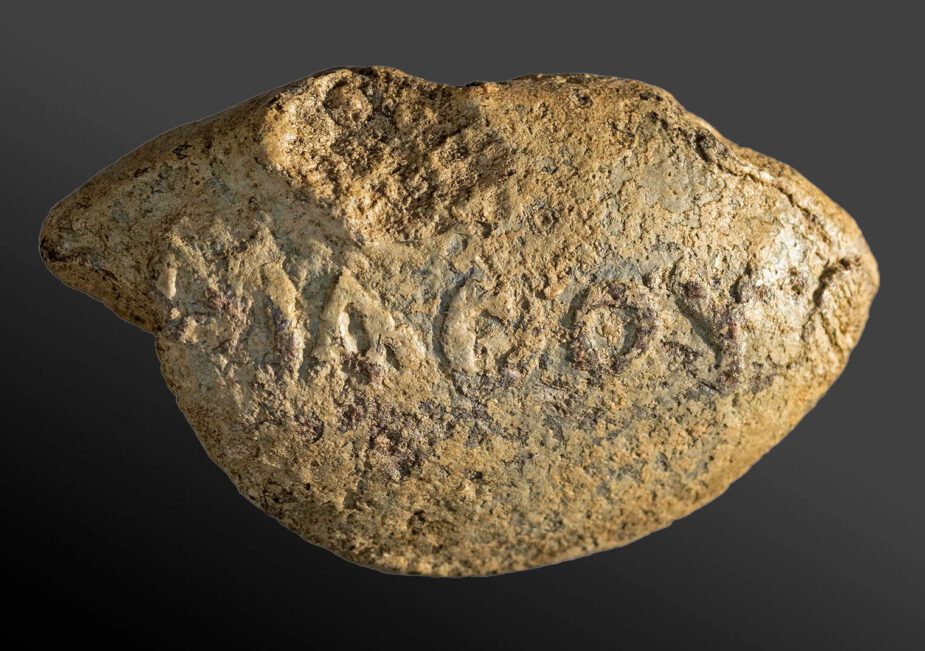
The oldest words on bullets, it’s generally agreed, come from the ancient Mediterranean world: almond-shaped lead slugs, weighing about as much as two AA batteries, shot from slings at ranges over several hundred meters. The earliest Greek “sling bullets” have been dated to the fifth century BCE. Inscriptions were easy enough to produce—you simply carved letters into the wet clay of the bullet molds—though it’s not clear what proportion of bullets had them. From archaeologists, we know that inscriptions often named the maker of the bullet, the military commander, the military unit, or the country.
Most of the Roman sling bullets with words on them, called glandes inscriptae, date to the first century BCE’s periods of factional fighting between Roman politicians. Like the Greek examples, they too bear the names of leaders and military units, cities, political slogans, and names of gods. In a 2005 paper, Spanish archaeologist Borja Díaz Ariño described how glandes inscriptae found on the Iberian Peninsula had inscriptions that assert political legitimacy through using a deity’s name or symbols (such as the anchor or thunderbolt) or presumptuously claiming a father’s name and title. Assuming that this was political propaganda—if you were under fire, you would know who was shooting at you—it means that, 2,400-odd years before a bored Utah gamer put memes on bullet casings, the Greeks had already done this.
Yes, the Greek bullets had some sarcastic messages too, all in Greek, addressed to an enemy that might not have known Greek or how to read at all, such as “ᴀ ꜱᴡᴇᴇᴛᴍᴇᴀᴛ,” “ᴇᴀᴛ ᴛʜɪꜱ,” “ᴛᴀᴋᴇ ᴛʜɪꜱ,” “ꜱᴇɪᴢᴇ ᴛʜɪꜱ,” and “ᴏᴜᴄʜ.” Roman bullets mostly used Latin but were also sometimes adorned with what scholars call paleo-Iberian letters and numbers. They also bore sarcastic quips, such as “ᴛᴀᴋᴇ ᴛʜɪꜱ” and “ɢᴇᴛ ᴘʀᴇɢɴᴀɴᴛ ᴡɪᴛʜ ᴛʜɪꜱ,” while others bore legitimate curses: “ᴀɴ ᴇᴠɪʟ ᴛᴏ ʏᴏᴜ ᴡʜᴏ ᴀʀᴇ ᴇᴠɪʟ,” “ᴏᴜʀ ᴘᴇʀꜱɪꜱᴛᴇɴᴄᴇ ᴡɪʟʟ ᴅᴇꜱᴛʀᴏʏ ʏᴏᴜ ᴜᴛᴛᴇʀʟʏ,” and “ʀᴜɴᴀᴡᴀʏꜱ, ʏᴏᴜ ᴀʀᴇ ᴅᴏᴏᴍᴇᴅ.” Nowadays, the saucy messages are cited most often, though the bulk of marked projectiles were likely serious, even a bit dull.
Writing on projectiles wasn’t confined to the Mediterranean. Thousands of bronze arrowheads from pre-imperial China (prior to 221 BCE) have been found, some of which carry the name of the factory or the commissioner but no other message. There is tantalizing evidence that one lone arrowhead from this period bore the inscription “not surrendering” (bu xiang 不降), but it appears to be the name of a place in eastern China, says Ondrej Skrabal, a researcher at the University of Hamburg. “I am afraid the Chinese arrowheads are not as exciting as I thought,” he wrote in an email. “The writing on them remains largely bureaucratic (indicating place of production for accounting purposes).” Maybe a wider range of messages were written in the pre-modern world, but Skrabal said the practice hasn’t yet attracted much scholarly attention.
No matter what the messages were, they differ from Mangione’s and Robinson’s in one critical respect: the Greek, Roman, and Chinese examples came from the process of making the bullets or arrowheads in batches, not hastily scrawled in an individual act of customization. But let’s set that aside to consider how both erase the physical distance between sender and target, one of whose effects is to make the violence more interpersonal: “Because I am addressing you, my enemy, through this projectile, I am acknowledging there’s a person on the other end of the trajectory.” Perhaps it’s some atavistic survival of hand-to-hand, face-to-face combat, in which a powerful adjunct to physical force was intimidation and inducing fear. Writing on a projectile substitutes for that intimidation, though weakly.
This psychological impact has been investigated by contemporary historians of such practices. In 2022, archaeologist Yuliya Ustinova explained the meaning of an inscription on a newly discovered 2,200-year-old sling bullet that bore the names of two gods, Heracles and Hauronas, considered to be divine patrons of the city of Yavne, in present-day Israel. “The inscriptions convey a message of unifying the warriors with the aim of raising their spirits, scaring the enemy, or a call intended to magically energize the sling bullet itself,” Ustinova told an Israeli television station. “They were part of psychological warfare, the main purpose of which was to terrorize the opponent, and in addition, to unite the warriors and raise their spirits.”
“Weapons, in general, were created to be intimidating,” Ustinova wrote in an email, pointing out that shields were decorated with frightening figures too. “I have no doubt that the modern practice of inscribing weapons with curses or indicating their desired direction has much in common with the ancient habit of intimidating or ridiculing the enemy by means of inscriptions.”
Because I am addressing you through this projectile, I am acknowledging there’s a person on the other end of the trajectory.
To reduce this distance (between victim and perpetrator) in contemporary warfare, words on bullets and bombs must be spread via social media (if not traditional forms as well). For one thing, the projectiles are exploded, obliterating the messages. Perversely, reducing the distance between the sender and target involves blasting information across the global platforms of Instagram, Telegram, and X.
Because on the internet, “everything seems to be gleefully stupid,” as a Task and Purpose piece put it, many of these communications adopt goofy meme dialects. Since the Russian invasion of Ukraine, a donation to the Ukrainian Armed Forces would get you a personalized message on bombs, artillery, rocket tubes, and even fighter planes. Six months after the Russian invasion, Max Hauptman reported on a service, signmyrocket.com, that charged forty dollars to write a single personal message “with indelible marker” on a 152-mm shell. The message could be to “wish someone a happy birthday/death in pain, propose marriage, name, instagram/telegram username.” Proceeds went to buying equipment for Ukrainian troops.
A year later, the practice had expanded. “After more than a year of war, Ukrainians have a lot to say to Russia,” wrote Maria Varenikova for The New York Times, “and many have chosen to say it on the sides of rockets, mortar shells, and even exploding drones.” Some of the thousands of messages are bitter, others obscure and personal. One mother, grieving the death of her son on the frontlines, wanted the message, “For Yura, from Mom. Burn in hell for our children.” A Ukrainian psychologist observed that writing such messages felt like justice for Ukrainians. “Personally for me it’s a tiny bit of revenge,” the widow of a soldier told Varenikova. “When I send money for the message on the bombs, I feel some kind of psychological relief.” (That the relief comes not from the writing but from the paying is an interesting complication of the chain of action.)
Three years later, the practice is still going strong, Varenikova wrote in an email. “Just recently, when I was at the launch of the long-range drones, the commander wrote on one of them: ‘Wings of Victory. I am flying at you,’” she said. (The message references the battle cry of a Ukrainian prince, substituting “going at you” for “flying at you” for the times of drones.) In times of struggle, people want to have an individual voice, particularly when they aren’t being heard otherwise. It’s not just a bomb; it’s “my” bomb in “my” war. Accumulated over time, it mobilizes more societal skin in the game.
Then, if you circulate images of people marking on projectiles, the propagandistic effect can be exponentially mobilizing as well as intimidating. In 2023, a small controversy erupted over photos circulating on X that apparently showed Israeli schoolchildren writing on shells to be fired at Gaza. However, the images actually came from a coordinated photo shoot that happened in 2006, when a group of children drew Israeli flags on shells that were going to be fired at Lebanon. Their parents reportedly wrote messages to Hezbollah leader Hassan Nasrallah (who was said to be responsible for the bombs targeting the town where the children lived). This form of propaganda sends the intimidating message that everyone in a given society is aligned on who the enemy is, even if that’s a fantasy.
Again, it mattered less that Nikki Haley wrote “Finish Them!” with a marker on shells in 2024 than that photos of her doing so were shared online by Israeli politician Danny Danon, who circulated photos of himself signing a shell with “America ❤️ Israel Always.” Such writing is always divisive: observers stand aghast at the crass inhumanity of it, while participants feel solidarity for their side.
It’s not just a bomb; it’s “my” bomb in “my” war. It mobilizes more societal skin in the game.
I’ve never written on a bullet casing, though I’ve written a name on a foggy mirror and a slogan on a car’s dirty rear windshield. Scholars call this “tertiary writing,” meaning writing on an object that already exists for other purposes. Tertiary writing includes graffiti, tattoos, carvings on trees (on which there’s a surprisingly large literature), and of course writing on ammunition and bombs.
Why does tertiary writing happen? Sometimes there’s nothing else to write on. Sometimes there’s nothing else to do. This is a far cry from magical incantation—the young man who allegedly shot Kirk admitted that his messages were mostly meaningless. “Remember how I was engraving bullets?” he wrote via text to his roommate. “The fuckin messages are mostly a big meme. If I see ‘notices bulge uwu’ [sic] on Fox News I might have a stroke.”
The scene of bored soldiers amusing themselves by writing on bombs comes up repeatedly. For example, in December 2023, an Israeli news presenter, Rotem Achihun, posted a video of her visit to an Israeli artillery team, when she wrote “for the people of Gaza,” on a shell in Hebrew, then climbed into a tank turret as the gun was fired. The video makes apparent that the crew was stationed in some remote spot with a single job, so it’s likely they spiced up the time by writing on artillery shells. Indeed, as the camera roamed over rows of gray and yellow shells, handwritten messages are visible on many of them. “Good luck,” reads one. “To Gaza with love,” reads another.
In 1941, the diary of a Luftwaffe pilot named Gottfried Leske was smuggled out of Germany and published in the U.S. as I Was a Nazi Flier. In the book was a description of ground crew “amusing themselves” in August 1940 by “painting inscriptions” on the bombs they loaded on the plane. “At first, they just painted ‘Gut Rusch’! (Happy Landing!). But recently they have become more ingenious,” Leske wrote. “Now they put real addresses on the eggs…. But most of them are just addressed to Churchill, or to Eden or Duff Cooper or the King.” One can easily imagine Greek and Roman bullet-makers amusing themselves in a similar way, waiting for the lead to melt so they could pour it in the molds.
That’s probably how the American atomic bomb dropped on Nagasaki, the “Fat Man,” ended up with writing on it: nothing sacred, nothing taunting, just the acronym “JANCFU,” for “Joint Army-Navy-Civilian-Fuckup.” (The bomb dropped on Hiroshima went bare.) It’s safe to say that as long as humans have been hurling bombs, there have been bored soldiers looking for amusement.
Writing on bombs as amusement and as propagandistic solidarity comes even closer to what I would argue are the roots of this practice: they’re not writing to an enemy, they’re mainly writing to, and for, themselves.
It’s safe to say that as long as humans have been hurling bombs, there have been bored soldiers looking for amusement.
Maybe everything painted, scratched, and penciled on bombs and bullets has been misinterpreted somehow. If writers on projectiles are engaged in any sort of shared project, maybe it’s because they’re trying to work out some older, perpetually unresolved issue of an existential nature that hangs over us: what it is that words are for, and what power they have?
As Roberto Calasso writes in Ardor (2014), his book about the Vedas, “The essence of the word is in its being a substitute: but for what?” In the West, we say the word stands in for the thing that’s named. But for the Vedics, Calasso says, the word is what happens when a sacrificial ritual succeeds—a sacrifice, perhaps, to whose level humans hope their violence rises. A word on a bullet traces that hope.
But maybe it’s something more mundane. Tertiary writing also includes writing on things to mark ownership and provenance, which is, in fact, most of the tertiary writing that I’ve ever done: names on kids’ hats and coats, camping gear, cupcake trays. And in fact, marking ownership is one hypothesis about the personal names carved into bronze Phoenician arrowheads, dating to 1100 to 900 BCE. Over a hundred names have been found on 63 arrowheads, many of which turned up in the antiquities market in the 1950s. The cuneiform was carved into the surface, probably by a craftsman.
Archaeologists disagree about what the names were for; the best evidence points to ownership and tomb offerings, though another hypothesis is that they were used for divination. Because no one knows where most of the pieces were found, the matter won’t be resolved completely, but this ownership explanation appeals to me. It is easy to imagine that in pre-industrial times, an arrowhead (like a lead bullet) was the product of no small human effort and not disposable. So after a battle, archers and sling-wielders picked through the carnage to find their projectiles for re-use. If it had your name on it, or that of your military unit, you retrieved it for another battle. Basically, these were functional labels for your own purposes.
Why do people write curses and taunts? Imagine that you don’t find all of your arrows or bullets. They’re just not on the battlefield. Where are they? Someone has scavenged them or carried them away in their flesh. So you add a message to that person just in case. Either way, your taunting “ᴇᴀᴛ ᴛʜɪꜱ” still identifies your projectile; you’re still writing for yourself.
Let’s draw another line from this practice to “ᴅᴇɴʏ, ᴅᴇꜰᴇɴᴅ, ᴅᴇᴘᴏꜱᴇ,” along with the line that connects curses and intimidation with Mangione’s words. Because the projectiles fly away, we’ve been tricked into thinking of them as messages to someone else. In fact, they’re meant to be used or consumed by those who write them. That gathers more of the examples here, such as American gun aficionados writing on casings to identify them and politicians writing on shells in order to advertise to hometown constituencies. Intimidating words pump up morale and secure resolve; mournful ones are therapeutic; sassy ones ensure one’s ironic bona fides.
A full archaeology of inscriptions on projectiles and weapons might reveal a range of people trying to latch onto occasions of violence to remind themselves of something, something they’ll want to have in mind long after the bullet casing rings on the pavement.