


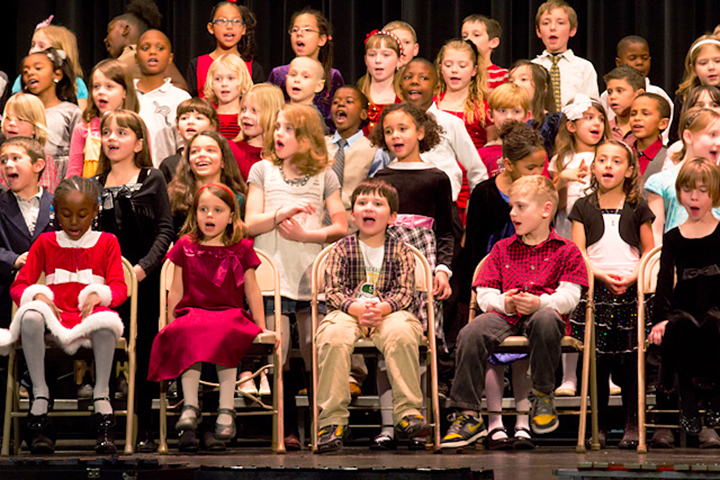
I loved my high school December choral concert. After banalities like “Winter Wonderland” and “Jingle Bells,” we performed a snazzy medley of Christmas carols, and the jazz choir always ended the evening with a fresh arrangement of “Silent Night.” Just like at my church’s Christmas Eve service, the last words anyone heard were “Christ the Savior is born.”
This was not a coincidence. My chorus teacher was also the director of music at my Presbyterian congregation. We ended our other concerts with John Rutter’s lovely “The Lord Bless You and Keep You,” and we sang Michael W. Smith’s “Friends” at graduation.
There weren’t a lot of religious minorities in my western New York suburb. I knew one Jewish girl in the school, and there was a smattering of South Asian families. Pretty much everyone was culturally if not actively Christian.
My high school self loved Jesus even more than choir. I was active in Young Life, a ministry dedicated to convincing teenagers to make decisions for Christ. I distributed invitations to our meetings every week and hung out with Young Life staff at school events. I even tried personal evangelism on occasion, albeit with limited success. I offended the above-mentioned Jewish girl by telling her that I thought Christians should only marry fellow Christians.
I never gave the least thought to how religious minorities would have felt at our December concerts. If asked, I would have reflexively defended Christmas music, probably by pointing to its secular quality or the fact that the vast majority of the community celebrated Christmas.
I didn’t realize at the time that Christmas celebrations in public schools have been a flashpoint for American religious minorities, especially Jews. Scott D. Seligman’s The Great Christmas Boycott of 1906 (Potomac Books, 2025) provides a cogent introduction to the subject as it played out in New York City in the early twentieth century.
School celebrations of Christmas were common in the city and usually uncontroversial. “Even as early as the turn of the twentieth century,” Seligman explains, “many saw [Christmas] as more of a cultural event than a religious festival.” Non-Christian families rarely raised objections to Christmas trees, carols, or even nativity pageants.
Certain administrators, however, were even more offensively zealous for Jesus than I once was. Frank F. Harding was among them. Harding, Presbyterian at least by upbringing, was the principal of Brooklyn’s P.S. 144, an elementary school whose student body was overwhelmingly Jewish, the children of immigrants from Russia, Poland, and elsewhere in Eastern Europe.
At a Christmas assembly the day before vacation began, Harding read passages from the King James Bible, both testaments. Then he delivered what amounted to an impromptu sermon. “Be like Christ,” he implored the students. “That is how I was you to be. Christ blesses all but the hypocrites, and the hypocrites are the people who do not believe in him.”
Fourteen-year-old Gussie Herbert arose, came to the front of the auditorium, and objected. “Mr. Harding,” she asked, “don’t you think that preaching on Christ belongs to the Sunday school or church and not to a public school?”Harding stated that anyone who did not like preaching on Christ could leave the room. And he told Gussie Herbert to sit down.
At another time and place, that might have been the end of it. But Herbert’s father, a lawyer, contacted Albert Lucas, secretary of the Union of Orthodox Jewish Congregations of America. Lucas sought to protect Jewish children from pervasive and sometimes government-supported attempts to Christianize them. One concern was Christian missions that lured immigrants with social assistance and then surrounded them with Christian imagery and evangelistic tracts. Lucas leveled harsh criticism at Jacob Riis, the Danish-American photojournalist whose settlement house aimed to convert the city’s “heathen” and “infidels,” who in Riis’s mind included Jews.
Social missions and settlement houses were private institutions that Jewish families could avoid. Schools were another matter. Lucas had been tracking the union between church and school for several years before Harding’s comments about the “hypocrites … who do not believe in [Christ].” Most teachers began the day with a reading from the Bible, often a verse from the New Testament. Children were taught to sing Christian hymns. And Christmas celebrations included elements that amounted to religious instruction. Lucas took his complaints to New York City’s superintendent of schools, who had directed the city’s teachers and administrators to avoid at least the most objectionable practices. Principal Frank Harding had ignored such counsel.
Lucas had struggled to convince many New York City Jews to support his concerns about Christmas celebrations. They knew that trying to take Christmas out of schools—or Christ out of Christmas—would inflame anti-Jewish sentiment when it already burned bright. But Harding’s over-the-top zealotry made the issue unavoidable. Lucas circulated a petition asserting that Gussie Herbert and other children had been bullied as “Christ killers” by their classmates in the wake of the assembly. A district school committee agreed to investigate and hold a hearing.
Gussie Herbert was the first witness. She detailed what had happened at the assembly and added that there was a picture of the Virgin Mary and baby Jesus in her sister’s classroom. Harding cross-examined her himself, and she conceded that when the students had sung Christmas songs, they had been about holly and Santa rather than the Christ child. In his own testimony, the principal allowed that he had spoken about Christ as a historical figure but denied having made the remark about “hypocrites.” After a second hearing, the district committee dismissed the charges against Harding.
The brouhaha received considerable attention in the press. The hearing prompted some Reform rabbis and journalists to defend Albert Lucas, with whom they often differed on both principle and strategy. Gentile newspapers unsurprisingly interpreted the petition and hearing as a Jewish attack on morality and patriotism.
In The Great Christmas Boycott of 1906, Seligman couples his narrative with fair-minded analysis. Contra Lucas’s allegation that Harding—and, by extension, other Christian educators—were “systematically Christianizing” Jewish children, Seligman suggests that “what was actually going on in the New York schools … was a good deal more benign.” Teachers and principals conflated morality and patriotism with Christianity, and they “gravitated to Christian symbols, traditions, and lore.” Seligman thinks that Harding told the truth when he denied any “intention of proselytizing,” and he notes that many New York schools tried hard to accommodate the religious observance and beliefs of their Jewish students.
At the same time, Christmas pageants and other celebrations were both secular and religious, and, against the backdrop of widespread antisemitism, many Jews interpreted them as non-benign. Even if New York’s school administrators in the early twentieth century did not plan Christmas pageants to evangelize their Jewish students, Protestants had for many decades understood free public education as a means to Christianize immigrant children, including Catholics and Jews.
Lucas and his allies did not abandon their fight. The Board of Education held its own hearing, reiterated that public schools had to adhere to secular purposes, and concluded that it could not “fully exonerate” Harding. It did not, however, offer any future guidance on Christmas celebrations. Lucas pressed Abraham Stern, the chairman of the board’s Committee on Elementary Education, to address the matter. Stern, a German-American Jew, told Lucas to simmer down. “There is nothing harmful in these Christmas observances,” he insisted.
The undeterred Lucas urged Jewish parents to keep their children home on the days of scheduled or anticipated Christmas exercises in December 1906. Some schools were nearly empty of students on those days. In other schools, students came but refused to attend Christmas pageants.
In 1907, the Board of Education approved a compromise. It did not scuttle Bible reading or prayer, but it did forbid the singing of hymns, and it urged that when it came to Christmas celebrations, “great care should be taken to eliminate therefrom any matter of a sectarian or religious character.” It was at least a partial victory for Lucas, but it proved pyrrhic, because the board’s new policy set off a local and national firestorm. “Antisemitism cannot be kept out of this country,” asserted a Michigan newspaper, “if the Jews seek to keep Christ out of the schools at Christmastime.” The board soon backtracked. Christmas proceeded as usual in many of the city’s schools, and Lucas’s plans for a second boycott fizzled.
Seligman’s narrative fizzles at this point as well, in part because daily prayer and Bible reading were more central to ongoing battles over the place of religion in public schools. In the early 1960s, the Supreme Court held that such practices violated the Establishment Clause of the First Amendment.
Even though the Court has never ruled on the constitutionality of Christmas celebrations in public schools, the drift of its jurisprudence, coupled with an increase in religious diversity, led many school districts to either dispense with Christmas celebrations or render them as secular and inclusive as possible. My own school district eventually rebranded its “Christmas concerts” as “winter concerts” and similarly renamed the break anchored to December 25. The successors to my chorus teacher selected fewer religious carols and more secular seasonal favorites. “Carol of the Bells,” maybe, but definitely no more “Silent Night.” Other districts have stuck with Christmas trees and carols.
And, as Seligman notes, most Jewish organizations have trod cautiously on the cultural minefield that is Christmas. The American Jewish Committee recommended avoiding raising objections in the late fall. The Anti-Defamation League prefers that schools ask children to craft snowflakes rather than Christmas trees but professes itself satisfied with holiday concerts that include “mostly Christmas songs and one Hanukkah and/or Kwanzaa song in the program.” It’s usually been bad public relations to be the grinch that tries to take Christmas away from children in any context. And the purported “war on Christmas” still has political salience as well. Our current president dislikes “Happy Holidays,” and the Texas legislature passed a law expressly permitting the greeting “Merry Christmas” in public schools.
Seligman thinks that there is a “stronger than ever case to be made for the bright red line that Albert Lucas sought to keep officially sanctioned devotional prayer, religious celebrations, and sectarianism out of the schools,” but he takes comfort in the fact that, for many Americans, “Christmas is now far more about tinsel and presents than it is about the birth of savior.”
Is this progress? It’s certainly an improvement on Frank Harding’s sermon, and a necessary discarding of the overt and coercive Christianity formerly present in public schools. And Christians hardly need everyone else to celebrate Christmas alongside them, especially not with silly jingles and ugly sweaters. It’s supposed to be the most wonderful time of the year, as two Jewish-American songwriters once put it.
That being said, if I were to attend a December concert at my own school, I would miss the old tunes, not for any ideological or political reason but simply out of nostalgia, a central ingredient in most Christmas celebrations. Our rendition of “Silent Night” was far better than any version of “Jingle Bells” I’ve ever heard.