


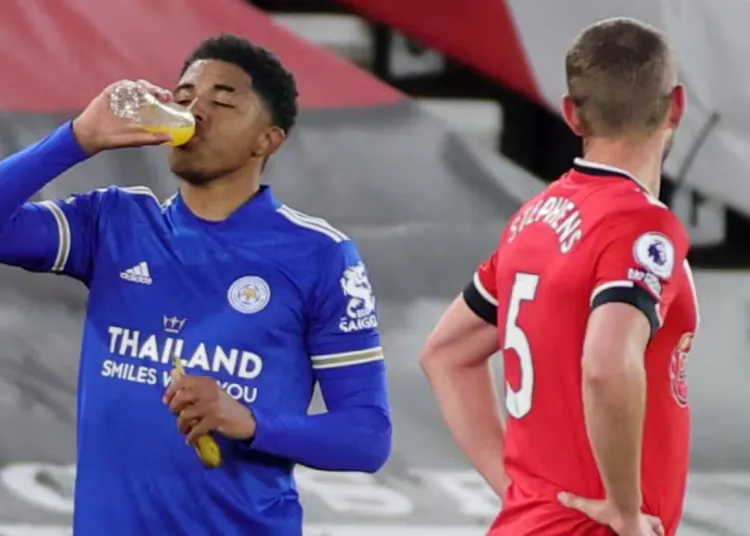
There are no time-outs in soccer, but in the thirteenth minute of Manchester City’s recent English Premier League match at Leeds United, a number of players ran to the sideline and had a bite to eat while their manager, Pep Guardiola, discussed with them how to wrest control of the game. The Leeds fans booed what they believed was an attempt to break up play and get illegal coaching. For Guardiola, one of history’s great managers, the fans’ behavior showed disgraceful intolerance: “It is a modern world, right? [You see] what is happening in the world today. Respect religion, diversity, that is the point.”
It was a testament to the newness and normalcy of Muslim players taking on sustenance at the end of Ramadan that both perspectives were possible. It is normal enough for Guardiola to have expected Leeds fans to recognize what was going on. But it’s new enough—and Guardiola’s gamesmanship has enough precedent—that Leeds fans, not specifically alerted to the short ritual breaking of fast, might indeed reasonably have been booing him.
Muslim players’ practice of getting some nutrition at nightfall during Ramadan in elite European soccer games has been going on informally for the better part of a decade, but only officially for the last few years. Where once they would see players like Neymar, the great Brazilian footballer, cross themselves and point to heaven to thank a Catholic God after scoring a goal, fans are now growing accustomed to seeing Muslim players like Mohammad Salah perform a sujood, kneeling and placing his forehead on the pitch, to thank Allah. With increasing numbers of non-Christian players from the continent and beyond joining rosters in Europe, different competitions across the continent have formalized their inclusion of Muslims by setting aside prescribed match time to take in food.
Traditionally, professional soccer has been dominated by South America and Europe. For the first century of organized Association Football, they shared the passion, the players, and the World Cup, while the latter held the purse strings. Over the past few decades, though—driven by the globalization of commerce and sport—soccer in Africa, America, Asia, and the Middle East has come of age. This change has shown up in three different ways: the ownership of soccer teams, the governance of the game, and the level of the players in different regions.
More recently, the balance of financial power has shifted in the world game. Indeed, Europeans no longer own many of their most storied club teams; Americans, Arabians, and others have picked them up as prize toys or as cash cows. The Glazer family has milked a billion dollars out of Manchester United since they bought it in June 2005. Just down the road, Manchester City was purchased, in 2008, by the Abu Dhabi United Group, and they have used the owner’s wealth to fund unprecedented success, although 115 charges of breaching financial rules are still pending, casting a shadow over an entire decade.
Arsenal, who just won the English Premier League for the first time in 22 years, are owned by Stan Kroenke, the American owner of the NFL’s Los Angeles Rams and the NBA’s Denver Nuggets but Arsenal’s Emirates stadium is named for the airline owned by Dubai. In the recent Champions League final that, essentially, crowns the best club team in the world, Arsenal played French Champions Paris St. Germain which was bought in 2011 by Qatar Sports Investments. QSI’s plan to curry favor in France and bring the Qatari royals reflected glory paid off first with the 2022 World Cup and more recently when PSG finally won the Champions League in 2025 and retained it in 2026. Germany does not allow foreign ownership, but money has spoken across the rest of the continent; more than twenty teams in Europe’s top leagues are owned by Americans, including a majority of the English Premier League’s twenty teams.
As with the Glazers’ acquisition, Americans tend to see these as business opportunities, whereas investors from the Arabian Peninsula, like the Qataris, are looking for prestige. Saudi Arabia (through its Public Investment Fund) bought Newcastle United of the Premier League and funded its run into the Champions League. More impressively, three of the best club teams in the world—Barcelona, Manchester City, and Real Madrid—have been sponsored by Qatar, the United Arab Emirates, and Dubai, respectively. Manchester City, the most successful English club team of the contemporary era, owes its success to its UAE ownership (who also own the Australian soccer champions). No longer does Europe own soccer.
That is important, because the game, always played across Africa and beyond, has become truly global on the playing field. No longer the sole purview of Christendom, soccer has peacefully and with little fanfare become a game shared between the world’s two and a half billion Christians and two billion Muslims. Club teams are owned by countries without an established church or millennia of Christian hegemony, and elite teams are increasingly populated by people of other faiths, Islam above all. As the premiums paid for player development have increased, clubs have been searching for and cultivating talent in an increasingly varied set of countries, notably in Africa.
Over the past few decades—driven by the globalization of commerce and sport—soccer in Africa, America, Asia, and the Middle East has come of age.
The first wave of players was roughly bookended by France’s two World Cup victories, in 1998 and 2018. For the first, the French media labeled the diverse team “Black-Blanc-Beur,” or roughly translated as “Black/White/Arab,” a play on the nickname for the country’s tricolor flag. Nine of the squad were immigrants, and players’ families came from mainland France, the Basque Country, Western Europe, and French overseas territories, as well as from North and West Africa. By the time France won again in 2018, 15 of the 23 squad members had African backgrounds, with seven Muslim players. In 2022, the French team beat Morocco in the semi-finals, but Morocco’s success in reaching that game marked a milestone: it was the first time an African, Arab, or Muslim country had reached that stage of the tournament.
No longer do Muslim or African players have to play for European countries to have success on the world stage. In the wake of Morocco’s exhilarating run in Qatar, a record number of majority-Muslim countries will be represented in the 2026 North American World Cup: Algeria, Saudi Arabia, Qatar, Jordan, Iraq, Bosnia and Herzegovina, Morocco, Egypt, Senegal, Tunisia, Turkiye, and Iran.
The explicit and practical welcome of Muslim players by footballing authorities—even in England, an explicitly Christian country—is lovely to see. Despite certain players, like Sam Morsy, the Egyptian captain of Ipswich Town, citing their “Muslim faith” in refusing to take part in the English Premier League’s LGBTQ inclusion events, the visible presence of Muslim players from different countries generally helps educate crowds about inclusion and understanding. Having Salah, the “King of Egypt,” at Liverpool FC has arguably done more to fight Islamophobia in that region than any other initiative. So many Muslim players are now present and happily accommodated in professional soccer that, during Ramadan, it became commonplace for games in Europe’s top leagues to pause for players to take refreshments at sundown.
Despite the warm welcome Muslim players have been receiving of late, there is a clear geographical and cultural dissonance between the excellence of (mostly African) Muslim players and the political machinations of Arabian oil heirs.
In the first ninety years of the World Cup, only one indisputably non-Catholic country has won the prized chalice, England in 1966, and no Muslim country ever hosted the World Cup Finals. In the 12 years between 2022 and 2034, though, three of the five tournaments will be hosted by Muslim countries. And, depending on the Saudi Arabian 2034 host committee, the World Cup may even see games in Mecca.
This sea change is the result of the increasing Qatari and Saudi influence on FIFA. The confederated and unaccountable nature of FIFA, along with voting rights for a number of poorer countries, means that vast infusions of cash, legal or illegal, can lead to support from executives, regardless of fairness or the wellbeing of their constituents. FIFA most recently disgraced itself when it “short-circuited its own rules and delivered the 2034 tournament to Saudi Arabia without competition,” as Tariq Panja put it in The New York Times. This follows a pattern. In 2010, Qatar and Russia bribed FIFA officials to receive the host privileges for World Cups 2018 and 2022. Officials voted for the tiny feudal petrostate despite the obvious logistical problems, like blazingly hot weather and the lack of a soccer culture (the country has about the same number of registered soccer players as Stamford, Connecticut).
In Asia, the Asian Football Confederation (whose members have been helped by the “unparalleled spending” of Saudi Arabia and Qatar) bewilderingly and belatedly changed its qualifying rules to favor the two countries who, unsurprisingly, qualified. While Saudi Arabia has often qualified for the finals, Qatar has never previously qualified, only taking part as the host nation in 2022. In that tournament, they performed worse than any previous host, losing all three games and appearing woefully out of their depth. They have qualified despite their egregiously poor showings in matches since 2022, losing to, among others, Lebanon and Palestine.
The corruption is thoroughgoing and easy to spot. The president of FIFA, Gianni Infantino, lived for free in a luxury villa in Qatar for the years leading up to the 2022 World Cup and, for years after, continued to have “unlimited access to a state-owned private jet,” according to Panja in 2025. Shamelessly, in April, FIFA even put out a book of “anecdote-based biography” from Infantino cataloguing the despots who have helped shape the rise to power of what Barney Ronay in the Guardian calls “this unremarkable Swiss lawyer.” Shortly after the Qatar World Cup, at a Bahrain convening of FIFA delegates, Infantino was joined on the 37-member FIFA council by Qatar Football Association president Sheikh Hamad bin Khalifa bin Ahmed Al Thani, whose cousin is the country’s emir, and Yasser Almisehal, president of the Saudi Arabian Football Federation.
When called to account for its corruption, as well as for criminalizing the LGBTQ+ community, treating women as second-class citizens, and building the stadiums using, as Drew Magary put it, “Moses-era slavery practices,” Qatar claimed it was being attacked because of Islamophobia. Though Saudi Arabia has a more robust infrastructure and will probably kill fewer migrant workers than the many thousands killed by Qatar to make the World Cup happen, the criticism of the state is the same—and it’s not a religious one. Both Qatar and Saudi Arabia happen to be Muslim states, but they win power and status through oil-fueled bribery, then use religious solidarity as a cover.
Over the past quarter century, soccer’s Christian monopoly has turned peacefully into a Christian-Muslim duopoly. On the field, that movement has been a testament to the shared love of football. But off the field, it has borne witness to a shared disgrace: the corruption of the beautiful game.