


A few years ago, my uncle was back down in Florida, gathering the bulk of Grand-Dad’s postage-stamp collection, and he got curious about whether there might be potential rare finds among the thousands of stamps in the albums and envelopes. What are the chances? We talked it out. Short answer, Uncle John? The Powerball odds are better.
Longer answer: the value in a stamp collection may reveal itself through the art, the graphics, and the celebration of human endeavor, through the recognition of histories and conflicts, places and people, at once familial and familiar, or very far off, lost to history, or too close for comfort. Stamps beckon the magnifying glass, but you never know what the lens may illuminate.
I saw Uncle John in New York not long after and he gave me the collection in a cardboard mailer postmarked Houston, Texas, where his brother Tom lives. It’s been a long time since I’ve seen Uncle Tom. I unpacked the box at my older sister’s dining room table that afternoon. Then, I set out to ballpark the book value, using the industry-standard Scott stamp catalogue, a hefty, floppy paperback resource on loan from the library.
The box mainly held Grand-Dad’s albums and binders, along with Uncle Tom’s collection of midcentury U.S. first-day covers, a sleeve of white envelopes loaded with world stamps, a smattering of international first-day covers, and crinkly cellophane envelopes with a hue of amber and a whiff of harsh memory. There was also a bit of philatelic ephemera, a 1973 postcard Uncle John sent to his parents while on honeymoon. And there was a note from Uncle Tom to Uncle John, saying this was most of the rest of the collection.
As I sifted through the contents and flipped through the albums, a small stack of identical postcards fell to the table and made me stop. The cards time-transported me to the late summer of 1981, my grandparents’ condominium in suburban New York (where I last saw the cards), and the events of the time. Now, years after the cards fell to my sister’s table, the madeleine moment continues to reverberate and remind me of the power of forgiveness and forbearance. The cards also prompted me to take a hard look at the events of that summer, how they have rippled through life, and how lucky I am to be alive at all to even tell this tale.
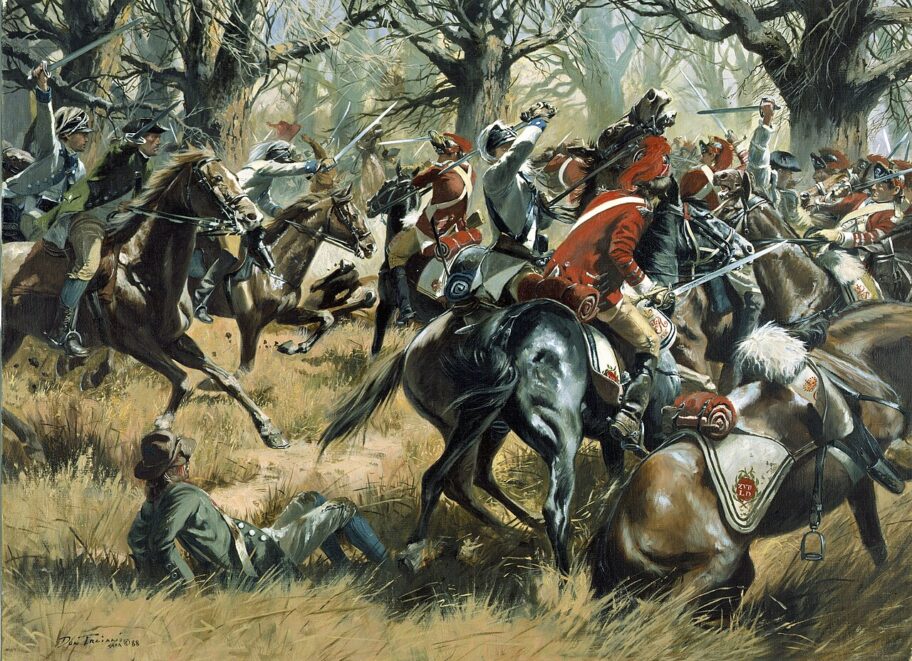
My personal drama should take nothing away from the history and importance of the postcard. The cream-hued card commemorates the January 1781 Battle of Cowpens, an engagement in the last year of the Revolutionary War that unfolded in a patch of South Carolina pastureland and was, according to the National Park Service, the turning point in the war in the South, setting off a chain of wartime events that led to the defeat of the British at Yorktown nine months later.
The 10-cent card was issued in January 1981 and, according to the Smithsonian National Postal Museum, features a painting by William Tylee Ranney showing the moment Continental colonel William Washington (distant cousin of George) is about to get killed but is saved by a sharpshooting soldier. The Cowpens card was part of an extensive commemoration of the bicentennial era that began in 1971, a year after the signing of the Postal Reorganization Act. That long-fought legislative mail-drop created the United States Postal Service and reframed postal priorities enumerated in the Constitution as a business-forward enterprise managed by the executive branch. The Constitution gives authority to Congress to establish “post offices and post roads” and left it at that. The PRA was passed following two outbreaks of Christmas-season postal gridlock in the 1960s and a postal-worker strike, among other factors that illuminated Congress’s chronic mismanagement when it came to operational control over mail delivery. Through rain, sleet, snow, and hail, through Reagan, Clinton, Bush, and Obama, the ensuing years after the passage of the PRA have been highlighted by a bumpy imbalance between the prerogatives of the competing executive and legislative branches.
In any event, while the Postal Service has descended into a swamp of politics and uncertainty, stamp collecting remains a fun and rewarding hobby.
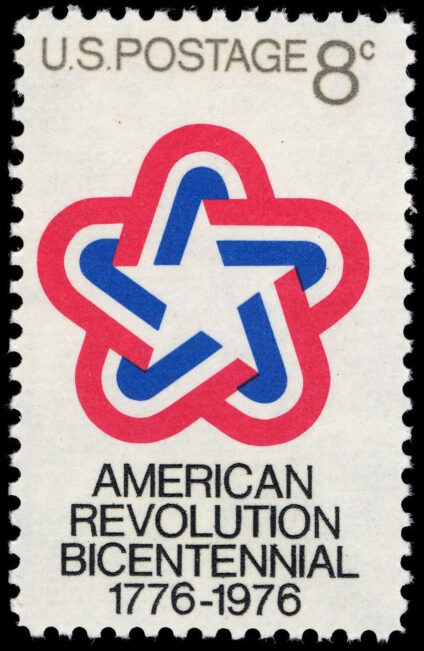
On July 4, 1971, the newly minted United States Postal Service issued a stamp that introduced Americans to the star-shaped logo for the 1976 commemoration, designed by famed graphic artist Bruce Blackburn. In 1983, the final stamp in the 12-year bicentennial philately blowout was issued, featuring an unfinished painting by Benjamin West of the 1783 signing of the Treaty of Paris. Scores of bicentennial stamps and postcards were issued over the years, including colonial-era flags, uniforms of the services, battles, key figures, plates of famous John Trumbull paintings, and stamps celebrating the printing press, freedom of religion, freedom of assembly, the contributions on the home front from wheelwrights and seamstresses, and more.
The philatelic offerings from the USPS for this year’s semiquincentennial are less ambitious but not insignificant. Maybe folks just aren’t quite feeling the milestone, what with all the divisiveness. But this year’s offering of commemorative stamps is diverse and inclusive and includes one set highlighting notable patriots like Cowpens general Nathanael Greene. The set emphasizes Indigenous contributions to the revolutionary cause, gives ample attention to Black people, and offers a stamp dedicated to Deborah Sampson, a combat hero who passed herself off as a man throughout the war. The emphasis on equity in the series also finds a postal tribute to Daniel Boone, his second: the fought-over frontiersman-slaver was previously honored in a 1968 stamp.
Designer Ralph Lauren, who has put his bipartisan pins in Hillary couture and the Melania line alike, curated a set of 13 stamps, anchored by a Lauren-designed knit flag and featuring iconic American items such as a baseball glove and a hamburger. Another set presents totemic items of the Revolutionary era, such as a powder horn and a wampum treaty belt. There was also a contest to decide America’s favorite stamp and the winning item, a 2018 Mr. Rogers stamp, is now available.
I missed the voting deadline last year but was pulling for the Cowpens card.
I was a happy grade-school member of the Young Collector’s Stamp Club in the 1970s, unconcerned about an American malaise afoot in Jimmy Carter’s America but deeply invested in filling up a stamp book in which the first country was Afghanistan. The club was an offering from General Mills Foods, where Young Collectors would order stamps from coupons on Cheerios boxes and other General Mills products. Back then, Grand-Dad would regularly off-load rafts of no-value stamps to me. He had also gifted me a red album that contained U.S. and world stamps from the 1870s to the 1950s.
My collection from the era is a colorful allotment mostly of sixties and seventies stamps ranging from a multinational array of Olympics series to Soviet Union and Soviet-bloc stamps with glorious images of battleships and warplanes, some seemingly held together by a collectively common paper stock if not an ideology. I collected stamps through the 1979 revolution in Iran and have a handful of Persian postal offerings from the Grand-Dad albums to go along with large and colorful pieces from the United Arab Emirates. Other faded favorites from Grand-Dad’s book include stamps from the former Free City of Danzig (now a city in Poland), the last of the Ottoman Empire stamps, colonial and post-colonial stamps from places like French Equatorial Guinea, a Jefferson Davis stamp from the Confederacy, and stamps depicting such infamous American luminaries as Robert E. Lee, D.W. Griffith, Henry Ford, and W.C. Fields.
If history is often the history of change through violence and disruption, then a consideration of history through a hobby focused on tiny pieces of paper, overwhelmingly with no cash value but nonetheless hefty with meaning, can bring measure, wonderment, a meditative hypnotic gaze over the pages. As a side benefit, I’ve found stamp collecting to be an especially salutary hobby for those with an unhealthy tendency to make a big deal out of small things. For example, I take great pleasure in pausing to admire a set of New Zealand moths rendered as stamps, while blasting the great Kiwi indie-rock band the Chills and thinking about how if I was going to be deported anywhere, please let it be Dunedin.
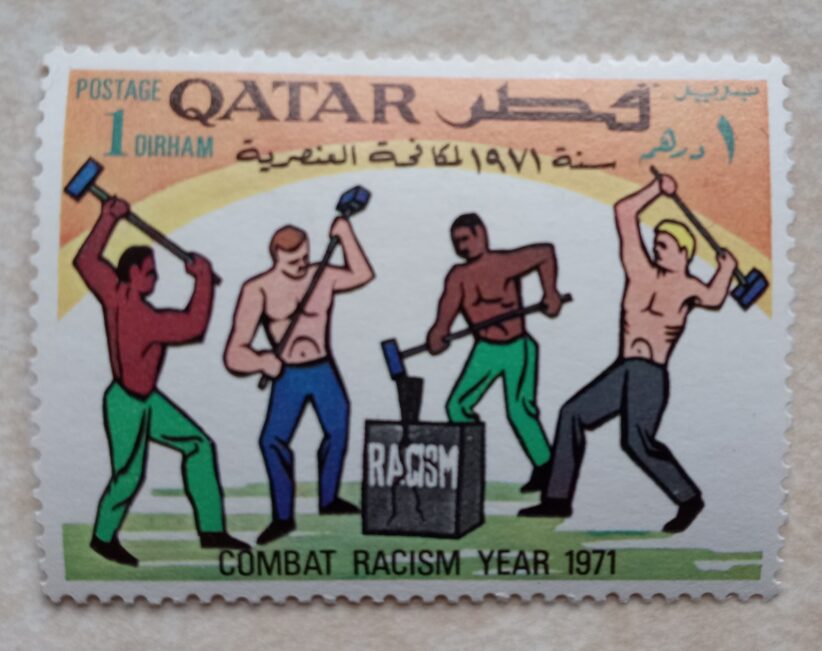
Lately I’ve been reexamining those stamps from the Emirates in consideration of the deep inflection of North American “values” or achievements being promoted: Dubai stamps feature native moonfish but also the first moon landing; there’s a very woke-ish Qatari stamp that recognized 1971 as “Combat Racism Year,” depicting four men—two brown, two white—together taking sledgehammers to a stone signifying racism. On a lighter note, I remember how as a kid I used to say “O, man!” at the sight of those Omani stamps that featured strangely patterned okapis and rangey hyenas.
My stamp collection sat in storage for many years, and when I finally retrieved it earlier in the decade and started to consider its utility and value in art, memoir, commerce, and my retirement plans, I pretty quickly realized the value of having no attachment to any of that whatsoever. I went to a couple of stamp club meetings at the local library, contacted a stamp dealer for guidance, and was totally ghosted in email attempts to connect with knowledgeable stamp collector Warren Buffett.
I ran Grand-Dad’s collection through the Scott’s book and put aside a couple of nineteenth-century Washington and Franklin stamps for possible professional appraisal. The pros will get down to the micrometer-determined minutiae of the perforations, the overlaid grille patterns (added to prevent or dissuade counterfeiting), any minor design changes from one year to the next, or peculiarities. Those can be a big deal. If and when I get the appraisal, I’ll make sure to offset the odds of hitting it big with a separate pile of scratch-off lottery tickets.
The value in Grand-Dad’s collection lies elsewhere, and according to the Scott catalogue, the combined value of the otherwise invaluable four 1981 Cowpens postcards is $1.
I was exiled to my mom’s parents’ condo for much of the summer of that year.
I was a verbally disruptive, annoyingly curious, and preternaturally ontic 13-year-old pubescent with two sisters and a nascent obsession with the music of Jimi Hendrix and the Ramones. There was no way I could be left at home with my own diversions while Mom worked at the pre-K day camp. Mom was concerned I would burn down the house, or at least the shed. I was concerned about the highly awkward thoughts I was having about older women’s boobs. It was not a good time for mother and son. As a related matter, my parents were separated, which was fine by me.
Uncle John and his family lived in the same condo complex as my grandparents, and he had served as a Marine in Vietnam. He owned a pharmacy near the water where I’d go fishing or play video games at the arcade across Main Street from the drugstore. Some days, I’d fish and catch nothing, or do some make-work for Uncle John in the parking lot behind his business, sucking in the asphalt and fish-fry fumes of a hot and steamy August, or I’d hit him up for more quarters for the arcade, at which point he’d get annoyed and say, “Why don’t you go fishing, Tommy.”
Other days, I’d stay at the condo and watch the Yankees game with Grand-Dad or play seven-card rummy in the cozy kitchen with cackling Gram and the watery instant coffee that gave way to the watery domestic beer around sunset.
One afternoon, a few days before my fourteenth birthday, Uncle John had to leave the pharmacy to drive me home. Something had happened to Mom at work and she was in the hospital. My uncle grabbed me from my grandparents’ condo. I recall the Cowpens cards were in a candy dish, and he said to leave the fishing poles, we’d get them another time.
My mother had collapsed with a cerebral aneurysm at the day camp and was put on life support. I learned decades later that birth control pills were a causal factor. Mom had designs on a teaching degree, smoked Camel no-filters, and had high blood pressure in her early thirties. In the Cosmo magazine–inflected year after my parents’ separation, my mother was taking karate classes, toking a little weed, and burning incense next to her copy of Linda Goodman’s Sun Signs in the den formerly occupied by my snoring, cheating, abusive father.
I remember in the Bicentennial year, before they were separated, when Mom took me and my sisters to a student production of 1776 at the local, walkable community college. The old man stayed behind in the Archie Bunker chair, home alone, to watch the big ships in New York Harbor on a Sears television screen, while I bounded the steps to the theater in a tri-cornered hat, strutting a bicentennial patriotism befitting any respectable suburban Froot Loop of the Scooby-Doo seventies. My father seemed a smaller man in his surliness when we got home from the play. Berobed and brooding in the chair, I recall some sort of argument, or someone was in trouble, my memory of ebullience as always shot through with my father’s craving for sabotage and drama.
The following year, my father’s mother died, and two years after that, his father died. I found Grandpa dead in his bedroom with blood trickling out his nose, a blessing-curse of sorts that, while traumatizing, did provide the severe clarity sufficient to eliminate any future magical thinking around death on my part. Then came 1981, and we buried Mom on September 11, after she was taken off life support. She was 34 years old. The following June 6, Grand-Dad died at the condo with his stamps and unfinished crossword puzzles. Then the surprise twist that leaves the audience cold: my father’s younger sister died just a couple of months after Grand-Dad.
The family was now as broken as broken can be, and would continue to break. My father was back in the house, and I battled trauma-induced paralysis during one very jarring period in my bedroom soon after Mom died; I wanted to die but had to figure out a way to go on. In the absence of therapy or a useful remaining parent, I didn’t know what to do, so I tried to vanquish all memories of my mother, effectively killing her all over again, in order that her memory would not haunt me. I also determined, disembodied and shaking under the blankets, that if I lived until the age my grandfather was when he died, 56, all this would be over, or I’d be dead. I then set a resiliency-clock-timer ahead more than 40 years and somehow wormholed my way back into my corporeal form, with a rewired fight-or-flight response mechanism that, while brutally if abrasively effective over the years, came with a price.
I regained a sense of wonderment, however maladjusted, at the thought of all the time that would pass that my mother would still be dead, and in the bargain all of my empathy went out the window, as I adopted a view on life as an endurance test and reset the fight-or-flight mechanism to all fight, all the time. The innocent and engaged wonderment of that child enthralled by tiny pieces of paper and the various potentials they brought to light—in visions of travel, academics, career, the future—was gone. Closing in on 60, I am at an uneasy peace with all of this. I take solace that while time can heal some but not all wounds, only time can heal some wounds.
A popular formulation these days is that when families break under the strain of trauma, they will continue to break until an intervening force steps in and says, “Enough, already.” Maybe a guiding light emerges, the family member who seizes initiative, finds and offers the Jesus-as-savior assistance to all broken members. That’s one success story I have heard from a friend in the mental health field.
The intervening force can take many forms, or it may never reveal itself. Or, perhaps, one day a set of cream-colored USPS-issued postcards falls from a pile, and it feels like the night in 2008 that Venus dripped eternity against a backlit full moon on the shoreline the week after my father died in my arms, and he and Grandpa showed up, apparently, placing wraithlike hands on my shoulder to say, “It’ll be okay.”
Or, that time I was working at Guitar World magazine in the nineties and got the call at work that Gram had died in Houston and my first, unforced thought was sad but not unhopeful: “Oh, I guess it’ll be a while before I see Grandma again.”
Not long after Uncle John gave me the stamp collection, my younger sister called to tell me she had found an apartment after a tough search in a tight market and that it was in the condo complex where our mom’s parents and Uncle John had lived. The landlord was a nice guy, accommodating to her needs, she said, adding that she believed the rental was close to the condos our mom’s family once owned. She was eight in 1981, and has no memories of Mom but sharp memories of our shared surroundings that are fuzzier for me to dial up.
I visited her at the new place on a Sunday soon after and wore the whites. The white clothing of purity and sanctification, the spiritual shield. I thought of St. John the Baptist, that when I come marching through the condo complex, saints akimbo, don’t you lose your spiritual head over a coincidence that may nevertheless resonate with tempting themes of resurrection, grace and peace.
For a housewarming gift, I brought my sister one of the four Cowpens postcards and magneted it to her refrigerator. I told her of the cards falling to the table the year previous and my last, 1981 memory of them.
I was relieved, very relieved in fact, that while my sister’s new place had the same layout as our grandparents’, it was not the same condo as theirs. That it was nearby at all had the capacity to test not so much my faith but my lack thereof. My determination that it wasn’t our grandparents’ place was based on a recollection of the landscaping and layout of the complex and where the condo was located in relation to Uncle John’s.
In the months that followed, I visited on a number of occasions, my sister and I played cards with friends, had dinners, helped each other out with errands, relaxed on the front patio, shared and compared the old family stories, filled in some blanks, planned for visits with two of my nephews, watched proudly as the third nephew went off to military service, had a great family Thanksgiving where I insisted on playing the Chills all night and thought about how I had first seen the video for their iconic “Pink Frost” in 1986, by which point I had kicked off a lifelong drinking problem and was pretty much a teenage sociopath. “What can I do if she dies,” Martin Phillipps sings. As I have come to understand its intention, the song is about the annihilation of the planet via thermonuclear holocaust. But you’d never know it.
During these visits I would meditate on this strange, timely Cowpens coincidence and the years of distance now bridged between myself and my sister—her struggles and her suffering, her strength in the face of murder-grade stress. There were many years I thought I’d never see her again, that while she might very well be dead, she would never be “dead to me,” and now here we were, hanging out on the patio as friends again.
I saw Uncle John about a year ago at the diner and, among other topics, we marveled at this family journey to a place of healing, even though everyone’s much older now and, in varying ways, falling apart. Soon after, my uncle texted me from Florida and included a photo of an old bill from the condos with Grand-Dad’s address. He asked if I knew my sister’s address. I experienced a discomfiting seep of bilious defiance against any further coincidence while urgently scrolling for the text my sister had sent when she moved to the condo that contained her address.
In the year that has since passed, those four Cowpens postcards continue to flutter across an eternity marked by a shared family trauma now transposed, in my case at least, to a measured joy, to an uneasy acceptance, to a soothing and deeply felt thought that yes, in life sometimes you can get a do-over.
The Cowpens card I gifted my sister is still on the fridge at the condo, and this year she planted a rose bush, prominently so, in the garden to honor our mother. Irene loved roses, Bette Midler, and “The Rose.” The condo visits are altogether more holy these days, where Gram’s ghostly cackle at the kitchen table now greets me on arrival and an echo of Nick Lowe’s 1976 power-pop potsticker, “So It Goes” provides a soothing-enough mantra to explain how it came to be that my sister, as it turns out, does live in my grandparents’ old condo. When the light is right around sundown, I watch as Gram points at the refrigerator door and asks:
“What are the chances?”