


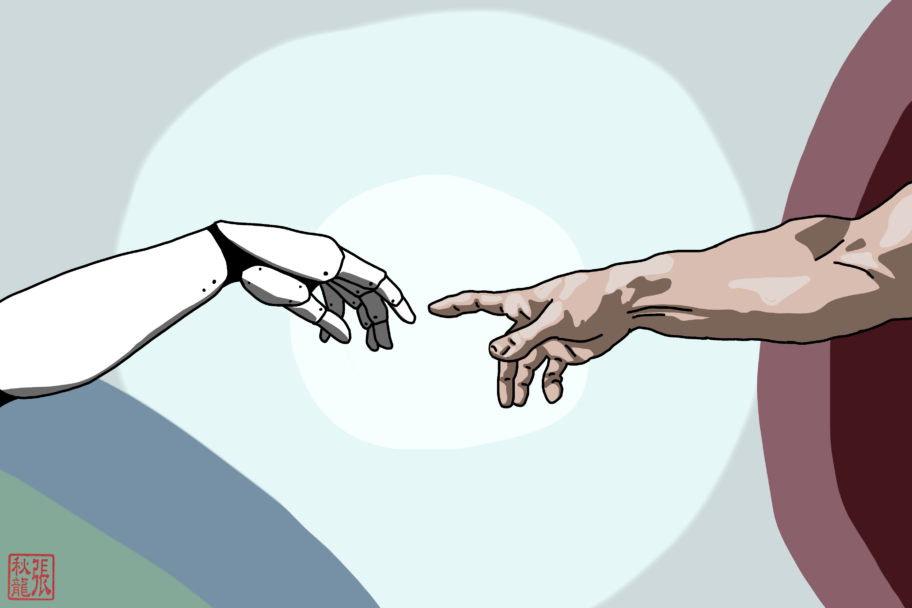
In 2024, OpenAI CEO Sam Altman told a room of developers in London that he does not pray for God to be on his side, but instead prays to be on God’s side, and that working on frontier artificial intelligence feels like “being on the side of the angels.” Other figures in the field have been more explicit. Arthur Mensch, CEO of Mistral AI, has stated that AI is “about creating God.” Engineers have described their work as “creating God” or becoming gods themselves, and technology executives have characterized artificial general intelligence as a God-making project. In 2015, a former Google engineer founded an AI-worshipping church and registered it with the IRS. These statements and actions are often dismissed as metaphor, insanity, or Silicon Valley excess, but they should instead be read as the latest episodes in a rich religious and spiritual history of AI.
Artificial intelligence is not merely a technological undertaking. It is the latest expression of a longstanding Western religious imagination, one oriented toward transcendence of the body, escape from mortality, and salvation through the perfection of the mind. From the mid-nineteenth-century origins of binary mathematics, through the 1956 Dartmouth Conference, and into today’s AGI race, the field has been shaped by goals and fantasies that far exceed its utilitarian value. AI did not develop primarily as a problem-solving tool. It took shape within a longer Western preoccupation with separating mind from body and overcoming the constraints of embodied finitude. What began as a spiritually inflected pursuit has now, in an age of unprecedented computational power and institutional authority, taken on the architecture of religion, complete with prophecy, eschatology, priesthood, and heresy.
The pattern is visible in the field’s core vocabulary, which inherits structures of fall and redemption, apocalypse and transformation, eternal life. Transcendence, liberation, immortality, singularity, the uploading of consciousness, terms often used by the famed AI futurist Ray Kurzweil—these are not technical terms borrowed for color. They are religious structures that organize how the field speaks about itself. This is not an assertion about this or that specific researcher—it is a provable historical genealogy. Religious imaginings, as Michael Benedikt put it in his influential anthology on cyberspace, are so often fueled by “the resentment we feel for our bodies’ clodishness, limitations, and final treachery, their mortality.” He wrote that cyberspace is the dimension where “we would enjoy triumphs without risks and eat of the Tree and not be punished.” That same resentful wish runs through AI’s foundational figures and documents. The divine would no longer descend to save us. We would build it ourselves.
At the field’s origins, the religious framing was explicit. When he was seventeen, George Boole—an intensely religious man whose binary algebra would come to lay the foundational code for all computers—had what he later described as “a mystical experience.” He understood his discoveries in mathematics as a divine call that he believed would simultaneously reveal “the mind of God.” His binary algebra, in which the number one symbolized the universal class, reflected his Unitarian belief in the oneness of the universe. When Boole met Charles Babbage in 1862 at the Great Exhibition, the two discussed the possibility of a “thinking machine” that would combine Babbage’s mechanical calculation with Boole’s logical operations. Babbage’s Ninth Bridgewater Treatise (1837) was an explicitly theological work arguing that miracles were not deviations from natural law, but rather the fulfillment of more extensive laws programmed into the structure of the universe by its divine maker. The thinking machine, from its earliest conception, was imagined as an instrument for revealing the divine part of humanity and rescuing it from its mortal prison.
Alan Turing, widely regarded as the father of artificial intelligence, addressed in a 1950 paper what he called the “theological objection” to thinking machines. He did not reject it. He proposed instead that humans designing machines were “instruments of His will providing mansions for the souls He creates,” and suggested that those troubled by the implications might find consolation in “the transmigration of souls”—the transfer of souls from human bodies into machines. His foundational paper in the field is arguably a theological meditation, as is much of his personal writing from that period. Shortly before his death in 1954, Turing sent friends a series of postcards he titled “Messages from the Unseen World.” One reads, “The Universe is the Interior of the Light Cone of the Creation.” Another: “Science is a Differential Equation, Religion is a Boundary Condition.” A third is a verse with echoes of Kabbalistic meditations: “Hyperboloids of wondrous Light, / Rolling for age through Space and Time; / Harbour those waves which somehow might / Play out God’s holy pantomime.” He took his own life by eating a cyanide-laced apple. The Edenic metaphor is hard to miss.
Transcendence, liberation, immortality, singularity, the uploading of consciousness—these are religious structures that organize how the field talks about itself.
Another forefather, Norbert Wiener, the founder of cybernetics, titled his 1964 book God and Golem, Inc. The book originated as a series of lectures Wiener delivered at Yale on the relationship between religion and science, an indication that his theological framing was not ornament but the actual frame of his late thinking. The Golem, a creature from Jewish mysticism animated by sacred text, was his central metaphor for artificial intelligence. He compared the traditional theological view of the sin of sorcery to what “attaches now in many minds to the speculations of modern cybernetics,” warning that the sin would lie in “using the magic of modern automatization to further personal profit or let loose the apocalyptic terrors of nuclear warfare.” For Wiener, creating intelligence was never a purely technical act. It carried the same moral and spiritual weight as ancient attempts to animate clay.
Even among the field’s avowedly secular pioneers, the theology may disappear, but the structure persists. Marvin Minsky, who co-founded the MIT AI Lab and dismissed the soul as a refuge for lazy thinkers, proclaimed that humans would one day build “machine minds and bodies efficient enough that individuals could transfer into them when their natural bodies grew decrepit through age or disease.” He posed the question whether we should “roboticize ourselves and stop dying.” He described the human brain as a “meat machine” and the body as a “teleoperator for the brain.” Death, in his framing, was not a natural limit but an engineering problem that intelligence could solve with sufficient perfection. The vocabulary of perfection, transfer, and the engineered dissolution of mortality is recognizably religious in shape, even when the faith is gone.
Herbert Simon, Nobel laureate, co-author of the seminal computer program Logic Theorist, and central architect of symbolic AI, claimed himself a devout atheist in all respects. Yet his only dabble into fiction (that we know of) is a short story, “The Apple,” that follows a protagonist raised in a castle whose only book is the Bible, and whose understanding of the world comes through abstract murals rather than experience. The story turns on the protagonist’s progressive interpretation of the Garden of Eden myth—Eve’s temptation, the Tree of Knowledge, the fall. Simon framed it as an illustration of the decision-making model from his 1956 paper “Rational Choice and the Structure of the Environment.” A foundational figure of AI chose, in his only foray into fiction, to render his theory of cognition through Genesis. This curious decision perhaps clarifies the cultural waters he was swimming in.
Another name worth mentioning is Edward Fredkin, who became convinced that AI was the only salvation for mankind, the means by which rational intelligence might prevail over human limitation. He bought a Caribbean island and fortified it for survival, taught courses at MIT and Stanford on “saving the world,” and developed what he called “digital physics”—the claim that the universe itself is a computer, and our world is God’s simulation. “God’s holy pantomime.” For Fredkin, AI was not an invention. It was the revelation of a preexisting divine order, written in code rather than scripture.
Today, the modern power of AI has brought the field’s inherited architecture into open view. Ilya Sutskever, then OpenAI’s chief scientist, reportedly led employees in chants of “Feel the AGI!” and burned an effigy of “unaligned” AI at a company retreat. Much of the field’s safety discourse is structured by Eliezer Yudkowsky’s framework, which treats superintelligent AI as a kind of Pascal’s Wager for the twenty-first century: because a future AI might wipe out humanity, every present moral decision must be made in its shadow, and even tiny probabilities of extinction outweigh present harms. “Roko’s Basilisk,” an experiment that is an offshoot of rationalist thought, posits a future AI god who could punish or torture simulated versions of anyone who failed to help bring it into existence. Yudkowsky suppressed mention of the Basilisk on his community forum LessWrong—not because he thought it was false, but because he feared it might be true. The same framework now shapes the safety departments of the largest AI labs.
Its central catechism—that AGI is coming, that it will either save us or destroy us, and that nothing else matters until then—has been compiled most fully not in a treatise but in a 660,000-word work of Harry Potter fan fiction Yudkowsky wrote between 2010 and 2015. The theological structure is completing itself: a coming judgment, eternal reward or eternal punishment, and the imperative to evangelize before it is too late.
In truth, AI did not develop merely, or even primarily, as a problem-solving tool or a model of cognition. It took shape within a redemptive imagination, a tradition that treats human discomfort with embodiment, finitude, and contingency as a problem to be solved by the perfection of mind. Early architects of computing and AI framed machine intelligence as a means of preserving, perfecting, or extending the human mind beyond the limits of the body. Contemporary visions of mind-uploading and post-biological intelligence continue this trajectory, promising a form of secular immortality that is functionally analogous to mystical union with the divine. The vision shaping AI is not only smarter machines, but a transformed humanity freed from contingency, vulnerability, and death.
What we are left with is a modern religion—or a sociological movement with religious architecture—that mirrors Christianity’s historical role by claiming divine inspiration and universal solution. Its foundational theology positions human experience and capacity as fundamentally flawed. Its adherents view physical and mental limitation as a condition to be liberated from. Its consequences, for those who are harmed and whose objections are dismissed, are very real. Its benefits were never the animating force behind it.
Contemporary AI debates remain structured by this salvific framework. Both accelerationist optimism and apocalyptic pessimism treat superintelligence as inevitable and quasi-transcendent, and both sideline concrete present harms on their road to extreme outcomes. This is why AI conversations feel like no other policy debate, why political hearings on regulation echo theological arguments about consciousness and human destiny. It is the consequence of a technology shaped not toward assisting us but toward replicating us, and even replacing us, in pursuit of an evolutionary culmination (and, as Michael Heim put it, the “all-at-onceness of divine knowledge”). Those peddling the utopian and doomsday extremes are also fiercely motivated by financial stakes. They now control critical infrastructure and are deploying systems that are largely unrequested, poorly governed, and deliberately designed to replace human processes—systems that affect billions of people.
Perhaps in this light, we can answer the hardest questions: why are we building this, and who really benefits?
Understanding AI as carrying a religious inheritance reveals the founding premise that the human condition is fundamentally limited and thus a defect. That our bodies are too slow, our minds too inefficient, our mortality an engineering problem to be solved. But our physical, embodied experience is not a flaw to be corrected. It is true intelligence, the source of our wisdom. Not a lesser version of it, not an obstacle to it, but the thing itself. As long as we accept the framework of AI’s architects, defining intelligence as processing speed, and progress as the transcendence of human limitation, we will continue to outsource our power to systems shaped by a tradition that treated humanness as the problem. Until we redefine intelligence, success, and societal progress, we cannot think freely about AI, and we will continue to surrender our imperfect capacities that make us perfectly human.