


Jewish people have been part of Australia since its very beginning. When the First Fleet arrived in 1788, carrying convicts from England, among the 1,400 prisoners were at least six Jews. From that moment on, Jewish life has been woven into the fabric of this country. My own ancestors came here during the Ballarat goldrush in the 1860s, chasing a better future. Decades later, my grandfather arrived as the sole survivor of his family, escaping the horrors of the Holocaust.
For me, being an Australian Jew has long felt like winning the lottery. I was born at the right time, in the right place, where I could embrace both my Australian and Jewish identities without conflict. I went to a Jewish day school, worked in political offices, and wrote regularly for several newspapers about what it means to be Jewish in Australia.
The way I saw it, Jews have succeeded here without hiding who we are. Our religion was never historically seen as a barrier to opportunity. Jewish Australians have held some of the highest positions in government, business, philanthropy, and law. I have always been proud of that balance, vibrant Jewish communities thriving alongside a country that, until recently, made room for us. We felt we belonged.
Growing up, antisemitism was rarely part of my experience. Such incidents, on the occasions they happened, were seen as unfortunate but infrequent. Like many Aussie Jews, I believed this country had moved beyond such hatred.
That belief shattered after October 7, when antisemitism began to rise here. Over the past two years, my community has repeatedly said that we no longer feel safe. Synagogues have been targeted, Jewish people verbally assaulted, and businesses boycotted. Threats have proliferated online and in person. Jewish creatives have been doxxed, Jewish houses have been sprayed with hateful graffiti. Many Jewish events now hide their locations to avoid security threats.
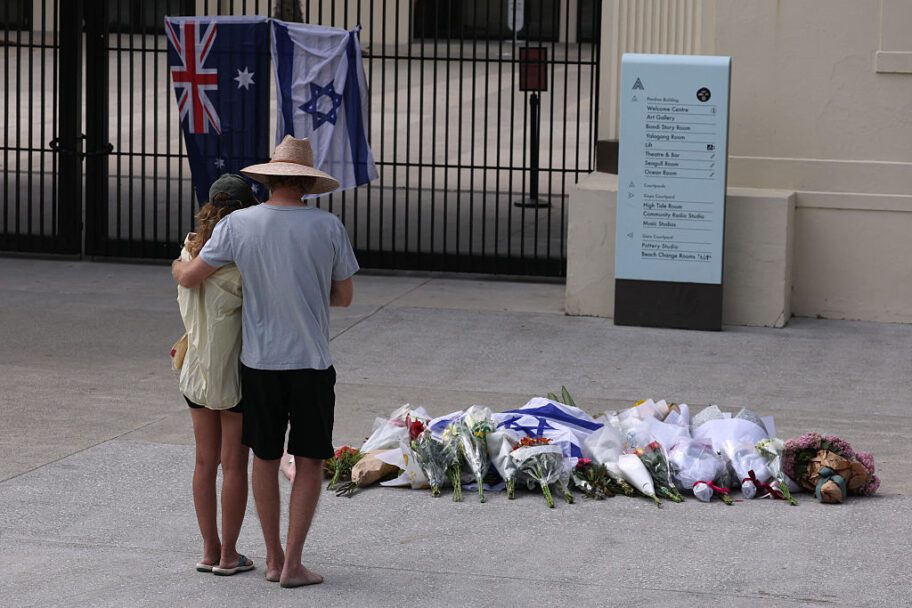
It’s almost unimaginable that fifteen people, amongst them a rabbi, could be killed while celebrating Hanukkah, in broad daylight, on Bondi Beach, one of the country’s most iconic beaches.
Australia’s Jewish community is small and closely connected, numbering around 120,000 people amongst a broader population of 27 million. We account for less than 1 percent of Australia’s population, so when tragedy strikes, it feels very close to home.
Most of us are not looking for special treatment. We are focused on our ordinary lives like work, school runs, cooking dinner, and paying bills.
There is a growing sense of injustice in how different my daily life feels compared to the lives of my non-Jewish friends and colleagues. My synagogue is guarded by armed security and secured with air-locked doors. My children’s Jewish schools look like fortified compounds, complete with bollards, tall fences, and layers of surveillance. No other religious or cultural group in Australia is expected to live this way. It feels profoundly wrong that this level of protection has become normal and that the cost of practicing Judaism is constant vigilance and physical barriers.
When I try to explain this reality to other Australians, I am often met with disbelief. Some express sympathy, but others doubt, as if suggesting we might be exaggerating the risk. The murder of Jews celebrating Hanukkah at Bondi Beach makes one thing clear: our precautions were not paranoia. They have been necessary.
For me, being an Australian Jew has long felt like winning the lottery. I was born at the right time, in the right place, where I could embrace both my Australian and Jewish identities without conflict.
Since October 7, I have been forced to ask questions I never thought I’d need to ask about my future here. I have always loved living in Australia. I am proud to be Australian. But if Jewish life can only continue behind fences and armed guards, if Jewish gatherings cannot be safely held in public, I am no longer sure this is the right place to raise my children.
I know most Australians are decent and many will be horrified by what has happened. But Jewish history teaches us to pay close attention at moments like this. Jews have often described ourselves as the canary in the coal mine. When antisemitism becomes normalized and violent, it rarely stays isolated. It signals a deeper fracture in society. History shows this kind of hatred rarely targets Jews alone.
Within the Jewish community, there is a growing feeling that the Australian government has not taken this antisemitism crisis seriously enough. A country where Jewish life can only exist under armed protection is not a healthy or functioning democracy.
For most of my life, I assumed, without really questioning it, that Australia was one of the safest places in the world to raise Jewish children. After last night, that assumption feels deeply shaken.