


Before I talk about Paul Gutjahr’s Faith in Space: American Religious Belief in Extraterrestrial Life (Princeton University Press, 2026) and the last volume of Jacques Vallee’s private journals, Forbidden Science 7: Final Report, The Journals of Jacques Vallee, 2020-2025 (Anomalist Books, 2026), I need to talk about the impossible.
In the last year, the national controversy about the reality of UFOs has been heating up, from the halls of Congress to the labs of Stanford to Hollywood. We are asking, in novel ways, all the fundamental questions about the significance of religion and the historical method itself. By the latter, I mean the reduction and explanation of what we know to human history, to what “actually” happened, which, or so it is assumed, is what physically happened (which we, of course, define with our physics).
I wish to call history into serious question, at least in terms of any adequacy. I wish to ask what the historical method blinds us to, what it does not allow us to see, much less to ask and pursue—to quest. To do this, I wish to hold up science fiction as a source of deep creativity and what I call the impossible (which is not impossible at all but is made to seem so by our assumptions—basically, what we cannot see). Science fiction was once the realm of religion. We are moving beyond that, after that. This is how we do this thing—through what we now call art and literature.
I am not saying what you probably think I am saying.
Let me put what I am saying in terms of the art of the impossible. In the opening sequence of the four episodes of the television series Beyond: UFOs and the Unknown (2024), there is this image of a beneficent female angel. Behind the image of the angel, we soon see a sinister-looking (male) alien, propping her up from behind. There is nothing to suggest that the alien is bad (or male). One just assumes that this is so. He looks wrinkly and worn. The message is that religious entities are not what they seem to be, at all.
Here is how I would put our situation. Religion is art that does not know it is art. Art is religion that does not know it is religion. Both are about special effects. It is time now to move beyond both, after both.
I am not proposing the popular model in which humanity’s earlier religious experiences are misperceived encounters with ancient astronauts, in which religious phenomena are really alien phenomena. I am orbiting around a different impossibility: that our religious experiences themselves are tricking us by their very nature and intent, and that this trick is very much a part of reality. I am also suggesting that there is something fundamentally “extraterrestrial” or “nonhuman” about the phenomenon. I know that is ambiguous.
If you want to be negative about it (and I do not), there is something “deceptive” going on in many an anomalous experience. If you want to be more positive about it (and I do), there is something “camouflaging” itself in many an anomalous experience.
I wish to call history into serious question, at least in terms of any adequacy.
I often speak of the UFO phenomenon as a Cold War narrative, or “invasion mythology.” I imagine that those phrases seem to imply, for most, a certain historical suspicion. That is certainly true enough. But I also intend a particular weird affirmation behind it all. I do not think this is only about the Cold War, after all. I think it is much more, or More (that is William James). I want to write of both, then, mostly because I think both the severe negation and the wild affirmation are reflective of what is actually going on.
I am often asked what ties all the modern experiencers of the extraterrestrial together. I do not hesitate to answer the question: ontological shock. Such a shock is absolute surprise, the utter WTF quality of the real, of which the experiencer in question had not a clue before the event. It is all very familiar to the historian of religions, though. The history of religions is one ontological shock after another.
Trauma and terror are sometimes the result of such a shock. Awe and transformation also sometimes follow. If the reader is not in shock, that is likely because the reader is reducing this all to some acceptable worldview. Sometimes that reduction is religious, as we see, for example, sometimes in Washington, D.C.—UFOs are “demons,” you know. Sometimes it is scientific—UFOs are psychological projections, illusions, hallucinations, or worse. Neither really works when one gets into the actual data and literatures, that is, when one knows what one is talking about. I roll my eyes a lot, at both the conservative religious and so-called scientific responses. Frankly, these two responses are ill-informed. I want to say they are stupid.
Ontological shock is absolute surprise, the utter WTF quality of the real, of which the experiencer in question had not a clue before the event.
The two books under review here, Paul Gutjahr’s Faith in Space: American Religious Belief in Extraterrestrial Life and the last volume of Jacques Vallee’s private journals, Forbidden Science 7: Final Report, The Journals of Jacques Vallee, 2020-2025, are not ill-informed, and so they do not participate in this reduction and normalization. They do, of course, engage historical context and the sciences. The physicality of the phenomenon, from the subtle energies and sexualities of morphing bodies to the radar of the fighter jets, is “bone-deep,” to use an apt phrase of Gutjahr’s.
As for the journals of Vallee, a computer scientist who is easily the world’s greatest living authority on the UFO, I consider all seven of them to be the gold standard of the ufological literature. These 3,500 pages are where I tell people to go if they seriously want to think with the experiencers and researchers. Vallee writes about pretty much everyone in this field, including people he probably should not have (and I say that with a knowing smile). There are notes, too, and citations, rabbit holes within rabbit holes. Occasionally, moreover, Vallee lets out what he himself is thinking at that moment—the door opens wide.
Vallee’s unique combination of the sciences and the humanities, of metamaterials and esoteric literature, is bracing and singular, as far as I can tell. The only theorists to follow in his lineage of whom I am aware are his French colleague, Bertrand Méheust, and the writer from whom they both draw, Aimé Michel. In my own writing, I once featured all three of them, but particularly Vallee and Méheust, as “authors of the impossible.” Today, thankfully, there are others pursuing similar method-breaking quests, people like Diana Pasulka and Aaron French in religious studies, Hussein Ali Agrama and Diana Espírito Santo in anthropology, and Jonathan Kendall in medicine. I could go on and on. The door has been opened wide.
It was Jacques Vallee who did more than anyone to open that door, particularly in the English language. The profound sense one gets from the Forbidden Science journals is that the intellectual quest is reminiscent of Faust’s struggle—that is, it is about a form of knowledge that is constantly and consistently demonized in Western society. This gnosis is from the Devil himself. It does not surprise me that Jacques has encouraged me on many an occasion to study the history and theology of the Devil in English and French. It also does not surprise me that it was Goethe, in his play Faust, who coined the word “superhuman” (Übermensch). The superhuman had nothing to do with twentieth-century German nationalism. That is just more bashing of Faust again, more demon-talk.
Jacques Vallee literally began our archival project at Rice University with the gift of his own files and correspondence, which are currently on moratorium, at his own request. A pioneering expert on AI who worked in classified contexts for years for the U.S. government through the entrepreneur Robert Bigelow, Vallee began the archival collection at Rice University—just think about that.
Vallee explains, particularly in the last two volumes of his journals, from 2010 to 2025, why he thought of an archival collection in the first place: to get around the classification schemes and the endless secrecy dead ends of researching the UFO phenomenon. He was deeply disturbed, in fact, with how twelve years of real research appeared to be wasted. He wanted to make research truly public, democratic, and intergenerational, and not engage in yet another act of classified secrecy.
As one of the curators of the archives that Vallee helped conceive, I profoundly admire Jacques Vallee, whom I know especially well. I also deeply admire Paul Gutjahr, whom I do not know at all. They belong together. The role of the history of religions is major in these two books. Indeed, it is the very focus of the Gutjahr tome and not far away from the final journal volume of Vallee, whose files remind this questing intellectual of the Gutjahr book, particularly in their fearless exposure of fraud and brave analysis of the esoteric dimensions of the phenomenon, wherever such research goes.
The basic point of Gutjahr is that the history of American religions, really the Western history of religions, has been a history of interaction with the larger cosmos. Gutjahr will in fact describe religion as “intergalactically minded belief systems,” and show his readers that there is a “deep reservoir of thinking about extraterrestrial life” in the combinative history of American religions. Think of the Swedish scientist and seer Emanuel Swedenborg, his main American follower and trance-writer Andrew Jackson Davis, Spiritualism, Mormonism, Seventh-day Adventism, Theosophy, Scientology, the Moorish Temple, the Nation of Islam, the Nuwaubian Nation of Moors, Heaven’s Gate, and the contemporary UFO phenomenon, with which the book begins and ends. My joke for years has been that, at the end of every alley, one finds Emanuel Swedenborg or Madame Blavatsky. Reading Gutjahr reminds me that this joke is not far from the truth of things, at least with respect to the history of American religions.
The German sociologist of religion Martin Riesebrodt, in his The Power of Salvation (2010), called the historical religions “legitimate science fiction.” Riesebrodt was writing of the world’s religions, big ones, traveling ones. But there is also much truth in the present context, including the fact that the religion of Scientology was founded by a science-fiction writer, L. Ron Hubbard; the Heaven’s Gate community replicated Star Trek down to their clothes and language. There is something more here, though, too. We will see the science fiction hermeneutic return, if in a very different way.
More recently, Diana Pasulka has written that the study of the UFO reminds her why she got into religious studies in the first place. The two fields, after all, can be read as foregrounding much the same thing. I sit with Diana, both intellectually and literally. We are on a shared quest, something that is particularly on display in her most recent book, just out, The Others: AI and the Secret Forces Guiding Human Destiny (St. Martin’s, 2026).
As I often comment (following Vallee’s famous comparisons of folklore and the flying saucer), our ancestors spoke of “gods,” “djinn,” “faeries,” “spirits,” and “demons.” The gods have always come down from the sky. And then I go on. Entities coming out of the heavens have been screwing with human beings (sometimes in the sexual sense) as far as we can see back. This is called “religion.” Now there is something called “disclosure,” which I cannot help observing is an almost perfect English translation of an ancient Greek word, “apocalypse.” Generally, people do not know what they are disclosing. They think it is about propulsion or some new form of energy, some intelligence agency or military organization perhaps. They do not understand that “disclosure” is about the revelation of reality as such. Or so I want to say.
There are so many “takeaways” in my reading of Gutjahr’s Faith in Space. It was the laughing ancient Greek Democritus (born around 460 BCE) who coined the expression a “plurality of worlds” and related these many worlds to “atomism,” that is, tiny indivisible particles in the void, combined, like a language, in an “infinite number of other worlds (aperoi kosmoi).”
I could not help but think that Spiritualism, or talking to the dead and all the mythology and folklore that involved (truly weird stuff), waned by the end of the nineteenth century, partly because it took Andrew Jackson Davis’s advice and became practical, medical, social. It ceased to focus on the anomalous and the strange. Too bad. Mormonism is far richer than is generally imagined in this same context. It is also somewhat earlier. In a particularly powerful chapter, Gutjahr teaches us that the sexual practice of polygamy is related to the late revelation of Joseph Smith about “progression,” a kind of cosmic evolution into gods, sexuality and godhood being conceived as realities of multiple inhabited worlds. Here is what Gutjahr calls “a god-filled intergalactic alliance.” Here are the plurality of worlds, wives, and spirit children, and the “eternal progression” of all three. That was 1844. Darwin would not come onto the published scene until 1859, fifteen years later. Already there was a kind of evolution into gods, who were once humans.
Gutjahr shows us that some American religious traditions were extraterrestrial in their beginnings, perhaps none more so than the modern UFO movements. Gutjahr traces the most recent fascination back to 1947 and the beginning of the Cold War. Vallee, however, offers us a potent reminder that visitations from the sky, or what is now called “outer space,” appear as far as we can see back.
There are in fact at least two schools of thought in the literature: the UFO phenomenon is about atomic energy and the bomb, and this is as “old as the hills,” that is, we can see the UFO phenomenon as far back as we can see, particularly if we are ready to realize that our modern language and framing is just that, a modern language and framing. I confess I am more attuned to the latter view. This is the history of religions.
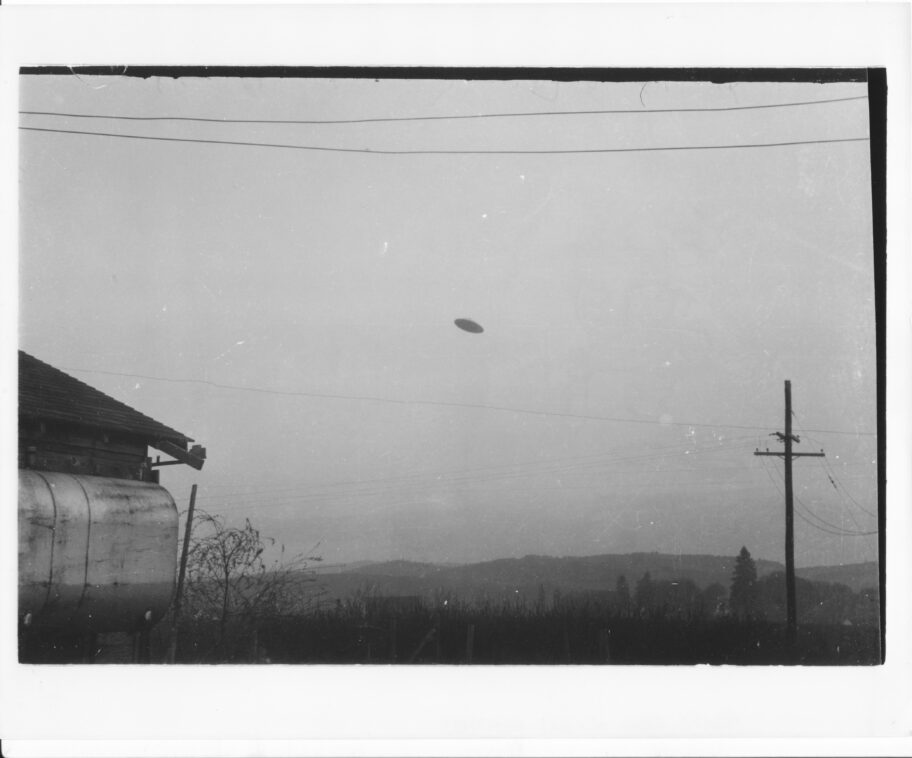
And here is the very key to what I most want to say. Here is where the historical method wanes for me. I am thinking in particular of Gutjahr’s historicizing phrase “took the form of flying saucers”—I am comparing such an expression to a blunt description that occurs in Vallee’s writings, as far back as the first volume of the journals, A Passion for Discovery. Vallee was a teenager. He was living in a suburb of Paris. He, his mother, and his friend all saw, in historical fact, what he described as a “grey metallic base with a clear bubble on top.” It was a flying saucer.
And the rabbit hole goes deeper. Vallee, for example, will write of the deep connections between his original sight of a flying saucer in 1955 and his later science fiction writing in the early 1960s. There was likely much more, then, on how whatever was “locked away” in Vallee’s mind helped produce two of his science fiction novels, Sub Space (1961) and Dark Satellite (1963). Sub Space won the Jules Verne Prize. He wrote it “in a sort of trance.” Both novels may speak, he writes, of “the key to consciousness beyond the brain.” After the first novel, Vallee begins his UFO research in earnest and what will become his work at the Paris observatory as a young astronomer, his move to Texas to help map Mars with early computers at the University of Texas, and his time on Project Blue Book with J. Allen Hynek at Northwestern University.
My ears perk up, because I have heard the exact same thing from a major religious leader (who was not Christian, and not American): his spiritual quest began after seeing a flying saucer outside his home. The stories can in fact be repeated over and over again, in Paris, Cairo, Houston, Santa Fe, Rio de Janeiro, Moscow, or ancient Rome. The place and context matter, but barely.
In the modern world, science fiction is a key, too. There is even a book, by none other than Bertrand Méheust, entitled, in English now, Science Fiction and Flying Saucers. It is on the profound relationship between early science fiction and later ufology. It also calls into question our naive commitment to materialism without remainder (and our firmly established commitment to a one-way causality from the past to the present). Méheust is right to question both. The subtitle of his book reads une réalité mythico-physique (“a mythical-physical reality”). The hyphenated expression boggles the reader.
I do not think this fusion of the mythical and physical is tangential. It is not a minor thing. It goes to the heart of the problem of beings from the sky, of the nature of religion itself. And so we come to the very long history of the absurd or the camouflage, what is sometimes called the giggle factor or, today, the “woo.” I confess I do not like such phrases and words, as they are meant to demean and dismiss human beings and their honest experiences, which do indeed baffle and traumatize. That is part of the point, though—the very paradox to which we need to listen.
Hence Vallee’s own struggles with those “scientific commissions,” including and especially the Condon Committee at the University of Colorado from 1966 to 1968. Vallee moved back to France after the committee’s report, so disgusted was he with the lies of the American scientific community. Hence his epic Passport to Magonia: From Folklore to Flying Saucers (1969) would be born, and that book that did so much to move the dials, as it were, from the treatment of the UFO as a machine in the sky to something that is as related to the appearances and visions of human folklore and mythology. Put more to the comparative point: the folklore and mythology around the extraterrestrial dimensions of the history of religions are not about fantasy. It is code, yes, but a code of something very real.
Vallee also described what would become Heaven’s Gate as a “messenger of deception” well before, really 18 years before, the group’s thirty-nine suicides, in 1997 (see his not-read-enough Messengers of Deception). His thoughts about the group in fact go back over two decades, to 1975. But why, Gutjahr asks, the attention to this particular group and its evolutionary, really fantastic beliefs in human metamorphosis? At its most attractive, it had no more than 150 followers. The tiny group is featured, of course, partly because it fits the stereotypes of a “cult.” It fits the bill of our present and presentist denials. But in Vallee’s analysis, the teachings, however childish or fabricated they may in fact be, also touch something central to many of these mythologies of the extraterrestrial. With or without M. H. Applewhite and Bonnie Nettles (“the Two” of Heaven’s Gate’s community teaching), Vallee is clear that the manipulation of the UFO phenomenon by our beliefs is very extensive, as Vallee shows in detail in the same book (and in the case studies at Rice University on moratorium).
There are also the points on which Gutjahr concludes his study. Aliens are sometimes saviors, but they are also sometimes sinister, even evil. There is both an angelology and a theology here, but there is also a demonology, and not always of the antimodern sense that blocks all real research, in the words of Vallee—the simplistic “demon” thing again. The extraterrestrial cosmologies also point to humanity’s cosmic importance: we are from the stars. They are also indirect ways of dealing with new technologies, now AI. Hence also, I suspect, Vallee’s information science. They finally work toward human self-understanding, that is, they are, in the end, meaning-making narratives, stories we tell ourselves, even if we sometimes need saviors (or devils) to tell them.
Yes, this is all so. But what if there is More? What if the phenomenon is not really us, as in “this is way beyond any of our technology”? That is certainly what those who encounter a UFO say over and over. When are we going to really listen to them and not reduce their reports to meaning-making grand narratives or cosmologies? But a badly used idea is not the same thing as a bad idea. It is not just Mormonism or Theosophy that is evolutionary. German idealism and Romanticism can be read in similar ways, as can Nietzsche in his own non-Darwinian way (ever read Thus Spoke Zarathustra?). Nietzsche was very clear in his notebooks: he saw the superhumans coming. I suspect they were slight and had almond eyes. Even the circular model of Neoplatonism can be read in a similar “evolutionary” way. When are we going to do that? I mean, really, when?
The simple truth is that I am mostly disappointed by the American religious traditions treated in such detail by Gutjahr. This is also the conclusion of Vallee often enough—messengers of deception, indeed. Such religious movements are obviously deep mixtures of racism and reality, as are most of us, maybe all of us. I am also certain the present narratives on offer are unjust in terms of future judgments. Critical theory is crucial, then. We need to ask these very questions.
But my other question remains. Who is deceiving, or tricking, whom? Put more positively, what is being camouflaged? I think this is all forcing us into a new conception of the human, one not nearly as individual, more collective, but also fundamentally cosmic, that is, not entirely restricted to Earth’s social, even biological history. I suppose I get frustrated with the grand narrative or meaning-making answer as sufficient, although, yes, of course all of these grand narratives should be critiqued and appreciated … as what, though? I certainly don’t believe any of them. This is where I so appreciate a hyphenated expression like Méheust’s “mythical-physical.” That seems exactly right to me. And paradoxical.
Vallee’s tentative “answers” in his final volume are perhaps worth quoting to conclude these thoughts, since it is also here that he opens the door onto greater questions. He addresses what he calls the “real controllers of the technology.” Now we are talking. “My own guess so far is that controllers are entities lacking the human analogies we’ve been assuming, while the creatures captured so far may be low-level biological zombies.” Whoa. “If they use higher dimensions, as I think I can show, they could even materialize in the sea and later emerge from there as 3D material objects.” Whoa. This all points to “multi-dimensional interaction among entities long ago informed–and involved–about us.” Whoa.
In the end, this is not about propulsion, or metamaterials, or quanta. This is about the very nature of consciousness, which is far more mind-boggling than anyone is imagining. And so Vallee writes of an impossible “brutal truth”:
“What if the phenomenon mutates on you guys?” I asked, adding: “It has done it twice before. It’s not passive. It’s not a bunch of microbes on some slide. It works from higher reality levels, and it commands phenomena we’ve never observed. It reprocesses human consciousness to fit realities we don’t comprehend. What if it deploys levels of scientific weirdness you’ve never seen? Or couldn’t imagine?”
I want finally to return to the image with which I began, the alien behind the angel, through another image, this one the cover painting of the fiftieth-anniversary edition of Passport to Magonia: From Folklore to Flying Saucers. I corresponded with the painter.
The first painting reproduced on the cover had a greenish grey behind the female angel, the red demon, and the green extraterrestrial. The viewer would think, would really think, that it is the alien grey behind the angel. On this particular edition, however, the fuller painting is shown. There is what looks like a human arm and hand, it turns out, playing the puppet of the alien grey, who is playing the special effects of the angel, the devil, and the extraterrestrial.
That is closer to what I actually think. The esoteric.
And yet, and yet … there is the nonhuman, the NHI, as it is said on Capitol Hill these days. The human arm and hand are darkened in the painting. The assumption is that it is human, but is it? It may be about something else that we cannot even ask with the historical method and its all-too-human analogies. Maybe there is More, though. Maybe the Mormon prophet Joseph Smith was onto something of ultimate concern. What he called progression, a kind of esoteric evolution, is ultimately a theological or philosophical matter. Science cannot get us there. Nor can physical “proof” or history. The human becomes the god, the human becomes a superhuman.
None of this means that the human being is not human, in all our fragility, historicity, and stupidity. Still, that very (im)possibility makes all the difference. I certainly want that evolving impossibility, even if this, too, is mythic in the end. That does not mean it is not physical.
Jacques Vallee really saw a flying saucer, after which he began his scientific and esoteric quest. We are not dealing with that.