


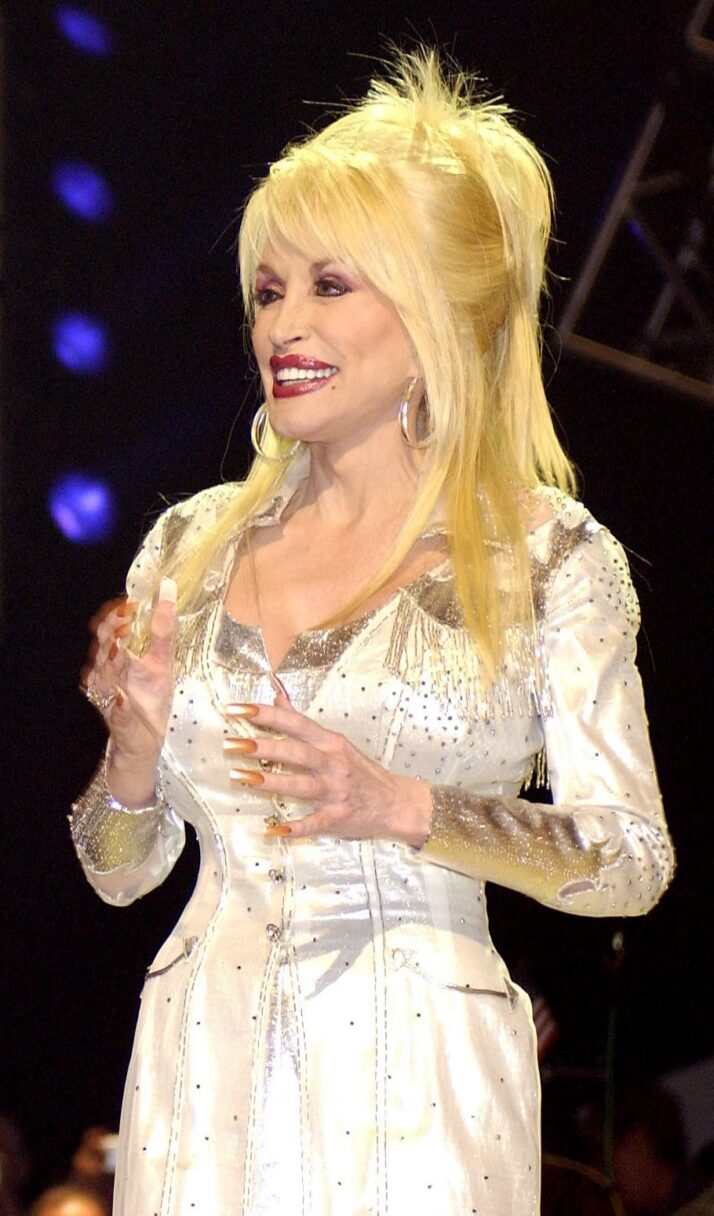
My first encounter with Dolly Parton came through Dollywood, the 150-acre amusement park in Sevierville, Tenn., which she co-owned with Herschend Family Entertainment and where she served as “Dreamer-in-Chief.” I don’t remember the first time I went to Dollywood—I must have been around seven, on a daytrip from my hometown an hour and a half away. Since then, I have been over a hundred times, at first only as a get-away and later as half–academic obsession, half-pilgrimage. As I explain in a new study of Christian theology, place, and the American South, Dollywood makes Dolly’s dreams geographical reality. It is a peculiar, dazzling presentation of Appalachia and of the South, both authentic and artificial, earnest and parodic; and, of course, there are rhinestones everywhere.
Dollywood is also one of only a handful of theme parks (all operated by Herschend) that has a mission statement, which ends: “All in a manner consistent with Christian values and ethics.” But which Christianity is it, and which Dolly Parton—who based her style on the village tramp, posed in Playboy, joked about looking like “a drag queen’s Christmas tree”—would be the figurehead?
Dolly Parton came to faith in her own way. As she recounts in her 1994 autobiography, by 12 years old, her already opinionated mind, her nascent sexuality (and the leering boys in the back of the church), and the pressure of her congregation led to a block in finding God, despite often responding to the altar calls. It was not until one day in an abandoned wooden chapel, its walls carved with sexual images and its broken piano’s strings refashioned into a makeshift guitar, that Dolly experienced sanctification:
So here, in one place, was God, music, and sex. My fascination was complete…. And so I would sing hymns to God for a while and look at dirty pictures for a while and pray for a while, and one day as I prayed in earnest, I broke through some sort of spirit wall and found God…. Here in this place of seemingly confusing images, I had found real truth. I had come to know that it was all right for me to be a sexual being. I knew that was one of the things God meant for me to be…. The joy of the truth I found there is with me to this day. I had found God. I had found Dolly Parton. And I loved them both.
In this telling of her salvation experience, we glimpse the heart of the gospel according to Dolly Parton: a (be)dazzlement of the sureties of contemporary American Christianity. A refusal to separate out what she understood God to have brought together in her own life: “God, music, and sex.” An undergirding commitment to love and to dreams, sometimes dismissed as trashy, tacky, or over-the-top. An authenticity that nevertheless revels in artifice and performance. A deep commitment, nevertheless, to a personal relationship with God and to “real truth” held amid seeming aesthetic and moral contradiction.
It is a peculiar, dazzling presentation of Appalachia and of the South, both authentic and artificial, earnest and parodic; and, of course, there are rhinestones everywhere.
Even before her death last week, Dolly was regularly called a “saint.” She consistently refused this title out of her own religious commitments and of a desire not to be dehumanized. It also came with a fair amount of irony, given how much previous decades characterized her as trashy, a dumb blonde, or a tramp. But Dolly’s actions seemed to speak for themselves: her multi-million-dollar fundraising to assist victims of wildfires in east Tennessee and of Hurricane Helene in western North Carolina; her donation of $1 million to fund clinical trials for a COVID-19 vaccine; her quiet funneling of royalties from Whitney Houston’s cover of “I Will Always Love You” into a Black community in Nashville; her support of up-and-coming (largely female) musicians; and above all, the Imagination Library, her literacy-focused foundation which has given over 300 million books to children. Etsy is full of votive candles and posters with Dolly’s head (and breasts) superimposed on icons of the Sacred Heart of Jesus and Immaculate Heart of Mary.
For her part, Dolly was an evangelical Christian, however idiosyncratic. Her music from the earliest years was stitched through with religious themes that, if anything, grew more explicit over time (2002’s Halos and Horns, 2003’s For God and Country, and 2024’s Smoky Mountain DNA: Family, Faith and Fables being the most notable). But that faith was, like everything in Dolly’s hands, reworked and transfigured. In an immersive film in Dollywood’s Songteller museum, Dolly’s voiceover sums up her career:
I’ve always tried to write songs and tell stories that would be uplifting to others, to share hope with others that might be down on their luck and may not see a way out. To help people see that one of the simplest things we can do is love. To invite everybody to dream big and to make the world a better place through hope, acceptance, faith, and above all else, love.
Dolly took the list of the theological virtues from 1 Corinthians (faith, hope, and love) and added a fourth, “acceptance,” tellingly before “faith.” These Dolly-logical virtues, as I like to think of them, define the Gospel According to Dolly. They respond to what she learned of God in that abandoned chapel, of herself over the sixty years of her public career, of the world through both hardship and love. They define a space and an attitude that made Dolly beloved by conservative evangelicals and drag queens alike, though for different reasons, never reconciled. And it is these Dolly-logical virtues that shine through the grief that many, that I, have felt in the days since her death—that hope, acceptance, faith, and love might abide.
Dolly ended most of her stage performances and online videos by singing “I Will Always Love You.” It was a promise. Over the past days, in the mouths of grieving, adoring fans, it has come to feel like a prayer.