


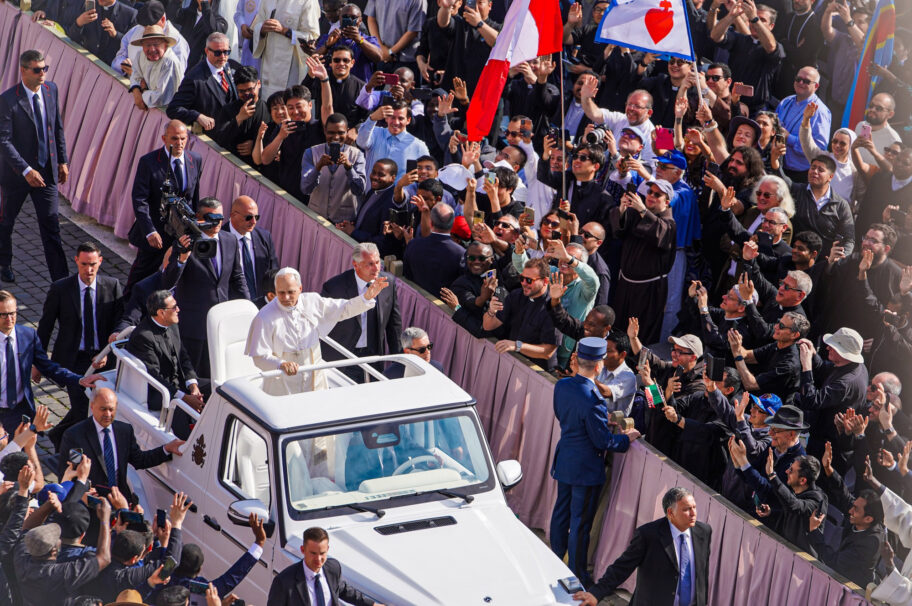
The Catholic Church, it seems, is finally taking its rightful place as the Democratic Party—perhaps even as the Democratic Socialists of America—at prayer. Or so many Catholic commentators seem to think. Writing in the August issue of Harper’s about the Catholic Church’s current “progressive revival” under Pope Leo XIV and his immediate predecessor, Pope Francis, Jack Hanson welcomes the demise of Catholicism’s devotion to “a phantom orthodoxy of rigid hierarchy, moral scorekeeping, and general if inconsistent antagonism toward the ‘modern.’” That reactionary attitude has supposedly been set aside by a new, emphatically more congenial understanding of the “Church’s self-presentation to the world.”
Like Francis, Pope Leo has moved beyond, or sidelined, “petty squabbles over contraception, sexual orientation, and divorce.” Perhaps even the “Romantic longing for the transcendent,” Hanson suggests, has been muted by more worldly concerns. After nearly two centuries of mostly bellicose opposition to liberal values, the Church, it is argued, has at last rediscovered its “long tradition of progressive politics.” What Hanson describes as the “radical reforms” of the Second Vatican Council (1962-65) are finally being fully embraced and implemented, after having been undermined by Pope John Paul II and Benedict XVI. As a consequence, “those accused of sedition and cultural Marxism can now be said to include the Vicar of Christ on Earth.”
Hanson’s assessment of the Church’s recent liberal turn is echoed by much of the Catholic commentariat elsewhere. In The New York Times, David Gibson argues that in emphasizing Catholic social teaching, Leo is “trying to shift Catholicism away from the near fixation on ‘pelvic theology.’” At The New Yorker, Paul Elie understands Leo to be “complet[ing] Francis’s effort to reclaim Vatican II” from John Paul II and Benedict’s conservative papacies. Writing in the Jesuit magazine America, the theologian Natalia Imperatori-Lee sees Leo as a “possibly transformative figure … for a church still seeking to embody the vision of full and active participation of all members.”
By almost every measure, I can be described as a card-carrying “liberal Catholic.” After all, I worked at Commonweal magazine, often regarded as the flagship of liberal Catholicism, for nearly thirty years, and was editor for 15. Like Hanson, and unlike many of my conservative co-religionists, I believe the Church can change; in fact, I know it has changed, often in significant ways. Since my wife is Jewish, the daughter of Holocaust survivors, it was important to me that at Vatican II the Church finally recognized Jews, as the U.S. bishops put it, as “our elder brothers in the faith of Abraham.” That remarkable concession implicitly, if perhaps too grudgingly, rejected the Church’s long history of antisemitism.
I grew up (long ago!) with the Latin Mass, most of which I found indecipherable. Although Vatican II’s liturgical reforms have often been carried out ineptly, I am under no illusions that a return to the traditional Latin Mass, advocated by a vocal minority of Catholics at the moment, is the answer to the Church’s demographic decline.
Predictably, I think the Church’s condemnation of artificial birth control is wrong and doesn’t make sense, given its endorsement of natural family planning; if the intention is the same in both instances, how can it be wrong in one and not in the other?
But I agree with the Church about the importance of sexual morality and the immorality of abortion, although how secular law deals with abortion is more complicated than many Catholic bishops are willing to admit. When it comes to the Church’s puritanical attitudes toward sex, at least as the Irish-dominated American Church embraced them, I’m inclined to be somewhat tolerant. Despite coming of age during the so-called sexual revolution, I discovered that nothing made me happier, or helped me grow up more, than marriage and raising our children. Family life is not just a haven in a heartless world; it is the source of societal stability, something the Church rightly and stubbornly preaches.
In short, the challenges the modern secular world presents to a two-thousand-year-old ritualistic and biblical faith such as Catholicism are daunting. Smells, bells, lacy outfits, and culture-war rallies just won’t cut it. I had my doubts about some of the disciplinary measures taken by Pope John Paul II and Benedict against theologians and Church reformers, and much more serious doubts about their handling of sexual abuse by clergy, but I respected their firm orthodoxy and theological sophistication. Pope Francis, and now Leo XIV, have been a welcome bit of fresh air, especially in the way they have acknowledged Catholics of more progressive and sometimes wayward attachments to the faith. But in general, when it comes to the Vatican and the hierarchy, I try to follow the advice of Ronald Knox, a convert and Catholic priest: “He who travels in the Barque of Peter had better not look too closely into the engine room.”
But I also find myself increasingly uncomfortable with the agenda of some of my fellow liberal Catholics. The abortion-rights organization Catholics for Choice seems to me to be pretty far out of bounds. Efforts to introduce inclusive language into the Scripture readings and liturgy are in many instances theologically problematic. Simple condemnations of patriarchy and hierarchy paint with too broad a brush. There should be a place for women in the hierarchy, but in all likelihood that will not entail ordination.
“He who travels in the Barque of Peter had better not look too closely into the engine room.”
The Church, in my opinion, is going to continue to be a hierarchical institution; an egalitarian polity is not the remedy for the alienation felt by many, and in any event, is inimical to a sacramental religion like Catholicism. A certain strain of liberal Catholicism, which seems determined to lobotomize us away from a sense of sin, except in the social and political spheres, trivializes the drama of personal salvation, which in the end is Catholicism’s most potent attraction. An emphasis on social and political reform gets you only so far when it comes to changing hearts and minds, arguably a challenge upon which most religions have long focused their attention. Yes, Pope Francis said “Who am I to judge?” when asked about homosexual priests, but he did not say that God does not judge our intentions and actions or that we have not been given commandments to follow. I doubt that Francis, as Hanson suggests, was “more or less relaxed about matters of sexual propriety.”
So, at the moment, I am made anxious by Catholics who have rushed to champion the papacy of Leo as a clear break with the past. Many see Leo’s style, as they saw that of Francis, as a kind of subversion of the reigns of John Paul II and Benedict. Ironically, this near idolization of a particular pope is the mirror image of the extravagant ways in which conservative and self-described “orthodox” Catholics proclaimed that John Paul II and Benedict had put an end to the alleged heterodoxies of post-Vatican II Catholic liberalism. Yes, there are real discontinuities among these modern papacies, but that is nothing new. The public engagement with the political and economic issues of the day by Leo XIII, the current pope’s namesake, was in many ways a rejoinder to the isolation of his immediate predecessor, Pius IX, who considered himself the prisoner of the Vatican. At the same time, it is an illusion for either conservative or liberal Catholics to think a new pope can right the Barque of Peter—whatever that might mean—by the stroke of a pen or an edict of excommunication. It’s an enormous vessel, with more than a billion adherents across six continents. It can be turned only very slowly, and given my long history with these questions, I’m inclined to think that is a blessing. What can seem urgent for one generation is often baffling or otiose to the next.
A certain strain of liberal Catholicism, which seems determined to lobotomize us away from a sense of sin, trivializes the drama of personal salvation.
In that light, liberal Catholics should curb some of their current enthusiasm, for it will likely end in disappointment, if not at some point in Leo, then after the next papal conclave. There is entirely too much talk about Francis and Leo’s supposed non-judgmentalism, their shift away from “legalism” and culture-war issues such as abortion and same-sex marriage. Leo’s concerns over the treatment of immigrants, his emphasis on the imperatives of social and economic justice, his opposition to unjust wars and a dehumanizing worship of technology, even his tolerant attitude toward gay Catholics, are entirely traditional.
That many pundits have discerned a “progressive revival” along secular lines now at work in the Church is only a very partial truth. In these debates, the familiar ghost of Catholic social teaching, often called the Church’s “best-kept secret,” is laid down as a kind of trump card. To be sure, Catholic social teaching’s emphasis on the common good, human dignity, economic fairness, and the necessary role of government in securing such goods aligns nicely with much of modern liberalism and even with much of the Democratic Party. In this regard, Leo’s recent statement that the “unity of the Church should not revolve around sexual matters” is catnip to many. But it is not at all clear that John Paul II and Benedict thought much differently; the unity of the Church was their first priority as well, if in a somewhat different key. Nor were they silent when it came to economic injustice or unjust wars, even wars waged by the United States.
But placing the Church’s social teaching at the heart of Catholicism’s “self-presentation to the world,” as many liberal Catholics often seem to do, ignores the fact that those teachings are ancillary to the much more controversial and difficult metaphysical claims Catholicism makes about Jesus Christ and biblical Revelation. Those articles of belief are not easily accommodated by “progressive revivals” or contemporary liberal attitudes about the nature of reality and the possible meaning of our lives. Reticence about those claims, something I have often been guilty of in my own efforts to persuade skeptics of the Church’s affinity for democracy and liberalism, puts the secular cart before the eschatological horse, so to speak. As the great Protestant theologian Karl Barth put it, “One cannot speak of God simply by speaking of man in a loud voice.” In the end, you can’t get around such stumbling blocks. The pope is called the Vicar of Christ, not the Vicar of Progressivism. The Church proclaims that Jesus, the Son of God, was born of a virgin two thousand years ago in a Palestinian backwater. He was crucified, died, and then, incredibly, rose from the dead. Those facts, not any seemingly adjacent political agenda, are the basis for the Church’s teachings about morality, whether personal, economic, or political. Historian Eamon Duffy explained the connection well. “I could find no way of holding on to the values of Christianity while denying the account Christianity gave of reality,” he wrote. “We [are] too inclined to forget that a Catholic response to the needs of the world needs to be Catholic as well as responsive, if it is to be of any use.”
The pope is called the Vicar of Christ, not the Vicar of Progressivism.
Many people of good will find it impossible to get their heads around the story the Church tells about the transcendent nature of reality and human destiny. I often have a hard time doing that myself. Then again, I’m something of a liberal. “St. Paul’s central proposition, that he had seen something more interesting than sex, was bound to wear thin after 2,000 years of secondhand repetition,” the critic and novelist Wilfrid Sheed wryly observed. Those difficulties don’t easily go away, and the Church’s compatibility with this or that political program shouldn’t make it any easier. In fact, I’m pretty sure that making sense of the Church’s central dogmas only becomes more difficult if you first place the emphasis on how Church teachings are reflective of everyday liberal understandings of the world. They are in fact contrary to both everyday liberal and conservative understandings.
Catholicism is not a progressive or conservative project or creed. It is something much stranger. Catholics profess a belief in eternal things and in God’s presence in humble realities such as bread and wine. Weird stuff. The Church is confident that justice will be served, if not in this life, then in the next. Even weirder. The Four Last Things will not be the singularity, a bond-market apocalypse, Elon Musk and his harem’s escape to Mars, or even a third term for Donald Trump. As the Church has long foretold, it will be an inevitable reckoning with Death, Judgment, Heaven, and Hell. Liberal Catholics should try bringing that counter-cultural witness into the public square as they strive to convince others of Catholicism’s indispensable contributions to our moral, political, and common life. It has surprising resonance with many Americans who are otherwise suspicious of liberalism, a political faith in desperate need of affirmation.