


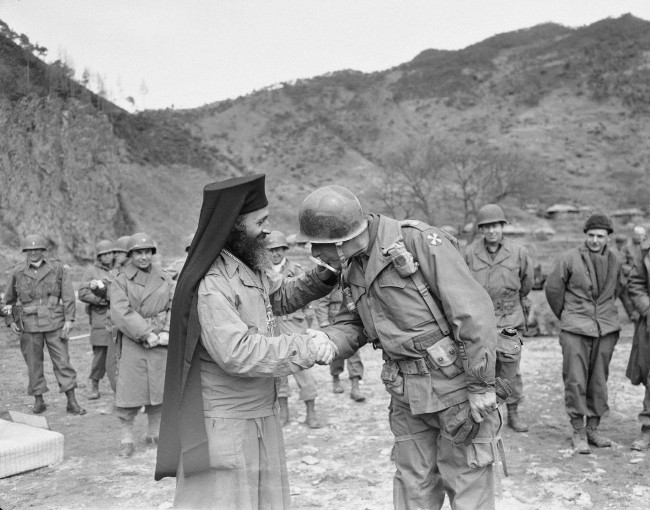
Bill Bartz is a Greek Orthodox priest and retired Navy chaplain. Despite spending the last five years of his career as the most senior Orthodox priest in the entire U.S. military, he has the down-to-earth manner of an old salt that puts you at your ease. It’s not hard to see how the retired captain was able to relate to sailors on guided-missile cruisers, hotshot pilots on aircraft carriers, and battle-hardened Marines from different walks of life and faith backgrounds. “The trust that the chaplain receives from the troops,” said Bartz, “accentuates the holiness” of this unique calling.
He remembers clearly a Marine officer, returned from Iraq, who visited his office. The man was in turmoil about an emotional affair, and although he was not an Orthodox Christian, Bartz was still able to listen and to accompany him as a fellow believer and a spiritual authority. “I always found it a very sacred moment when these people would come into my office not knowing me well,” he said, “and they would strip their souls naked.”
The religious makeup of the U.S. military is a rough microcosm of broader American religious demographics. Around 70 percent of the U.S. military identifies as Christian, and although official numbers aren’t available, it is likely that less than one percent of religiously affiliated service members identify as Greek Orthodox. As a chaplain for a minority faith group, Bartz would occasionally fly into combat zones in Iraq to administer the sacraments on Orthodox holy days. But he retired before the recent uptick in people under forty—men in particular—joining the Orthodox Church. As the endorsing agent for Greek Orthodox military chaplains, Bartz says there are currently only six Greek Orthodox chaplains spread across the active-duty military. Amid a wider priest shortage in Greek Orthodoxy in the U.S., that’s not enough. The disparity between an abundant harvest and too few laborers is especially apparent in American military life, a predominantly male environment that emphasizes rigorous discipline—the same thing many theorize is attracting young men to Orthodoxy.
Chris Moody, a U.S. Army chaplain and Greek Orthodox priest stationed at Fort Sill, Okla., sees this trend in his ministry. He said he has received numerous inquiries about Orthodoxy from young soldiers at different duty stations. Like many young Orthodox converts, many of the (predominantly) male soldiers approaching him come from Protestant backgrounds. The young people he encounters are dissatisfied with the fractured postmodern outlook they’ve inherited, Moody said, and are drawn to the Orthodox phronema: a unified symbolic worldview that experiences corporal realities through the lens of faith and liturgy.
Discussing a recent basic training class, Moody said the number of attendees at his services went from ten to two hundred in the space of three months, outgrowing the facility they had been designated for services. “It was kind of a monastic setup,” Moody said. Even though Divine Liturgy participants are expected to fast before a service, Moody’s was the last service of the day, coinciding with lunch time at the dining facility. And when the air conditioning broke during a sweltering Oklahoma summer, the soldiers to be, lacking chairs, stood in formation like they’d been taught, with some spilling out into the foyer where a livestream had to be set up.
The number of attendees at his services went from ten to two hundred in the space of three months.
Land-locked in peacetime at a time of increased interest in Orthodoxy, Moody’s pastoral work in 2026 looks different from Bartz’s during the global War on Terror. Moody no longer oversees basic trainees. In fact, he now says Divine Liturgy on Fort Sill for a congregation of around fifty that includes soldiers, civilian families, and a rotating 20 percent who are coming just to check it out. He said there are six converts scheduled for baptism this April 4, which will be Lazarus Saturday (the Saturday before Palm Sunday), and that many of these inquirers come to Greek Orthodoxy from their own reading and research, usually online.
“I kid you not,” Moody said. “All the inquirers that I’ve had, if they went to seminary, they would have read through much of the curricula.”
Moody considers it his job to help the newly Orthodox connect theory and practice, as well as teaching them how to discern real Orthodox voices from any guy on YouTube with a podcast mic and a St. George icon in the background. He likes to give a spiritual rule to soldiers with a tendency to go down intellectual rabbit holes on the faith: for every hour spent reading, they have to spend an hour in prayer. “I encourage practical discipline to balance out the intellectual overload some people might have,” said Moody. A non-commissioned officer who leads physical training (PT) in the mornings, he said, must also remember to get in their morning prayer practice, or as he calls it, “the Lord’s PT.”
Like Bartz, Moody sees himself as a cross-cultural missionary, not just between the various institutional cultures that exist within the Army but between denominations, between the secular and religious worlds, and between Greek and American culture.
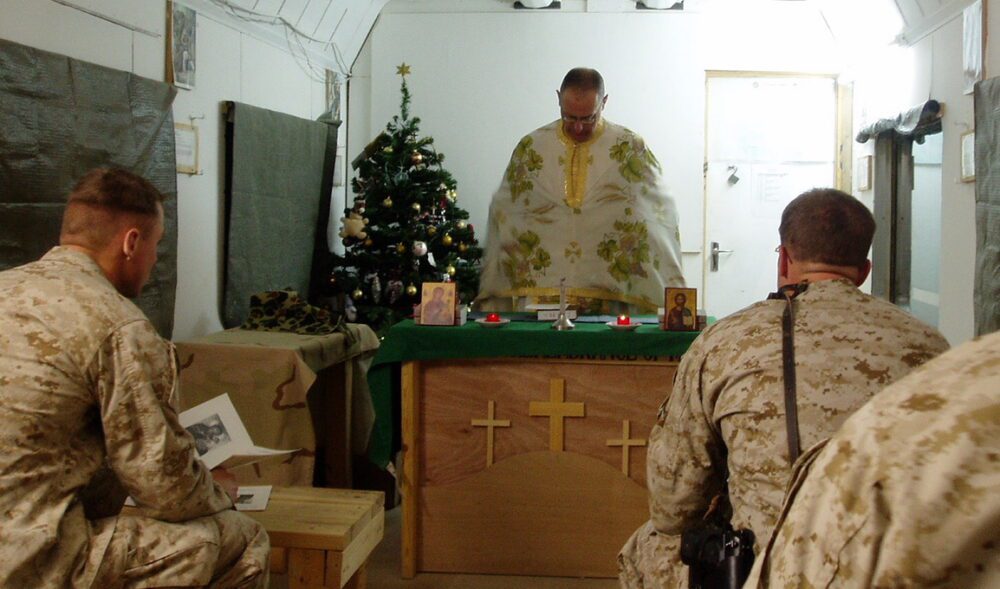
Military chapels often service multiple denominations on a single Sunday, meaning Greek Orthodox trappings must be put away after services to accommodate the other denominations that use the space. “I can’t provide a robust Orthodox experience,” Moody said. As a result, “It’s usually a toss-up whether the Orthodox service member will attend off-post or with you.” Sometimes it’s a matter of liturgical preference. Other times, it’s simply wanting a break from the military community.
Moody considers it his job to help the newly Orthodox connect theory and practice, as well as teaching them how to discern real Orthodox voices from any guy on YouTube with a podcast mic and a St. George icon in the background.
Although they retain their distinct denominational doctrines, U.S. military chaplains are required to support all faiths (or none at all) in their day-to-day duties. When chaplains perform services in their own faiths, austere deployment conditions and the shared spaces of multifaith chapels often mean that liturgical denominations like Orthodoxy offer less ornate versions of their traditions. But while boosters maintain that the kids are looking for old time religion of the smells and bells variety, the rough and ready “field version” of Greek Orthodoxy doesn’t appear to deter young service members who are curious about it. Rather than watering down the Greek Orthodox experience, it may be precisely the military chaplaincy’s “all things to all men” missionary ethos that makes Divine Liturgies like Moody’s accessible to inquiring service members. Even if he’s read his John Chrysostom and Cappadocian fathers, to a Baptist kid from the Southeast attending a service for the first time, an English language Divine Liturgy stripped down to the essentials may seem less alien. “I’ve translated Patristic Greek, I’m pro-Hellenism,” Moody said. “But you’ve got an audience that doesn’t know.”
Bartz sees a silver lining here for priests. Freed from the concerns of running a territorial parish, the military chaplain is to some extent the captain of his own ship. Paradoxically, because customization is off the table, the priest and parishioners are less susceptible to timesucking distractions like disagreements over where to place the flowers on the altar (a longstanding debate of Greek Orthodox practice). Instead, when everyone shows up to pray, they “worship together, and all that stuff kind of disappears,” Bartz said.
So far, this kind of pastoral latitude isn’t attracting new priests to replace the retiring Greek Orthodox chaplains on active duty. Seminaries exist first and foremost to support parishes, and those parishes need them. A 2023 report from the Orthodox Studies Institute found that nearly two hundred Greek Orthodox churches in the U.S. are expected to need new priests in the next five years. “Of those men who choose to become a priest, how many of those are inclined to do this specialized ministry?” Bartz said.
He explains the process: first, training in a seminary to become a priest in a parish, then a specialized request for permission to become a military chaplain. Once a candidate makes it through that process, Bartz, as the endorsing agent, lets the military know they are getting a sanctioned Greek Orthodox priest with denominational approval. From there, it’s off to U.S. military chaplain school.
But chaplaincy isn’t for everyone. There are the strict physical standards, and there is also the stripping away of the grandeur of the Divine Liturgy, not to mention the diminished role of a priest, who must subordinate himself to the demands of a commander and the needs of Uncle Sam.
Still, Bartz is hopeful that increased interest in Orthodoxy among young men will lead to more priests and, ultimately, military chaplains. “I’m rather confident,” said Bartz. He said he gets calls from men asking how they can become military chaplains. “I fully expect that there will be eventually more men going to seminary,” he said, “and from that, looking to pursue the chaplaincy as well.”
In a military context, “spiritual readiness” has often been lumped in with mental health. Moody clarifies that chaplains are doing something different than counseling or “throwing a Bible verse at someone.” “It really requires digging down with a person and getting to know them” in what he calls “a spiritual father role.” For those seekers who have come to Orthodoxy from their own research, it means fostering what Moody calls “a basic spirituality that’s more devotional than intellectual.” The breadth and depth of ministerial experience afforded to Greek Orthodox military chaplains, Bartz believes, offer ongoing benefits once the priests return to civilian life. “What the priests gain, learn, and become in the military,” he said, “when they go in the parish, the quality of care and leadership that that parish experiences is always, always, appreciated and respected.”